



High Weightage Topics in NIFT Quantitative Ability 2026: NIFT GAT has an important Quantitative Ability section that carries a lot in your overall score and admission chances. Since GAT carries 40% weightage in the final selection, it becomes very important to do well in high-weightage concepts for you to get NIFT 2026 . A strategic preparation plan that concentrates on high-scoring topics with less preparation time will boost your scoring chances. NTA will conduct NIFT 2026 entrance exam on February 8, 2026.
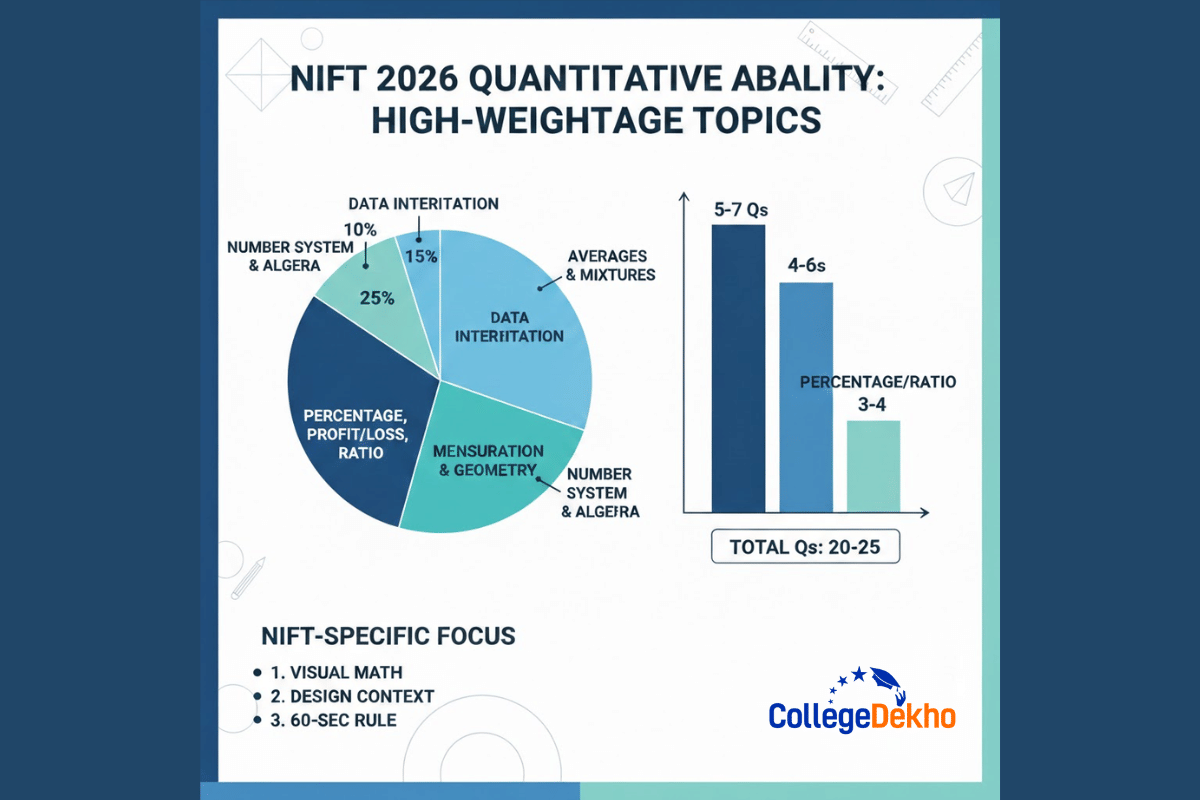
High Weightage Topics in NIFT Quantitative Ability 2026
Check here the high-weightage topics you should be aware of in NIFT quantitative ability for 2026:
Topic | Weightage | Questions (Approx) | Difficulty Level |
|---|---|---|---|
Percentage | 15-20% | 4-5 | Easy to Moderate |
Ratio and Proportion | 12-18% | 3-5 | Easy to Moderate |
Time, Speed & Distance | 10-15% | 3-4 | Moderate |
Profit, Loss & Discount | 8-12% | 2-3 | Easy to Moderate |
Simple & Compound Interest | 8-12% | 2-3 | Moderate |
Averages | 6-10% | 2-3 | Easy |
Work and Time | 6-10% | 2-3 | Moderate to Difficult |
Geometry & Mensuration | 8-12% | 2-3 | Moderate to Difficult |
Number Systems | 5-8% | 1-2 | Easy to Moderate |
Data Interpretation | 5-8% | 1-2 | Moderate |
Algebra (Basic) | 5-8% | 1-2 | Moderate |
Probability | 3-5% | 1 | Moderate |
Detailed Topic Breakdown
Now that you have an idea of the important high-weightage topics, let's understand them one by one in detail:
Topic | Key Concepts Tested | Quick Tips & Formulas |
|---|---|---|
Percentage (15-20%) | • Percentage increase/decrease • Successive percentage changes • Percentage-based profit/loss • Population growth problems • Fraction to percentage conversion |
|
Ratio & Proportion (12-18%) | • Dividing quantities in ratios • Partnership problems • Mixture and alligation • Fourth proportional • Comparing multiple ratios |
|
Time, Speed & Distance (10-15%) | • Average speed calculations • Relative speed (trains, boats) • Meeting point problems • Circular track races • Boats and streams |
|
Profit, Loss & Discount (8-12%) | • Profit/loss percentage • CP and SP problems • Successive discounts • Marked price vs selling price • Break-even analysis |
|
Simple & Compound Interest (8-12%) | • SI calculations • CI for multiple years • Difference between SI and CI • Rate, time, principal relations • Amount calculations |
|
Averages (6-10%) | • Average of numbers • Weighted averages • Average speed problems • Impact of adding/removing values • Age-based averages |
|
Work & Time (6-10%) | • Work efficiency problems • Multiple workers • Pipes and cisterns • Work done in given days • Combining work rates |
|
Geometry & Mensuration (8-12%) | • Area & perimeter (triangles, circles) • Volume (cubes, cylinders, cones) • Surface area problems • Pythagoras theorem • Similar triangles |
|
Number Systems (5-8%) | • LCM and HCF • Prime numbers and factors • Divisibility rules • Even/odd properties • Simplification |
|
Data Interpretation (5-8%) | • Bar graphs and line charts • Pie charts with percentages • Tables with multiple data • Comparing data • Percentage from data |
|
Algebra Basics (5-8%) | • Linear equations • Quadratic equations • Algebraic identities • Age-based equations • Two-variable problems |
|
Preparation Tips for NIFT Quantitative Ability 2026
Read below to understand some of the best preparation strategies for NIFT quantitative ability 2026:
1. Prepare Design-Centric Arithmetic: NIFT mathematics is practical and closely linked to real-life design applications. Prioritise key topics that carry significant weightage, including percentages and ratios for fabric composition, profit and loss for pricing strategies, and mensuration to understand pattern areas and packaging volumes effectively.2. Use Visual Math: NIFT is conducted in paper-based and CBT modes, making speed a decisive factor. Memorise fraction-to-percentage conversions up to 1/20 for quicker calculations, and practise approximation techniques to eliminate incorrect options efficiently and arrive at the most logical answer under time pressure.
3. Understand GAT-CAT Time Bridge: Avoid spending excessive time on one difficult question. Follow the 60-second rule, skip any Quantitative problem that exceeds a minute to manage time better across GAT and CAT. Also, use reverse engineering by substituting options to quickly identify the answer without lengthy calculations.
4. Prioritise the Big Three Topics: Based on recent 2026 exam trends, prioritise the Big Three topics in your preparation strategy. Focus on Data Interpretation to strengthen your ability to analyse trends crucial for fashion forecasting, Averages and Mixtures for production cost and fabric calculations, and Time, Speed & Distance to enhance logical problem-solving in practical scenarios.
Best Books for NIFT Quantitative Ability
- Quantitative Aptitude for Competitive Examinations by Arun Sharma
- NIFT Entrance Exam Guide by Verma
- Fast Track Objective Arithmetic by Arihant
- NIFT, NID and IIFT Entrance Exam Guide by D. Mittal
- A Modern Approach to Verbal & Non-Verbal Reasoning by R.S. Aggarwal
Focus your NIFT 2026 quantitative preparation on mastering high-weightage topics first, and then move on to medium and low ones. Intensive practice on past years' papers and occasional tests also increases your speed and accuracy, which count in the ultimate score in the fiercely competitive scoring.
FAQs
Practice 50+ questions from each high-weightage topic, maintain an average time of 90-120 seconds per question, and take weekly mock tests to improve accuracy and speed.
Remember the fundamental formula D=S×T (Distance = Speed × Time). For relative speed, subtract speeds for the same direction and add for opposite directions.
You can expect approximately 4-5 questions from the 'Percentage' topic, making it a crucial area to master.
Percentage (15-20%), Ratio & Proportion (12-18%), and Time, Speed & Distance (10-15%) are among the topics with the highest weightage.
The Quantitative Ability section in NIFT GAT carries a significant 40% weightage in the final selection process for NIFT 2026.
 Quick Facts














Similar Articles
UCEED Round 1 Cutoff Marks 2026 (Out)
Important Instructions to be Followed after UCEED Round 1 Seat Allotment 2026
NIFT Kannur Cutoff Ranks 2026: Expected Cutoff with Previous Years' Trends
NIFT Patna Cutoff Ranks 2026: Expected Cutoff with Previous Years' Trends
NIFT Hyderabad Cutoff Ranks 2026: Expected Cutoff with Previous Years' Trends
NIFT Kangra Cutoff Ranks 2026: Expected cutoff with Previous Years' Trends