
- We’re on your favourite socials!


When you are a student at Indira Gandhi National Open University (IGNOU) there is a good chance you will become confused between the two terminologies
- What is IGNOU Result?
- What is IGNOU Grade Card?
- IGNOU Grade Card vs Result: Detailed Comparison
- Understanding IGNOU Marking Scheme
- Why IGNOU Grade Card is More Important?
- Why Do IGNOU Result and Grade Card Show Different Status?
- When Should You Be Concerned?
- How to Check IGNOU Result and Grade Card?
- Common Mistakes Students Make
- Practical Example for Better Understanding
- How IGNOU Updates Results and Grade Card?
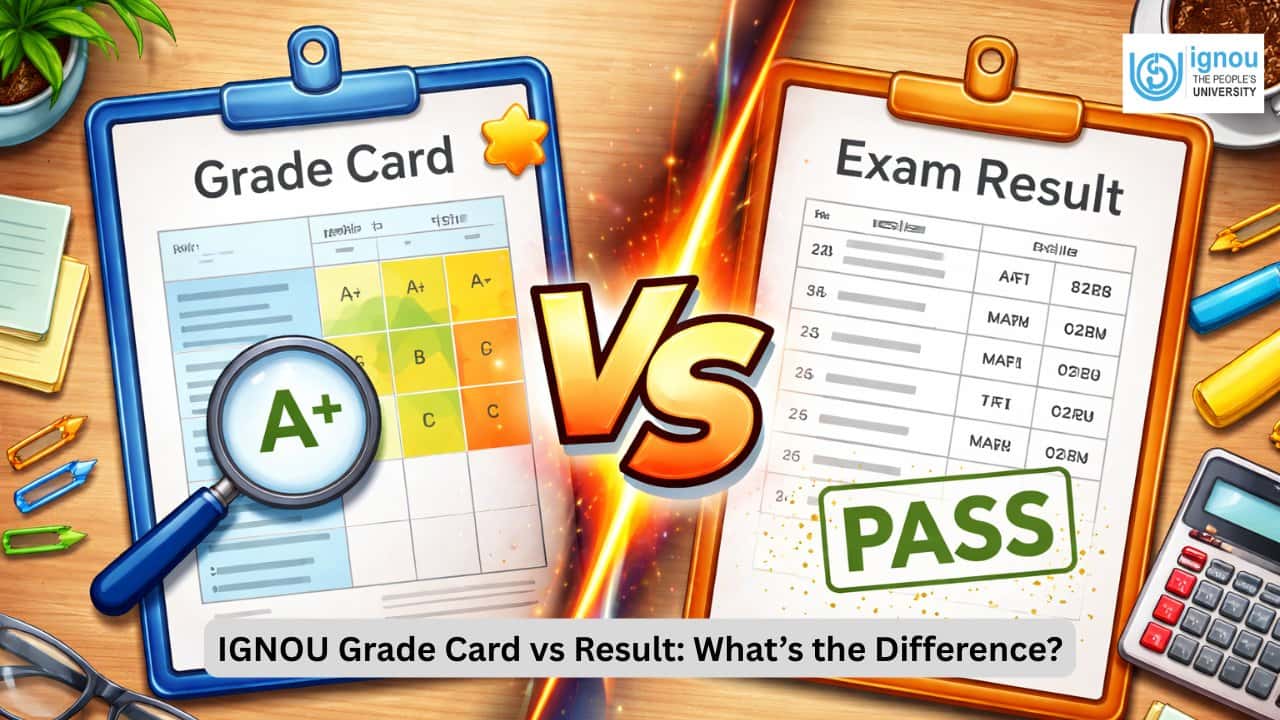
When you are a student at Indira Gandhi National Open University (IGNOU) there is a good chance you will become confused between the two terminologies IGNUO Grade Card and Result of IGNOU because they refer to entirely separate things but many students feel that when they see their overall result for their course they can consider themselves to be finished.
In simple terms, you would normally view your TEE result (the result you receive when you complete your semester) via IGNOU online. However, when viewing the Grade Card you will see that some of your subjects appear as "incomplete" with respect to their final status on the Grade Card. The examination results of IGNOU reflect how well you did on the TEE, while the Grade Card from IGNOU reflects all subjects (i.e., assignments and any practicals) taken in an academic year and a summary of the work submitted in that academic year leading to your final degree. So, understanding how each relates to Academic Standing can significantly affect your degree far more than just having a total score (i.e., "overall") result to mathematics will give you.
What is IGNOU Result?
The IGNOU Result is the outcome of your Term-End Examination (TEE), which is conducted twice a year, in June and December. It is usually the first update students receive after exams.
Key Features of IGNOU Result
- Displays marks obtained in theory exams
- Released within 30–45 days after exams
- Shows pass/fail status for each subject
- Does not include assignment or practical marks
- Updated quickly compared to grade card
The main purpose of the IGNOU Result is to give students a quick snapshot of their exam performance. It helps you understand whether you have cleared the written exam or need to reappear.
However, it is important to remember that this result is not the final academic record. It only represents one part of your evaluation.
What is IGNOU Grade Card?
The IGNOU Grade Card is a detailed and comprehensive record of your academic performance. It includes all the components required to successfully complete a subject.
Key Features of IGNOU Grade Card
- Includes assignment marks
- Includes theory exam marks
- Includes practical/project marks (if applicable)
- Shows completion status of each subject
- Updated in multiple stages
The grade card is designed to provide a complete overview of your performance, combining both internal and external assessments. Unlike the result, which only focuses on exams, the grade card reflects whether you have fulfilled all academic requirements of your course.
IGNOU Grade Card vs Result: Detailed Comparison
Feature | IGNOU Result | IGNOU Grade Card |
Purpose | Exam performance | Overall course performance |
Includes Theory Marks | Yes | Yes |
Includes Assignment Marks | No | Yes |
Includes Practical/Project | No | Yes |
Nature | Temporary | Final |
Update Frequency | Faster | Slower |
Completion Status | Partial | Complete |
From the table, it is clear that the result is only one part of your evaluation, while the grade card is the final and complete record.
Understanding IGNOU Marking Scheme
IGNOU follows a structured marking system that divides evaluation into different components.
Weightage System
- Assignments: 30%
- Term-End Exams: 70%
To successfully pass a subject, students must:
- Submit assignments on time
- Score minimum passing marks in assignments
- Pass the theory exam separately
Note: This means that even if you score well in the exam, failing in assignments will result in an incomplete status in the grade card.
Why IGNOU Grade Card is More Important?
Many students focus only on the result, but the grade card holds more importance for several reasons.
1. Final Academic Record
The grade card is considered your official academic performance record within IGNOU.
2. Required for Degree Completion
Your degree will only be awarded when all subjects show 'completed' status in the grade card.
3. Includes All Components
It combines assignments, theory, and practicals, making it a complete evaluation tool.
4. Used for Verification
For higher studies or job applications, the grade card provides detailed subject-wise marks.
Note: In short, the result tells you how you performed in exams, but the grade card confirms whether you have actually passed the course.
Why Do IGNOU Result and Grade Card Show Different Status?
It is very common for students to see differences between the result and the grade card.
For example:
- The result shows 'Pass'.
- The grade card shows 'Not Completed'.
This can be confusing, but there are valid reasons behind it.
Common Reasons for Mismatch
- Assignment marks are not yet updated
- Practical or project evaluation is pending
- The study centre has not uploaded marks
- Data synchronization delay in IGNOU system
IGNOU updates marks in phases, which is why the grade card often takes more time to reflect the final status.
Note: This delay is normal and does not indicate any problem in most cases.
When Should You Be Concerned?
While delays are common, there are situations where you should take action.
You should be concerned if:
- Grade card is not updated even after 45 days
- Assignment marks are missing for a long period
- Practical marks are not uploaded
- Subject shows incomplete despite completing all requirements
What You Can Do
- Contact your study center
- Reach out to your regional center
- Submit proof of assignment submission
- Raise a complaint through IGNOU grievance portal
Note: Always keep records of your assignments and submissions for safety.
How to Check IGNOU Result and Grade Card?
Checking both the result and grade card is a simple process.
Steps to Check IGNOU Result
- Visit the official IGNOU Result portal
- Enter your enrolment number.
- Select exam session
- Click 'submit'.
- View or download your result
Steps to Check IGNOU Grade Card
- Visit IGNOU Grade Card page
- Select your programme.
- Enter Enrollment Number
- View detailed marks
Note: Students should regularly check both portals to stay updated.
Common Mistakes Students Make
Many students misunderstand the evaluation system, which leads to unnecessary stress.
Mistake 1: Assuming the Result is Final – Students often think passing the result means completing the subject, which is not true.
Mistake 2: Ignoring Assignments – Assignments carry 30% weightage, so ignoring them can lead to failure.
Mistake 3: Not Checking Grade Card – Some students don’t track grade card updates, missing important information.
Mistake 4: Panicking Early – Delays in updates are normal, and immediate panic is not necessary.
Practical Example for Better Understanding
Let’s understand this with a simple example:
- You scored 40 marks in theory exam (Pass)
- But did not submit assignment
Result: Shows Pass
Grade Card: Shows Incomplete
Note: This clearly shows why relying only on the result can be misleading.
How IGNOU Updates Results and Grade Card?
IGNOU follows a step-by-step process for updating marks:
- Conducts Term-End Exams
- Releases theory exam results
- Evaluates assignments
- Updates assignment marks
- Uploads practical/project marks
- Updates final grade card
Because these steps happen separately, the grade card always takes more time.
There is a small but very significant distinction between an IGNOU result and an IGNOU grade card. The result will provide you with general feedback about how well you did in the exams, whereas your IGNOU grade card will include information about how well you did in all aspects of your course, including your assignment marks and your practicals.
Thus students should not just look at their result as being indicative of whether they have completed their course; they should look to their grade card as being the actual determining factor in whether they have completed the course. Therefore, although both may show different results at first due to delays in updating records, these discrepancies are quite common and will eventually resolve themselves.
FAQs
No, the IGNOU result only shows theory exam marks. To confirm passing a subject, you must check the grade card, which includes assignments and practical marks. A subject is considered complete only when all components meet the required criteria.
This usually happens because assignment or practical marks have not yet been uploaded. IGNOU updates grade cards in phases, and assignment evaluation often takes longer than theory paper checking.
No, IGNOU issues degrees only after the grade card shows “Completed” status for all subjects. Even if your result shows pass, incomplete grade card means your course is still pending.
The grade card is more important because it reflects your complete academic performance. The result is only a temporary indicator of exam performance, while the grade card determines final eligibility.
Grade cards are usually updated within 1–3 months after exams, depending on assignment and practical evaluation timelines. In some cases, delays may extend beyond this period.

- Colleges in New Delhi
- Indira Gandhi National Open University (IGNOU)
- IGNOU Grade Card vs Result: What’s the Difference?
