KCET 2026 Eligibility Criteria - Check Age Limit, Marks Required, No of Attempts, Important Factor

KCET Eligibility Criteria 2026 are set by KEA. According to the KCET 2026 Eligibility Criteria, you have to be a citizen of Karnataka and score at least 50-60% marks from a recognised university listed under VTU.

Get KCET Sample Papers For Free

KCET 2026 Eligibility Criteria

KCET 2026 eligibility criteria are set by the Karnataka Examination Authority for aspiring students of the KCET 2026 exam. According to the KEA, the eligibility criteria require you to be a citizen of Karnataka. You have to score at least 50% to 60% marks from a recognised university listed under Visvesvaraya Technological University. It entails various aspects, such as the nationality of the aspirant, the score obtained in the qualifying exam, caste category, combination of subjects, domicile criteria, etc. You must have a complete awareness of the KCET eligibility criteria for 2026 before completing the KCET 2026 registration. The eligibility will vary as per the category of the student. The KCET 2026 aspirants must meet the eligibility criteria of KCET 2026 to appear for the exam.

Also check:KCET 2026 Syllabus
KCET eligibility criteria

Upcoming Exams :

Detailed KCET Eligibility Criteria 2026

Check the detailed eligibility criteria of KCET 2026 below.

1. You must be Indian citizens and residents of Karnataka.

2. You should have completed the qualifying examination with at least 50-60% marks from a university recognised by VTU (Visvesvaraya Technological University).

3. If you have obtained your qualifying exam certification from a university not recognised by VTU or from Karnataka State Open University, then you are not eligible to apply for KCET 2026.

4. In case you are currently taking the qualifying exam for 2nd PUC (Pre-University Colleges) or (12th board exams) in 2026 and your results are pending, you can apply for KCET 2026. But you will not be eligible for admission if you do not pass the qualifying examination. 

5. If you wish to enrol in medical, dental, or Ayush (Ayurveda, Yoga, Naturopathy, Unani, and Homoeopathy) courses, you must qualify for NEET (National Eligibility cum Entrance Test).

6. If you are aiming for admission to architecture programmes, you are required to take either the NATA (National Aptitude Test for Architecture) or the JEE Main 2026 paper.

7. If you are looking to gain admission through the agriculture quota, the merit list will be determined based on 25% of the marks obtained in relevant combinations in the 2nd PUC & KCET and 50% of the marks earned in the practical examination.

KCET Eligibility Criteria 2026 : Domicile Rules

KCET Eligibility Domicile Rules: KEA has set certain parameters for various clauses A to O as part of the KCET 2026 eligibility criteria. Aspirants satisfying any of the domicile rules mentioned below are eligible to appear for KCET 2026. You must produce appropriate documents supporting your eligibility.

The domicile rules for KCET 2026 are as follows:

RulesClause CodeDomicile NormsApplicability of Kannada Language Test
Domicile Rule 1A
  • You should have studied and passed in one or more government or government-recognised educational institutions located in the State of Karnataka for a minimum period of SEVEN academic years commencing from 1st standard to 2nd PUC / 12th standard as of 1st July of the year in which the Entrance Test is held and must have appeared and passed either the SSLC / 10th standard or 2nd PUC / 12th standard examination from Karnataka State.
No
Domicile Rule 2B
  • You should have studied and passed either the 1st and 2nd year Pre-University Examination or the 11th and 12th standard examination within the State of Karnataka from an educational institution run or recognised by the State Government, and either of the parents should have studied in Karnataka for a minimum period of SEVEN years.
No
Domicile Rule 3C
  • You or any of your parent's native languages should be Kannada, Tulu or Kodava. If either of the parents was domiciled in the state of Karnataka. You should have passed the qualifying examination from a University or Board or any other Institution located outside Karnataka and should be residing outside the State of Karnataka as of 1st May of 2023. Provided that the student must undergo a Kannada Language Test conducted by KEA.
Yes
Domicile Rule 4D
  • A student whose mother tongue is Kannada, Tulu or Kodava should have resided and studied for SEVEN YEARS between 1st and 12th standards in a disputed Kannada-speaking area of South Sholapur or Akkalkot or Jath or Gadhinglaj Taluks of Maharashtra State or Kasargod or Hosadurga or Manjeshwar Taluks of Kerala State. They shall undergo a Kannada Language Test conducted by KEA.
Yes
Domicile Rule 5E
  • In the case of a student who is a son or daughter of defence personnel who has worked continuously in Karnataka for a minimum period of one year in Karnataka during the two years of study of candidates in the PUC / 11th and 12th standard courses.
No
Domicile Rule 6F
  • Son or daughter of serving Defence personnel from Karnataka who, at the time of joining the Defence service had declared his/her hometown a place in the State of Karnataka. (Defence Applicant)
No
Domicile Rule 7G
  • In the case of a student who is a son or daughter of defence personnel who had served in Karnataka for at least one year and is posted on duty in the Fied or Active Service and whose family is permitted by Defence Authorities to continue to stay in Karnataka. Such candidate should have studied and passed the qualifying examination from any government or government-recognised educational institution located in Karnataka
No
Domicile Rule 8H
  • Son or daughter of ex-servicemen who, at the time of joining the defence service, had declared a place in Karnataka as their hometown. Further, the student should have passed the Q.E. from a University or Board or any other institution located anywhere in India
No
Domicile Rule 9I
  • In the case of a student who is a son or daughter of an employee of the Union Government or an employee of the Union or Karnataka State Government Undertaking or Joint Sector Undertaking, who is liable to be transferred anywhere in India as per the terms and conditions of his employment and has worked in Karnataka for a minimum period of one year in Karnataka during the two years of study of candidates in PUC / 11th and 12th Standard courses. A student who studied and passed the qualifying examination from any Government or Government-recognised educational institution located in the State of Karnataka

No
Domicile Rule 10J
  • Son or daughter of a working or retired employee of the Union Government or employee of the Union or Karnataka State Government undertaking or Joint Sector undertaking, where such employee:

  • (a) had declared to the employer at the time of joining service that any place in Karnataka would be his hometown; 

  • (b) had studied in any Government or Government-recognised educational institution or institutions located in Karnataka for a minimum period of seven years

No
Domicile Rule 11K
  • Son or daughter of Members of Parliament elected from Karnataka. Further, the student should have passed the Q.E. (Qualifying Exam) from a University or Board or any other institution located anywhere in India
No
Domicile Rule 12L
  • Son or daughter of a serving or retired employee: (a) belonging to the All India Service of the Karnataka cadre; and (b) of the Karnataka State Government, who has served or is serving outside the State of Karnataka.
No
Domicile Rule 13M
  • Son or daughter of Jammu & Kashmiri migrants, proof of such migration (IDENTITY CARD) should be obtained and produced from the jurisdictional “District Magistrate and Deputy Commissioner” of any state in India
No
Domicile Rule 14N
  • A student who has studied TEN full academic years in the Kannada medium from 1st standard to 10th standard in places outside the state of Karnataka. Such candidates need not appear for the Kannada Language Test conducted by KEA.
No
Domicile Rule 15O
  • Son/Daughter of a working or Retired employee in the Central Armed Police Force service, who at the time of joining the CAPF service (Central Armed Police Force) had declared the hometown as a place in the State of Karnataka
No

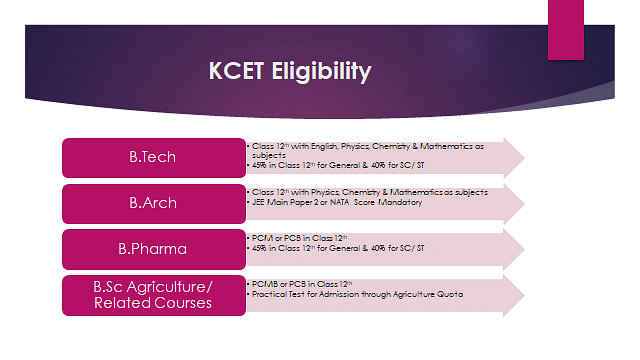
KCET 2026 Course-Wise Eligibility Criteria

If you are seeking admission into UG courses in the state of Karnataka, then you must meet the eligibility criteria set by KEA. Only eligible candidates will be allowed to proceed with the KCET 2026 application process. The Course-wise KCET 2026 Eligibility Criteria are as follows:

Name of the CourseEligibility Requirements
B.Tech
  • You must pass Class 12 with a minimum of 45% of marks in Physics, Chemistry, Mathematics/Biology/Biotechnology.
  • English should be one of the compulsory languages in Class 12.
  • For SC/ST, the minimum qualifying mark is 40%
B.Arch
  • You need to pass Class 12 with a minimum of 50% of marks in Physics, Chemistry, and Mathematics.
  • Additionally, you should have appeared for NATA or JEE Main Paper 2.
  • For SC/ST, the minimum qualifying marks in Class 12th should be 45%.
  • BSc (Hons) Agriculture
  • BSc (Hons) Horticulture
  • BSc (Hons) Sericulture
  • BSc (Hons) Forestry
  • BTech Bio-Technology
  • BTech Agriculture Engineering
  • BTech Food Technology
  • BTech Dairy Technology
  • B.F.Sc. (Fisheries)
  • You should have passed Class 12 with Physics, Chemistry, Mathematics, and Biology (PCMB) as subjects.
  • For admission through the Agriculture Quota, you must undergo a Practice Test, which will have 50% weightage in the admission process

B.VSc & AH (Veterinary Science and Animal Husbandry)

B.Sc. Nursing

  • You should have passed Class 12 or 2nd PUC with English, Biology, Physics, and Chemistry as the major subjects.
  • There will be a Practical Test for B.VSc & AH applicants. 
B.Pharm
  • You should have passed Physics, Chemistry, and Biology or Physics, Chemistry, and Mathematics as the major subjects in Class 12.
  • For the General category, the minimum qualifying marks in Class 12 should be 45%, and the same for SC/ST is 40%. 
Lateral Entry B.Pharm
  • You need to pass a Diploma in Pharmacy.
PharmD
  • Students passed in 12th Std/Second PUC with Physics, Chemistry and Biology or Physics, Chemistry and Mathematics
  • Passed the Diploma in Pharmacy Examination from an institution approved by the Pharmacy Council of India
Naturopathy & Yoga
  • The students must have passed Class 12 with Physics, Chemistry and Biology as the major subjects with a minimum 50% aggregate
  • Minimum 40% for reserved categories

Can other state students apply for KCET?

One question that you may wonder about is, 'Can other state students apply for KCET 2026?''

The answer is 'No'. Students who do not have a Karnataka domicile cannot apply for KCET 2026. The exam is conducted specifically for students with a Karnataka domicile. If you are from another state aiming for admission into Karnataka colleges, you can explore other entrance exams like COMEDK, which is conducted for admission to private engineering colleges in Karnataka.

KCET 2026 Eligibility Criteria - Documents Required Candidates

The table below contains the list of documents required for admission through the KCET 2026 exam.

Rules

Code

List of Documents

Domicile Rule 1

CODE A

  • SSLC or Class 10 mark sheet.
  • Caste/Caste Income Certificate issued by Concerned Tehsildar- For SC/ST in Form D, Category I in Form E and 2A, 2B, 3 and 3B in Form F, if claiming reservation benefits.
  • Rural Study Certificate for a complete 10 years from Class 1 to Class 10 (if claiming the rural quota).
  • 2nd PUC or Class 12 mark sheet.
  • Kannada Medium Study Certificate for a complete 10 years from Class 1 to Class 10 (if claiming a rural quota).
Domicile Rule 2

 CODE B

  • SSLC or Class 10 mark sheet.
  • 2nd PUC or Class 12 mark sheet.
  • Study certificate for either of the parents who have studied for at least 7 years in Karnataka from the Head of the Educational Institution where they had studied.
  • Caste/Caste Income Certificate issued by Concerned Tehsildar- for SC/ST in Form-D, Category-I in Form E and 2A, 2B, 3 and 3B in Form F, if claiming reservation benefits.
  • Candidate’s study certificate for having studied both 1st & 2nd PUC or Class 11 & 12 standard in Karnataka issued by the Head of the Educational Institution.
Domicile Rule 3

CODE C

  • SSLC or Class 10 mark sheet.
  • Class 12 mark sheet of the candidate.
  • Domicile certificate issued by the concerned Revenue or Municipal Authorities certifying that the applicant or either of the parents have resided outside the state of Karnataka as of 01-05-2019. The place of the issuing authority should correspond to the place of domicile of the candidate/father/mother.
  • Candidate’s Study Certificate, Transfer Certificate.
  • Domicile certificate issued by concerned Revenue Authorities of the state of Karnataka regarding the previous domicile of the father/mother of the candidate as a place in the state of Karnataka. The place of issuing authority should correspond to the place of domicile of the father/mother.
  • Either the parent's (father or mother) 10th standard marksheet or cumulative record in original in support of the mother tongue, which is Kannada/Tulu/Kodava.
  • A duly sworn declaration regarding the mother tongue of the student.
Domicile Rule 4

 CODE D

  • SSLC/Class 10 Marks Card.
  • 2nd PUC/Class 12 Marks Card.
  • Candidate’s study certificate issued by the head of the institution, which should be countersigned by the Taluk Education Officer.
  • Residential certificate from the concerned Tahsildar of the respective disputed Taluk.
  • A duly sworn declaration regarding the mother tongue of the candidate.
Domicile Rule 5

CODE E

  • SSLC/Class 10 Marks Card.
  • 2nd PUC/Class 12 Marks Card.
  • Employment certificate of the parents issued by the Controlling Office where the parent’s working period is indicated.
  • Candidate’s study certificate for 2nd PUC or equivalent examination in Karnataka issued by the head of the educational institution.
Domicile Rule 6

CODE F

  • SSLC/Class 10 Marks Card.
  • 2nd PUC/Class 12 Marks Card of the student.
  • Parent’s hometown declaration certificate while joining the service issued by the respective branch of the integrated HQ of MoD for officers and respective record offices for JCOs.
  • Caste/Caste Income certificate issued by Concerned Tahsildar.
Domicile Rule 7

CODE G

  • SSLC/Class 10 Marks Cards.
  • 2nd PUC/Class 12 Marks Card of the candidate.
  • Service certificate of the parent issued by the Controlling Office indicating the period during which the parent has worked in Karnataka and a certificate showing the present place of posting, indicating that his family is permitted to stay in Karnataka.
  • The candidate’s study certificate for the 2nd PUC or equivalent examination in Karnataka is issued by the head of the educational institution.
  • The present working place of the parent should be indicated by name and not by code numbers.
Domicile Rule 8

CODE H

  • SSLC/Class 10 mark sheet.
  • 2nd PUC/Class 12 mark sheet.
  • Parent’s hometown declaration certificate while joining the service issued by the Joint Director/Deputy Director of the concerned district and countersigned by the Director, Department of Sainik Welfare and Resettlement, Bangalore.
  • Caste/Caste Income Certificate issued by Concerned Tehsildar- For SC/ST in Form-D, Category-I in Form E and 2A, 2B, 3 and 3B in Form F, if claiming reservation benefits.
Domicile Rule 9

CODE I

  • SSLC or Class 10 Marks Cards.
  • 2nd PUC/Class 12 Marks Card of the student.
  • Certificate from the employer indicating the parent’s period of employment in the state of Karnataka and also showing that they are transferable anywhere in India.
  • Student's study certificate for 2nd PUC or equivalent examination in Karnataka issued by the head of the educational institution.
  • Certificate from the employer indicating parents as employees of Union or Karnataka State Government Undertaking or Joint Sector Undertaking.
Domicile Rule 10

CODE J

  • SSLC or Class 10 mark sheet.
  • 2nd PUC or Class 12 mark sheet.
  • Caste/Caste Income Certificate issued by Concerned Tehsildar- For SC/ST in Form D, Category I in Form E and 2A, 2B, 3 and 3B in Form F, if claiming reservation benefits.
  • Hometown declaration certificate of the parent employee while joining the service and showing that he is transferable anywhere in India, issued by the employer.
  • A study certificate of the parent employee for having studied for at least 7 years in Karnataka from the Head of the educational institution where they had studied.
Domicile Rule 11

CODE K

  • SSLC or Class 10 mark sheet
  • 2nd PUC or Class 12 mark sheet.
  • Caste/Caste Income Certificate issued by Concerned Tehsildar- For SC/ST in Form-D, Category-I in Form E and 2A, 2B, 3 and 3B in Form F, if claiming reservation benefits.
  • Certificate showing that the parent is/was a Member of Parliament elected from Karnataka, issued by the Parliament Secretariat.
Domicile Rule 12

CODE L

  • SSLC or Class 10 mark sheet.
  • 2nd PUC or Class 12 mark sheet.
  • Caste/Caste Income Certificate issued by Concerned Tehsildar- For SC/ST in Form-D, Category-I in Form E and 2A, 2B, 3 and 3B in Form F, if claiming reservation benefits.
  • Certificate from the Principal Secretary/Deputy Secretary/Under Secretary, DPAR, Government of Karnataka, Bangalore, where the parent belongs to the All India Service of Karnataka cadre, stating that the parent is a member of such All India cadre.
  • Certificate to state the period for which they have served or are serving outside Karnataka and, if they are a state government employee, a certificate certifying the same from the concerned head of the office/department.
Domicile Rule 13

CODE M

  • SSLC or Class 10 mark sheet.
  • 2nd PUC or Class 12 mark sheet.
  • As proof of migration, an original certificate was issued by the Jurisdictional District Magistrate and Deputy Commissioner of any state in India. Under the clause, you can claim eligibility for the seats earmarked by the government.
Domicile Rule 14

CODE N

  • SSLC or Class 10 mark sheet.
  • 2nd PUC or Class 12 mark sheet.
  • Study certificate issued by the head of the institution for having studied in Kannada medium from 1st standard to 10th standard.
  • A domicile certificate issued by the concerned Revenue or Municipal Authorities certifying that the candidates and their parents have resided outside the state of Karnataka as of May 1, 2014. The place of issuing authority should correspond to the place of domicile of the candidate/father/mother.
Domicile Rule 15

CODE O

  • SSLC or Class 10 mark sheet.
  • 2nd PUC or Class 12 mark sheet.
  • Parent’s hometown declaration certificate while joining the service issued by the Record Office of the CAPF unit, where the parents' service records are maintained.
  • Caste/Caste Income Certificate issued by Concerned Tehsildar- for SC/ST in Form-D, Category-I in Form E and 2A, 2B, 3 and 3B in Form F, if claiming reservation benefits.

Want to know more about KCET

Still have questions about KCET Eligibility ? Ask us.

  • Typical response between 24-48 hours

  • Get personalized response

  • Free of Cost

  • Access to community

Top