

 CBSE Class 12 Chemistry Exam 2026 LIVE Updates
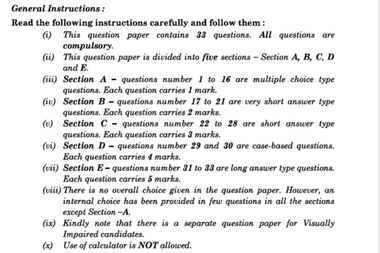
CBSE Class 12 Chemistry Exam 2026 LIVE: The Chemistry exam of CBSE Class 12 was held on February 28, 2026. Through this live blog, set-wise answer key solutions along with detailed student reviews have been provided below. The exam was held from 10:30 AM to 1:30 PM. The CBSE Class 12 Chemistry 2026 paper was divided into five sections with a total of 33 questions. All questions were compulsory to attempt. Do note that there was no overall choice, but internal choices were provided in some questions in Sections B, C, D, and E. Use of log tables and calculators was strictly not allowed.
Did you appear for CBSE Class 12th Chemistry Exam 2026 on February 28? If yes, click on the link below to submit your feedback on the examination! |
|---|
CBSE Class 12 Chemistry 2026 Answer Key (Unofficial)
The answer key of CBSE Class 12 Chemistry 2026 has been shared below:Question Summary | Correct Answer |
|---|---|
Which of the following molecules is chiral in nature? | (B) Butan-2-ol |
Identify the correct increasing order of boiling points. | (C) Propan-1-ol < Butan-2-ol < Butan-1-ol < Pentan-1-ol |
Compound produced by the reduction of Ethanenitrile with LiAlH_4 | Ethylamine |
The base present in DNA but not in RNA is: | (C) Thymine |
Proteins are polymers of alpha-amino acids joined by | (B) Peptide Bond |
When raisins are kept in water, they swell. Name the phenomenon involved in this process. | Endosmosis |
Why is osmotic pressure more advantageous than other colligative properties? | Measurement at Room Temperature |
Which phenomenon is responsible for the desalination of seawater? | Reverse Osmosis (RO) |
What happens when Chloroethane is treated with aqueous potassium hydroxide? | When chloroethane is treated with aqueous potassium hydroxide (KOH), it undergoes a nucleophilic substitution reaction to form ethanol and potassium chloride. |
Why is it difficult to separate Lanthanoids? | Due to Lanthanoid Contraction, they have very similar chemical properties and ionic radii. |
Which of the following molecules is chiral in nature? | (B) Butan-2-ol |
Identify the correct increasing order of boiling points of the given compounds: | (C) Propan-1-ol < butan-2-ol < butan-1-ol < pentan-1-ol |
Identify the compound produced by the reduction of Ethanenitrile with Lithium aluminium hydride: | (A) Ethylamine |
The base which is present in DNA but not in RNA is: | (C) Thymine |
Proteins are polymers of alpha-amino acids, which are joined to each other by: | (B) Peptide Bond |
Differentiate between a primary battery and a secondary battery. | Primary: Non-rechargeable (e.g., Dry cell). Secondary: Rechargeable (e.g., Lead storage battery). |
Why does the cell potential of a mercury cell remain constant throughout its life? | The overall reaction does not involve any ions in solution whose concentration can change. |
Mechanism of acid-catalysed hydration of alkene to alcohol. | 1. Protonation of alkene; 2. Nucleophilic attack of H2O; 3. Deprotonation. |
| A: Zn, Cd, Hg are not transition elements. R: They have completely filled d-orbitals in ground/common oxidation states. | Both are true, and Reason is the correct explanation. |
| A: Aromatic primary amines can be prepared by Gabriel Phthalimide synthesis. R: Aryl halides do not undergo nucleophilic substitution with phthalimide anion. | Assertion is false (Aromatic amines cannot be made this way), Reason is true. |
A: Glucose gets oxidized to gluconic acid with bromine water. R: The carbonyl group is absent in open chain glucose. | (C) Assertion is true, Reason is false (Carbonyl/Aldehyde group is present). |
Define activation energy. | The minimum extra amount of energy required by a reactant molecule to get converted into product. |
Define coordination number. | The total number of coordinate bonds formed by ligands with the central metal ion in a complex. |
Why difficult to separate Lanthanoids? | Due to Lanthanoid Contraction, they have very similar ionic radii and chemical properties. |
CBSE Class 12 Chemistry 2026 Chapter-Wise Weightage
Understanding the blueprint is essential for you to revise the chapters smartly. Organic Chemistry occupies nearly 47% of the theory paper. Here’s the chapter-wise weightage for the CBSE Class 12 Chemistry 2026 exam.
Unit Type | Chapters | Total Marks |
|---|---|---|
Physical | Solutions, Electrochemistry, Chemical Kinetics | 23 Marks |
Inorganic | d & f Block Elements, Coordination Compounds | 14 Marks |
Organic | Haloalkanes to Biomolecules | 33 Marks |
CBSE Class 12 Chemistry 2026 LIVE Updates
02 10 PM IST - 28 Feb'26
Answer Key Released
The answer key has been released! Find the solved question paper, student feedbacks and expert opinions here!
01 30 PM IST - 28 Feb'26
EXAM CONCLUDES: Pens Up!
The Chemistry Exam 2026 is over! Well done! Stay tuned for our Live Paper Analysis and Answer Key updates coming up anytime soon.
01 15 PM IST - 28 Feb'26
THE FINAL 15 MINUTES: Revision Mode
Stop writing new answers. Use this time to:
- Check if you've written Units for all numerical answers.
- Ensure your Roll Number is correct on every supplement sheet.
- Check if you've answered all 33 questions (No negative marking!).
12 30 PM IST - 28 Feb'26
TWO HOURS IN: The Organic Push
You should be deep into Section C and D now. Ensure your Organic conversions are clearly written with reagents on the arrows. If you are solving a numerical, clearly state the Formula used before the calculation.
11 30 AM IST - 28 Feb'26
ONE HOUR IN: Watch the Clock!
You should be finishing Section A and moving into Section B (Very Short Answers) by now. If a 1-mark MCQ is confusing you, circle it and move on—don't waste 10 minutes on 1 mark!
10 30 AM IST - 28 Feb'26
PENS DOWN ON PAPER: Exam Starts!
The bell has rung! Start with your strongest section. Most toppers recommend starting with Section A (MCQs) to build confidence or Section E (Long Answer) while the brain is fresh. Good luck!
10 15 AM IST - 28 Feb'26
15-MINUTE READING TIME: The Strategy Phase
The paper is in your hands! Do not start writing. 1. Identify the Assertion-Reason questions in Section A. 2. Choose your options in the Internal Choice questions of Section E. 3. Read the Case-Based passages in Section D to locate the "keywords."
09 00 AM IST - 28 Feb'26
ARRIVAL AT CENTER: Stay in the Zone
Students are now arriving at centers. Avoid discussing "hard" topics with peers—it only breeds anxiety. Take deep breaths and visualize yourself solving the paper with ease.
08 00 AM IST - 28 Feb'26
THE BAG CHECK: Final Essentials Only Time to leave for the center! Ensure you have:
- Original Admit Card (Laminated is fine).
Blue/Black Ballpoint Pens (carry at least 3).
Transparent Water Bottle.
School ID Card. No digital watches, calculators, or log tables allowed!
07 00 AM IST - 28 Feb'26
The Morning "Reaction Recap"
Spend 30 minutes glancing at your "Named Reaction" flowchart. Specifically, look at Reimer-Tiemann, Rosenmund Reduction, and Hoffmann Bromamide. These are high-frequency "fill-in-the-blank" style questions.
06 00 AM IST - 28 Feb'26
THE FINAL WAKE-UP: Morning Checklist Begins
Good morning, future toppers! The day has arrived. Start your morning with a glass of water and a quick glance at your Named Reaction flowcharts. Today is the day you turn your hard work into a 70/70.
05 00 AM IST - 28 Feb'26
HALOARENES: The "Nucleophilic Substitution" Difficulty
Why is Chlorobenzene less reactive than Methyl Chloride?
Resonance (Partial double bond character).
sp2 Hybridization of Carbon (Stronger bond).
Instability of Phenyl Cation.
Expect this as a 3-mark reasoning question!
04 00 AM IST - 28 Feb'26
EARLY BIRD ALERT: The "Iodoform" Functional Group
Which compounds give the Iodoform test? Only those with a Methyl Keto group (-COCH3) or a secondary alcohol that can be oxidized to a methyl keto group (like Isopropyl alcohol). Ethanol is the only primary alcohol that gives this test.
03 00 AM IST - 28 Feb'26
The "F-BLOCK" Oxidation States
While +3 is the most common oxidation state for all Lanthanoids, remember the exceptions: Cerium (Ce) shows +4 and Europium (Eu) shows +2. These are favored 1-mark "fill in the blanks" or MCQ options.
02 00 AM IST - 28 Feb'26
OVERNIGHT TIP: Handling Log Values Without a Calculator
If you encounter log 2.5 and only know log 2(0.30) and log 3 (0.47), estimate it as the midpoint (~ 0.38). CBSE examiners look for correct steps and the Nernst Equation application; minor log estimation errors rarely cost full marks.
01 00 AM IST - 28 Feb'26
KINETICS: The "Half-Life" Shortcut for MCQs
For a First-Order reaction, the half-life (t1/2) is independent of the initial concentration. If the concentration is doubled, the half-life remains the same. Use this logic to quickly eliminate wrong options in Section A MCQs.
12 00 AM IST - 28 Feb'26
The "Sleep is a Catalyst" Advice
Research shows that sleep helps in "Memory Consolidation." If you haven't slept yet, close the books. Your brain needs this time to move the Reimer-Tiemann mechanism and Kohlrausch's law from short-term to long-term memory.
11 00 PM IST - 27 Feb'26
BIOMOLECULES: Primary vs. Secondary Structure of Proteins
A quick 2-mark distinction: The Primary structure is just the sequence of amino acids held by peptide bonds. The Secondary structure (Alpha-helix or Beta-pleated sheet) is formed due to Hydrogen bonding between the -CO and -NH groups of the peptide backbone.
10 00 PM IST - 27 Feb'26
ORGANIC CHEMISTRY: The "Ortho Effect" in Substituted Benzoic Acids
Regardless of whether a substituent is electron-withdrawing or donating, an ortho-substituted benzoic acid is generally stronger than benzoic acid itself. This "ortho effect" is a sophisticated reasoning point that can help you stand out in the 5-mark Section E.
09 45 PM IST - 27 Feb'26
AMINES: The Hinsberg Test Visuals
Memorize the observations for Section C:
- Primary Amines: React with Hinsberg Reagent to form a precipitate soluble in alkali.
- Secondary Amines: Form a precipitate insoluble in alkali.
- Tertiary Amines: Do not react at all.
09 30 PM IST - 27 Feb'26
THE "SOLUBILITY" SURPRISE: Henry’s Law & Temperature
A common MCQ trap: Does the solubility of gases in liquids increase or decrease with temperature? Solubility decreases as temperature increases because the dissolution of a gas is typically exothermic. This is why aquatic species are more comfortable in cold water than in warm water.
09 15 PM IST - 27 Feb'26
SOLUTIONS: The Azeotrope Alert!
Understand the difference for Section A: Minimum Boiling Azeotropes show a large positive deviation from Raoult's Law (e.g., Ethanol + Water), while Maximum Boiling Azeotropes show a large negative deviation (e.g., Nitric Acid + Water).
09 00 PM IST - 27 Feb'26
THE 12-HOUR COUNTDOWN: Final Strategy for Section E
Section E contains three 5-mark questions. Experts suggest tackling these first or second in the exam. They are usually split into (a), (b), and (c). Even if you don't know the numerical in part (a), you can score full marks on the theory in parts (b) and (c). Never leave a 5-marker completely blank!
08 45 PM IST - 27 Feb'26
The "Zero Order" Rate Constant Unit.
Students often mix this up. For a Zero-order reaction, the rate is independent of concentration. Therefore, the unit of k is the same as the unit of rate: mol . L-1 s-1. Double-check this in Section A MCQs!
08 30 PM IST - 27 Feb'26
Aldehydes: The Etard Reaction
This is a specific way to turn Toluene into Benzaldehyde using Chromyl Chloride (CrO2Cl2) in CS2. It involves a brown "Chromium Complex" intermediate. This is a very popular 2-mark named reaction question.
08 15 PM IST - 27 Feb'26
Haloalkanes: Why Alkyl Halides are Insoluble in Water
Despite being polar, alkyl halides cannot form Hydrogen Bonds with water. The energy required to break the existing H-bonds in water is higher than the energy released when new bonds form between the halide and water. Hence, they are immiscible.
08 00 PM IST - 27 Feb'26
Amines: The Electrophilic Substitution of Aniline
Aniline is so highly reactive that bromination gives 2,4,6-tribromoaniline immediately. To get a mono-substituted product (like p-bromoaniline), you must first "protect" the amino group by acetylation with acetic anhydride.
07 45 PM IST - 27 Feb'26
Biomolecules: The Inversion of Sugar
Sucrose is dextrorotatory, but after hydrolysis, the resulting mixture of Glucose and Fructose is levorotatory. This happens because the levorotation of fructose is greater than the dextrorotation of glucose. This change in sign is called the Inversion of Sugar.
07 30 PM IST - 27 Feb'26
The Gatterman-Koch Reaction vs. Gatterman Reaction
Don't confuse them! Gatterman-Koch uses CO + HCl to turn Benzene into Benzaldehyde. The Gatterman reaction uses Cu powder/ HX to turn Benzenediazonium chloride into Haloarenes. One is for making aldehydes; the other is for haloarenes.
07 15 PM IST - 27 Feb'26
Phenols: The Coupling Reaction for Azo Dyes
Phenol reacts with Benzenediazonium chloride in basic medium (pH 9-10) to form p-Hydroxyazobenzene, which is an Orange Dye. If you use Aniline instead of Phenol, you get a Yellow Dye. This is a high-probability "Identification" question.
07 00 PM IST - 27 Feb'26
The Gabriel Phthalimide Synthesis Limitation
This method is used only for the preparation of Aliphatic Primary Amines. It cannot be used for Aniline because aryl halides do not undergo nucleophilic substitution with the phthalimide ion under ordinary conditions.
06 45 PM IST - 27 Feb'26
Kinetics: Molecularity vs. Order of Reaction
Molecularity is a theoretical concept and cannot be zero, fractional, or negative. Order is an experimental property and can be zero or fractional. This distinction is a 100% likely MCQ or 2-mark theory question.
06 30 PM IST - 27 Feb'26
d-Block: Why Copper (+2) is more stable than Copper (+1)
Even though Cu+ has a d10 configuration, Cu2+ is more stable in aqueous solution. Why? Because the Hydration Enthalpy of Cu2+ is much more negative (exothermic) than C+, which more than compensates for the energy required to remove the second electron.
06 15 PM IST - 27 Feb'26
Glucose vs. Fructose: The "Functional Group" Distinction
Glucose is an Aldohexose (contains an aldehyde group), while Fructose is a Ketohexose (contains a ketone group). Interestingly, both give a positive Tollen's test because Fructose isomerizes to Glucose in the presence of the basic reagent!
06 00 PM IST - 27 Feb'26
Electrochemistry: Why Conductivity Decreases with Dilution
Conductivity (?) is the conductance of ions per unit volume. On dilution, the number of ions per unit volume decreases, so ? always decreases. However, Molar Conductivity (λ m) increases with dilution because the volume effect overrides the ion-concentration effect.
05 45 PM IST - 27 Feb'26
Why Chloroacetic Acid is Stronger than Acetic Acid?
Expect a 2-mark reasoning question on the Inductive Effect (-I effect). The electronegative Chlorine atom withdraws electron density, stabilizing the carboxylate ion. More Chlorine atoms = higher acidity. Trichloroacetic acid is the strongest of the lot.
05 30 PM IST - 27 Feb'26
The Anisole Exception: Reaction with HI
When Anisole reacts with HI, the products are always Phenol and Methyl Iodide. The O-CH3 bond breaks because the O- C6 H5 bond has partial double-bond character due to resonance. Students often incorrectly guess Iodobenzene and Methanol; don't make that mistake!
05 15 PM IST - 27 Feb'26
Expert Tip: The "Label Everything" Rule
Whether you are drawing an electrochemical cell, a kinetics graph, or the structure of DNA, label every part. Boards award marks for diagrams, and clear labeling can save you even if your explanation is brief. Stay confident—you've got this!
05 00 PM IST - 27 Feb'26
Haloarenes: Electrophilic Substitution Trends
In Chlorobenzene, the -Cl group is ortho-para directing but deactivating. This means reactions like Nitration or Sulfonation will occur at the o/p positions, but they will be slower than in Benzene. Draw the resonance structures to prove the electron density at o/p sites.
04 45 PM IST - 27 Feb'26
Alcohols & Phenols: The Mechanism of Ether Formation
Revise the Williamson Synthesis. It is an SN2 reaction where an alkoxide ion attacks a primary alkyl halide.
Warning: If you use a tertiary alkyl halide, you will get an alkene (elimination) instead of an ether. This "exception" is a favorite MCQ trap.
04 30 PM IST - 27 Feb'26
Coordination Compounds: VBT Limitations & CFT Advantages
Why do we need Crystal Field Theory (CFT)? Because Valence Bond Theory (VBT) cannot explain the color of complexes or why certain ligands are "strong" while others are "weak." In the 2026 paper, expect a reasoning question on the drawbacks of VBT.
04 15 PM IST - 27 Feb'26
The "Step-Up" vs. "Step-Down" Conversion Trick
To increase the carbon chain length (Step-up), use KCN followed by reduction or hydrolysis. To decrease the chain length (Step-down), use the Hoffmann Bromamide Degradation (for amides) or decarboxylation (for acids). These are the "keys" to solving 5-mark conversion questions.
04 00 PM IST - 27 Feb'26
The "Balanced Equation" Golden Rule
In Chemistry, a description without a balanced chemical equation is only worth half-marks. Whether it's a named reaction, a distinction test, or a reasoning question, always write the balanced equation to secure full credit.
03 45 PM IST - 27 Feb'26
Chemical Kinetics: Collision Theory & Effective Collisions
Two factors determine an effective collision: Energy barrier (must have activation energy) and Orientation barrier (molecules must collide in the right direction). Use the example of the reaction between Bromomethane and Hydroxide ion to explain orientation.
03 30 PM IST - 27 Feb'26
Biomolecules: Fibrous vs. Globular Proteins
A quick 2-mark comparison: Fibrous proteins (Keratin, Myosin) are water-insoluble and have a thread-like structure. Globular proteins (Insulin, Albumin) are water-soluble and folded into spherical shapes.
03 15 PM IST - 27 Feb'26
d-Block: The Paradox of Ionization Enthalpies
Note that the first ionization enthalpy of 5d series elements is higher than the 3d and 4d series. Why? Because of the weak shielding of the nucleus by 4f electrons (Lanthanoid Contraction), which results in a greater effective nuclear charge.
03 00 PM IST - 27 Feb'26
Carboxylic Acids: The Hell-Volhard-Zelinsky (HVZ) Reaction
This is the only reaction in your syllabus that halogenates the alpha-position of carboxylic acids using Red Phosphorus and Cl2/Br2. It is a very specific "Named Reaction" that often catches students off guard.
02 45 PM IST - 27 Feb'26
Organic Chemistry: The Reactivity of Haloarenes vs. Haloalkanes
Why are Haloarenes less reactive towards Nucleophilic Substitution? 1. Resonance effect (C-X bond gets partial double bond character), 2. Difference in hybridization of Carbon (sp2 vs sp3), and 3. Instability of phenyl cation. This 3-point answer is a "Board Topper" favorite.
02 30 PM IST - 27 Feb'26
Coordination Compounds: Linkage and Coordination Isomerism
Linkage isomerism occurs when ambidentate ligands (like SCN- or NO2-) are present. Coordination isomerism occurs when both cation and anion are complex ions. If you see these ligands in a formula, "Isomerism" is almost certainly the question.
02 15 PM IST - 27 Feb'26
Solutions: Azeotropes and Non-Ideal Behavior
Understand the difference between Minimum Boiling Azeotropes (Positive deviation from Raoult's Law, like Ethanol + Water) and Maximum Boiling Azeotropes (Negative deviation, like Nitric Acid + Water). These are frequently tested in Assertion-Reasoning.
02 00 PM IST - 27 Feb'26
d-Block Elements: Why is Zinc not a Transition Element?
This is a "reasoning" staple. Transition elements must have incompletely filled d-orbitals in their ground state or common oxidation states. Since Zinc (Zn), Cadmium (Cd), and Mercury (Hg) have a fully filled d10 configuration (Zn = [Ar] 3d10 4s2), they are strictly "non-transition" d-block elements.
01 30 PM IST - 27 Feb'26
Biomolecules: The Essential vs. Non-Essential Amino Acids
Memorize at least two examples of each. Essential amino acids (like Valine or Leucine) cannot be synthesized by the body and must be taken in diet. Also, focus on the Zwitterion structure of amino acids—it explains their high melting points and water solubility.
01 15 PM IST - 27 Feb'26
Amines: The Carbylamine Test & Identification
Only primary amines (both aliphatic and aromatic) give the Carbylamine test (foul-smelling isocyanides). Secondary and tertiary amines do not. This is the best way to distinguish Aniline from N-Methylaniline in a "Distinction Test" question.
12 30 PM IST - 27 Feb'26
Aldehydes & Ketones: The Nucleophilic Addition Mechanism
When HCN adds to a Carbonyl group, the nucleophile (CN-) attacks the sp2 hybridized carbon. The geometry changes from planar to tetrahedral. Practice drawing this specific transition state, as it is a common 3-mark mechanism question.
12 15 PM IST - 27 Feb'26
Organic Chemistry: The Acidity of Phenols vs. Alcohols
Expect a question on why Phenol is more acidic than Ethanol. The answer lies in the Resonance Stabilization of the Phenoxide ion. If an electron-withdrawing group like -NO2 is present (especially at para-position), the acidity increases further. This is a high-probability "Arrange in increasing order" question.
12 00 PM IST - 27 Feb'26
Coordination Chemistry: The Spectrochemical Series & Color
Why is [Ti(H2O)6]3+ colored but [Sc(H2O) 6]3+ colorless? It’s all about d-d transitions. Sc3+ has a d0 configuration, so no electron can jump. Ti3+ has a d1 configuration, allowing the transition. Use this logic for any "color-based" reasoning question in Section C.
11 45 AM IST - 27 Feb'26
The "Van't Hoff" Trap: Association vs. Dissociation in Solutions
When solving numericals on Colligative Properties, the value of 'i' (van't Hoff factor) is the most common place where students lose marks. Remember: for dissociation (like NaCl), i > 1; for association (like Benzoic acid in Benzene), i < 1. If the question mentions "complete dissociation," i equals the number of ions.
11 30 AM IST - 27 Feb'26
Coordination Chemistry: The Spectrochemical Series
Quickly glance at the series to know which ligands cause high pairing energy. This determines if a complex is Inner Orbital or Outer Orbital.
11 15 AM IST - 27 Feb'26
Amines: Basic Strength Trends
Expect a question on the basic strength of amines in gaseous vs. aqueous phases. Remember the 213 (Ethyl) and 231 (Methyl) order for aqueous solutions.
11 00 AM IST - 27 Feb'26
The "Unit Conversion" Warning
A common mistake in Electrochemistry and Solutions is forgetting to convert $cm$ to $m$ or grams to kilograms. Double-check your units before the final calculation!
10 45 AM IST - 27 Feb'26
Assertion-Reasoning Strategy: The "Because" Test
To solve Assertion-Reasoning: Read the Assertion, add the word "Because," and then read the Reason. If it makes sense, Option A is your winner.
10 30 AM IST - 27 Feb'26
Expert Tip: Managing Section E (5-Mark Questions)
Section E questions are usually split into sub-parts (a, b, c). If you get stuck on a numerical in part (a), move to the theory in part (b). Don't let one hard sub-question ruin the whole 5 marks.
10 15 AM IST - 27 Feb'26
Preparation Strategy: Solving "Roadmap" Problems
Practice questions where "Compound A reacts with X to give B." These test your knowledge of multiple chapters at once and are common in the 5-mark Section E.
10 00 AM IST - 27 Feb'26
Named Reactions: The "Reaction Bank"
Memorize the reagents for Aldol Condensation, Cannizzaro, and Reimer-Tiemann. Writing the name of the reaction next to the equation often helps in gaining partial credit if the product is slightly off.
09 30 AM IST - 27 Feb'26
The Organic Marathon: 33 Marks on the Line
Organic Chemistry is the heart of the paper. Start with Aldehydes, Ketones, and Carboxylic Acids (8 Marks). This chapter is the most challenging but also the most rewarding.
09 15 AM IST - 27 Feb'26
Break Time: Hydrate & Reset
You’ve covered Physical and Inorganic basics! Take a 15-minute screen break. We dive into the massive Organic Chemistry section next.
09 00 AM IST - 27 Feb'26
Section-Wise Breakdown: Section A MCQs
Section A has 16 marks. Many of these will be conceptual. If a statement in the Assertion-Reasoning section seems factually wrong, the answer is likely Option D.
08 45 AM IST - 27 Feb'26
Preparation Strategy: The 15-Minute Reading Hack
Use your 15-minute reading time tomorrow to solve the Assertion-Reason questions. They don't require calculations and can be "pre-solved" so you can write them down the moment the bell rings.
08 30 AM IST - 27 Feb'26
Chapter Weightage: d & f Block (7 Marks)
Keep an eye on the preparation and properties of K2Cr2O7 and KMnO4. While the structures are important, their oxidizing behavior in acidic media is a high-probability exam question.
08 15 AM IST - 27 Feb'26
Expert Tip: Crystal Field Theory (CFT)
Focus on the splitting of d-orbitals in octahedral and tetrahedral fields. Understand how
 Δ° relates to the color of the complex—this is a prime topic for Case-Based questions in Section D.
08 00 AM IST - 27 Feb'26
Coordination Compounds: IUPAC & Hybridization
You will likely see a question on naming a complex or predicting its geometry using Valence Bond Theory (VBT). Know your strong-field and weak-field ligands to correctly predict the magnetic moment (μ).
07 45 AM IST - 27 Feb'26
Expected Question: Lanthanoid Contraction
Expect a 2-mark question on Lanthanoid Contraction and its consequences (e.g., why Zr and Hf have similar atomic radii). This is one of the most repeated topics in the last 10 years.
07 30 AM IST - 27 Feb'26
Inorganic Strategy: Why Logic Trumps Rote Learning
Inorganic Chemistry (d & f Block, Coordination Compounds) accounts for 14 marks. Instead of memorizing every reaction, focus on the "Reasoning" behind transition elements, like their catalytic properties and alloy formation.
07 15 AM IST - 27 Feb'26
Morning Motivation: The 70/70 Vision
Chemistry is the most scoring subject in the Science stream. Stay calm, keep your formula sheet handy, and remember: accuracy in units is just as important as the final answer!
07 00 AM IST - 27 Feb'26
Quick Note: Kohlrausch’s Law Applications
A favorite for Section B or C is the application of Kohlrausch’s Law to find the limiting molar conductivity of weak electrolytes like Acetic Acid. It’s a simple addition/subtraction of values, don't miss these easy marks!
06 45 AM IST - 27 Feb'26
Chemical Kinetics: The Zero vs. First Order Graphs
Don't forget to review the integrated rate equations. A common 1-mark MCQ involves identifying the order of a reaction from the unit of the rate constant (k). Memorize: mol1-n Ln-1 s-1
06 30 AM IST - 27 Feb'26
Preparation Strategy: The "NCERT Only" Rule
With less than 24 hours to go, stop using heavy reference books. Stick to NCERT In-text questions and back exercises. History shows that 85% of CBSE Chemistry theory is lifted directly from NCERT examples.
06 15 AM IST - 27 Feb'26
CBSE Class 12 Chemistry 2026 Chapter-Wise Weightage: Solutions (7 Marks)
In the "Solutions" chapter, focus on Colligative Properties. Expect a numerical on the depression of freezing point or elevation of boiling point. Always double-check if the solute is an electrolyte to apply the van't Hoff factor (i).
06 00 AM IST - 27 Feb'26
Expert Tip: Mastering the Nernst Equation
The Nernst Equation is a guaranteed 3 to 5-mark area. Ensure you practice calculating E cell and know how to handle the log terms. Pro-Tip: If the temperature is 298 K, use the simplified 0.059/n value to save time.
05 45 AM IST - 27 Feb'26
High-Yield Alert: The "Big Three" of Physical Chemistry
Physical Chemistry (Solutions, Electrochemistry, Kinetics) carries 23 marks. These are "numerical heavy" chapters. Experts suggest starting your morning by practicing at least 5 numericals from each to get your calculation speed up before the exam.
05 30 AM IST - 27 Feb'26
Kickstarting the Final 24 Hours!
Good morning, Class 12 students! Today is the most critical day for your Chemistry preparation. We are starting with the 70-mark blueprint. Remember, Organic Chemistry holds the lion's share at 33 marks, so plan your day to hit those chapters by noon.
05 15 AM IST - 27 Feb'26
Distinction Tests: Tollen’s, Fehling’s, and Lucas Test
Memorize the visual cues! Tollen’s reagent gives a silver mirror with aldehydes; Fehling’s gives a red-brown precipitate. For alcohols, remember the turbidity timings of the Lucas Test (Primary: no turbidity, Secondary: 5 mins, Tertiary: immediate).
05 00 AM IST - 27 Feb'26
Roadmap Problems: How to Identify Compounds A, B, and C
Practice at least three "Roadmap" problems. These involve a chain of reactions where you must identify unknown compounds based on their chemical properties (e.g., "Compound A gives a positive Iodoform test but negative Tollen's test"). This test assesses your comprehensive understanding of the syllabus.
04 45 AM IST - 27 Feb'26
Named Reactions: The "Big Five" for 2026
If you only study five reactions today, make them: Aldol Condensation, Cannizzaro Reaction, Reimer-Tiemann, Kolbe’s Reaction, and Hoffmann Bromamide Degradation. These frequently appear as direct questions or part of multi-step conversions.
04 30 AM IST - 27 Feb'26
Organic Chemistry Strategy: Mastering the 33-Mark Weightage
Organic Chemistry is the make-or-break section. Shift your focus to the "Must-Know" mechanisms. In the 2026 paper, expect at least one mechanism-based question (3 marks) from Dehydration of Alcohols or Nucleophilic Addition to Carbonyl groups.
04 15 AM IST - 27 Feb'26
Electrochemistry Checklist: Kohlrausch’s Law & Fuel Cells
Review the application of Kohlrausch’s Law for calculating limiting molar conductivity of weak electrolytes. Additionally, re-read the theory on H2-O2 Fuel Cells and lead-acid storage batteries; these are prime candidates for the "Assertion-Reasoning" section in Section A.
04 00 AM IST - 27 Feb'26
Early Bird Kickoff: The Physical Chemistry Numerical Blueprint
Start your final countdown by mastering the "Big Three" of Physical Chemistry: Solutions, Electrochemistry, and Chemical Kinetics. These chapters account for 23 marks. Ensure you have the relationship between Gibbs Free Energy (∆G°) and Cell Potential (E° cell) memorized, as it is a board favorite for 3-mark questions.