


The AP Inter 2nd Year Commerce Answer Key 2026 has been released on March 11, 2026. Check the live updates, including paper analysis and solved question paper here.
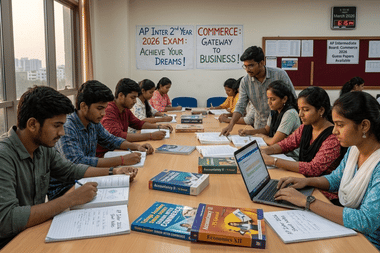 AP Inter 2nd Year Commerce Answer Key 2026
AP Inter 2026 2nd Year Commerce Answer Key: The AP Inter 2nd Year Commerce Exam 2026 was successfully held on March 11, 2026, at various centres across the state of Andhra Pradesh. The examination was conducted from 9 AM to 12 PM. It will have two parts- Part I (Commerce) and Part II (Accountancy). Students can get a maximum score of 100 in the exam. Part 1 has 50 marks, and Part 2 has 50 marks too.
To help students get an idea of their exam performance, CollegeDekho has provided LIVE updates on the AP Inter 2nd Year Commerce Answer Key 2026. Students can access the solved question paper, analysis and students' feedback as well as other updates, here. This will be very useful for the students in analysing their exam performance.
Also Read:
AP Inter Result Date 2026 Prediction: When will BIEAP declare results?
AP Inter 2nd Year Commerce Answer Key 2026
Here is the AP Inter 2nd Year Commerce Answer Key 2026:
Question No. | Question | Comprehensive Answer Summary |
|---|---|---|
Section A - Q1 | What do you understand by the word Transport? Discuss the benefits and limitations of Transport. |
Definition:
Transport is the physical movement of goods, people, and animals from one location to another, bridging the gap between producers and consumers.Benefits:
|
Section A - Q2 | Define Stock Exchanges and explain its functions. |
Definition:
A Stock Exchange is a highly organized market where government and industrial securities (stocks, bonds) are bought and sold under specific rules.
|
Section A - Q3 | Explain the redressal mechanism available to consumers under the Consumer Protection Act, 1986/2019. |
Redressal Mechanism (Three-Tier System)
|
Section B - Q4 | Characteristics of Entrepreneurs |
Risk-Taking:
Willingness to assume the risk of loss for potential profit.
|
Section B - 5 | Types of Entrepreneurs |
Innovative:
Those who introduce brand new products or technologies.
|
Section B - 6 | International Trade & Its Types |
Definition:
The exchange of goods and services across national borders.
|
Section B - 7 | What is SEZ? Explain their objectives. |
Definition:
Special Economic Zones (SEZ) are designated areas with liberal economic laws to promote business.
|
Section B - 8 | Advantages of E-Banking |
|
Section B - 9 | Distinction: Primary vs. Secondary Market |
Primary Market:
Deals with the issue of new securities for the first time (IPOs). The company is directly involved.
|
Section C - 10 | Write one definition of Entrepreneurship | According to A.H. Cole, "Entrepreneurship is the purposeful activity of an individual or a group of associated individuals, undertaken to initiate, maintain or aggrandize profit by production or distribution of economic goods and services." |
Section C - 11 | Explain any one function of an Entrepreneur. | Risk-Taking: The most fundamental function of an entrepreneur is to bear the uncertainty and financial risk of a business. They invest capital and resources into a venture without a guaranteed return, taking responsibility for any potential losses in pursuit of profit. |
Section C - 12 | Define 'Business Finance'. | Business finance refers to the provision of money for use in business activities. It involves the procurement and utilization of funds by a business enterprise to meet its operational and long-term requirements. |
Section C - 13 | What is a 'Joint Venture'? | A Joint Venture is a business arrangement in which two or more parties agree to pool their resources for the purpose of accomplishing a specific task or a new business activity, sharing both profits and risks. |
Section C - 14 | What is meant by 'E-Commerce'? | E-commerce (Electronic Commerce) is the buying and selling of goods and services, or the transmitting of funds or data, over an electronic network, primarily the internet. |
Section C - 15 | Define 'Working Capital'. | Working Capital is the capital of a business which is used in its day-to-day trading operations, calculated as the current assets minus the current liabilities. (Working Capital = Current Assets - Current Liabilities). |
Section C - 16 | What is 'Consumerism'? | Consumerism is a social movement seeking to augment the rights and powers of buyers in relation to sellers. It protects consumers from unfair trade practices like adulteration and false advertising. |
Section C - 17 | What is 'Advertising'? | Advertising is a paid, non-personal communication about an organization, product, service, or idea by an identified sponsor, intended to persuade or inform a target audience. |
Section G - 25 | What is a Bill of Exchange? | A Bill of Exchange is an instrument in writing containing an unconditional order, signed by the maker (drawer), directing a certain person (drawee) to pay a certain sum of money only to, or to the order of, a certain person or to the bearer of the instrument. |
Section G - 26 | What is Obsolescence? | Obsolescence refers to the reduction in the value of a fixed asset due to it becoming out of date or "obsolete" because of new inventions, improved production methods, or changes in market demand, rather than physical wear and tear. |
Section G - 27 | What is an Account Sales? | An Account Sales is a periodic statement sent by a consignee (agent) to the consignor (principal). It provides details regarding the goods sold, expenses incurred, commission charged, and the net amount payable to the consignor. |
Section G - 28 | Legacy | A Legacy is the amount received by a non-profit organization as per the will of a deceased person. It is generally treated as a capital receipt and shown on the Liabilities side of the Balance Sheet. |
Section G - 29 | Gaining Ratio |
Gaining Ratio is the ratio in which the remaining partners acquire the share of profit from a retiring or deceased partner. The formula is:
Gaining Ratio = New Ratio – Old Ratio . |
Section G - 30 | What is Authorized Capital? | Authorized Capital (or Nominal Capital) is the maximum amount of share capital that a company is legally authorized to issue to its shareholders as per its Memorandum of Association. |
Section G - 31 | Ready to use Accounting Software. | These are standardized, "off-the-shelf" software packages developed for a wide range of users (e.g., Tally, QuickBooks). They are easy to install but offer limited customization compared to bespoke software. |
Section G - 32 | Calculate the profit or loss of a Concern... | Profit/Loss = Capital at the end - Capital at the beginning Calculation: ₹14,000 - ₹15,000 = -1,000 Result: There is a Loss of ₹1,000. |
AP Inter 2nd Year Commerce Exam 2026 Quick Facts
Some of the details and facts related to AP Inter 2nd Year Commerce Exam 2026 can be found below:
Aspect | Details |
|---|---|
Exam Date | March 11, 2026 |
Exam Time | 9 AM to 12 PM |
Paper Structure | Part I (Commerce) and Part II (Accountancy) |
Total Marks | Part I Marks - 50 Marks Part II Marks - 50 Marks |
Sections | Sections A to G |
Questions and Marking Scheme |
|
Max Marks | 100 Marks |
Commerce and Accountancy is a full-scoring paper in the Intermediate examination, as most questions are theory and problem-based and follow a fixed pattern. Students who memorized the definitions, understand the concepts, and provided answers in the form of well-structured points can easily get a good score in the test.
The Physics exam is next and will be held on March 13, 2026. The timings will be the same- 9 AM to 12 PM. To perform well on the test, students should focus on understanding core concepts, practicing numerical problems and deriving formulas. Students are advised not to start new topics or chapters in the last few days and focus on complete revision.
AP Inter 2nd Year Commerce Exam 2026 LIVE:
01 50 PM IST - 11 Mar'26
Entire Solved Question Paper Out!
The entire answer key of AP Inter 2nd Year Commerce Exam 2026 has been released!
12 45 PM IST - 11 Mar'26
Answer key released!
The answer key has been released for Section A and Section B. The unsolved question paper for the remaining sections will be added here shortly.
12 00 PM IST - 11 Mar'26
AP Inter Commerce Exam Concludes Successfully
The AP Inter 2nd Year Commerce exam has concluded successfully across examination centres. Students are exiting the exam halls, and initial reactions suggest that the question paper covered key chapters from both Commerce and Accountancy sections. Detailed analysis and student reactions will follow shortly.
11 30 AM IST - 11 Mar'26
Commerce Exam to Conclude Shortly; Student Reviews and Paper Analysis Expected Soon
With only a few minutes remaining for the AP Inter 2nd Year Commerce Exam 2026, the examination is set to conclude shortly across centres in Andhra Pradesh. Student reactions, expert reviews, and detailed paper analysis will be made available. These updates will include the overall difficulty level, section-wise analysis for Commerce and Accountancy, and expected marks trends, helping students understand how the paper compared with previous years. Stay tuned for the latest updates and insights.
10 15 AM IST - 11 Mar'26
Exam Running Smoothly; Facilities Available at Centres
Reports from several examination centres indicate that the Commerce exam is progressing smoothly. Authorities have ensured facilities such as drinking water, proper seating arrangements, and ventilation. In some centres, medical staff are also available to assist students if any health issues arise during the examination.
09 00 AM IST - 11 Mar'26
AP Inter 2nd Year Commerce Exam Begins
The AP Inter 2nd Year Commerce examination has begun across various examination centres in Andhra Pradesh. Students are writing the exam under proper supervision and invigilation. Initial reports indicate that the exam started smoothly without any disruptions.
08 25 AM IST - 11 Mar'26
Last-Minute Revision Outside Exam Centres
Many students gather outside exam centres revising short notes and definitions. Experts advise focusing only on quick revision rather than attempting new problems. Staying calm and confident is essential for performing well in theory-based subjects like Commerce.
07 35 AM IST - 11 Mar'26
Students Preparing to Leave for Examination Centres
Students appearing for the AP Inter 2nd Year Commerce exam should ensure that they carry their hall tickets, pens, pencils, and calculators if permitted. Reaching the exam centre early reduces last-minute stress. Avoid discussing difficult topics with peers outside the exam hall, as it may create unnecessary anxiety.
06 35 AM IST - 11 Mar'26
Final Guess Paper Hints for Commerce Exam
Based on blueprint trends and previous exams, experts predict that the question paper may include:
Commerce:
• Functions of SEBI
• Consumer rights
• Banking functionsAccountancy:
• Consignment account problem
• Depreciation calculation
• Partnership admission adjustmentsStudents should attempt questions they are most confident about first.
05 35 AM IST - 11 Mar'26
Important Topics to Revise Before Leaving Home
Students should quickly review the most important topics.
Commerce topics:
• Business Services
• Financial Markets
• Consumer Protection
• Entrepreneurship DevelopmentAccountancy topics:
• Consignment Accounts
• Partnership Accounts
• DepreciationThese chapters carry significant marks weightage in the exam.
04 35 AM IST - 11 Mar'26
Early Morning Study Begins for Commerce Exam
Many students begin their final revision early in the morning. Experts suggest revising short notes and important concepts rather than attempting entirely new topics. Reviewing definitions, differences between business concepts, and accounting formats will help refresh memory and improve confidence before heading to the exam centre.
03 35 AM IST - 11 Mar'26
Top 10 Expected Commerce Questions for Tomorrow’s Exam
Expected questions include:
• Explain functions of banks
• Explain advantages of insurance
• Explain SEBI functions
• Explain consumer rights
• Explain characteristics of entrepreneurs
• Explain functions of wholesalers
• Explain stock exchange functions
• Explain electronic banking services
• Explain types of entrepreneurs
• Explain international trade.Students should revise these carefully.
02 35 AM IST - 11 Mar'26
Quick Revision of Commerce Essay Questions
Students should revise the most expected essay questions from the Commerce section.
Expected long-answer questions:
• Explain functions of banks
• Explain functions of SEBI
• Explain rights of consumers
• Explain characteristics of entrepreneursPresentation tip:
• Write answers with clear headings and bullet points
• Include 6–8 points in essay questions.01 35 AM IST - 11 Mar'26
Important Accountancy Numerical Models
Students revising Accountancy should review common numerical formats that often appear in exams.
Key problem types:
• Depreciation calculation problems
• Consignment account preparation
• Profit calculation using capital comparison method
• Partnership admission adjustmentsTip for students:
• Always show working calculations
• Maintain neat ledger formats to secure full marks.12 35 AM IST - 11 Mar'26
As the Commerce exam day begins, students are advised to keep their preparation light and focused. Instead of solving lengthy numerical problems, revise important definitions and theory concepts from Entrepreneurship Development, Financial Markets, and Consumer Protection. For Accountancy, review formats of Consignment Account, Partnership Accounts, and Depreciation calculations. Adequate sleep is important so that students remain fresh and attentive during the exam.
Students who are revising late at night should focus on key definitions that frequently appear in very short answer questions.
Important definitions to revise:
• Entrepreneur – person who organizes and manages a business
• Consumer – person who purchases goods for personal use
• Stock Exchange – organized market for buying and selling securities
• Insurance – contract providing financial protection against lossWriting definitions clearly in two or three lines helps secure quick marks.
11 45 PM IST - 10 Mar'26
Midnight Revision Strategy for Commerce Students
As the Commerce exam day nears, students are advised to keep their preparation light and focused. Instead of solving lengthy numerical problems, revise important definitions and theory concepts from Entrepreneurship Development, Financial Markets, and Consumer Protection. For Accountancy, review formats of Consignment Account, Partnership Accounts, and Depreciation calculations. Adequate sleep is important so that students remain fresh and attentive during the exam.
11 00 PM IST - 10 Mar'26
Final Preparation Advice for Commerce Students
Students should now stop heavy study and focus on relaxation.
Important reminders:
• Keep hall ticket ready
• Carry required stationery
• Sleep well to maintain concentration10 43 PM IST - 10 Mar'26
Accountancy Full Numerical Practice Reminder
Before finishing revision, students should solve one full numerical problem.
Recommended problems:
• Consignment account preparation
• Partnership admission balance sheet
• Depreciation calculationPracticing one problem improves calculation confidence.
10 25 PM IST - 10 Mar'26
Final Guess Paper Strategy for Commerce Exam
Experts suggest focusing on the following high-probability questions:
Commerce:
• Functions of SEBI
• Consumer rights
• Functions of entrepreneursAccountancy:
• Consignment account problem
• Partnership admission problem
• Depreciation calculation.Students should revise these carefully.
10 10 PM IST - 10 Mar'26
Presentation Tips to Score Full Marks
Students should follow these presentation guidelines:
• Write answers point-wise
• Underline key headings
• Draw ledger formats neatly
• Show all working calculationsClear presentation helps examiners award full marks.
09 55 PM IST - 10 Mar'26
Last-Minute Quick Revision Topics
Students should revise the following before sleep:
Commerce:
• Definitions and short notes
• 10-mark essay questionsAccountancy:
• Partnership problems
• Consignment account format
• Depreciation calculations.Experts recommend quick revision rather than solving new problems.
09 40 PM IST - 10 Mar'26
Accounting from Incomplete Records Important Problem
Example problem:
Opening capital = ₹40,000
Closing capital = ₹60,000
Drawings = ₹5,000Steps:
• Adjust drawings
• Calculate increase in capital
• Determine profitProfit = Closing capital − Opening capital + Drawings.
09 25 PM IST - 10 Mar'26
Problem 5: Partnership Profit Sharing
Q: A and B share profits in the ratio 3 : 2.
Total profit = ₹25,000.Solution
Total ratio = 3 + 2 = 5
A's share = 3/5 × 25,000 = ₹15,000
B's share = 2/5 × 25,000 = ₹10,000Final Answer:
A receives ₹15,000
B receives ₹10,00009 10 PM IST - 10 Mar'26
Problem 4: Bills of Exchange Journal Entry
Q: Ram sells goods worth ₹10,000 to Ravi and draws a bill for three months.
Journal Entry in Ram's Books
Bills Receivable A/c Dr ₹10,000
To Ravi A/c ₹10,000Explanation:
The bill received from Ravi becomes a Bills Receivable asset for Ram.08 55 PM IST - 10 Mar'26
Problem 3: Consignment Commission Calculation
Q: Goods worth ₹1,00,000 were sent on consignment.
Consignee commission = 5% on sales.
Goods sold = ₹80,000.Solution
Commission = 5% of ₹80,000
Commission = 0.05 × 80,000
Commission = ₹4,000Final Answer:
Consignee Commission = ₹4,00008 40 PM IST - 10 Mar'26
Problem 2: Profit Calculation from Incomplete Records
Q: Opening Capital = ₹40,000
Closing Capital = ₹55,000
Drawings = ₹5,000Solution
Profit = Closing Capital − Opening Capital + Drawings
Profit = 55,000 − 40,000 + 5,000
Profit = ₹20,000Final Answer:
Profit earned during the year = ₹20,00008 25 PM IST - 10 Mar'26
Problem 1: Depreciation Calculation
Q: Furniture purchased for ₹50,000.
Depreciation is charged at 10% per year using the straight line method.Solution
Depreciation per year
= 10% of ₹50,000
= ₹5,000Value of furniture after one year
= ₹50,000 − ₹5,000
= ₹45,000Final Answer:
Annual Depreciation = ₹5,000
Book Value after 1 year = ₹45,00008 10 PM IST - 10 Mar'26
Important Commerce Definitions with Answers
Entrepreneur
An entrepreneur is a person who organizes, manages, and takes the risk of running a business or enterprise. The entrepreneur brings together resources such as capital, labor, and technology to produce goods or services and earn profit.
Entrepreneurship
Entrepreneurship refers to the process of identifying business opportunities, organizing resources, and taking risks to establish and run a new business venture.
Banking
Banking refers to the business activity of accepting deposits from the public and providing loans or financial services for economic development.
Insurance
Insurance is a contract between the insurer and the insured in which the insurer promises to compensate the insured for losses in exchange for a premium.
Consumer
A consumer is a person who purchases goods or services for personal use and not for resale or commercial purposes.
Stock Exchange
A stock exchange is an organized marketplace where securities such as shares, bonds, and debentures are bought and sold.
SEBI
SEBI (Securities and Exchange Board of India) is a regulatory authority that protects investors and regulates the securities market in India.
07 55 PM IST - 10 Mar'26
Accountancy Problem: Depreciation Calculation
Depreciation problems often appear as numerical questions.
Example format:
Furniture purchased for ₹60,000
Depreciation charged at 10%Steps:
• Calculate annual depreciation
• Record depreciation in furniture account
• Show closing balanceStudents should practice both:
• Straight Line Method
• Written Down Value Method.07 40 PM IST - 10 Mar'26
Important Essay Questions from Consumer Protection
Consumer Protection is a very important chapter.
Most expected 10-mark questions:
• Explain consumer rights
• Explain responsibilities of consumers
• What is consumer protection?
• Explain consumer redressal agenciesPreparation tips:
• Write answers with clear headings
• Use bullet points for each right or responsibility.07 25 PM IST - 10 Mar'26
Top 10 Very Short Questions Students Must Revise
Important 2-mark questions:
• Define entrepreneur
• What is mobile banking?
• What is SEBI?
• What is insurance?
• What is innovation?
• Define wholesaler
• Define retailer
• What is bonded warehouse?
• What is treasury bill?
• What is NIFTY?07 10 PM IST - 10 Mar'26
Accountancy Problem Focus: Consignment Accounts
Consignment problems require careful accounting entries.
Typical problem includes:
• Cost of goods sent to consignee
• Expenses paid by consignor
• Commission paid to consignee
• Sales made by consigneeStudents must prepare:
• Consignment Account
• Consignee Account
• Goods Sent on Consignment AccountPresentation tip:
• Show calculation of commission clearly.
06 55 PM IST - 10 Mar'26
Final Revision Focus: Entrepreneurship Development
Students should now revise Entrepreneurship Development, an important unit in Part-I Commerce.
Important questions to practice:
• Define entrepreneur and entrepreneurship
• Explain characteristics of entrepreneurs
• Explain functions of entrepreneurs
• Explain types of entrepreneursPreparation tips:
• Begin answers with a clear definition
• Write 5–6 bullet points explaining characteristics or functions
• Include examples where possible to improve answer quality.06 40 PM IST - 10 Mar'26
Evening Revision Strategy for Commerce Exam
As evening preparation begins, students should shift from solving new problems to revising important topics.
Suggested revision order:
• Commerce theory definitions
• 10-mark essay questions
• Accountancy numerical problems
• Ledger formats and adjustmentsExperts advise students to practice at least one full accounting problem tonight to maintain accuracy.
06 25 PM IST - 10 Mar'26
Final Practice Problem: Profit Calculation Method
Example problem format:
Capital at beginning of year: Rs. 7,500
Capital at end of year: Rs. 10,000Steps to solve:
• Compare opening and closing capital
• Adjust drawings
• Adjust additional capital introducedStudents should remember that profit = increase in capital after adjustments.
06 10 PM IST - 10 Mar'26
Important Accountancy Adjustments in Numerical Problems
Adjustments are crucial in accounting problems.
Common adjustments include:
• Outstanding expenses
• Prepaid expenses
• Provision for doubtful debts
• Depreciation on assetsStudents must remember to show these adjustments separately in working notes.
05 55 PM IST - 10 Mar'26
Important Commerce Definitions for Quick Revision
Definitions often appear in 2-mark questions.
Students should revise the following definitions:
• Entrepreneur
• Entrepreneurship
• Wholesaler
• Retailer
• Insurance
• Banking05 40 PM IST - 10 Mar'26
High-Weightage Units Students Must Revise Now
According to the blueprint, some units carry higher marks weightage.
Commerce high-weightage units:
• Business Services
• Financial Markets
• Entrepreneurship DevelopmentAccountancy high-weightage units:
• Consignment Accounts
• Partnership Accounts
• Not-for-Profit OrganisationsStudents should prioritize these chapters for final revision.
05 25 PM IST - 10 Mar'26
Important Ledger Format Students Should Practice
Ledger accounts are often required in accounting problems.
Students should practice drawing the following formats:
• Consignment Account
• Consignee Account
• Bills Receivable Account
• Furniture AccountPresentation tip:
• Draw proper ledger columns
• Write narration clearly
• Maintain neatness for better marks.05 10 PM IST - 10 Mar'26
Most Repeated 2-Mark Questions from Commerce
Very short answer questions are quick scoring.
Important terms to revise:
• NIFTY
• Treasury Bill
• State Commission
• Mobile Banking
• Bonded Warehouse
• InnovationStudents should practice writing precise definitions in two lines.
04 55 PM IST - 10 Mar'26
Commerce Section: Domestic and International Trade
Students should revise the Domestic and International Trade chapter carefully.
Important questions:
• What is international trade?
• Explain types of international trade
• Explain advantages of foreign trade
• Explain objectives of SEZ (Special Economic Zone)Preparation tip:
• Write answers in 5–7 points
• Use headings for clarity.04 40 PM IST - 10 Mar'26
Accounting from Incomplete Records Important Concepts
Accounting from incomplete records may appear as a problem question.
Key concepts to revise:
• Single entry system
• Calculation of profit or loss
• Statement of affairs method
• Capital comparison methodExample problem format:
• Capital at beginning and end of year
• Drawings during the year
• Additional capital introducedStudents must calculate profit using capital comparison method.
04 25 PM IST - 10 Mar'26
Company Accounts: Short Answer Topics to Revise
Company Accounts usually produce conceptual questions and short answers.
Important questions to revise:
• Meaning of share capital
• Types of shares
• Equity shares vs preference shares
• Issue of sharesPreparation tips:
• Write answers in point-wise format
• Include definitions and advantages where applicable.04 10 PM IST - 10 Mar'26
Partnership Accounts: Admission of Partner Important Steps
Partnership Accounts carry significant marks in the exam.
Important steps when solving admission of partner problems:
• Calculate old profit sharing ratio
• Determine new profit sharing ratio
• Calculate sacrifice ratio
• Adjust goodwill brought by the new partner
• Prepare revised balance sheetExpected question:
• “Prepare the revised Balance Sheet after admission of a partner.”
Students must show all working calculations clearly.
03 55 PM IST - 10 Mar'26
Not-for-Profit Organisation Accounting: Key Problem Type
Students preparing for the Accountancy section should focus on Not-for-Profit Organisation accounting problems, which are often asked as 10-mark numerical questions.
Important topics:
• Preparation of Income and Expenditure Account
• Conversion of Receipts and Payments Account
• Adjustment of outstanding expenses
• Treatment of subscriptionsImportant exam tip:
• Always prepare working notes for adjustments
• Show calculation of subscriptions received and outstanding clearly.03 40 PM IST - 10 Mar'26
Consignment Accounts Most Expected Problem
Consignment account questions require step-by-step calculation.
Typical problem includes:
• Cost of goods sent on consignment
• Expenses paid by consignor
• Commission paid to consignee
• Calculation of profit or lossStudents must revise:
• Consignment Account format
• Consignee Account
• Goods Sent on Consignment Account.03 25 PM IST - 10 Mar'26
Depreciation Important Numerical Problem
Depreciation is another frequently asked accounting topic.
Example problem format:
• Furniture purchased for Rs. 80,000
• Depreciation charged at 10% per year
• Prepare furniture accountImportant points:
• Understand straight line method
• Calculate yearly depreciation
• Show opening and closing balances.03 10 PM IST - 10 Mar'26
Accountancy Important Problem: Bills of Exchange
Bills of exchange questions frequently appear in the exam.
Typical question pattern:
• Drawing of bill
• Acceptance by debtor
• Discounting with bank
• Dishonour of billImportant journal entries:
• Bills Receivable A/c
• Bills Payable A/c
• Discount A/cStudents should revise the sequence of entries carefully.
02 55 PM IST - 10 Mar'26
Very Short Answer Questions Students Must Not Miss
Very short answer questions are usually easy scoring.
Important terms to revise:
• Innovation
• Entrepreneur
• Wholesaler
• Retailer
• Mobile Banking
• Treasury Bill
• Bonded Warehouse02 40 PM IST - 10 Mar'26
Entrepreneurship Development Key Questions
Students should revise important questions related to entrepreneurship development.
Expected questions:
• Define entrepreneur
• Explain characteristics of entrepreneurs
• Explain functions of entrepreneurs
• Explain types of entrepreneursAnswer writing tip:
• Start with definition
• Follow with 5–6 key characteristics.02 25 PM IST - 10 Mar'26
Consumer Protection Important Questions
The Consumer Protection chapter usually produces both short-answer and essay questions.
Important questions:
• Who is a consumer?
• Explain rights of consumers
• Explain responsibilities of consumers
• What is consumer protection?Preparation tip:
• Write answers in clear bullet points
• Mention examples where possible.02 10 PM IST - 10 Mar'26
Financial Markets Chapter Important Topics
Financial Markets is another high-weightage chapter in the Commerce section.
Important concepts to revise:
• Meaning of financial market
• Role of SEBI
• Functions of stock exchange
• Differences between primary and secondary marketsMost expected question:
• Explain the objectives and functions of SEBI.
Students should focus on definitions and structured point-wise explanations.
01 55 PM IST - 10 Mar'26
Important Essay Questions from Business Services Chapter
The Business Services chapter is one of the most scoring areas in Part-I Commerce. Students should revise long-answer questions from banking and insurance topics carefully.
Important 10-mark questions:
• Define Banking and explain functions of banks
• Explain advantages of insurance
• Explain types of banking services
• Explain electronic banking servicesPreparation tips:
• Write answers in 10–12 bullet points
• Use headings like “Meaning”, “Features”, and “Advantages”.01 40 PM IST - 10 Mar'26
Preparation Tips for Commerce and Accountancy Exam
Experts advise students to focus on both theoretical clarity and numerical accuracy.
Final revision tips:
• Revise important definitions and concepts
• Practice at least two accountancy problems
• Write answers in points for theory questions
• Draw ledger formats neatly in accounting problems
• Allocate time properly during the examCommerce and Accountancy together form a high-scoring paper when answers are presented clearly and calculations are shown step by step.
01 25 PM IST - 10 Mar'26
Accounting for Not-for-Profit Organisations
Important accounting topic expected in the exam.
Common problems:
• Prepare Income and Expenditure Account
• Convert Receipts and Payments Account into Income and Expenditure Account
• Adjust outstanding expenses and subscriptionsKey adjustments to revise:
• Outstanding subscriptions
• Prepaid expenses
• Depreciation on assetsThese adjustments are often included in exam questions.
01 10 PM IST - 10 Mar'26
Consignment Accounts Important Model Question
Important problem format:
• Goods sent on consignment
• Expenses incurred by consignor
• Commission paid to consignee
• Preparation of Consignment AccountExample data to practice:
• Goods worth Rs. 3,00,000 sent on consignment
• Freight and insurance Rs. 12,000
• Commission 5% on salesStudents should revise the format of consignment account and ledger entries carefully.
12 55 PM IST - 10 Mar'26
Important Accountancy Problem from Partnership Accounts
Example Problem:
Dinesh and Ramesh share profits in the ratio 3:2. They admit Vasu as a partner for 1/5 share.
Steps to solve:
• Calculate old profit sharing ratio
• Determine sacrifice ratio
• Adjust goodwill brought by the new partner
• Prepare revised balance sheetTip:
• Write formulas clearly before calculation
• Show working notes to secure full marks.12 40 PM IST - 10 Mar'26
Accountancy Section: Most Important Numerical Topics
Accountancy contributes 50 marks in the paper, so practicing numerical problems is essential.
Key scoring topics:
• Partnership admission problems
• Consignment accounts preparation
• Depreciation calculations
• Bills of exchange journal entries
• Accounting from incomplete recordsStudents should practice solving ledger and balance sheet questions step by step.
12 25 PM IST - 10 Mar'26
Very Short Answer Questions Students Must Revise
Very short answer questions usually carry 2 marks and are definition-based.
Important terms to revise:
• Innovation
• Types of Entrepreneurs
• Wholesaler
• Mobile Banking
• Bonded Warehouse
• Treasury Bill
• NIFTYTip:
• Write the definition in one or two lines only
• Avoid unnecessary explanation.12 10 PM IST - 10 Mar'26
Frequently Asked 5-Mark Questions (Short Answer Section)
Short answer questions test conceptual understanding of important topics.
Important questions:
• Explain the five functions of entrepreneurs
• What is International Trade?
• Explain types of International Trade
• Explain advantages of Business Services
• Distinguish between Primary Market and Secondary MarketPreparation tip:
• Write answers in 5–6 clear points
• Avoid writing long paragraphs
• Use keywords like “definition”, “features”, and “advantages”.11 55 AM IST - 10 Mar'26
Important 10-Mark Questions from Commerce Section
Essay-type questions usually carry 10 marks and require detailed explanations.
Expected questions:
• Define Banking and explain functions of banks
• Explain the objectives and functions of SEBI
• What are the responsibilities of a consumer?
• Explain advantages of insurance
• Explain characteristics of entrepreneursAnswer writing tips:
• Begin with a clear definition
• Write points in numbered format
• Include headings and sub-points for clarity.11 40 AM IST - 10 Mar'26
Most Scoring Units to Revise First for Commerce Exam
Students starting their final revision for the AP Inter 2nd Year Commerce exam should focus on the highest weightage units from both Part-I Commerce and Part-II Accountancy.
Important scoring topics:
• Business Services – banking, insurance, and e-banking concepts
• Financial Markets – SEBI, stock exchange functions
• Entrepreneurship Development – characteristics and functions of entrepreneurs
• Partnership Accounts – admission of partner problems
• Consignment Accounts – preparation of ledger accountsTip for students:
• Revise definitions and key points for theory questions
• Practice at least one accounting numerical problem before moving to other topics.