

 CBSE Class 12 Physics Answer Key 2026 LIVE: PDF Links Now Available for All Sets; Student Reviews
CBSE Class 12 Physics Exam 2026: The Physics exam for CBSE Class 12 students has concluded at 1:30 PM on February 20, 2026. As per the initial reviews shared by experts and students, the exam was of a 'Moderate' difficulty level. The Physics unofficial answer key prepared by the subject expert for Set 1, 2 and 3 question papers has been provided here, along with student reactions and expert analysis. Students can follow the live thread below to get question-wise answers. Students must note that there are unofficial keys and there might be slight errors. CBSE does not release any official answer key for CBSE Class 12 Physics 2026.
- If you wish to submit your opinion or review on the Question paper, Click Here to submit your Review
C BSE Class 12 Physics Answer Key 2026 for 55/4/2
Check out the CBSE Class 12 Physics Answer Key 2026 PDF for Set 55/4/2 here:
C BSE Class 12 Physics Answer Key 2026 for 55/4/3
Here is the CBSE Class 12 Physics Answer Key 2026 PDF for Set 55/4/3:
C BSE Class 12 Physics Answer Key 2026 for 55/3/3
Here is the CBSE Class 12 Physics Answer Key 2026 for 55/3/3:
CBSE Class 12 Physics Answer Key 2026 for 55/5/3
Answer key for CBSE Class 12 Physics Answer Key 2026 for 55/5/3 is provided below:
C BSE Class 12 Physics Answer Key 2026 for 55/4/1
Download CBSE Class 12 Physics Answer Key 2026 for 55/4/1 from here :
CBSE Class 12 Physics Answer Key 2026 for 55/1/3
Here is the CBSE Class 12 Physics Answer Key 2026 for 55/1/3 :
CBSE Class 12 Physics Exam 2026: Student Reviews & Expert Analysis
As per the reviews shared by students and experts, the following reactions have been reported for the CBSE Class 12 Physics Exam 2026:
According to Varun from Mumbai, the exam was of a moderate difficulty level. He says, "The paper looked a little bit tough but not too hard. Doable paper. Just a few questions were extra time taking".
Aastha from Andaman & Nicobar Islands (UT) also found the paper of Moderate difficulty level.
As per subject experts, the 2-mark questions are mainly "direct". They said questions from topics such as semiconductor electronics and nuclei were straightforward, while questions from other topics were designed to test the conceptual clarity and problem-solving abilities.
Many students found the 3-mark and 5-mark questions manageable and of Moderate difficulty level.
Aspirants found the case study on semiconductors easy and doable, while the case study on ray optics complicated.
Also Read| CBSE 12th Physical Education 2026 LIVE: Answer Key Available; Paper Moderate as per Student Reviews
All in all, the exam was of a moderate difficulty level. But, for average students, time was an issue. Due to the calculation-intensive nature and lengthy questions, it was time-consuming.
Stay tuned for CBSE Class 12 Physics Exam 2026 Important Questions, Analysis, Reviews and more on this live blog!
CBSE Class 12 Physics Exam 2026 LIVE
06 00 PM IST - 20 Feb'26
CBSE Class 12 Physics Exam 2026 Live Coverage Ends
The live coverage of CBSE Class 12 Physics Exam 2026 now comes to an end! The answer key and student reactions have been shared to help students verify their responses and get an idea of their exam performance!
05 50 PM IST - 20 Feb'26
Answer for 10 in Section A for QP 55/3/3
Q) The ratio of the de Broglie wavelengths associated with the electron revolving in the first and third orbits in Hydrogen atom is?
Correct Answer: d) 1/3
05 40 PM IST - 20 Feb'26
Answer for 8 in Section A for QP 55/3/3
Q) If r1 and r2 are the radii of atomic nuclei of mass numbers 64 and 27 respectively, then the value (r1/r2) is?
Correct Answer: b) 4/3
05 30 PM IST - 20 Feb'26
Answer for 2 in Section A for QP 55/3/3
Q) A ray of monochromatic light travelling in air is incident on a glass slab and is partly reflected and partly refracted. Both the reflected and refracted lights will have?
a) Same wavelength
b) Same frequency
c) Same intensity
d) Same speed
Correct Answer: b) Same frequency
05 20 PM IST - 20 Feb'26
Answer for 12 in Section A for QP 55/5/3
Q) The radius of a nucleus of mass number 125 is?
Correct Answer: a) 6 fm
05 10 PM IST - 20 Feb'26
Answer for 7 in Section A for QP 55/5/3
Q) The energy of an electron in an orbit in Hydrogen atom is -3.4eV. Its angular momentum in the orbit will be?
Correct Answer: c) h/π
05 00 PM IST - 20 Feb'26
Answer for 6 in Section A for QP 55/5/3
Q) Which of the following statements is not true for electric energy in ac form compared to that in de form?
a) Production of ac is economical.
b) ac can be easily and effectively converted from one voltage to the other.
c) ac can be transmitted economically over long distance.
d) ac is less dangerous.
Correct Answer: d) ac is less dangerous.
04 50 PM IST - 20 Feb'26
Answer for 3 in Section A for QP 55/5/3
Q) A square loop of side 0.50m is placed in a uniform magnetic field of 0.4 T perpendicular to the plane of the loop. The loop is rotated through an angle of 60 degree in 0.2s. The value of emf induced in the loop will be?
a) 5 V
b) 3.5 V
c) 2.5 V
d) Zero V
Correct Answer: c) 2.5 V
04 40 PM IST - 20 Feb'26
Answer for 2 in Section A for QP 55/5/3
Q) A good diode checked by a multimeter should indicate:
a) high resistance in reverse bias and a low resistance in forward bias.
b) high resistance in both forward bias and reverse bias.
c) low resistance in both reverse bias and forward bias.
d) high resistance in forward bias and low resistance in reverse bias.
Current Answer: a) high resistance in reverse bias and a low resistance in forward bias.
04 30 PM IST - 20 Feb'26
Answer for 8 in Section A for QP 55/4/1
Q) While studying photoelectic emission from a given surface, the wavelength of the incident radiation is changed from 600 nm to 400 nm, keeping the intensity of radiation the same. Then:
a) cutoff potential will decrease
b) cutoff potential will increase
c) saturation current will decrease
d) saturation current will increase
Correct Answer: b) cutoff potential will increase
04 20 PM IST - 20 Feb'26
Answer for 7 in Section A for QP 55/4/1
Q) The ratio of the amplitude of electic field to the amplitude of the magnetic field associated with an electromagnetic wave propagating in glass in (n=1.5) is?
Correct Answer: b) 2x 10^8 ms^-1
04 10 PM IST - 20 Feb'26
Answer for 4 in Section A for QP 55/4/1
Q) The dimensions of the rate of change of magnetic flux are:
Correct Answer: b) [ML^2T^-3A^-1]
04 00 PM IST - 20 Feb'26
Answer for 3 in Section A for QP 55/4/1
Q) An electron moves around the nucleus in a circular orbit of radius r and makes n revolutions per second. The value of the equivalent current in the orbit is?
a) e/n
b) ne
c) ne/r
d) e/nr
Correct Answer: b) ne
03 50 PM IST - 20 Feb'26
Answer for 11 in Section A for QP 55/1/3
Q) The phenomenon of interference is shown by?
a) Longitudinal mechanical wave only
b) Transverse mechanical wave only
c) Electromagnetic waves only
d) all these waves
Correct Answer: d) all these waves
03 40 PM IST - 20 Feb'26
Answer for 9 in Section A for QP 55/1/3
Q) Welders wear special glass goggles or face masks with a glass window to protect their eyes from?
a) Infrared rays
b) Ultraviolet waves
c) X-rays
d) Microwaves
Correct Answer: b) Ultraviolet waves
03 30 PM IST - 20 Feb'26
Answer for 8 in Section A for QP 55/1/3
Q) The ratio of the potential energy to the kinetic energy of an electron in the nth orbit of the Bohr model of the hydrogen atom is?
a) -1/2
b) 1/2
c) 2
d) -2
Correct Answer: d) -2
03 20 PM IST - 20 Feb'26
Answer for 4 in Section A for QP 55/1/3
Q) The electric potential for various points in the x-y plane is given by V= 1.0x^2 - 2.0y^2, where V is in Volts and x,y are in meters. The angle that the electric field at point (2.0m, 1.0m) makes with the positive x-axis is?
Correct Answer: a) 45 degrees
03 15 PM IST - 20 Feb'26
Answer for 3 in Section A for QP 55/1/3
Q) In an unbiased p-n junction, at equilibrium, which of the following statements is true?
Correct Answer: c) diffusion and drift currents are equal and opposite
03 10 PM IST - 20 Feb'26
Answer for 2 in Section A for QP 55/1/3
Q) An electromagnetic wave passes from a vacuum into a dielectric medium with relative electrical permittivity (3/2) and relative magnetic permeability (8/3). Then, its:
Correct Answer: c) wavelength is halved, and frequency remains unchanged
03 05 PM IST - 20 Feb'26
Answer for 12 in Section A for QP 55/4/2
Q) In an experiment on photoelectric emission, the intensity of incident radiationis halved, keeping its frequency constant. As a result?
a) cutoff potential will increase.
b) maximum kinetic energy of photoelectrons will remain the same.
c) photocurrent will increase.
d) cutoff potential will decrease.
Correct Answer: b) maximum kinetic energy of photoelectrons will remain the same.
03 00 PM IST - 20 Feb'26
Answer for 9 in Section A for QP 55/4/2
Q) An AC voltage is given as v= 14sin (314t)V. The average and the effective value of the Voltage (in V) over a cycle are respectively?
a) 14 and 7
b) 10 and 14
c) 0 and 10
d) 10 and 0
Correct Answer: c) 0 and 10
02 55 PM IST - 20 Feb'26
Answer for 7 in Section A for QP 55/4/2
Q) In a reverse-biased p-n junction diode, the applied voltage mostly drops across?
a) p region
b) n region
c) depletion region
d) the diode
Correct Answer: c) depletion region
02 50 PM IST - 20 Feb'26
Answer for 6 in Section A for QP 55/4/2
Q) The kinetic energy of a charged particle is increased to 4 times its initial value. The de Broglie wavelength associated with the particle will be?
a) increase by 100% of its initial value
b) increase by 50% of its initial value
c) decrease by 25% of its initial value
d) decrease by 50% of its initial value
Correct Answer: d) decrease by 50% of its initial value
02 45 PM IST - 20 Feb'26
Answer for 5 in Section A for QP 55/4/2
Q) Paschen series in the spectrum of the Hydrogen atom lies in?
a) infrared region
b) ultraviolet region
c) visible region
d) partly in the ultraviolet region and partly in the visible region
Correct Answer: a) Infrared region
02 40 PM IST - 20 Feb'26
Answer for 3 in Section A for QP 55/4/2
Q) Which of the following characteristics of electrons determines the current in the conductor?
a) Drift velocity only
b) Thermal velocity only
c) Both
d) Neither
Correct Answer: a) Drift velocity only
02 35 PM IST - 20 Feb'26
Answer for 2 in Section A for QP 55/4/2
Q) A closely wound long solenoid of self-inductance L is cut into two identical solenoids. The value of the self-inductance of each small solenoid will be?
a) L/2
b) 2L
c) 3L
d) 4L
Correct Answer: a) L/2
02 30 PM IST - 20 Feb'26
Answer for 1 in Section A for QP 55/4/2
Q) A wire is gradually stretched to make it 100% longer. Its resistance will be increased by?
a) 100%
b) 200%
c) 300%
d) 400%
Correct Answer: c) 300%
02 25 PM IST - 20 Feb'26
Answer for 10 in Section A for QP 55/4/3
Q) A proton and an alpha particle have the same kinetic energy. The ratio of De Broglie wavelengths associated with the proton to that with the alpha particle is?
a) 1
b) 2
c) 2 root 2
d) 1/2
Correct Answer: b) 2
02 20 PM IST - 20 Feb'26
Answer for 9 in Section A for QP 55/4/3
Q) A plane wavefront is incident on a concave mirror of radius of curvature 'R'. The radius of the refracted wavefront will be?
a) 2R
b) R
c) R/2
d) R/4
Correct Answer: c) R/2
02 15 PM IST - 20 Feb'26
Answer for 8 in Section A for QP 55/4/3
Q) Name the electromagnetic waves also known as 'heat waves'?
a) Radio waves
b) Microwaves
c) X-waves
d) Infrared waves
Correct Answer: d) Infrared waves
02 10 PM IST - 20 Feb'26
Answer for 6 in Section A for QP 55/4/3
Q) Which one of the following has a relative magnetic permeability between 0 and 1?
a) Aluminium
b) Alnico
c) Water
d) Sodium
Correct Answer: c) Water
02 05 PM IST - 20 Feb'26
Answer for 5 in Section A for QP 55/4/3
Q) Photons of energy 3.2 eV are incident on a photosensitive surface. If the stopping potential for the emitted electrons is 1.5 V, the work function for the surface is?
a) 1.5 eV
b) 1.7 eV
c) 3.2 eV
d) 4.7 EV
Correct Answer: b) 1.7 eV
02 00 PM IST - 20 Feb'26
Answer for 3 in Section A for QP 55/4/3
Q) Which of the following statements is not true for nuclear forces?
a) They are stronger than Coulomb forces.
b) They have about the same magnitude for different pairs of nucleons.
c) They are always attractive.
d) They saturate as the separation between two nucleons increases.
Correct Answer: c) They are always attractive.
01 55 PM IST - 20 Feb'26
Answer for 2 in Section A for QP 55/4/3
Q) A light of frequency ν is incident on a metal surface whose work function is W₀. The kinetic energy of the emitted electron is K. If the frequency of the incident light is doubled, then the Kinetic Energy of the emitted electron will be?
a) 2k
b) more than 2k
c) between k and 2k
d) less than k
Correct Answer: b) more than 2k
01 45 PM IST - 20 Feb'26
Answer for 1 in Section A for QP 55/4/3
Q) In a Young's double-slit experiment, the fringe width is found to be β. If the entire apparatus is immersed in a liquid of refractive index μ, the new fringe width will be?
a) β
b) μβ
c) β/μ
d) β/μ^2
Correct Answer: c) β/μ
01 35 PM IST - 20 Feb'26
Exam Over; Answer key soon
CBSE Class 12 Physics Exam 2026 has ended at 1:30 PM. The solved question paper and exam review will be added here shortly!
12 30 PM IST - 20 Feb'26
Exam concludes in 1 hour
The exam shall conclude in an hour. No incidents on paper leak, wrong question paper distrution or mismatch of set codes have been reported.
12 26 PM IST - 20 Feb'26
Direct Student Reviews on Physics to be Collected
We will be directly collecting student reviews on CBSE 12th Physics after the exam, and the real-time student reviews shall be added in this live thread.
12 00 PM IST - 20 Feb'26
CBSE 12th Physics Question Paper 2026: Three set codes expected
There could be atleast three set codes for the CBSE 12th Physics question paper. More clarity on the same will come only after the conclusion of the exam. We will be providing an answer key for all set codes.
11 00 AM IST - 20 Feb'26
No Paper Leak incidents Reported So far on CBSE 12th Physics Exam 2026
There are no incidents reported on the CBSE 12th Physics leak in the last 4 hours, and the exam is going on in a smooth manner. In the last 24 hours, too, incidents of paper leak reported.
10 30 AM IST - 20 Feb'26
CBSE 12th Physics Exam 2026 Begins
The exam has commenced at all the exam centres, and the same shall conclude at 1:30 PM. Once the exam is over, a detailed expert answer key, along with student reviews, shall be updated through this live thread.
10 00 AM IST - 20 Feb'26
CBSE 12th Physics 2026: Entry into the exam centre ends
Finally, the exam is about to start, and the entry into the exam centre has closed. Question papers shall be distributed in another 20 minutes, and the exam starts at 10:30 AM.
09 30 AM IST - 20 Feb'26
Physics Exam begins in a hour
The exam is going to begin in an hour, and students have already gathered at the exam centre. The entry into the exam hall will be close at 10 AM.
09 00 AM IST - 20 Feb'26
The Final Gate Entry: Trust Your Ncert Foundation
As you enter the exam center, remember: The 2026 paper is designed for students who know their NCERT fundamentals. You have mastered the "Golden Rules", Units, Diagrams, and the 15-minute reading window. Take a deep breath. You are ready to ace it!
08 22 AM IST - 20 Feb'26
CBSE Class 12 Physics 2026: List of resources to be provided after the exam by CollegeDekho
Once the exam ends at 1:30 PM, the following helpful resources shall be provided to students -
- Full answer key for all MCQ questions
- Answer key for short answer questions
- Detailed stuent reviews
- CollegeDekho Physics Subject Expert's Exam Analysis
- Guidance for upcoming exam
08 00 AM IST - 20 Feb'26
Travel Mode: The "Zen" Commute To The Center
On your way to the exam hall, stay away from "Deep Revision." Instead, mentally visualize the Section-Wise Time Management strategy. Plan to spend exactly 30 minutes on MCQs to ensure you have 45 minutes reserved for the 5-mark derivations in Section E.
07 00 AM IST - 20 Feb'26
Breakfast For The Brain: Light And Energizing
CollegeDekho experts recommend a light, protein-rich breakfast. Avoid heavy or oily foods that could cause lethargy during the 3-hour exam. Stay hydrated, but avoid excessive caffeine, which can increase jitteriness during the delicate drawing of circuit diagrams.
06 00 AM IST - 20 Feb'26
The "Sign Convention" Refresher: Avoid The Mirror Trap
Take 10 minutes to mentally rehearse the Cartesian Sign Convention. Remember: For a converging lens (Convex), f is positive; for a diverging lens (Concave), f is negative. Swapping these in the 5-mark Optics question is the most common reason students lose a full grade.
05 00 AM IST - 20 Feb'26
The "Formula Flash" Round: Quick-Fire Revision
Good morning! Spend this hour only on High-Yield Formulas. Recite the Lens Maker’s Formula, Biot-Savart Law, and Einstein’s Photoelectric Equation aloud. If you can explain the formula to yourself, you can apply it numerically.
04 00 AM IST - 20 Feb'26
The "Quiet Hour" Opportunity: Early Risers’ Advantage
For those waking up now, the next 60 minutes are the best for "Visual Recall." Quickly flip through your notes for Modern Physics graphs, specifically the Binding Energy curve and the Stopping Potential vs. Frequency plots.
03 00 AM IST - 20 Feb'26
Deep Sleep Phase: Minimizing Exam-Day Anxiety
Deep sleep reduces cortisol levels, which prevents "blanking out" when you see a difficult numerical in Section C. If you wake up feeling anxious, practice box-breathing for five minutes rather than reaching for your textbook.
02 00 AM IST - 20 Feb'26
Emergency Check: Admit Card And Stationary Ready?
If you are still awake, do a quick physical check: Is your Original Admit Card in your bag? Do you have two black/blue ballpoint pens and a sharpened pencil? Physics requires precision; ensure your ruler is transparent and not chipped, as you'll need it for accurate ray diagrams.
01 00 AM IST - 20 Feb'26
The "Subconscious" Recall: Let The Brain Organize Data
While you sleep, your brain moves today's intense revision of Optics and Magnetism from short-term to long-term memory. Trust the preparation you have put in over the last 48 hours; your mind is more capable of recalling complex derivations after a period of total rest.
12 00 AM IST - 20 Feb'26
The "Brain-Rest" Mandate: No New Topics Beyond This Point
CollegeDekho experts issue a final warning: Studying after midnight leads to "Cognitive Overlap," where formulas from different units begin to blur. For a subject like Physics, where clarity on sign conventions is everything, a 6-hour sleep cycle is your most effective "score-booster."
11 00 PM IST - 19 Feb'26
The "Shutdown" Protocol: Brain Recovery Is Mandatory
CollegeDekho Team’s strongest advice: Stop studying now. Sleep is essential for "Information Consolidation." A tired brain is more likely to make "silly" calculation errors in Section A. Rest well to ensure 100% focus during the 10:30 AM – 1:30 PM window.
10 30 PM IST - 19 Feb'26
Wave Optics Alert: Huygens’ Principle And Wavefronts
Review the construction of a plane wavefront and its behavior through a prism and a thin convex lens. Remember, the secondary wavelets are the key to proving the laws of reflection—this 3-mark derivation is a frequent "Exam Eve" favorite.
10 00 PM IST - 19 Feb'26
The "Pen And Pencil" Audit: Don't Leave It For The Morning
Check your geometry box now. You need at least two sharpened pencils for ray diagrams and a long, transparent ruler. Pro-Tip: Draw all circuit symbols and light rays with a pencil; examiners often deduct marks for messy, hand-drawn pen sketches.
09 30 PM IST - 19 Feb'26
Final Formula Recall: The "Big Five" Units
CollegeDekho experts suggest a quick mental walkthrough of formulas for Optics, Electrostatics, Magnetism, EMI, and AC. Write down the Mirror Formula and Lens Maker’s Formula one last time, sign convention errors here are the most common cause of mark loss.
09 00 PM IST - 19 Feb'26
The "Last 10 Minutes" Revision Protocol
Use the last 10 minutes to ensure you haven't left any sub-parts unanswered. In 5-mark questions, there is often a small 1-mark conceptual part (e.g., "What happens if...?") at the end that students overlook in a rush.
08 30 PM IST - 19 Feb'26
Understand The "Or" Option Strategy In Section E
The CollegeDekho team advises: Don't just pick the first 5-mark option you see. Quickly scan both choices. Often, one is a long theoretical derivation, while the other is a short derivation paired with a simple numerical example. Choose the latter to save time and ensure accuracy.
08 00 PM IST - 19 Feb'26
Stand In Front Of A Mirror Or A Blank Wall And Explain A Derivation
If you can explain the Lens Maker's Formula or Ampere's Law out loud without looking at your notes, you have truly mastered it. This "Feynman Technique" is the CollegeDekho team's top recommendation for the night before the exam.
07 30 PM IST - 19 Feb'26
Avoid Vague Answers; Stick To Keywords And Bullet Points
In board exams, "beating around the bush" doesn't help. Use bullet points and underline key terms like Resonance, Work Function, Threshold Frequency, and Coherent Sources. This helps the examiner find the right points quickly and award full marks.
07 00 PM IST - 19 Feb'26
Solve The "Case-Based" Questions From The NCERT Exemplar Book
Section D contains case-study questions that are often lifted directly or inspired by the NCERT Exemplar. Spend 30 minutes tonight going through the solved examples of the Exemplar, particularly for Optics and Magnetism.
06 30 PM IST - 19 Feb'26
Experts Advise: Allocate Your 180 Minutes Strategically To Avoid The Last-Minute Rush
Use 1.5 minutes per mark (e.g., 7.5 minutes for a 5-mark question). This leaves you with 15-20 minutes at the end to re-verify your numerical calculations and ensure all diagrams are labeled with a pencil.
06 00 PM IST - 19 Feb'26
Tackle Conceptual Traps With The "Logic Connective" Method
Expert Tip: For Assertion-Reasoning questions, always check if the Reason is the correct explanation of the Assertion. Most students lose marks here by choosing Option (A) when the answer is actually (B). Practice 10 questions tonight to sharpen your logic.
05 30 PM IST - 19 Feb'26
Memorize The Characteristics of P-N Junction Diodes
CollegeDekho experts highlight that the difference between Forward Bias and Reverse Bias is a guaranteed question. Practice the circuit diagrams for Half-wave and Full-wave rectifiers. Ensure your output waveforms are neatly aligned with the input AC cycles to get full credit.
05 00 PM IST - 19 Feb'26
Focus On Photoelectric Graphs And Binding Energy Calculations
These chapters (Atoms, Nuclei, Dual Nature) are largely direct. Practice the calculation of Mass Defect and Binding Energy per nucleon. For Dual Nature, be ready to explain why the Wave Theory of light failed to explain the Photoelectric Effect.
04 30 PM IST - 19 Feb'26
Solve LCR Circuit Numericals Using Phasor Diagrams
CollegeDekho recommends practicing the derivation for Motional EMF (E = Blv). In Alternating Current, spend time on the Phasor Diagram for LCR circuits. Understanding the lead/lag relationship between current and voltage is the key to solving Section C numericals correctly.
04 00 PM IST - 19 Feb'26
Expert Time-Hack: The "Reverse Section" Approach
CollegeDekho experts recommend starting with Section E (5-markers) while your mind is fresh. These three questions secure 15 marks and usually involve standard derivations you’ve practiced, leaving plenty of time for tricky MCQs later.
03 30 PM IST - 19 Feb'26
Master Kirchhoff’s Loop Rule And Meter Bridge Calculations
CollegeDekho experts suggest solving at least five numericals on complex circuits using Kirchhoff's Laws today. For the Meter Bridge, remember the balanced condition (P/Q = R/S). Note: If the null point shifts, understand how it relates to the resistance in the gaps.
03 00 PM IST - 19 Feb'26
Focus On Equipotential Surfaces And Capacitance With Dielectrics
Don’t just memorize Gauss's Law; practice numericals involving the electric field due to an infinite line charge. Expert Tip: Be prepared for conceptual questions on Equipotential Surfaces. Remember that they are always perpendicular to the electric field lines, and no work is done in moving a charge along them.
02 30 PM IST - 19 Feb'26
Practice The "Combination Of Lenses" And "Ray Diagrams" For 5-Markers
CollegeDekho team identifies Unit VI as the highest priority. Practice the derivation for the equivalent focal length of two thin lenses in contact (1/f= 1/f1 + 1/f2). For Wave Optics, ensure you can draw the intensity distribution curve for diffraction; it’s a frequent 3-mark topper favorite.
01 30 PM IST - 19 Feb'26
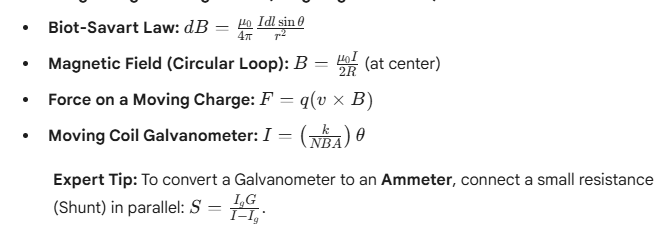
Key Formulas of Moving Charges & Magnetism
(Weightage: 17 Marks):
01 00 PM IST - 19 Feb'26
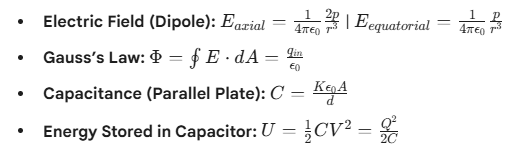
Important Formulas of Electrostatics & Capacitance
(Weightage: 16 Marks):
12 30 PM IST - 19 Feb'26
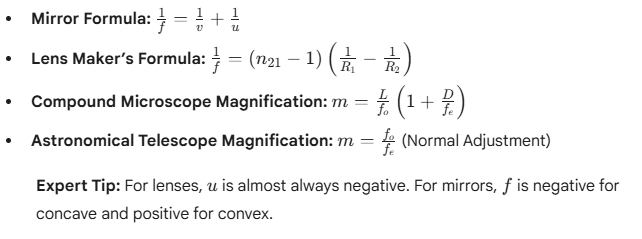
Ray Optics & Optical Instruments Formula Cheet Sheet
(Weightage: 18 Marks):
12 00 PM IST - 19 Feb'26
Final Topic Round Up: The "Magnificent Seven"
Ensure you have ticked off these seven "Confirm" topics:
- Gauss’s Law Applications
- Kirchhoff’s Law Numericals
- Ampere’s Circuital Law
- Lens Maker’s Formula
- YDSE Fringe Width
- Einstein’s Photoelectric Equation
- P-N Junction Diode (Rectifiers)
11 30 AM IST - 19 Feb'26
ALTERNATING CURRENT: The "Q-Factor" and Sharpness
The Quality Factor (Q-factor) of a series LCR circuit represents the sharpness of resonance. A higher Q-factor means better selectivity. Remember the formula: Q= 1/R √L/C
11 00 AM IST - 19 Feb'26
ELECTROMAGNETIC WAVES: The Easy 3 Marks
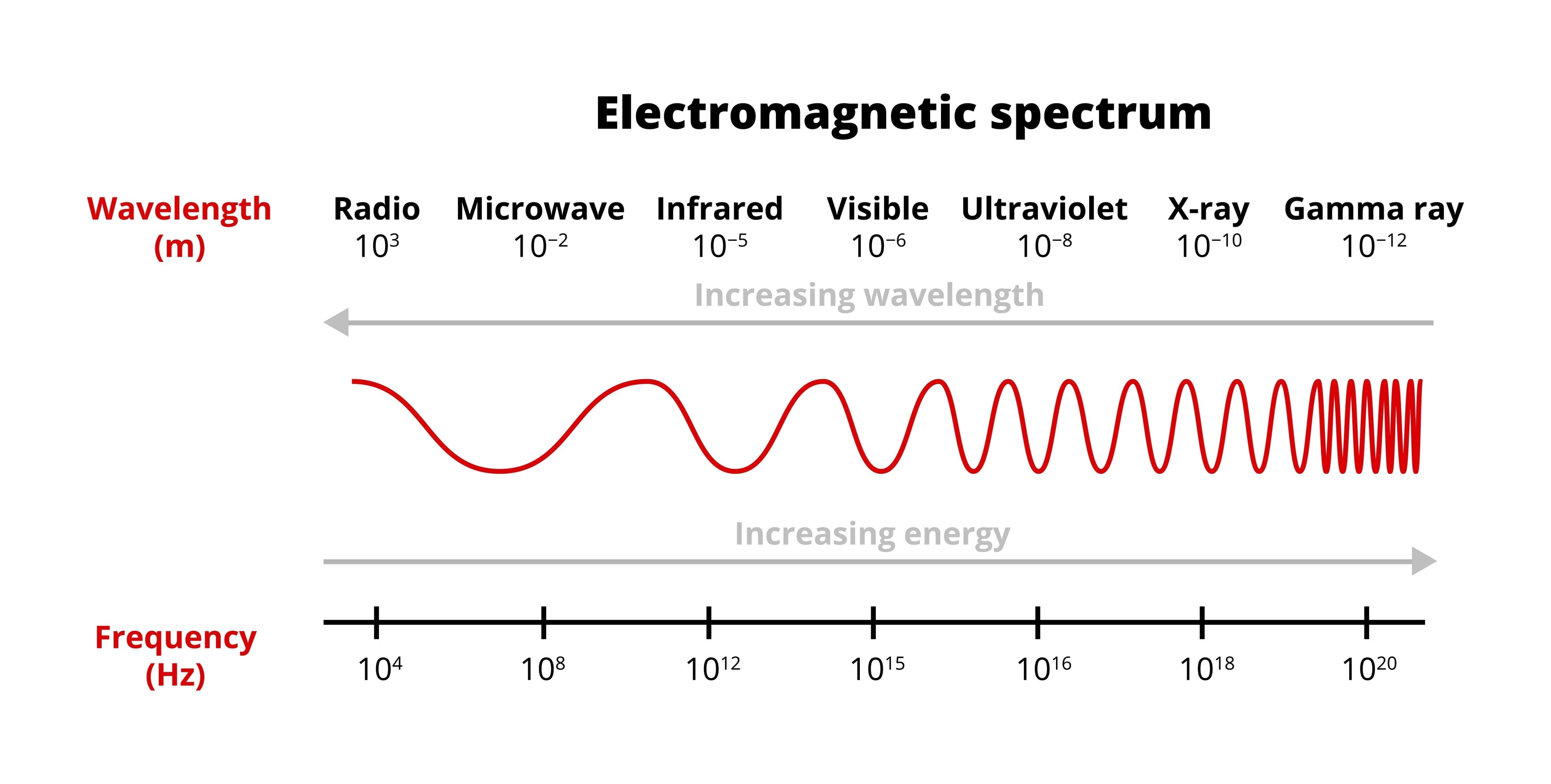
The EM Waves unit is small but scoring. Memorize the Electromagnetic Spectrum in order of frequency/wavelength. Focus on the production and use of Infrared (remote controls), Microwaves (RADAR), and X-rays (medical imaging).
10 30 AM IST - 19 Feb'26
Post Mock Analysis: Fix the "Silly Errors"
Done with your practice paper? Don't just check the score. Look at why you lost marks. Was it a calculation error? Did you miss a ray diagram arrow? Or did you forget to mention the direction of the Magnetic Field? Fix these now so you don't repeat them tomorrow.
10 00 AM IST - 19 Feb'26
Numerical Hack: The "Given-Formula-Answer" Method
Even if you get the final calculation wrong, CBSE awards Step Marks.
- Write "Given" values with units.
- State the Formula clearly.
- Show the substitution. This ensures at least 1.5/2 or 2/3 marks even without a final result.
09 30 AM IST - 19 Feb'26
WAVE OPTICS: Diffraction vs. Interference
Don't get confused! Remember: Interference is the superposition of waves from two coherent sources (Young's Slit), while Diffraction is from a single source (Single Slit). In Diffraction, the central fringe is twice as wide as the others.
09 00 AM IST - 19 Feb'26
CASE-STUDY Prediction: Look into Unit III and VI
Based on current trends, the Case-Study questions (Section D) for 2026 are likely to be sourced from Ray Optics (Optical instruments) or Moving Charges and Magnetism (Cyclotron/Velocity selector principles). Read the NCERT "blue boxes" for these chapters today.
08 30 AM IST - 19 Feb'26
Section-wise Time Management: The Expert Clock
To finish the 70-mark paper comfortably, aim for this timeline:
- Section A (MCQs): 30 minutes
- Section B (2-markers): 30 minutes
- Section C (3-markers): 45 minutes
- Section D (Case Study): 20 minutes
- Section E (5-markers): 45 minutes
- Buffer/Revision: 10 minutes
08 00 AM IST - 19 Feb'26
The "MOCK EXAM" Window: Simulate the Real Deal
Starting now? Set a timer for 3 hours. Solve a full sample paper or the 2025 previous year paper. This is not just about the questions; it is about training your brain to stay focused during the exact window of the actual exam tomorrow.
07 00 AM IST - 19 Feb'26
Wave Optics: Calculating Fringe Width in YDSE
The CollegeDekho team reminds students that Fringe Width β= γD/d is a constant for all fringes in interference. However, in Diffraction, the central maximum is twice as wide as the secondary maxima. Know the difference!
06 00 AM IST - 19 Feb'26
OPTICS FORMULA GOLDMINE: Lens Maker’s and Thin Lens Equations
For Ray Optics, the Lens Maker’s Formula
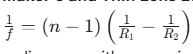 is the highest-probability derivation. Expert Tip: Always draw your ray diagrams with arrows indicating the direction of light, or you risk losing full marks on the question.
05 00 AM IST - 19 Feb'26
EMI & AC: The Resonance and RMS Relationship
The most critical formula in Unit 4 is the Peak vs. RMS value (Vrms = V0/ √2). CollegeDekho experts warn: always check if a numerical gives you the "Peak Voltage" or just "Voltage"—if not specified, assume it is RMS.
04 00 AM IST - 19 Feb'26
MAGNETISM FORMULA ALERT: Moving Charges and Force Equations
The CollegeDekho team highlights the Force on a moving charge (F = qvB sin θ) Remember, if θ = 90 degree, the path is circular; if it’s an acute angle, the path is helical. Don't skip the formula for the Magnetic Moment of a revolving electron: μ = evr/2.
03 00 AM IST - 19 Feb'26
CURRENT ELECTRICITY: Kirchhoff’s Laws are the Numerical Backbone
Expert Tip: When applying Kirchhoff’s Loop Rule (ΣV = 0), consistency in sign convention is more important than the direction you choose. Master the relation V = E - Ir for cells in discharge; it’s a frequent 2-mark numerical favorite.
02 00 AM IST - 19 Feb'26
Master The Electrostatics Triad: Flux, Potential, And Capacitance
The CollegeDekho team emphasizes that Unit 1 is formula-heavy. Ensure you have Gauss’s Law (θ = q/∊0) and the Potential Energy of a dipole (U = -pE cos θ) memorized. For Capacitance, remember that adding a dielectric constant K increases capacitance to C = KC0
01 00 AM IST - 19 Feb'26
CBSE Class 12 Physics 2026 Practice Questions 7
A compound microscope consists of an objective lens of focal length 0.82 cm and an eyepiece lens of focal length 2.9 cm. An object is placed 0.91 cm from the objective lens. The image is formed at the near point (25 cm) from the eye. (I) Calculate that the angular magnification of the microscope. (II) Draw the ray diagram of compound microscope in normal adjustment
12 00 AM IST - 19 Feb'26
Class XII Physics 2026 CBSE Practice Questions 6
Draw the reflected wave front for a plane wave front incident on a plane reflecting surface. Hence verify the laws of reflection using Huygen’s principle.
For VI Candidates:
(I) Define wave front? (II) Define wavelet? (III) What will be the shape of the wave front intercepted by a large reflecting type telescope on earth, due to a star far-away from our solar system?
11 00 PM IST - 18 Feb'26
CBSE 12th Physics 2026 Practice Question 5
A solenoid has a core of material with relative permeability 200. The windings of the solenoid are insulated from the core and carry a current of 1A. If the number of turns is 2000 per metre, calculate (A) magnetic intensity, (B) magnetic field & (C) magnetisation
10 30 PM IST - 18 Feb'26
NUMERICAL DRILL: The Power of Approximation
When solving for 1/ ε0 or √LC, don't get stuck in deep decimals. Use rounding to check if your answer is in the right "Order of Magnitude." This saves precious time during the actual paper.
10 00 PM IST - 18 Feb'26
SEMICONDUCTORS: The Logic Gate Checklist
Quickly sketch the truth tables for AND, OR, NOT, NAND, and NOR gates. NAND and NOR are "Universal Gates"—be prepared for a question asking you to realize basic gates using only these two.
09 40 PM IST - 18 Feb'26
REST IS A SCORE-BOOSTER: The Science of Sleep
Expert Tip: Staying awake all night leads to "Equation Scrambling" during the exam. Your brain needs at least 6 hours of sleep to move the formulas you studied today from short-term to long-term memory. Shut down the books and recharge.
09 20 PM IST - 18 Feb'26
Class 12th CBSE Physics Practice Question 4
Q: When an external voltage is applied across a semiconductor diode such that p-side is connected to the positive terminal of the battery and n-side to the negative terminal it is said to be forward biased. The applied voltage mostly drops across the depletion region and the voltage drop across the p-side and n-side of the junction is negligible. When an external voltage is applied across the diode such that n-side is positive and p-side is negative, it is said to be reverse biased. The applied voltage mostly drops across the depletion region.
09 00 PM IST - 18 Feb'26
Class 12th CBSE Physics Practice Question 3
(A) Derive lens maker’s formula.
(B) Equi-convex lenses are to be manufactured from a glass of refractive index 1.55, with both faces of the same radius of curvature. What is the radius of curvature required if the focal length is to be 10cm?
08 40 PM IST - 18 Feb'26
AC CIRCUITS: The Resonance Factor
As you wrap up, review the LCR Circuit. Focus on the condition for resonance (XL = XC) and the power factor (cos θ). Remember, at resonance, the circuit is purely resistive, and the power factor is maximum (equal to 1).
08 20 PM IST - 18 Feb'26
CBSE XII Physics 2026 Practice Question 2
(A) State the working principle of a moving coil galvanometer? What modification
is required in the galvanometer to make its scale linear?
(B) If a galvanometer of resistance 49.5Ω has range of 0.05A. What will be the
value of resistance needed to convert it in ammeter of range 5A?
(C) How these two resistors should be connected to galvanometer in both cases?08 00 PM IST - 18 Feb'26
WAVE OPTICS: Huygens’ Principle & Wavefronts
A common 3-mark question involves drawing the shape of a wavefront after refraction through a prism or a thin convex lens. Remember: a point source gives a spherical wavefront, while a distant source (at infinity) gives a plane wavefront.
07 40 PM IST - 18 Feb'26
CBSE Class 12 Physics 2026: Practice Question 1
If a charged hollow sphere and a solid sphere of aluminum and copper of equal radii
are in electrostatic equilibrium, then which of the following statements is true?
(A) Both the spheres are having equal charges.
(B) The hollow sphere will have more charge than solid sphere at its surface.
(C) The aluminum sphere will have more charge on its surface than copper sphere.
(D) If hollow sphere is also made up of aluminum then it will have more charge.07 20 PM IST - 18 Feb'26
Magnetism Refresher: The Right-Hand Rules
It's crucial to distinguish between the Right-Hand Thumb Rule and Fleming’s Left-Hand Rule. The Right-Hand Thumb Rule helps determine the direction of the magnetic field around a current-carrying conductor by pointing your thumb in the current's direction. In contrast, Fleming’s Left-Hand Rule identifies the force on a conductor in a magnetic field, using your left hand to align the thumb with force, the index finger with the magnetic field, and the middle finger with the current.
07 00 PM IST - 18 Feb'26
The "FORMULA FLUSH" Strategy
Before sleeping, spend 30 minutes writing down all constants and formulas from Units 1 to 4. Writing them down from memory is the best way to identify "knowledge gaps."
Don't forget the value of:

06 40 PM IST - 18 Feb'26
ASSERTION-REASONING: How to tackle the trickiest section?
Section A will feature several Assertion-Reasoning questions. The "Expert Hack": Read the Assertion, then add the word "BECAUSE" before reading the Reason. If the logic flows naturally, you’ve likely found your answer.
06 20 PM IST - 18 Feb'26
Semiconductors: Focus on Logic Gates and Rectifiers
For the Electronic Devices unit, pay close attention to the p-n junction diode characteristics in forward and reverse bias. The circuit diagram for a full-wave rectifier is a high-probability 3-mark question for the 2026 paper.
06 00 PM IST - 18 Feb'26
Modern Physics: The "Scoring Zone"
If you are feeling overwhelmed, switch to Atoms, Nuclei, and Semiconductors. These chapters carry 19 marks total and are largely theoretical and formula-based. They take less time to revise but offer a high return on investment (ROI).
05 40 PM IST - 18 Feb'26
Electrostatics Check: Gauss’s Law and its Applications
Don't just memorize the statement of Gauss's Law. The 2026 paper is expected to feature a conceptual application involving an infinite line charge or a uniformly charged thin spherical shell. Be ready to explain the field both inside and outside the shell.
05 20 PM IST - 18 Feb'26
Diagram Strategy: Why pencil work wins
In Physics, your diagram is your first impression. Examiners are instructed to give credit for neat, labeled diagrams even if the derivation has minor errors. Pro-tip: Always use a sharpened pencil and a ruler for ray diagrams and circuit symbols.
05 00 PM IST - 18 Feb'26
The "0.5 MARK" Trap: The importance of SI Units
A common mistake that lowers the scores of even top-tier students is omitting SI Units. Whether it’s $Tesla$ for Magnetic Field or $Farads$ for Capacitance, a missing unit means an automatic deduction of 0.5 marks. Make it a habit to double-check units as you solve numericals today.
04 40 PM IST - 18 Feb'26
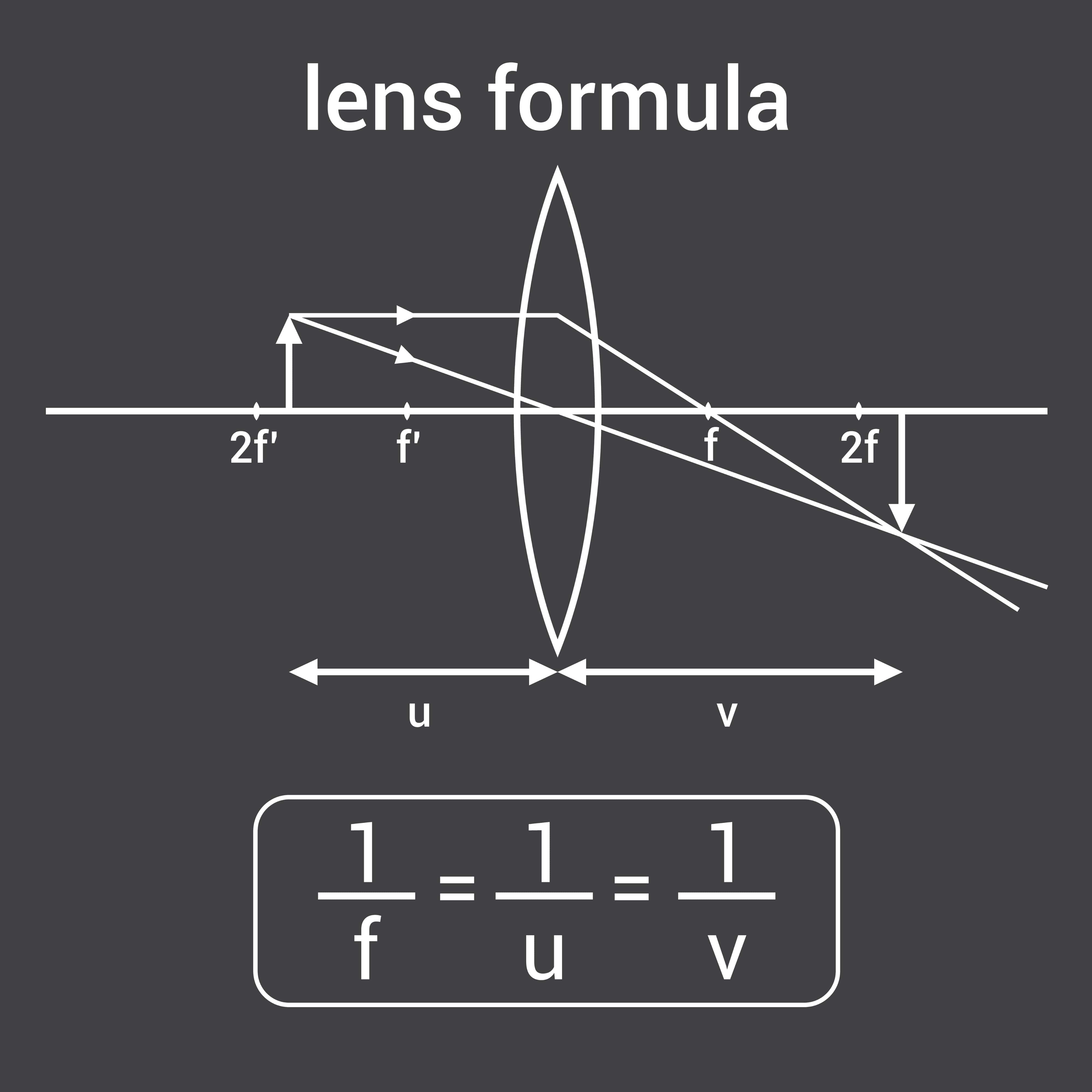
Optics ALERT: The Lens Maker’s Formula is Non-Negotiable
Expert analysis of previous papers suggests that the Lens Maker’s Formula and Young’s Double Slit Experiment (YDSE) are the most frequent 5-mark questions. Practice these derivations twice tonight to ensure your diagrams and sign conventions are flawless.
04 20 PM IST - 18 Feb'26
The 70 Marks Blueprint: Where the marks are hidden?
As per the marking scheme, Unit VI (Optics) remains the king of the paper with 18 marks. Following closely are Magnetic Effects (17 marks) and Electrostatics (16 marks). If you master these three units, you've already covered over 70% of the theory marks!
04 00 PM IST - 18 Feb'26
THE KICK-OFF: 48 Hours to CBSE Class 12 Physics Exam 2026
The countdown for the most anticipated science paper has begun! With only two days left for the CBSE Class 12 Physics exam (Subject Code: 042), students are advised to shift from "Learning" mode to "Refinement" mode. Focus today should be on the heavyweights: Optics and Electrostatics.