 CBSE Class 12 Political Science 2026 Answer Key LIVE
CBSE Class 12 Political Science exam for 2026 was successfully held today, i.e. on March 23, 2026. The theory paper was held in a single morning shift from 10:30 AM to 1:30 PM . This 80-mark examination is paired with a 20-mark internal assessment or project work, making for a total of 100 marks. You need at least 26 marks in theory and 6 marks in internals to pass.
This year’s paper followed the updated NEP 2020 guidelines, shifting the focus to competency-based learning rather than just memorizing facts. About 50% of the questions appeared in the exam to test your application skills through MCQs, case studies, and source-based tasks. The syllabus was split into two parts: Contemporary World Politics and Politics in India Since Independence, each carrying 40 marks. The CBSE Class 12 Political Science answer key 2026 will be shared here soon.
CBSE Class 12 Political Science 2026 Answer Key
The CBSE Class 12 Political Science Answer Key 2026 has been shared below:Question | Correct Answer |
|---|---|
Section A | |
1) Nuclear Non-Proliferation Treaty refers to? | D) Reduction of nuclear weapons stockpiles |
2) Match the following: |
Violation of Human Rights - Iraq's invasion of Kuwait
|
3) Choose the statement that best describes the concept of globalisation | A) The process of rapid integration or inter-connection among countries of the world through the flow of goods, capital, people and ideas |
4) Identify the political party which has had continuous growth in its Lok Sabha seats in the General Elections from 2009 to 2019 | B) BJP |
5) Choose the correct answers
| A) Both Statement I and Statement II are true |
6) Which measure was adopted by China to solve its economic crisis? | C) China opened its economy for privatisation step by step for the development of its economy. |
7) Which led to the formation of Andhra State in 1952? | C) Death of Congress leader Potti Sriramulu, which caused great unrest and led to the resignation of several legislators of Madras in protest |
8) Choose the name of PM who abolished the 'Privy Purse' | D) Indira Gandhi |
9) Arrange in chronological order | C) (iv), (ii), (i), (iii) |
10) Which statement is NOT correct about the princely states? | B) All the princely states had accepted to be an integral part of India after the end of British rule. |
11) Identify the State with which the phrase 'Aaya Ram, Gaya Ram' is related to? | C) Haryana |
12) Given below are two statements marked ----- given below | C) Assertion is false, but Reason is true |
CBSE Class 12 Political Science 2026 Paper Analysis
Students felt the paper was from NCERT but a bit lengthy. MCQs were a little difficult, but the Map and Cartoons were direct. The exam was data-heavy, but the long answer questions were doable.CBSE Class 12 Political Science 2026 Exam Quick Facts
Some of the details and facts related to the CBSE Class 12 Political Science 2026 can be found below:
Aspect | Details |
|---|---|
Exam Date | March 23, 2026 |
Exam Time | 10:30 AM to 1:30 PM |
Sections | Parts A, B, C, D & E |
Questions and Marking Scheme |
|
Max Marks | 80 Marks |
The exam had 1 mark, 2 mark, 4 mark and 6 mark problems with no penalty for incorrect or unattempted questions.
For more such information on CBSE Class 12 Political Science 2026 answer key, keep reading our LIVE blog below.
CBSE Class 12 Political Science 2026 Exam LIVE
02 20 PM IST - 23 Mar'26
Answer Key & Analysis Released
The solved question paper and exam analysis of CBSE Class 12 Political Science 2026 Exam have been released! The exam was Moderate and a bit lengthy to attempt.
01 45 PM IST - 23 Mar'26
Unofficial Answer Key & Paper Analysis Coming Up Soon
The unofficial answer key and detailed paper analysis for the CBSE Class 12 Political Science exam will be available shortly. Students can check answers, evaluate their performance, and understand the difficulty level of the paper. Stay tuned to this LIVE blog!
01 30 PM IST - 23 Mar'26
CBSE Class 12 Political Science 2026 Exam Ends
The Class 12 Political Science exam has now concluded. Students are now coming out of their exam centres. It is time to relax and take a break after your efforts.
12 30 PM IST - 23 Mar'26
Final Hour of the Exam
The exam is now in its final phase. Students are completing their answers as the end time approaches.
11 30 AM IST - 23 Mar'26
Exam in Full Swing
The exam is underway smoothly. Students are engaged in writing their answers as per the given time duration.
10 30 AM IST - 23 Mar'26
CBSE Class 12 Political Science 2026 Exam Starts
The Class 12 Political Science exam has started. Students have begun attempting the question paper at centres across the country.
10 00 AM IST - 23 Mar'26
Thirty Minutes Left for the Exam!
Students have been seated inside exam halls across centres. Invigilators are completing formalities before the distribution of question papers.
09 00 AM IST - 23 Mar'26
Students Reaching Exam Centres
Students are now arriving at their allotted exam centres. Entry procedures and verification are being carried out at multiple locations.
08 00 AM IST - 23 Mar'26
Students Leaving Their Homes
Students have started leaving their homes to appear for the Political Science exam. Many are accompanied by parents as they head towards their respective exam centres.
07 00 AM IST - 23 Mar'26
Morning Traffic Alert!
Students appearing for the exam should plan their travel carefully. Morning traffic in many areas may cause delays, so it is better to leave early.
06 00 AM IST - 23 Mar'26
Political Science Exam Timings Reminder
Your exam will begin at 10:30 AM. Make sure you reach the exam centre by 9:30 and follow all instructions carefully. Do not forget to carry your admit card, required stationery, and follow all guidelines issued by the board.
05 00 AM IST - 23 Mar'26
Good morning, students! Exam Day is Here
Good morning, students. Your Class 12 Political Science exam day has finally arrived. Start your day with a calm and positive mindset.
04 00 AM IST - 23 Mar'26
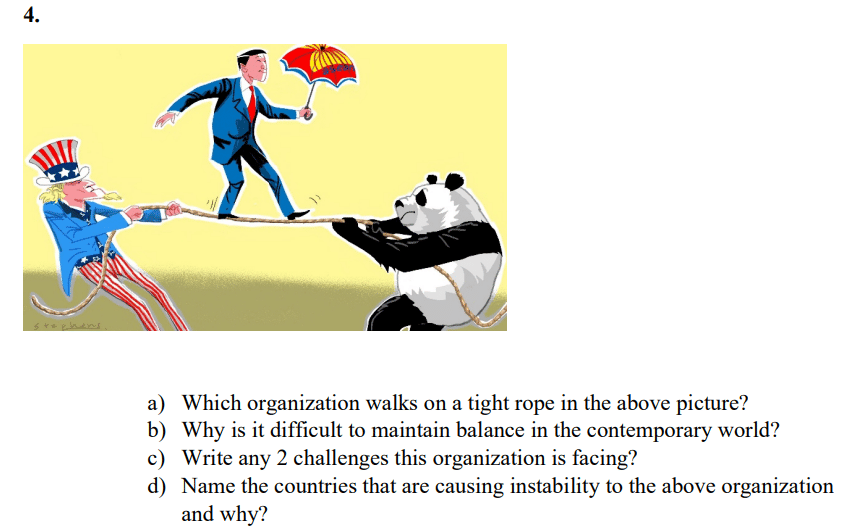
Cartoon-Based Practice Question 4
Below is another cartoon-based question for you to practice:
03 00 AM IST - 23 Mar'26
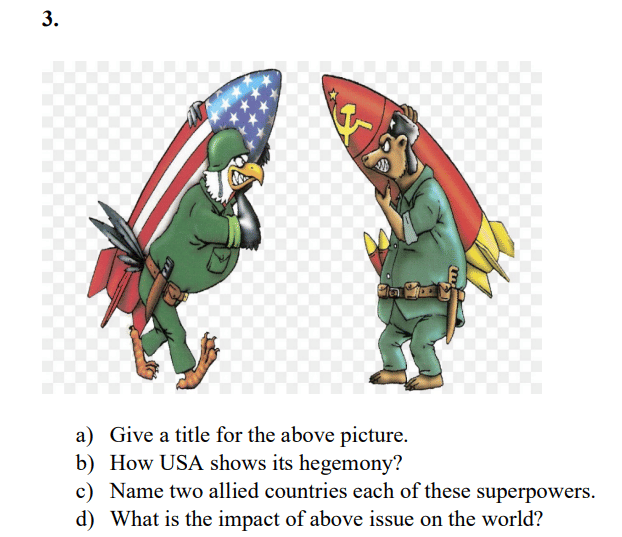
Cartoon-Based Practice Question 3
Solve the cartoon-based question given below:
02 00 AM IST - 23 Mar'26
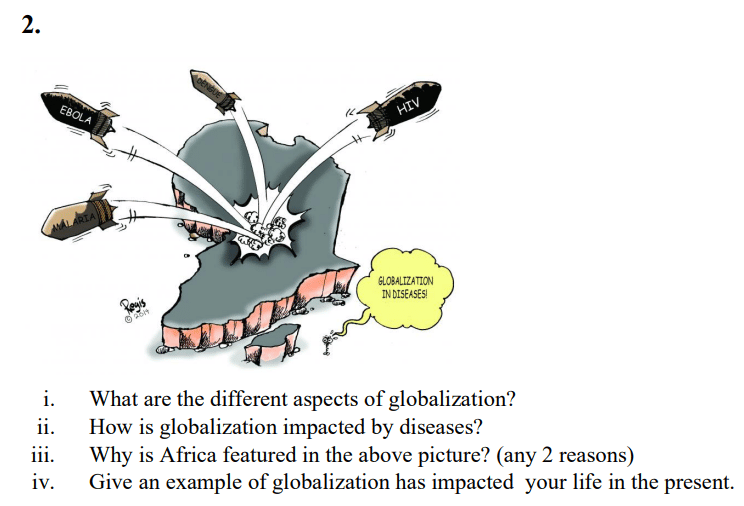
Cartoon-Based Practice Question 2
You can check another cartoon-based question to practice below:
01 00 AM IST - 23 Mar'26
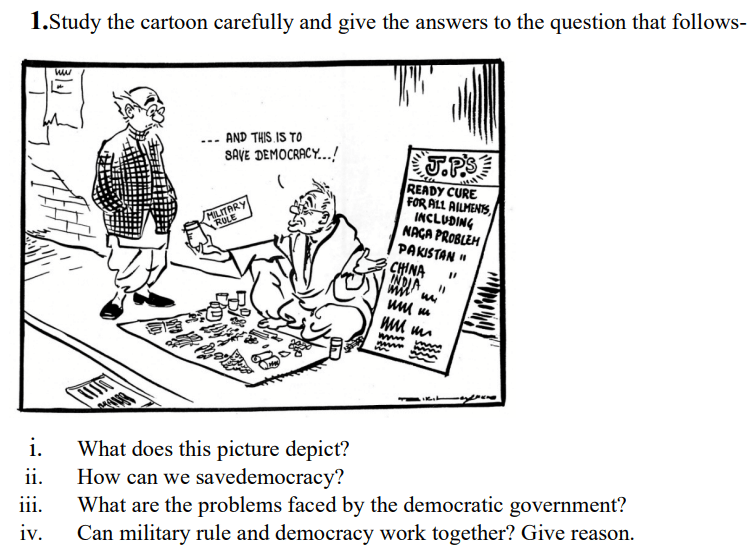
Cartoon-Based Practice Question 1
An important cartoon-based question to practice is given below:
12 00 AM IST - 23 Mar'26
Cartoon-Based Practice Questions
In the coming updates, we will cover important cartoon-based questions for Class 12 Political Science. These questions test your understanding of political situations and usually carry good marks in the exam.
11 30 PM IST - 22 Mar'26
What not to do right now?
Do not start any new chapter or topic. Avoid discussing preparation with others if it creates stress. Do not stay up too late. Stay calm, avoid panic, and get proper sleep before the exam.
11 00 PM IST - 22 Mar'26
Essentials Checklist for the exam tomorrow
- Admit card printed and kept in your bag
- School ID card (if required)
- 2 to 3 blue pens (working properly)
- 1 extra pen for backup
- Pencil, eraser, and sharpener
- Transparent pouch for stationery
- Watch (if allowed in exam hall)
- Water bottle (transparent, if required)
- Handkerchief or tissues
- Exam centre checked and route planned
- Uniform or clothes kept ready
- Bag packed and placed near the door
- Alarm set for tomorrow morning
10 30 PM IST - 22 Mar'26
Political Science Sample Paper Solutions
Get the detailed solutions and marking scheme for the Political Science Sample Paper here. These solutions will help you understand answer writing and improve your preparation.
10 00 PM IST - 22 Mar'26
CBSE Class 12 Political Science Sample Paper
Download the latest CBSE Class 12 Political Science Sample Paper here. Practice it to understand the exam pattern, types of questions, and marking scheme.
09 30 PM IST - 22 Mar'26
What did the Second Five-Year Plan stress upon?
The Second Five-Year Plan stressed on the development of heavy industries and industrialisation. Its aim was to build a strong industrial base in the country for long-term economic growth.
09 00 PM IST - 22 Mar'26
Who was the main architect of the Second Five-Year Plan?
The main architect of the Second Five-Year Plan was P. C. Mahalanobis.
08 45 PM IST - 22 Mar'26
Goals of national movement achieved after independence
- India established a democratic system of government by adopting its Constitution. People were given the right to vote and elect their representatives, which fulfilled the idea of self rule.
- The country also became a secular state, where all religions are treated equally. Citizens were given the freedom to follow any religion of their choice.
- Another important achievement was national unity and integration. Despite diversity in language, culture, and region, India remained united as a single nation.
- India also focused on economic development through planned growth. The government introduced Five Year Plans to improve agriculture, industry, and overall development.
08 30 PM IST - 22 Mar'26
Indira Gandhi & Poverty Question
Highlight any two steps taken by Indira Gandhi to remove poverty.
Indira Gandhi took several steps to reduce poverty in India.
- She was responsible for the nationalisation of banks in 1969. This helped in providing loans to farmers, small industries, and poor sections of society, which supported economic development.
- Another step was the introduction of the “Garibi Hatao” program, which focused on reducing poverty and improving the living conditions of the poor.
These measures helped in addressing poverty and gaining support from weaker sections of society.
08 15 PM IST - 22 Mar'26
Outcomes of the Rio Summit
The Rio Summit, also known as the Earth Summit held in 1992, had several important outcomes for environmental protection and sustainable development.
- One of the outcomes was Agenda 21, which is a plan of action for sustainable development to be followed by countries at the global, national, and local levels.
- Another was the Convention on Biological Diversity (CBD), which aimed to protect biodiversity and ensure the sustainable use of natural resources.
- The summit also led to the United Nations Framework Convention on Climate Change (UNFCCC), which focused on reducing greenhouse gas emissions and addressing climate change.
- Additionally, the Rio Declaration on Environment and Development was adopted, which laid down principles for sustainable development and emphasized the responsibility of countries to protect the environment.
08 00 PM IST - 22 Mar'26
Threats to the survival of Indigenous people
Indigenous people face several serious threats to their survival due to modern development and global changes:
- One is the loss of land and forests. Large scale projects like mining, dams, and industrial activities often displace indigenous communities from their traditional habitats, affecting their livelihood.
- Another threat is the loss of culture and identity. With increasing contact with outside societies, their languages, traditions, and customs are slowly disappearing.
- They also face economic exploitation and poverty, as they are often not given fair compensation or opportunities for development.
- There is lack of political representation and rights, which makes it difficult for them to protect their interests and resources.
07 45 PM IST - 22 Mar'26
Map-Based Practice Question - 3
In the given Political outline map of India, four states have been marked as (A), (B), (C) and (D). Identify these states on the basis of the information given below:
(i) The state where a coalition called the SVD with the two socialist parties SSP and the PSP came to power after 1967 election.
(ii) The state where Congress did not get the majority but formed government with the help from others.
(iii) The state associated with the defection in 1967 election.
(iv) K.Kamraj was the Chief Minister of this state.
07 30 PM IST - 22 Mar'26
Map-Based Practice Question - 2
In the given Political outline map of India, four states have been marked as (A), (B), (C) and (D). Identify these states on the basis of the information given below:
(i) The State related to former Prime Minister Chaudhary Charan Singh.
(ii) The State to which former Deputy Prime Minister Jagjivan Ram belonged.
(iii) The State where the Naxalites were very active.
(iv) A State where the Congress party could not win even a single seat in the Lok Sabha elections in 1977.
07 15 PM IST - 22 Mar'26
Map-Based Practice Question - 1
In the given Political outline map of India, four states have been marked as (A), (B), (C) and (D). Identify these states on the basis of the information given below:
(i) The Princely State whose ruler resisted its merger with India.
(ii) The State that was most affected by the partition of the country.
(iii) The State carved out from Madhya Pradesh.
(iv) The State that was formed in 1952.
07 00 PM IST - 22 Mar'26
Map-Based Question Coming Up
Get ready to practice important map-based questions for Class 12 Political Science. These questions are often asked in the exam.
06 45 PM IST - 22 Mar'26
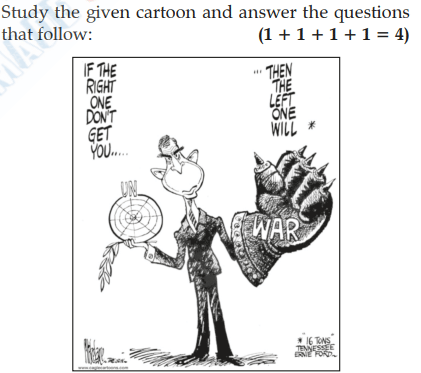
Another Cartoon-Related Question
What is the primary objective of UNO?
(A) To foster economic ties of the developed nations
(B) To promote international peace and cooperation
(C) To eradicate terrorism
(D) To promote health care
06 30 PM IST - 22 Mar'26
Some More Cartoon-Related Questions
What message is given by the cartoon?
(A) If UN fails then the US can control the world by its military power.
(B) Economic superiority of US
(C) Veto power of permanent members of UN
(D) US is the largest contributor to UN
Why this cartoon is not relevant today?
(A) UN has become more powerful.
(B) Many new powerful international organisations have emerged.
(C) Countries are not having faith in UN.
(D) Now many new centres of power have emerged.
06 15 PM IST - 22 Mar'26
Cartoon-Related Questions
What does the cartoon depict?
(A) Influence of UNO on the World
(B) Influence of USA on UNO
(C) Relevance of UNO
(D) Influence of USA on the World
06 00 PM IST - 22 Mar'26
Cartoon-Based Question
You can study the cartoon given below before moving to the questions:
05 45 PM IST - 22 Mar'26
6-Mark Practice Questions - 8
- Describe any three major developments that took place in Indian politics in the last decade of the 20th century.
- Describe any three recommendations of the Mandal Commission to solve the problems of the other backward classes.
05 30 PM IST - 22 Mar'26
6-Mark Practice Questions - 7
- “The foreign policy of Independent India has pursued the dream of a peaceful world.” Support the statement with three suitable arguments.
- “India played an important role in maintaining Afro-Asian Unity.” Support the statement with three suitable examples.
05 15 PM IST - 22 Mar'26
6-Mark Practice Questions - 6
- Explain any three security challenges faced by the newly independent countries of Asia and Africa after the Second World War.
- Explain any three differences between the Non-traditional and traditional notions of security.
05 00 PM IST - 22 Mar'26
6-Mark Practice Questions - 5
- Explain any two contentious issues between China and India. Suggest any two measures to resolve these issues for greater cooperation.
- “ASEAN took steps to establish an ASEAN community on the basis of its three pillars.” Explain the importance of these three pillars.
04 45 PM IST - 22 Mar'26
Environment and Natural Resources Question - 2
Name any four greenhouse gases.
Four important greenhouse gases are carbon dioxide, methane, nitrous oxide, and chlorofluorocarbons (CFCs).04 30 PM IST - 22 Mar'26
Environment and Natural Resources Question - 1
Suggest any four steps for the Indian Government to take to check the pollution and save the environment.
The Indian Government can take several effective steps to control pollution and protect the environment:
- They should promote the use of renewable sources of energy such as solar and wind energy. This will reduce dependence on fossil fuels and decrease pollution levels.
- Another step is to implement strict laws and regulations against industries that cause pollution. Proper monitoring and penalties can help control harmful emissions.
- The government should also encourage afforestation and protect forests, as trees help in reducing air pollution and maintaining ecological balance.
- It is important to create public awareness about environmental protection. Educating people about reducing waste, recycling, and conserving resources can bring long-term positive change.
04 15 PM IST - 22 Mar'26
Political Consequences of Globalisation
Globalisation has had several important political consequences for countries around the world.
- One of them is the reduction in the power of the state in some areas. Governments now have to consider global markets and international institutions while making decisions, which limits their full control.
- At the same time, globalisation has led to the rise of international organisations like the United Nations, WTO, and others, which influence global policies and decision-making.
- Another consequence is the increase in cooperation among countries. Nations work together on issues like climate change, security, and trade.
However, globalisation has also led to the rise of resistance movements. Some groups oppose globalisation because they believe it increases inequality and affects local cultures and economies.
04 00 PM IST - 22 Mar'26
Causes of Globalization
Globalisation refers to the increasing interconnectedness of countries through trade, technology, and communication.
- One major cause of globalisation is the development of technology, especially in communication and transportation. The internet, mobile phones, and faster transport have made it easier for countries to connect and do business.
- Another important cause is the liberalisation of economies. Many countries reduced trade barriers, opened their markets, and allowed foreign investment, which increased global trade and economic interaction.
- The role of international organisations has also been significant. Institutions like the IMF and World Bank encouraged countries to adopt open economic policies and integrate with the global economy.
- Also, the growth of multinational corporations has contributed to globalisation. These companies operate in multiple countries and promote the flow of goods, services, and capital across borders.
03 45 PM IST - 22 Mar'26
Solved Statement-Based Question - 4
Question: Given below are two statements regarding the dissolution of the Soviet Union:
Statement-I: The collapse of the ‘Second World’ of the Soviet Union and the socialist system in Eastern Europe had no profound consequences for world politics.
Statement-II: The end of the Soviet bloc meant the emergence of many new countries. All these countries had their own independent aspirations and choices.
Options:
(A) Both Statement-I and Statement-II are true.
(B) Both Statement-I and Statement-II are false.
(C) Statement-I is true, but Statement-II is false.
(D) Statement-I is false, but Statement-II is true.
Correct Answer: (D) Statement-I is false, but Statement-II is true.
03 30 PM IST - 22 Mar'26
Solved Statement-Based Question - 3
Question: Given below are two statements regarding the political history of the Maldives:
Statement-I: The Maldives was a Sultanate till 1965. In 1965, it was transformed into a republic with a presidential form of government.
Statement-II: The Maldivian Democratic Party (MDP) dominates the political affairs of the island and it won the 2018 elections.
Options:
(A) Both Statement-I and Statement-II are true.
(B) Both Statement-I and Statement-II are false.
(C) Statement-I is true, but Statement-II is false.
(D) Statement-I is false, but Statement-II is true.
Correct Answer: (D) Statement-I is false, but Statement-II is true.
03 15 PM IST - 22 Mar'26
Solved Statement-Based Question - 2
Question: Given below are two statements regarding the political history of Pakistan:
Statement-I: Pakistan formed an elected government under the leadership of Zulfikar Ali Bhutto which lasted from 1971 to 1977.
Statement-II: The Zulfikar Ali Bhutto government was removed by General Pervez Musharraf in 1977.
Options:
(A) Both Statement-I and Statement-II are true.
(B) Both Statement-I and Statement-II are false.
(C) Statement-I is true, but Statement-II is false.
(D) Statement-I is false, but Statement-II is true.
Correct Answer: (C) Statement-I is true, but Statement-II is false.
03 00 PM IST - 22 Mar'26
Solved Statement-Based Question - 1
Question: Given below are two statements regarding the political history of Nepal:
Statement-I: Nepal was a Hindu Kingdom in the past and then a constitutional monarchy in the modern period for many years.
Statement-II: The struggling pro-democracy forces achieved their first major victory in 2006 when the king was forced to restore the House of Representatives.
Options:
(A) Both Statement-I and Statement-II are true.
(B) Both Statement-I and Statement-II are false.
(C) Statement-I is true, but Statement-II is false.
(D) Statement-I is false, but Statement-II is true.
Correct Answer: (A) Both Statement-I and Statement-II are true.
02 45 PM IST - 22 Mar'26
6-Mark Questions from J&K Topic
- Analyse any three reasons for the disturbance and unrest in Kashmir.
- Suggest any three measures to maintain peace in Jammu and Kashmir.
02 30 PM IST - 22 Mar'26
Jammu & Kashmir Questions
It is important to understand both the past and present situation of Jammu and Kashmir. Questions from this topic are often asked in the exam, so focus on important events, changes, and current developments for better preparation.
02 15 PM IST - 22 Mar'26
Another Congress Party Question
Analyse the Congress Party as an ideological coalition.
The Congress Party acted as an ideological coalition because it included leaders with different ideologies, such as conservatives, socialists, and centrists. These groups worked together within the same party, making it a broad platform for diverse political ideas.
02 00 PM IST - 22 Mar'26
Congress Party Question
Analyse the Congress Party as a social coalition.
The Congress Party acted as a social coalition because it brought together people from different social groups such as castes, classes, religions, and regions. It included both rich and poor, urban and rural groups, which helped it gain wide support across the country.
01 45 PM IST - 22 Mar'26
Reasons for Split in the Congress Party in 1969
The split in the Congress Party in 1969 was an important event in Indian politics. It led to the division of the party into Congress (O) and Congress (R), under the leadership of Indira Gandhi.
One big reason was the conflict between Indira Gandhi and the senior leaders, known as the Syndicate. The Syndicate wanted to control party decisions, while Indira Gandhi wanted to assert her own authority, which created a power struggle within the party.
Another reason was the difference in ideology and policies. Indira Gandhi supported more radical and pro-poor measures like bank nationalisation, while the Syndicate preferred conservative economic policies. This led to growing differences.
The Presidential election of 1969 also played a key role. Indira Gandhi supported V. V. Giri as an independent candidate, while the official Congress candidate was N. Sanjiva Reddy. This open defiance of party leadership deepened the division.
Lastly, the issue of party discipline and leadership control contributed to the split. Indira Gandhi was expelled from the party by the Syndicate, after which she formed her own faction.
01 30 PM IST - 22 Mar'26
Secessionist Movement of the people of Mizo Hills area
The secessionist movement in the Mizo Hills area took place between 1966 and 1986 and was led by the Mizo National Front. The movement demanded independence from India.
The main cause of the movement was the neglect and dissatisfaction of the Mizo people, especially after the famine of 1959, known as Mautam. The government’s slow response created anger among the people. This led to the rise of the MNF, which initially started as a relief organisation but later became a political and militant group demanding a separate nation.
In 1966, the MNF launched an armed uprising against the Indian government. In response, the government took strict military action to control the situation. This led to violence and unrest in the region for many years.
However, over time, efforts were made to bring peace through negotiations. Finally, in 1986, the Mizo Peace Accord was signed between the Government of India and the MNF. As a result, Mizoram was granted full statehood, and peace was restored in the region.01 15 PM IST - 22 Mar'26
Another Solved 4-Mark Question
Highlight any four features of India’s foreign policy.
- One important feature is Non-Alignment. This means India does not join any major power bloc and maintains independence in its foreign policy decisions. It allows India to take decisions based on its own national interest.
- Another feature is peaceful coexistence. India believes in resolving conflicts through dialogue and negotiations rather than war. It promotes friendly relations with other countries.
- India’s foreign policy also strongly supports anti-colonialism and anti-racism. India has always opposed colonial rule and racial discrimination and has supported countries fighting for independence and equality.
- India follows the principle of respect for sovereignty and territorial integrity. It believes that all countries, big or small, should be treated equally and their borders and independence should be respected.
01 00 PM IST - 22 Mar'26
Important Solved 4-Mark Question
Analyse any four factors that enhanced the popularity of Indira Gandhi in the early 1970s.
The popularity of Indira Gandhi increased significantly in the early 1970s due to a multiple events:
- One major factor was her “Garibi Hatao” (Remove Poverty) slogan. This policy focused on helping the poor and weaker sections of society. It created hope among the masses and helped her gain strong support, especially from rural and economically weaker groups.
- Another was her bold and decisive leadership style. She took strong decisions without hesitation, which made people see her as a powerful and confident leader during a time of political instability.
- Her role in the 1971 India-Pakistan war was also a key reason for her popularity. India’s victory in the war led to the creation of Bangladesh. This brought a sense of national pride and strengthened her image as a successful leader.
- Additionally, her economic and social reforms, such as the nationalisation of major banks and the abolition of privy purses, were seen as steps in favour of social justice. These decisions reduced the power of the rich and aimed to benefit the common people.
12 45 PM IST - 22 Mar'26
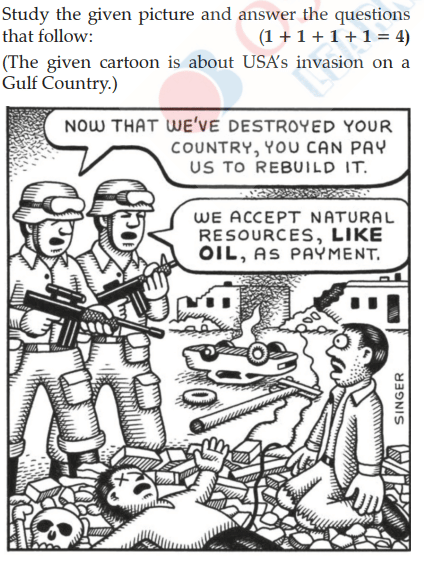
Some More Picture-Related Questions
Q: Which Gulf country was invaded by US America?
A: Iraq
Q: What was the objective of the United States of America to attack the Gulf country?
A: To get control on the oil resources
12 30 PM IST - 22 Mar'26
Picture-Related Questions
Q: Which one of the following is the most important resource in global strategy?
A: Oil
Q: Which of the following regions accounts for about 30% of global oil production?
A: Gulf Region
12 15 PM IST - 22 Mar'26
4-Mark Picture-Based Question
You can study the picture given below before moving to the questions:
12 00 PM IST - 22 Mar'26
Picture-Based Question
In the coming updates, we will solve an important picture-based question for Class 12 Political Science. These questions are commonly asked in the exam and usually carry 4 marks. Stay tuned!
11 45 AM IST - 22 Mar'26
6-Mark Practice Questions - 4
- Describe any three circumstances under which the State Reorganisation Commission was constituted.
- Describe the circumstances and events that led to Manipur’s accession to India in 1949.
11 30 AM IST - 22 Mar'26
6-Mark Practice Questions - 3
- “Regional demands from different parts of India show that India has adopted a democratic approach to accommodate diversity.” Justify the statement.
- Examine any three problems related to Jammu and Kashmir.
11 15 AM IST - 22 Mar'26
6-Mark Practice Questions - 2
- Explain the importance of International organisations like the United Nations in the contemporary world.
- Explain any four changes that have occurred after the Cold War and have affected the realities of world politics.
11 00 AM IST - 22 Mar'26
6-Mark Practice Questions - 1
- Explain any two commonalities and two differences between Bangladesh and Pakistan in their democratic experiences.
- Explain any two issues of co-operation and two issues of confrontation between India and Bangladesh.
10 45 AM IST - 22 Mar'26
Impact of globalisation on the Indian culture
Globalisation has had a significant impact on Indian culture in many ways:
- One major impact is the increase in cultural exchange. People in India are now exposed to different cultures, traditions, food habits, and lifestyles from around the world.
- It has also influenced clothing, language, and entertainment. Western culture, fast food, and the use of English have become more common, especially among the youth.
- At the same time, globalisation has helped in promoting Indian culture globally. Indian food, yoga, and festivals have gained popularity in many countries.
However, it has also raised concerns about the loss of traditional values and cultural identity. Thus, globalisation has both positive and negative effects on Indian culture.
10 30 AM IST - 22 Mar'26
Treaties signed between the US and the Soviet Union
The United States and the Soviet Union signed several important arms control treaties to limit nuclear weapons and reduce tensions during the Cold War.
- The SALT I (Strategic Arms Limitation Talks I) agreement was signed in 1972. It aimed to freeze the number of nuclear weapons and included the Anti-Ballistic Missile (ABM) Treaty, which limited missile defence systems.
- The SALT II agreement was signed in 1979. It sought to place further limits on the number of strategic nuclear weapons.
These treaties played an important role in controlling the arms race and promoting peace between the two superpowers.
10 15 AM IST - 22 Mar'26
Features of Nuclear Policy of India
India’s Nuclear Policy is based on promoting national security while maintaining peace and responsibility.
- One important feature is the principle of No First Use, which means India will not use nuclear weapons unless it is first attacked by another country using nuclear weapons. This shows India’s defensive approach.
- Another feature is maintaining a credible minimum deterrence, which means India keeps only the required number of nuclear weapons to deter threats, not for aggression.
- India also supports peaceful use of nuclear energy, such as for electricity generation and scientific development.
- Additionally, India follows a policy of non-use against non-nuclear countries, which reflects its commitment to responsible nuclear behavior.
10 00 AM IST - 22 Mar'26
Role of ‘Other Backward Classes’ in Indian politics.
The Other Backward Classes have played an important role in Indian politics, especially after the 1990s. Their political importance increased with the implementation of the Mandal Commission recommendations, which provided reservation in government jobs and education.
OBCs began to demand greater political representation and social justice. This led to the rise of regional and caste based parties, which focused on the interests of backward classes.
Their participation made Indian politics more inclusive and democratic by giving a voice to previously underrepresented groups. It also changed the power structure, as leaders from OBC communities gained important positions in government.
09 45 AM IST - 22 Mar'26
Important 2-Mark Question - 4
Suggest any two ways to reduce economic disparity between the poor and the rich countries at the global level.
- One way is to promote fair trade practices so that developing countries get better prices for their goods.
- Another way is to provide financial and technical assistance to poor countries to support their development and reduce inequality.
09 30 AM IST - 22 Mar'26
Important 2-Mark Question - 3
Explain any two reasons for the split in the Janta Party in 1979.
- One reason was internal conflicts and lack of unity among leaders of the Janata Party. Leaders had personal differences and power struggles.
- Another reason was ideological differences, especially over dual membership related to the RSS, which created divisions within the party.
09 15 AM IST - 22 Mar'26
Important 2-Mark Question - 2
Explain any two differences between the First Five-Year Plan and the Second Five-Year Plan.
- The First Five-Year Plan focused mainly on agriculture and irrigation to solve food shortages. On the other hand, the Second Five-Year Plan focused on industrial development, especially heavy industries.
- Another difference was that the First Plan aimed at stability, while the Second Plan aimed at rapid economic growth through industrialisation.
09 00 AM IST - 22 Mar'26
Important 2-Mark Question - 1
'During the period of dominance of the Congress Party, its leaders never showed any desire to form new parties.’ Analyse any one reason for this.
One reason was that the Congress Party already included leaders with different ideologies and viewpoints. It acted like a broad platform, so leaders felt no need to form separate parties.
08 45 AM IST - 22 Mar'26
Some More 1-Mark Questions
You can check some more important solved 1-mark MCQs from the table below:
Question
Correct Answer
The ‘ASEAN Way’ is a form of interaction that is ________.
cooperative
Which one of the following countries is not a founder-member of ASEAN?
Myanmar
Which one of the following countries is not included in ‘South Asia’?
China
There was considerable unease in Indo-US relations during the 1950s because:
India had a growing partnership with the Soviet Union.
Which one of the following was not a major objective of Jawaharlal Nehru’s foreign policy?
To make India a nuclear power.
08 30 AM IST - 22 Mar'26
Solved 1-Mark Questions
You can check some important solved 1-mark MCQs from the table below:
Question
Correct Answer
Which political party of India wanted India to follow a pro-US foreign policy?
Bharatiya Jan Sangh
Which political party won 16 Lok Sabha seats and was at second place in the first General Election of India?
Communist Party of India
Choose the correct full form of the EVM.
Electronic Voting Machine
On which one of the following basis was emergency declared in 1975?
Internal disturbances
In which country was an Australian Mining Company ‘WMC’ opposed?
Philippines
08 15 AM IST - 22 Mar'26
1-Mark Gorbachev-Related Question
Given below are two statements:
Statement-I: Mikhail Gorbachev, who had become General Secretary of the Communist Party of the Soviet Union in 1985, sought to reform the Soviet System.
Statement-II: Gorbachev’s decision to normalise relations with the West and democratise and reform the Soviet Union had some other effects that neither he nor anyone else intended or anticipated.
Options:
(A) Both Statement-I and Statement-II are true.
(B) Both Statement-I and Statement-II are false.
(C) Statement-I is true, but Statement-II is false.
(D) Statement-I is false, but Statement-II is true
The correct answer is:
(A) Both Statement-I and Statement-II are true.
08 00 AM IST - 22 Mar'26
Gorbachev and the Disintegration
Mikhail Gorbachev became the leader of the Soviet Union in 1985 and tried to reform the system to save it.
He introduced two important reforms. The first was Glasnost, which means openness. This allowed people to speak freely, express opinions, and criticize the government. The second was Perestroika, which means restructuring. It aimed to improve the economy by reducing state control and allowing some private businesses.
07 45 AM IST - 22 Mar'26
Important Question for “Shock Therapy”
Can Shock Therapy be called the best way to make transition from authoritarian socialist system to liberal capitalist system after the disintegration of Soviet Union? Explain
No, Shock Therapy cannot be called the best way for transition.
It aimed at a rapid shift to a capitalist economy, but it led to serious problems like unemployment, poverty, and inequality. The sudden changes reduced the standard of living for many people, so it was not a successful or ideal method.
07 30 AM IST - 22 Mar'26
Consequences of Shock Therapy
While some private businesses developed, many people suffered in the short term. There was a sharp rise in unemployment and poverty. The gap between rich and poor increased, and the standard of living fell for many people. This made shock therapy a painful process for several countries.
07 15 AM IST - 22 Mar'26
What was Shock Therapy?
After the disintegration, many former Soviet countries adopted a policy known as shock therapy. This meant a rapid shift from a socialist economy to a capitalist market economy. Under shock therapy, state-owned industries were privatized, prices were freed from government control, and economies were opened to international trade and investment. The aim was to quickly modernize and grow the economy.
07 00 AM IST - 22 Mar'26
CBSE Class 12 Political Science 2026 notes & imp questions coming up!
Get ready for a quick revision. We will be sharing chapter-wise short notes and important questions to help you prepare better in the final hours. Stay tuned and keep refreshing this live blog for all updates.
06 45 AM IST - 22 Mar'26
How to Approach 4-Mark Questions
Use 4 distinct sub-headings. Each heading should be a 1-2 sentence explanation followed by a bullet point.
06 30 AM IST - 22 Mar'26
Topper’s Tip for 2-Mark Questions
Strict 2-point format. No "stories." Write the definition and one relevant example.
06 15 AM IST - 22 Mar'26
Topper’s Tip for the Map Section
In the map section, always write the Alphabet Code (A, B, C) along with the name of the state/country. Never just mark it on the map without labelling the answer sheet.
06 00 AM IST - 22 Mar'26
Secret Tips to Get the "Extra Edge"
To move from a 90 to a 100, you need these "Extra Mark" boosters:
- If a question asks about the "Disintegration of the USSR" or "Process of Integration of Princely States," don't just write text. Draw a quick flowchart to show the sequence of events.
- Examiners have hundreds of copies to check. Make their job easy by underlining dates (like, 1991, 1947), names of leaders (like, Mikhail Gorbachev, Sardar Patel), and specific political terms (like, Shock Therapy, Non-Alignment).
- Use specific political science vocabulary. Instead of "ending of friendship," use "Abrogation of Treaty." Instead of "rich/poor countries," use "Global North and Global South."
05 45 AM IST - 22 Mar'26
The "Topper's Attempt" Strategy for Pol. Science
We have talked to multiple toppers of CBSE Class 12 Political Science and gathered their insights regarding attempting the exam. You can use these tactics to stand out to the examiner:
- Use the initial reading time to categorize questions into Easy (MCQs you know instantly) and Challenges (6-markers that need a structured outline).
- Many toppers prefer starting with Section E (6-mark questions). Your energy and handwriting are best at the start, ensuring these high-value answers are detailed and neat.
- The "Three-Part" Answer Rule:
- Introduction: Define the core term (example, if the question is on Globalization, start with its literal definition).
- Body (Point-wise): Use bullet points with bold sub-headings. Never write long, dense paragraphs.
- Conclusion: A 1-sentence wrap-up or a relevant contemporary example (example, mentioning G20 while discussing International Organizations).
05 30 AM IST - 22 Mar'26
Expert Preparation Tips for 2026
- NCERT is your bible, but for 2026, the board expects you to link textbook theory with current global affairs. For example, when studying International Organizations, don't just learn about the UN; read a snippet about the current relevance of the UN in the Russia-Ukraine or Middle East conflicts.
- Never skip the "cartoon boxes" or "maps" in NCERT. They account for 12 marks (Section D) and are often the easiest to lose if not practiced.
- Since half the paper is competency-based, practice Assertion-Reasoning and Case-Based questions weekly. These aren't about "what" happened, but "why" and "how" it impacts the present.
05 15 AM IST - 22 Mar'26
High-Priority Chapter Weightage 2026
Focusing on weightage helps you allocate time where it matters most.
Part
Chapter Name
Marks
Difficulty
Part A
The End of Bipolarity
6
Medium
International Organizations
6
Easy (Scoring)
Security in the Contemporary World
6
Medium
Part B
Challenges of Nation-Building
6
High (Concept heavy)
India’s External Relations
6
Medium
Recent Developments in Indian Politics
8
High (Most Important)
05 00 AM IST - 22 Mar'26
Question Paper Design
You can check out the question paper design for the Political Science exam below:
Question Type
Contemporary World Politics
Politics in India since Independence
Total No. of Marks and Questions
Objective Type 1 Mark
6
6
12
SA Type I 2 Marks
3
3
6
SA Type II 4 Marks
3
2
5
Passage/Map/Carton based 4 Marks
1
2
3
LA Type 6 Marks
2
2
4
Total Weightage
40
40
80
04 45 AM IST - 22 Mar'26
Blueprint of Political Science Class 12 2026
The question paper blueprint has been shifted toward a more competency-based approach. The details can be checked in the table below:
S. No.
Competencies
Marks
Percentage
1
Knowledge and Remembering: Exhibit memory of previously learned material by recalling facts, terms, and basic concepts.
22
27.5%
2
Understanding: Understanding of facts and ideas by organizing, comparing, explaining, describing, and stating main ideas.
24
30%
3
Applying: Solve problems by applying acquired knowledge, facts to interpret a situation/ cartoon/ clippings/ sources/ Map
22
27.5%
4
Analysis and Evaluation: Classify, compare, contrast, or differentiate between pieces of information; organise and/ or integrate from a variety of sources; Examine, synthesize information into parts and identify motives or causes. Make inferences and find evidence to support generalizations.
12
15%
Total
80
100%
04 30 AM IST - 22 Mar'26
Political Science Chapter-Wise Weightage
The prescribed chapter-wise weightage for the Political Science exam is given below:
Chapter No.
Chapter Name
Marks Allotted
PART A: CONTEMPORARY WORLD POLITICS
1
The End of Bipolarity
6
2
Contemporary Centres of Power
6
3
Contemporary South Asia
6
4
International Organizations
6
5
Security in the Contemporary World
6
6
Environment and Natural Resources
6
7
Globalisation
4
PART A Total
40
PART B: POLITICS IN INDIA SINCE INDEPENDENCE
1
Challenges of Nation-Building
6
2
Era of One-Party Dominance
4
3
Politics of Planned Development
2
4
India’s External Relations
6
5
Challenges to and Restoration of the Congress System
4
6
The Crisis of Democratic Order
4
7
Regional Aspirations
6
8
Recent Developments in Indian Politics
8
PART B Total
40
TOTAL
80
04 15 AM IST - 22 Mar'26
Hall Ticket Reminder!
Don’t forget to carry your CBSE Class 12 admit card on the exam day, as entry to the exam hall will not be allowed without it. Make sure all details on the hall ticket are correct, and keep a valid school ID with you.
04 00 AM IST - 22 Mar'26
CBSE Class 12 Political Science 2026 Exam Date & Timings
The Class 12 Political Science 2026 exam is scheduled to be held on March 23, 2026 (Monday). The exam will take place in a single morning shift from 10:30 AM to 1:30 PM, as per the official date sheet released by CBSE.