


 ICSE Geography Answer Key 2026 (Out) LIVE: Unofficial Key by Subject Expert; Exam Analysis
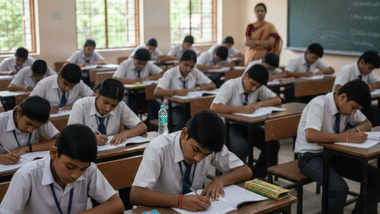
ICSE Geography Exam 2026 is over!
Council for the Indian School Certificate Examinations concluded the ICSE Geography Exam 2026 today, March 18, at 1 PM. Initial student reactions suggest a
moderate
difficulty
level
. A few students also reported that the paper felt lengthy, particularly Part I, leaving them with little time for a final revision.
The answer key has also been released.
Through this live blog, you can check the unofficial answer key prepared and shared by CollegeDekho Social subject expert Sakunth Kumar, along with the detailed analysis of the question paper. The upcoming important exam for the ICSE students is Economics, which is scheduled to be conducted on March 27.
ICSE Geography Answer Key 2026 (Unofficial)
Geography unofficial answer key is being updated below:| Question | Answer |
|---|---|
| i) Mawsynram, the rainiest place in the world, gets the rain from: | (b) South-west monsoon wind - Bay of Bengal branch |
| ii) Choose the characteristic that is true about Laterite soil. | (d) It undergoes desilication. |
| iii) Identify the option which is most similar to: Tropical Evergreen vegetation : Tall trees and hardwood | (b) Tropical Desert vegetation : Small leaves and spines |
| iv) Assertion (A): Irrigation is practised in large parts of India. Reason (R): India has a variety of soil types. | (d) Both (A) and (R) are true but (R) is not the correct explanation of (A) |
| v) Identify the type of coal that has the highest calorific value. | (d) Anthracite |
| vi) The residue of __________ forms an important part of the cattle feed and manure. | (a) groundnut |
| vii) Identify the crop that is grown in the Rabi cropping season. | (c) Mustard |
| viii) Which industry is ideally located close to the raw material producing area? | (d) Sugar industry |
| ix) Which of the following is NOT suitable for composting? | (c) Neem soap |
| x) Identify the pair of cities which are most likely to be the terminal points of the waterway shown in the above picture: | (a) Prayagraj and Haldia |
Also read |
ICSE Class 10 Result 2026 Release Date Prediction
Video - ICSE Geography 2026 Quick Paper Review

ICSE Geography Exam 2026 LIVE
04 00 PM IST - 18 Mar'26
ICSE Geography Exam Live Coverage Ends
That’s a wrap on today’s live updates for the ICSE Geography 2026 exam. Thanks for staying with us throughout the day.
03 00 PM IST - 18 Mar'26
Student Reviews and Reactions
Most students felt the paper was fair and strictly within the scope of the 2026 Specimen Paper. The map was easier than expected, but the Toposheet had a couple of tricky contour-related questions. Overall, it was a high-scoring paper if you knew your concepts.
02 00 PM IST - 18 Mar'26
Unofficial Answer Key Released!
The unofficial answer key for the ICSE Geography 2026 exam is now available in this blog. You can start checking your responses and get a clear idea of your expected scores and overall performance.
01 15 PM IST - 18 Mar'26
Unofficial Answer Key & Paper Analysis Coming Up Soon
Stay tuned as we will soon share a complete paper analysis along with unofficial solutions. This will help you understand question trends, section-wise difficulty, and expected answers.
01 00 PM IST - 18 Mar'26
ICSE Geography Exam 2026 Ends
The test has concluded. Soon, the reviews will be collected from the students, and the question paper will also be taken for formulating the unofficial answer key. Both feedback, and answer key will be shared on the page above. Stay tuned to access the same!
12 00 PM IST - 18 Mar'26
ICSE Geography Exam 2026: 1 Hour Left
Only 1 hour is left for the test to conclude. Candidates are half way through answering their respective papers.
11 00 AM IST - 18 Mar'26
ICSE Geography Exam 2026 Starts
The examination has started. Candidates are seated at the exam hall after the pre-verification process completion. Candidates need to finish the paper by 1 PM.
10 00 AM IST - 18 Mar'26
ICSE Geography Exam 2026: Reporting Time
Candidates are reporting to the examination center. The identity-verification will begin now.
09 00 AM IST - 18 Mar'26
Class Board 10 ICSE Geography Exam 2026: Short Note on Waste Management – Segregation at Source
Segregation is the practice of separating waste into Biodegradable (wet) and Non-biodegradable (dry) categories at the point of origin (homes/offices). This ensures that organic waste can be composted and dry waste can be efficiently recycled or safely disposed of.
08 00 AM IST - 18 Mar'26
Important Topic 13: Waste Management – Impact and Methods
This is the most "scoring" chapter. Focus on the health hazards of e-waste, the process of Composting, and the "3Rs" (Reduce, Reuse, Recycle). You must explain how Segregation at Source reduces the burden on municipal landfills.
07 00 AM IST - 18 Mar'26
Short Note on Waste Management – The 3Rs Principle
The "3Rs" stand for Reduce (using fewer resources), Reuse (using items multiple times), and Recycle (processing waste into new products). This hierarchy is the most effective way to minimize the environmental impact of waste and reduce the pressure on municipal landfills.
06 00 AM IST - 18 Mar'26
Class Board 10 ICSE Geography Exam 2026: Map Pointing Tip 12: Final Review and Tidiness
Avoid overwriting or using an eraser too frequently, as it can smudge the map and make it unreadable. Check that all labels are written horizontally (except for rivers and mountain ranges) and that your handwriting is clear.
05 00 AM IST - 18 Mar'26
Important Topic 12: Transport – Advantages of Different Modes
Compare the Golden Quadrilateral (Roadways) with Railways. Focus on why Air Transport is vital for the North-Eastern states and the cost-effectiveness of Inland Waterways for heavy cargo.
04 00 AM IST - 18 Mar'26
Class Board 10 ICSE Geography Exam 2026: Important QnA on Waste Management (Conceptual)
Question: What is the difference between "Composting" and "Landfilling"?
Answer: Composting is the biological decomposition of organic waste (food, leaves) into nutrient-rich manure. Landfilling involves disposing of non-biodegradable or mixed waste by burying it in deep trenches and compacting it with soil to prevent odor and pollution.
03 00 AM IST - 18 Mar'26
Class Board 10 ICSE Geography Exam 2026: Short Note on Transport – The Golden Quadrilateral
This is a massive highway network connecting India’s four major metropolitan cities: Delhi, Mumbai, Chennai, and Kolkata. It aims to reduce the time and distance between these hubs, boosting industrial growth and trade efficiency across the country.
02 00 AM IST - 18 Mar'26
Map Pointing Tip 11: Pass Marking
Passes like the Karakoram Pass or Nathu La should be marked using the "inverted brackets" symbol ()() across the mountain range. This represents the gap in the mountains through which the pass exists.
01 00 AM IST - 18 Mar'26
Class Board 10 ICSE Geography Exam 2026: Important Topic 11: Manufacturing Industries – Agro and Mineral Based
The Sugar and Tea industries are the most expected agro-based topics, while the Iron and Steel (TISCO/Bhilai) and Electronics (Bangalore - Silicon Valley of India) are the key mineral-based industries. Focus on why industries are shifting to the South or near port areas.
12 00 AM IST - 18 Mar'26
ICSE Geography Exam 2026 Today
CISCE will conduct ICSE Geography Exam 2026 today, March 18, from 11 AM to 1 PM. The examination will be held offline at designated exam centres.
11 00 PM IST - 17 Mar'26
ICSE Board 10th Geography Exam 2026: Short Note on Manufacturing – Integrated vs. Mini Steel Plants
Integrated plants (like TISCO) handle everything from raw material processing to steel making in one location. Mini steel plants use electric furnaces, rely on steel scrap or sponge iron, and are decentralized, catering to local market demands for specific steel products.
10 30 PM IST - 17 Mar'26
Map Pointing Tip 10: Coastal Plains and Plateaus
The Konkan Coast and Malabar Coast are narrow strips; mark them precisely along the coastline. For plateaus like the Deccan Plateau, shade the triangular area between the Western and Eastern Ghats lightly in brown or orange.
10 00 PM IST - 17 Mar'26
ICSE Board 10th Geography Exam 2026: Important Topic 10: Agriculture – Food and Cash Crops
Focus on the "Requirement for Growth" (Temperature, Soil, Rainfall) for Rice, Wheat, Tea, and Coffee. Understand the "Ratoon Cropping" in Sugarcane and the "Ginning" process in Cotton. This chapter often links to the "Shifting vs. Intensive" farming methods.
09 30 PM IST - 17 Mar'26
Important QnA on Manufacturing Industries (Location Factors)
Question: Why is the "Tata Iron and Steel Company" (TISCO) located at Jamshedpur?
Answer: TISCO enjoys "location advantages": Iron ore from Noamundi, Coal from Jharia, and water from the Subarnarekha and Kharkai rivers. Its proximity to the Kolkata port and a well-connected railway network facilitates the export of finished steel.
09 00 PM IST - 17 Mar'26
ICSE Board Class 10 Geography Exam 2026: Short Note on Agriculture – Ratoon Cropping
In the Sugar Industry, Ratooning is the practice of leaving the lower part of the sugarcane stalk and the roots in the soil after the first harvest to allow a second crop to grow. While it saves labor and cost, the yield decreases with each successive ratoon.
08 30 PM IST - 17 Mar'26
Map Pointing Tip 9: Marking Soil and Mineral Regions
When asked to mark a region of Black Soil or an Iron Ore field, use diagonal hatch lines or light shading. Always provide a Key/Index at the bottom of the map if you are using specific patterns or symbols to differentiate multiple regions.
08 00 PM IST - 17 Mar'26
ICSE Board Class 10 Geography Exam 2026: Important Topic 9: Mineral and Energy Resources
Prioritize Iron Ore (Haematite/Magnetite), Coal (Anthracite/Bituminous), and Petroleum. In the energy sector, focus on the advantages of Solar and Wind energy over conventional thermal power, and the location of major nuclear power plants like Tarapur or Kaiga.
07 45 PM IST - 17 Mar'26
Important QnA on Agriculture (Problem-Solving)
Question: Give two reasons why the yield per hectare of wheat is higher in Punjab compared to other states.
Answer: 1. Extensive use of HYV (High Yielding Variety) seeds and chemical fertilizers. 2. Excellent irrigation facilities (canals and tube wells) which compensate for the lack of winter rain.
07 30 PM IST - 17 Mar'26
ICSE Board Class 10 Geography Exam 2026: Short Note on Minerals – "Black Gold" (Petroleum)
Petroleum is called "Black Gold" because of its immense value in the modern economy. In India, the major offshore field is Mumbai High, while the oldest onshore field is Digboi in Assam. It is used not just as fuel but as a raw material for fertilizers and plastics.
07 15 PM IST - 17 Mar'26
Map Pointing Tip 8: Labeling Water Bodies
For large bodies like the Arabian Sea or Bay of Bengal, write the name in bold blue capital letters in the center of the area. For smaller features like the Gulf of Kutch or Gulf of Khambhat, use an arrow if the space for text is too tight.
07 00 PM IST - 17 Mar'26
ICSE Board Geography Exam 2026: Important Topic 8: Water Resources – Conventional vs. Modern Irrigation
With increasing focus on sustainability, compare Canal Irrigation with Drip and Sprinkler Irrigation. Understand why Inundation Canals are being replaced by Perennial Canals and the geographical importance of Rainwater Harvesting.
06 45 PM IST - 17 Mar'26
ICSE Board Geography Exam 2026: Important QnA on Mineral Resources (Usage)
Question: Why is "Manganese" considered a vital mineral for the Iron and Steel industry?
Answer: Manganese acts as a hardening agent. It is used to toughen steel, remove impurities like oxygen and sulfur during the smelting process, and make the steel resistant to rust and abrasion.
06 30 PM IST - 17 Mar'26
Short Note on Water Resources – Inundation vs. Perennial Canals
Inundation canals are taken out directly from rivers without any barrage or dam and only contain water when the river is in flood. Perennial canals are fed by dams or weirs, providing a constant water supply throughout the year, making them far more reliable for agriculture.
06 15 PM IST - 17 Mar'26
ICSE 2026 Geography Exam: Map Pointing Tip 7: Use of Arrows for Winds
For South-West Monsoons or North-East Monsoons, draw at least three parallel arrows to show the direction of the wind. Ensure the arrows for the South-West Monsoon originate from the sea and point towards the land.
06 00 PM IST - 17 Mar'26
Important Topic 7: Natural Vegetation – Tropical Evergreen vs. Deciduous
The distinction between Evergreen and Monsoon (Deciduous) forests is vital. Study the climatic conditions required for each and the commercial importance of trees like Teak, Sal, and Sandalwood. Be ready to explain the importance of Mangrove (Littoral) forests in coastal protection.
05 45 PM IST - 17 Mar'26
ICSE 2026 Geography Exam: Important QnA on Water Resources (Modern Methods)
Question: State two reasons why "Bamboo Drip Irrigation" is popular in Meghalaya.
Answer: 1. It is an indigenous, eco-friendly method that uses locally available bamboo pipes. 2. It is ideal for the hilly terrain where water needs to be transported from springs to lower reaches without wastage or soil erosion.
05 30 PM IST - 17 Mar'26
Short Note on Natural Vegetation – Xerophytic Plants
In the Tropical Desert regions, plants like Cactus and Acacia are "Xerophytic." They have adaptations like long roots to reach groundwater, thick fleshy stems to store water, and leaves reduced to spines to minimize transpiration.
05 15 PM IST - 17 Mar'26
ICSE 2026 Geography Exam: Map Pointing Tip 6: Marking Latitudes and Longitudes
The Tropic of Cancer (23\degree 30'\text{N}) and the Standard Meridian (82\degree 30'\text{E}) must be drawn as dashed lines. Use a ruler to ensure they are straight and pass through the correct landmarks (e.g., the Standard Meridian must pass through Mirzapur).
05 00 PM IST - 17 Mar'26
Important Topic 6: Soil Resources – Types and Characteristics
Focus on the Alluvial, Black, Red, and Laterite soils. Understand the "Leaching" process in Laterite soil and why Black soil is "self-ploughing." Soil conservation methods like Terrace Farming and Shelter Belts are frequently tested 2-mark questions.
04 45 PM IST - 17 Mar'26
10th ICSE Geography Exam 2026: Important QnA on Natural Vegetation (Short Notes)
Question: Why are the Tropical Evergreen forests not commercially very significant?
Answer: 1. They are very dense with thick undergrowth, making transportation difficult. 2. Different species of trees are found mixed together (lack of pure stands), making selective felling expensive and labor-intensive.
04 30 PM IST - 17 Mar'26
Short Note on Soil – Humus and Alluvial Soil
Alluvial soil is the most widespread soil in India, formed by the deposition of silt by rivers. It is rich in Potash but lacks Nitrogen. It is divided into Khadar (new, fertile alluvium) and Bhangar (old, less fertile alluvium containing lime nodules).
04 15 PM IST - 17 Mar'26
10th ICSE Geography Exam 2026: Map Pointing Tip 5: Shading for Deserts and Plains
When marking the Thar Desert or the Gangetic Plains, use a light yellow color. Ensure the shading is uniform and stays within the natural boundaries. Do not cross over into the mountain regions or water bodies.
04 00 PM IST - 17 Mar'26
Important Topic 5: Climate – Data-Based Questions
Be prepared to interpret a climate table. You will be asked to calculate the Annual Range of Temperature (Highest Temp – Lowest Temp), total rainfall, and identify the wind system responsible for rainfall based on the months (e.g., Oct-Nov rainfall suggests the Retreated Monsoon on the East Coast).
03 45 PM IST - 17 Mar'26
Class 10 ICSE Geography Exam 2026: Important QnA on Soil Resources (Distinction)
Question: Differentiate between Khadar and Bhangar soil.
Answer: Khadar is new alluvium, fine-textured, more fertile, and found in floodplains. Bhangar is old alluvium, contains calcareous kankar nodules, is less fertile, and found in upland areas away from rivers.
03 30 PM IST - 17 Mar'26
Short Note on Soil – Leaching and Laterite
Soil Laterite soil is formed by Leaching, a process where heavy tropical rains wash away the fertile top layer (silica and nutrients), leaving behind iron and aluminum oxides. This makes the soil acidic and less fertile, suitable mainly for plantation crops like cashew and tea.
03 15 PM IST - 17 Mar'26
Class 10 ICSE Geography Exam 2026: Map Pointing Tip 4: The Dot Method for Cities
Cities like Delhi, Mumbai, or Kolkata must be marked with a small, sharp red dot. The placement is critical: for example, the dot for Kolkata must be exactly at the tip of the Hooghly river, and Mumbai must be on the island-like protrusion on the west coast.
03 00 PM IST - 17 Mar'26
Important Topic 4: Climate – Factors Affecting India's Climate
This topic is a staple for reasoning questions. Focus on why the Himalayas act as a barrier, the role of the Jet Streams, and the Distance from the Sea. You must explain the "Variability of Rainfall" and why the Western Ghats receive more rain than the Deccan Plateau.
02 30 PM IST - 17 Mar'26
Short Note on Climate – Continental vs. Maritime Climate
Continental climate (interior regions like Delhi) features extreme temperatures—very hot summers and very cold winters. Maritime climate (coastal regions like Mumbai) features a moderate range of temperature throughout the year due to the influence of land and sea breezes.
02 15 PM IST - 17 Mar'26
ICSE 10th Geography Exam 2026: Map Pointing Tip 3: Marking Mountain Ranges vs. Peaks
Mountain ranges like the Himalayas or Vindhyas should be marked as a bold, thick brown line along their extent. For a peak like Mt. K2 or Kanchenjunga, use a small brown triangle (\triangle) and label it with its name and height if required.
02 00 PM IST - 17 Mar'26
Important Topic 3: Map of India – Rivers and Water Bodies
Rivers are tested every year. You must be able to trace the course of the River Narmada, River Tapi, and River Mahanadi. Additionally, be ready to mark the Gulf of Kutch, Andaman Sea, and the Chilka Lake.
01 45 PM IST - 17 Mar'26
ICSE Class 10 Geography Exam 2026: Important QnA on Climate of India (Reasoning)
Question: Why does the state of Tamil Nadu receive winter rainfall?
Answer: During winter, the North-East Monsoon winds (Retreating Monsoon) blow from the North-East toward the Bay of Bengal. As they cross the sea, they pick up moisture and strike the Coromandel Coast, bringing heavy rainfall to Tamil Nadu between October and December.
01 30 PM IST - 17 Mar'26
Short Note on Climate – The "Rain Shadow" Effect
This is a critical concept for reasoning questions. A rain shadow area is the leeward side of a mountain range (like Pune on the leeward side of the Western Ghats) that receives very little rainfall because the moisture-laden winds have already shed their rain on the windward side.
01 15 PM IST - 17 Mar'26
ICSE Class 10 Geography Exam 2026: Map Pointing Tip 2: Precision in River Tracing
When marking a river like the Narmada or Tapi, trace the entire course from the source to the mouth. Do not just draw a line; ensure it follows the curves of the river provided on the physical map. Always write the name of the river along its course.
01 00 PM IST - 17 Mar'26
Important Topic 2: Map of India – Physical Features
For the compulsory 10-mark map work, focus on the precise marking of the Karakoram Pass, Chota Nagpur Plateau, and the Thar Desert. Ensure your shading for the Ganges-Brahmaputra Delta and the Konkan Coast is accurate and stays within the geographical boundaries.
12 45 PM IST - 17 Mar'26
ICSE Class 10 Geography Exam 2026: Important QnA on Map of India (Compulsory Part I)
Question: How should the "Standard Meridian of India" be marked, and what is its specific value?
Answer: It should be marked as a vertical dashed line passing through Mirzapur (near Allahabad). Its value is 82\degree 30' \text{E}. Always label the degree clearly to avoid losing marks.
12 30 PM IST - 17 Mar'26
Short Note on Toposheet – Conventional Signs
Short notes on toposheets must include the meaning of specific colors: Yellow represents arable (agricultural) land, Green represents forested area, and White represents uncultivable waste land. Always remember that Red grid lines are used for Eastings and Northings, while Brown lines are contours indicating relief.
12 15 PM IST - 17 Mar'26
ICSE Geography Exam 2026: Map Pointing Tip 1: Use the Correct Color Pencils
CISCE mandates specific colors for geographical features. Use Blue for water bodies and rivers, Brown for mountain ranges and peaks, Yellow for plains or deserts, and Red for cities and the Standard Meridian. Never use a pen for marking.
12 00 PM IST - 17 Mar'26
Important Topic 1: Topographical Map Interpretation (Compulsory)
This is the most critical 10-mark section. You must master 6-figure grid references, calculating direct distance (using a thread or ruler), identifying drainage patterns (dendritic, trellis, radial), and recognizing human activities based on conventional signs (e.g., a "Yellow Wash" indicating agriculture).
11 45 AM IST - 17 Mar'26
ICSE Geography Exam 2026: Important QnA on Topographical Maps (Compulsory Part I)
Question: If the 4-figure grid reference for a settlement is 2518, what does the '25' and '18' represent? Also, how is the direction of a river determined on a toposheet?
Answer: '25' represents the Easting (vertical line) and '18' represents the Northing (horizontal line). The direction of a river is determined by the arrow mark in the river bed or by looking at the decreasing value of contour lines (water flows from higher to lower elevation).


