

 ICSE Physics Answer Key 2026 Live Updates: Unofficial Key by Subject Expert; Paper Analysis
ICSE Physics Exam 2026 (Science Paper 1) is over!
It was conducted today, Monday, March 9, 2026, from 11:00 AM to 1:00 PM. As per the reviews collected by actual test takers, the overall difficulty level is reported to be a bit hard. Many if them did not expect this difficulty level; while some who prepared well were able to judge questions well. Most of the questions were syllabus-based and some were also taken from previous year papers.
The exam followed the usual pattern with a mix of MCQs, short-answer questions, and structured questions. As per the paper pattern, all questions in Section A were compulsory, while students had internal choices in Section B. Thousands of Class 10 students across the country appeared for the physics paper.
Through this blog, we are sharing the unofficial answer key and detailed solutions prepared by subject experts, along with student reactions and a complete question paper analysis. We will also share insights on the overall difficulty level of the ICSE Physics Exam 2026. Stay Tuned!
ICSE Physics Answer Key 2026 (Unofficial)
The unofficial answer key of ICSE Physics is being updated below:| Questions | Answers |
|---|---|
| (i) For a body to be in dynamic equilibrium, its: | (b) acceleration should be zero |
| (ii) The energy transformation taking place during photosynthesis in plants is: | (c) light to chemical |
| (iii) The Velocity Ratio (VR) of a block and tackle system of two pulleys with the effort in the upward direction is: | (c) 3 |
| (iv) From the figure given below, the refractive index of medium B with respect to medium A is: | (d) sin 60/sin 45 |
| (v) When a blackened bulb thermometer is moved beyond the red region of the visible spectrum, there is a rapid rise in the temperature. This is due to the presence of: | (a) Infrared radiations |
| (vi) A fast-moving cyclist stops pedalling on reaching a hilly track. If he continues to move with the acquired energy, then assuming no loss of energy: | (d) his total mechanical energy remains constant. |
| (vii) The distance (V) of a virtual image formed by a lens of focal length 15 cm never exceeds a certain finite value, then this value will be: | (d) less than or equal to 15 cm |
| (viii) Assertion (A): Tiny air molecules scatter blue light more than red light. Reason (R): The refractive index of a medium is greater for blue light than red light. | (d) Both (A) and (R) are true but (R) is not the correct explanation of (A). |
| (ix) In the circuit given below, identify the lamp whose failure would not interrupt the power supply to the other lamps. | (b) L2 |
(x) Equal volumes of water are added to three cylindrical jars A, B and C....If you blow air into the mouth of these jars, which jar will produce the shrillest note? | (b) B |
| (xi) A metallic wire is stretched in such a way that its new length becomes twice the original length. How does its specific heat capacity change? | (d) remains the same |
| (xii) The correct formula to calculate the equivalent resistance of two resistors.. | (b)R1R2/R1+R2 |
| (xiii) The diagram below shows the top view of the Wire A shown by a cross (X), carrying current into the plane of the paper. Which of the compasses is correctly aligned with the magnetic field produced by the current carrying wire? | (c) Both 1 and 2 are aligned |
| (xiv) Three substances A, B and C of same mass are present at their respective melting points. On heating, if they melt completely in 5 minutes, 6 minutes and 7 minutes respectively, then which substance has the highest specific latent heat? (Assume heat is absorbed at the same rate) | (c) Substance C |
| (xv) An atom of lithium contains 3 electrons, 3 protons and 4 neutrons. Its mass number is: | (c) 7 |
Video - ICSE Physics Paper 2026 Quick Analysis

Stay tuned to this LIVE blog for the ICSE Physics Exam 2026 latest updates, expert answers, and reactions from students across the country.
ICSE Physics Exam 2026 LIVE
03 45 PM IST - 09 Mar'26
ICSE Physics Exam Live Coverage Ends
This brings us to the end of our ICSE Physics Exam 2026 live coverage. We hope the unofficial answer key, solutions, student reactions, and paper analysis helped you understand the exam better. Stay connected with us for more updates on ICSE board exams, answer keys, and result announcements.
01 20 PM IST - 09 Mar'26
Unofficial Answer Key & Analysis Coming Shortly
We will shortly share the unofficial answer key, expert solutions, and a detailed paper analysis for the ICSE Physics Exam 2026. Stay tuned to this live blog to check the correct answers, section-wise difficulty level, and student reactions.
01 05 PM IST - 09 Mar'26
ICSE Physics Exam 2026 Concludes
The Physics exam 2026 has now concluded. Students are beginning to come out of their exam centres across the country after completing the paper. Many are now discussing questions and comparing answers with their peers.
11 00 AM IST - 09 Mar'26
ICSE Physics Exam 2026 About to Begin Shortly
The ICSE Physics Exam 2026 is about to begin shortly. Students are now settling into their examination halls as invigilators complete the final checks. Candidates are advised to stay calm, read the question paper carefully, and manage their time wisely.
10 00 AM IST - 09 Mar'26
Students Arrive at ICSE Physics Exam Centres
Students have started reaching their examination centres for the ICSE Physics Exam 2026. Outside several schools, candidates can be seen revising formulas and short notes while waiting for entry into the exam hall.
09 00 AM IST - 09 Mar'26
Students Begin Leaving Homes
Many students across cities have started leaving their homes to reach their designated ICSE Physics examination centres. Parents and guardians are accompanying some candidates to ensure they reach the venue comfortably and on time.
08 00 AM IST - 09 Mar'26
Traffic Advisory for Students Heading to Exam Centres
Students travelling to their ICSE Physics exam centres are advised to leave home early as morning traffic in several areas may cause delays. Carry your admit card and required stationery, and plan your route beforehand to ensure a smooth journey.
07 00 AM IST - 09 Mar'26
Good Morning Students! ICSE Physics Exam 2026 Day Is Here
The day many of you have been preparing for has finally arrived. The ICSE Physics Exam 2026 will be conducted today from 11 AM, and students are advised to reach their centres at least 30-40 minutes before.
06 00 AM IST - 09 Mar'26
Alpha vs Beta vs Gamma Radiation
Radioactive substances emit different types of radiation. The table below compares the basic properties of alpha, beta, and gamma radiation.
Property
Alpha (α)
Beta (β)
Gamma (γ)
Nature
Helium nuclei
Fast electrons
Electromagnetic waves
Charge
Positive
Negative
No charge
Penetrating Power
Low
Medium
Very high
Ionising Power
Very high
Moderate
Low
05 00 AM IST - 09 Mar'26
Potential Energy vs Kinetic Energy
Energy can exist in different forms. The table below compares potential energy and kinetic energy, which together form mechanical energy.
Potential Energy
Kinetic Energy
Energy possessed due to position or configuration.
Energy possessed due to motion.
Formula: PE = mgh
Formula: KE = ½ mv²
A body may have PE even when it is not moving.
A body has KE only when it moves.
Example: water stored in a dam.
Example: moving car or flowing water.
04 00 AM IST - 09 Mar'26
Concave Lens vs Convex Lens
Lenses are important optical devices used in many instruments. The table below compares the features of concave and convex lenses.
Concave Lens
Convex Lens
Thinner at the centre and thicker at the edges.
Thicker at the centre and thinner at the edges.
It is a diverging lens.
It is a converging lens.
Always forms a virtual, erect, and smaller image.
Can form real or virtual images depending on object position.
Used in spectacles for myopia.
Used in magnifying glasses and cameras.
03 00 AM IST - 09 Mar'26
Mass vs Weight
Mass and weight are often confused with each other, but they are different physical quantities. The table below highlights their key differences.
Mass
Weight
Amount of matter present in a body.
Gravitational force acting on a body.
It is a scalar quantity.
It is a vector quantity.
Unit: kilogram (kg).
Unit: newton (N).
Mass remains constant everywhere.
Weight changes with gravity.
Measured using a beam balance.
Measured using a spring balance.
02 00 AM IST - 09 Mar'26
Scalar Quantity vs Vector Quantity
The table below shows the main differences between scalar quantities and vector quantities.
Scalar Quantity
Vector Quantity
A physical quantity that has only magnitude.
A physical quantity that has both magnitude and direction.
Direction is not important.
Direction is very important.
These quantities are added using simple algebra.
These quantities follow vector addition rules.
Examples: mass, time, temperature, energy.
Examples: velocity, force, acceleration, displacement.
01 00 AM IST - 09 Mar'26
ICSE Physics PYQ 2023 - Download Here!
Access the ICSE Physics 2023 question paper here to revise important topics and get familiar with the types of questions asked in the exam.
12 00 AM IST - 09 Mar'26
ICSE Physics PYQ 2024 - Download Here!
Download the ICSE Physics 2024 question paper here to understand and practice important questions for better preparation.
11 00 PM IST - 08 Mar'26
ICSE Physics PYQ 2025 - Download Here!
Practising ICSE Physics previous year question papers is a great way to understand the exam pattern and important topics. Download the paper for 2025 here!
09 45 PM IST - 08 Mar'26
Get Proper Rest Before the Exam
Experts often recommend getting proper sleep the night before an exam. Students appearing for the ICSE Physics Exam 2026 tomorrow should try to sleep on time so they wake up fresh and focused for the test.
09 30 PM IST - 08 Mar'26
What Not to Do Right Now
Students should avoid staying up too late or trying to learn completely new topics tonight. This can lead to unnecessary stress and confusion. Instead, focus on relaxing your mind after a quick revision and ensure you get enough rest before the exam day.
09 15 PM IST - 08 Mar'26
Essentials Checklist for Tomorrow’s Exam
Students appearing for the ICSE Physics Exam 2026 tomorrow should take a moment tonight to check all essential items:
- Admit Card / Hall Ticket
- School ID (if required)
- Blue/Black Ball Pens (2-3)
- Pencil
- Eraser
- Sharpener
- Ruler / Scale
- Geometry Box
- Transparent Water Bottle
- Wrist Watch
- Handkerchief or Tissues
09 00 PM IST - 08 Mar'26
Nuclear Fission vs Nuclear Fusion
Check out the most important differences between nuclear fission and fusion for quick revision:
Basis of Difference
Nuclear Fission
Nuclear Fusion
Meaning
The process in which a heavy nucleus splits into two smaller nuclei.
The process in which two light nuclei combine to form a heavier nucleus.
Type of Nuclei Involved
Heavy elements like uranium or plutonium.
Light elements like hydrogen isotopes.
Energy Released
Large amount of energy is released.
Even greater amount of energy is released compared to fission.
Temperature Required
Does not require extremely high temperature to start the reaction.
Requires very high temperature and pressure.
Chain Reaction
Can produce a controlled or uncontrolled chain reaction.
Chain reaction is very difficult to control.
Occurrence
Occurs in nuclear reactors and atomic bombs.
Occurs naturally in the Sun and stars.
Example Reaction
Uranium-235 splits into barium, krypton and neutrons.
Hydrogen nuclei combine to form helium.
Energy Source
Used in nuclear power plants to generate electricity.
Considered a future source of energy because it releases very high energy.
08 15 PM IST - 08 Mar'26
Mega Practice 10: Competency-Based Questions Class 10 ICSE Physics 2026
Check out some more 2-mark short-answer questions below for you to practice for the physics exam:
Q: You are given three resistors of magnitude 3 Ω each. You can join them either in a series or in a parallel combination. How will you arrange them so that the equivalent resistance would become:
(a) maximum
(b) minimumQ: In a gold atom (atomic number 79), an electron revolves around the nucleus in a circular orbit. There is a strong electrostatic force between the positively charged nucleus and the negatively charged electron. Though the total positive charge possessed by the nucleus is much higher than the negative charge of the electron, there is no displacement of the electron in the direction of the force.
(a) Name the force responsible for the movement of the electron around the nucleus in its own orbit.
(b) In the absence of such force, what would happen to the movement of the electron?Q: A straight wire is passed vertically through cardboard sprinkled with iron filings.
(a) When current is passed through the wire in the upward direction, the iron filings arrange themselves in a definite pattern. Why?
(b) What would happen to this arrangement if more current were passed through the wire?Q: On a hot summer day, we often put ice cubes to cool the water. Why?
Q: A metre rod is half made of copper and half made of iron. If the mass of the copper part is 900 g and the mass of iron is 800 g, calculate the position at which the rod can remain in equilibrium.
08 00 PM IST - 08 Mar'26
Mega Practice 9: Competency-Based Questions Class 10 ICSE Physics 2026
Check out some 1-mark MCQs below for you to practice for the physics exam:
Questions Topic Ice in high mountains does not melt all at once because:
(a) high specific heat of ice
(b) low specific heat of ice
(c) low latent heat of fusion of ice
(d) high latent heat of fusion of ice
Heat
If three resistors R₁, R₂ and R₃ are connected in series and R₁ > R₂ > R₃, what is the relation between currents I₁, I₂ and I₃?
(a) I₁ = I₂ = I₃
(b) I₁ < I₂ < I₃
(c) I₁ > I₂ > I₃
(d) 1/I₁ < 1/I₂ < 1/I₃
Electricity and Magnetism
During the change of state from solid to liquid, heat is absorbed but temperature does not rise because:
(a) only kinetic energy increases
(b) only potential energy increases
(c) both kinetic and potential energy increase
(d) neither kinetic nor potential energy increases
Heat
Assertion: When current flows through a wire, a magnetic field is produced around it.
Reason: When magnetic flux linked with a coil changes, induced current is produced.
(a) Both A and R are correct, and R explains A.
(b) Both A and R are correct, but R does not explain A.
(c) A is correct but R is wrong.
(d) Both A and R are wrong.
Electricity and Magnetism
Which combination correctly represents the charges on particles?
+1.6 × 10⁻¹⁹ C | −1.6 × 10⁻¹⁹ C | +3.2 × 10⁻¹⁹ C
(a) proton | neutron | alpha particle
(b) alpha particle | electron | neutron
(c) proton | electron | alpha particle
(d) electron | proton | alpha particle
Modern Physics
07 45 PM IST - 08 Mar'26
Example of Beta Decay
C → N + β
Atomic number increases by 1, mass number remains the same.
07 30 PM IST - 08 Mar'26
Example of Alpha Decay
U → Th + α
Atomic number decreases by 2 and mass number decreases by 4.
07 15 PM IST - 08 Mar'26
Atomic Structure
An atom contains a nucleus at the centre.
The nucleus has:
- Protons (positive charge)
- Neutrons (no charge)
Electrons revolve around the nucleus.
Atomic number (Z): Number of protons.
Mass number (A): Number of protons + neutrons.07 00 PM IST - 08 Mar'26
Colour Coding of Wires
In modern wiring systems:
Live wire → Brown
Neutral wire → Blue
Earth wire → Green or Green-Yellow
06 45 PM IST - 08 Mar'26
What Should Students Do This Evening?
As the exam is just a few hours away, students should focus on light revision rather than intensive studying. Quickly review important formulas, definitions, diagrams, and short notes from chapters like Electricity, Sound, Light, and Heat. Avoid starting completely new topics now and focus on staying calm and confident on the exam day.
06 30 PM IST - 08 Mar'26
Exam Timings & Reporting Time
The ICSE Physics Exam 2026 will be conducted tomorrow from 11:00 AM to 1:00 PM. Students should try to reach their exam centres at least 30-45 minutes before the reporting time.
06 15 PM IST - 08 Mar'26
Physics Exam 2026 Tomorrow
Students appearing for the ICSE Physics exam tomorrow are advised to begin wrapping up their revision for the day. This is a good time to organise your study material, keep your admit card ready, and review a few important formulas or short notes.
06 00 PM IST - 08 Mar'26
ICSE Physics Exam 2026 Syllabus
You can download the complete syllabus for the Physics exam tomorrow from here! It’s important to download and take a quick look at it to revise the topics, formulas, and concepts that may appear in the paper.
05 45 PM IST - 08 Mar'26
Internal Resistance
Internal resistance is the resistance offered by the electrolyte and electrodes inside a cell. Because of internal resistance, the terminal voltage becomes slightly less when current flows.
05 30 PM IST - 08 Mar'26
Electromotive Force (EMF)
EMF is the total energy supplied by a cell per unit charge. It is the potential difference across the terminals of a cell when no current is flowing.
Unit: volt (V)
05 15 PM IST - 08 Mar'26
Ohmic and Non-Ohmic Conductors
Ohmic conductors follow Ohm’s Law.
Example: metallic wires.Their V–I graph is a straight line.
Non-ohmic conductors do not follow Ohm’s Law.
Example: diode, filament lamp.05 00 PM IST - 08 Mar'26
Short Notes on Ohm’s Law
Ohm’s Law explains the relationship between current, voltage, and resistance in an electric circuit.
It states that the current flowing through a conductor is directly proportional to the potential difference across its ends, provided the temperature remains constant.
Formula:
V = IR
Where
V = potential difference (volt)
I = current (ampere)
R = resistance (ohm)If voltage increases, current also increases, provided resistance remains constant.
04 45 PM IST - 08 Mar'26
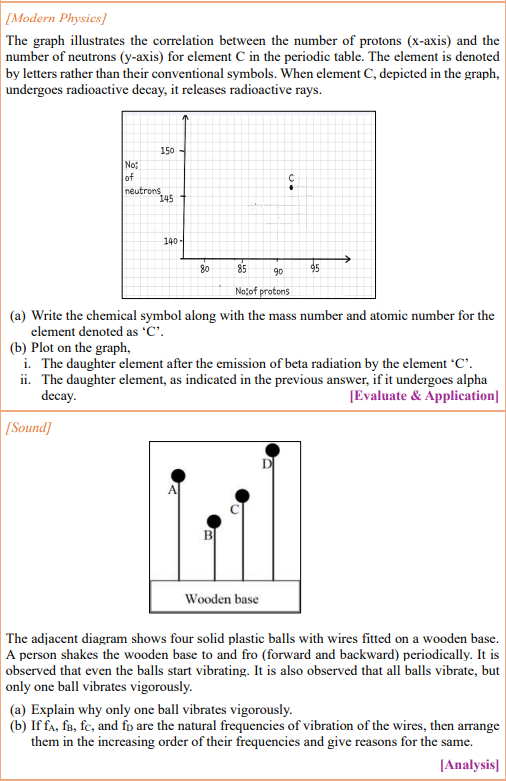
Mega Practice 8: Competency-Based Questions Class 10 ICSE Physics 2026
You can find some more practice questions of 4-marks. These might help you with the long-answer questions section of the physics paper:
04 30 PM IST - 08 Mar'26
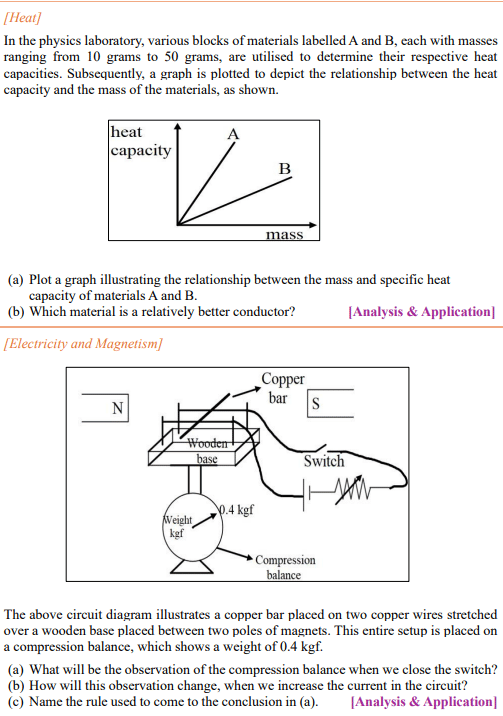
Mega Practice 7: Competency-Based Questions Class 10 ICSE Physics 2026
Check out some more 3-mark short-answer questions below for physics exam prep:
04 15 PM IST - 08 Mar'26
Mega Practice 6: Competency-Based Questions Class 10 ICSE Physics 2026
Check out some more 2-mark short-answer questions below for you to practice for the physics exam:
Q: The two metals A and B have their specific heat capacities in the ratio 2:3. If they are supplied the same amount of heat, then:
(a) which metal piece will show a greater rise in temperature if their masses are the same?
(b) calculate the ratio in which their temperatures rise, if the mass ratio of metal A : B = 3 : 5.Q: Soumya took two right circular cones of the same vertical height. One of the two cones is a solid one, while the other is hollow from inside. By measuring the cross-sectional areas of the cones and from the knowledge of symmetry, by using suitable formulas, he found the positions of the centre of gravity of both cones. He found that the difference is about 1.5 cm. What is the vertical height of the two cones?
Q: Seismic waves have different frequencies. During earthquakes, why are short-length buildings more prone to damage caused by high-frequency seismic waves?
Q: Will the centre of gravity of a hollow sphere filled half with mercury and half with oil be identical to that of an empty hollow sphere? Give reasons for your answer.
Q: (a) Convert to SI unit: 1 J/g °F
Q: Ashish, Sameer, Aditya and Mohit were sitting on the terrace of Ashish’s house listening to songs playing on Aditya’s mobile phone. Mohit, sitting a little distance away, asks to increase the volume. Aditya says the volume is already full. Sameer goes to the kitchen, brings an empty steel glass, places the mobile phone inside it, and solves the problem. What is the reason for Sameer keeping the mobile phone in the glass?
(b) Why does 1 g of water at 0°C have 336 J more heat energy than 1 g of ice at 0°C?04 00 PM IST - 08 Mar'26
Mega Practice 5: Competency-Based Questions Class 10 ICSE Physics 2026
Check out some 1-mark MCQs below for you to practice for the physics exam:
Question
Topic
Three metals A, B and C are supplied with the same quantity of heat. Their masses are in the ratio 2 : 3 : 4. If they show the same rise in temperature, the ratio of their thermal capacities will be:
(a) 1 : 1 : 1
(b) 4 : 3 : 2
(c) 2 : 3 : 4
(d) 2 : 3 : 1
Heat
A magnetic compass is placed on a table near a wall. When a man switches on an air conditioner fitted near the ceiling, the compass needle deflects immediately. What is the most probable reason?
(a) Air blowing in the room
(b) Current starts flowing through AC wire concealed in the adjacent wall
(c) Vibrations produced when the man talks
(d) Vibrations caused by a file falling on the ground
Electricity and Magnetism
Two substances A and B have the same mass. Substance A has a higher specific heat capacity than B. When supplied with the same amount of heat:
(a) Substance A will experience a smaller temperature change than B.
(b) Substance A will experience a larger temperature change than B.
(c) Both substances will experience the same temperature change.
(d) Temperature change depends on other factors.
Heat
A student traces the path of light through a glass prism and draws conclusions:
I. On entering the prism, light bends towards its base.
II. Refraction occurs at both surfaces of the prism.
III. The emergent ray is deviated from the incident ray.
IV. At emergence, the angle of refraction is less than the angle of incidence.
Which are correct?
(a) I, II and III
(b) I, III and IV
(c) II, III and IV
(d) All of these
Light
Assertion: Sometimes the sky appears reddish in the evening.
Reason: Red light, having longer wavelength, scatters more than other colours.
(a) A and R are true, and R is the reason for A.
(b) A and R are true, but R is not the reason for A.
(c) A is true, but R is false.
(d) A is false, but R is true.
Light
Assertion: When displacement is zero, work done is zero. Therefore if work done is zero, displacement must be zero.
Reason: Work done is given by W = FScosθ.
(a) A and R are true, and R is the reason for A.
(b) A and R are true, but R is not the reason for A.
(c) A is true, but R is false.
(d) A is false, but R is true.
Force, Work, Power and Energy
The frequency of a stretched string is:
(a) directly proportional to its length and inversely proportional to tension
(b) inversely proportional to length and directly proportional to tension
(c) directly proportional to √length and inversely proportional to tension
(d) inversely proportional to length and directly proportional to √tension
Sound
A ray of light passes from a medium of refractive index 1.33 to another medium of refractive index 1.5. The ray will:
(a) bend towards the normal
(b) bend away from the normal
(c) travel along the normal
(d) undergo total internal reflection
Light
Assertion: In passport photography, the object is placed beyond the centre of curvature of the camera lens.
Reason: The image formed is real and diminished and can be captured on a screen.
(a) Both A and R are true, and R correctly explains A.
(b) Both A and R are true, but R does not explain A.
(c) A is true, but R is false.
(d) Both A and R are false.
Light
03 45 PM IST - 08 Mar'26
SONAR & Uses
SONAR stands for Sound Navigation and Ranging. It is a device that uses sound waves to detect objects underwater.
In SONAR, sound waves are sent into the water. When these waves hit an object, they are reflected back as echoes. By measuring the time taken for the echo to return, the distance of the object can be calculated.
SONAR is used in:
- Detecting submarines
- Measuring ocean depth
- Locating underwater objects
03 30 PM IST - 08 Mar'26
Physics Short Notes on Echo
An echo is the repetition of sound that is heard after the original sound is reflected from a distant surface.
For example, if you shout near a large empty building or a mountain, you may hear your voice again after a short delay.
Condition for Hearing an Echo
The reflected sound must reach the ear after at least 0.1 seconds of the original sound. This is because the human ear cannot distinguish two sounds that arrive within 0.1 seconds.
For this to happen, the reflecting surface must be at least about 17 metres away from the listener.
This distance comes from the speed of sound in air, which is approximately 340 m/s.
03 15 PM IST - 08 Mar'26
Reflection of Sound
Just like light, sound waves can also reflect when they strike a surface such as a wall, mountain, or building. This bouncing back of sound waves is called reflection of sound.
The laws of reflection of sound are similar to the laws of reflection of light.
- The angle of incidence is equal to the angle of reflection.
- The incident wave, reflected wave, and the normal lie in the same plane.
03 00 PM IST - 08 Mar'26
Short Notes on Lenses
A lens is a transparent curved piece of glass that refracts light and forms images.
There are two main types.
Convex Lens (Converging Lens)
A convex lens is thicker in the middle and thinner at the edges.
It converges parallel rays of light to a point called the focus.
Common uses:
Magnifying glass
Camera
Human eye
Microscope
Concave Lens (Diverging Lens)
A concave lens is thinner in the middle and thicker at the edges.
It diverges light rays.
Uses:
Spectacles for short-sightedness
02 45 PM IST - 08 Mar'26
Conditions for No Refraction (Undeviated Ray)
A light ray passes undeviated in two cases:
- When the ray passes along the normal
- When the ray enters and leaves a parallel-sided glass slab
02 30 PM IST - 08 Mar'26
Refraction Through a Glass Block
When light passes through a rectangular glass block, it bends twice.
- First at the air–glass surface
- Then at the glass–air surface
The ray finally emerges parallel to the original ray but slightly shifted sideways. This shift is called lateral displacement.
02 15 PM IST - 08 Mar'26
Laws of Refraction
Refraction follows two simple laws.
First Law
The incident ray, refracted ray, and the normal at the point of incidence all lie in the same plane.
Second Law (Snell's Law)
For a given pair of media:
sin i / sin r = constant
This constant is called the refractive index.
02 00 PM IST - 08 Mar'26
ICSE Physics Short Notes: Refraction of Light
When light travels from one medium to another, its path changes. This bending of light is called refraction.
Refraction happens because the speed of light changes in different media such as air, water, or glass.
For example, when light passes from air to water, it slows down and bends towards the normal. When light moves from water to air, it speeds up and bends away from the normal.
Because of refraction, objects under water appear closer and slightly shifted from their real position.
Common everyday examples include:
- A stick placed in water appears bent
- A coin at the bottom of a bowl appears raised
- A swimming pool looks shallower than it actually is
01 45 PM IST - 08 Mar'26
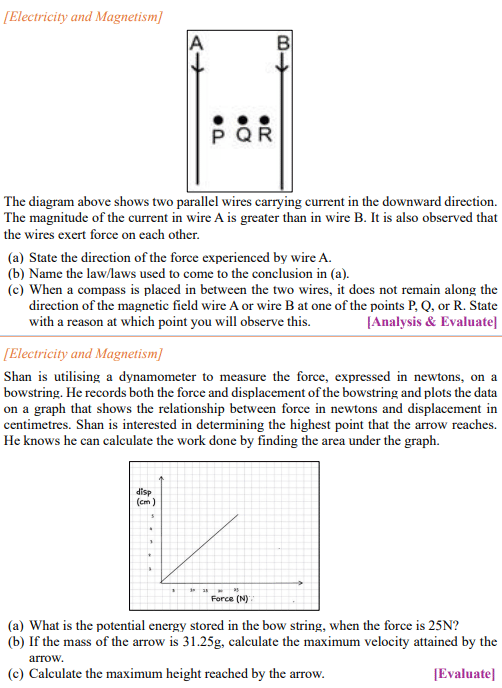
Mega Practice 4: Competency-Based Questions Class 10 ICSE Physics 2026
You can find some practice questions of 4-marks. These might help you with the long-answer questions section of the physics paper:
01 30 PM IST - 08 Mar'26
Mega Practice 3: Competency-Based Questions Class 10 ICSE Physics 2026
Check out some 3-mark short-answer questions below for physics exam prep:
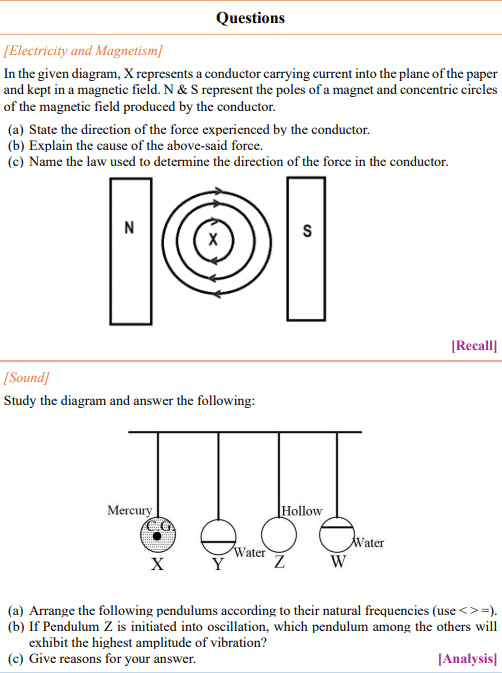
01 15 PM IST - 08 Mar'26
Mega Practice 2: Competency-Based Questions Class 10 ICSE Physics 2026
Check out some 2-mark short-answer questions below for you to practice for the physics exam:
Q: Anu and Amy purchased ice creams in plastic balls and cones, respectively, during their outing at the science fair. After consuming their ice creams, Anu stated that regardless of whether they were filled with ice cream or empty, the centre of gravity of the objects would remain unchanged. Do you agree with Anu? Why?
Q: Regenerative braking involves harnessing the energy that is typically lost when a car decelerates and brakes and instead using it to recharge the car's batteries. Unlike traditional braking systems that simply dissipate energy, regenerative braking allows some of that energy to be recycled.
(a) What is the energy conversion process that results in the wastage of energy in a normal car during braking?
(b) How does regenerative braking differ from normal braking in terms of energy conversion?Q: When Shyam, the band leader, struck both the bass drum and the kettle drum with equal force, the bass drum emitted a sound measuring 120 dB, whereas the kettle drum produced 90 dB. Explain this discrepancy in the loudness.
Q: There are two copper wires of length ratio 1:2 that have their cross-sectional areas in the ratio 1:4. What will be the ratio of their:
(a) resistances?
(b) specific resistances?Q: AB is an object, and PQ is its real, inverted image. The lengths of AB and PQ are equal. This is possible when a lens is present between the object and its image.
(a) What kind of lens is used here? Also, state the position of the lens and where it is to be placed.
(b) Name a device where this lens action is used.
01 00 PM IST - 08 Mar'26
Mega Practice 1: Competency-Based Questions Class 10 ICSE Physics 2026
Check out some 1-mark MCQs below for you to practice for the physics exam:
Question
Topic
When light enters from air to glass, it bends toward the normal. If red, blue, and yellow colours are allowed to enter the same glass block at the same angle of incidence, then for which colour, the value of ∠i − ∠r be greater?
(a) green
(b) red
(c) blue
(d) yellow
Light
Assertion (A): When light passes through a triangular prism, it is observed that for two angles of incidence, the angle of deviation is the same.
Reason (R): According to the principle of reversibility, the light retraces the path in reversing the direction.
(a) A and R are true, and R is the reason for A.
(b) A and R are true, and R is not the reason for A.
(c) A is true, but R is false.
(d) A is false, but R is true.
Light
During his experiments with a single movable pulley, Jas determined the effort, mechanical advantage and efficiency as X, Y & Z respectively. After lubricating the pulley thoroughly, he recalculated them as X′, Y′ & Z′. Which relationship is correct?
(a) X′ > X
(b) Y′ < Y
(c) Z′ > Z
(d) Z′ = Z
Force, Work, Power and Energy
Assertion: For a glass block, the i vs r graph is a straight line.
Reason: When a ray of light undergoes refraction, it follows Snell's law.
(a) Both Assertion and Reason are true, and the Reason is the correct explanation of the Assertion.
(b) Both Assertion and Reason are true, but Reason is not the correct explanation of the Assertion.
(c) Assertion is true, but the Reason is false.
(d) Assertion is false, but the Reason is true.
Light
________ of UV > ________ of microwaves.
The quantity suitable for filling both blanks is:
(a) speed in vacuum
(b) speed in a medium
(c) frequency
(d) wavelength
Sound
Data: mass = 10 g, heat supplied = 120 J, rise in temperature = 10°C.
STATEMENT A: The heat capacity of the substance is 12 J/g.
STATEMENT B: The specific heat capacity of the substance is 1.2 J/gK.
(a) Only statement A is correct.
(b) Only statement B is correct.
(c) Both statements A and B are correct.
(d) Both statements A and B are incorrect.
Heat
Resistivity of Gold = 2.1 × 10⁻⁸ Ωm
Resistivity of Platinum = 10.5 × 10⁻⁸ Ωm
STATEMENT A: 5 metres of platinum wire will have the same resistance as 1 metre of gold wire.
STATEMENT B: Gold wire of 1 cm radius will have the same resistance as platinum wire of 5 cm radius.
(a) Only statement A is correct.
(b) Only statement B is correct.
(c) Both statements A and B are correct.
(d) Both statements A and B are incorrect.
Electricity and Magnetism
Assertion: A switch will serve the purpose of making and breaking a circuit when it is connected to the neutral wire.
Reason: Neutral wire is at zero potential.
(a) Both Assertion and Reason are true, and the Reason is the correct explanation of the Assertion.
(b) Both Assertion and Reason are true, but Reason is not the correct explanation of the Assertion.
(c) Assertion is true, but the Reason is false.
(d) Both Assertion and Reason are false.
Electricity and Magnetism
12 45 PM IST - 08 Mar'26
Short Notes on Work
Work is said to be done when a force causes displacement in the direction of the force.
Formula
W = F × s × cosθ
Where
F = force
s = displacement
θ = angle between force and displacementSpecial Cases
θ = 0°
Force and displacement are in the same direction.
W = F × s
Work is maximum.
θ = 90°
Force is perpendicular to displacement.
W = 0
Example: Carrying a bag while walking.
12 30 PM IST - 08 Mar'26
Centripetal and Centrifugal Force
Examples
Planets revolving around the Sun
A stone tied to a string while rotating
Centrifugal Force This is the apparent force that pushes the body away from the centre.
Example: When a car takes a sharp turn, passengers feel pushed outward.
12 15 PM IST - 08 Mar'26
Uniform Circular Motion
When a body moves in a circular path with constant speed, the motion is called uniform circular motion.
Example: A stone tied to a string and whirled in a circle.
Even though the speed remains constant, the direction keeps changing. Because of this change in direction, the body has acceleration.
This acceleration is called centripetal acceleration.12 00 PM IST - 08 Mar'26
ICSE Physics Short Notes: Centre of Gravity
The centre of gravity is the point through which the entire weight of a body appears to act.
If a body is supported at this point, it will balance in any direction.
Examples
Regular bodies -
- Sphere → centre
- Uniform rod → midpoint
- Square plate → intersection of diagonals
Irregular bodies -
The centre of gravity is found experimentally by suspending the object from different points and drawing vertical lines.
- Sphere → centre
11 45 AM IST - 08 Mar'26
Most Important Formulas from Sound for Numericals
Students usually get numericals only from these:
- v = fλ
- d = vt / 2
- t = 2d / v
11 30 AM IST - 08 Mar'26
“Sound” Chapter Important Relations
Loudness Relation
Loudness ∝ Intensity
And:
Intensity ∝ Amplitude²
So:
Loudness ∝ Amplitude²
Pitch Relation
Pitch ∝ Frequency
Where:
Higher frequency → Higher pitch
Lower frequency → Lower pitch
11 15 AM IST - 08 Mar'26
Important Formulas 2 - Sound
For echo to be heard separately:
Minimum time gap = 0.1 s
Minimum distance formula:
d = vt / 2
Using standard values:
v ≈ 340 m/s
t = 0.1 s
Minimum distance:
d ≈ 17 m
So:
Minimum distance for echo ≈ 17 m
SONAR Formula
Depth or distance measured using SONAR:
d = vt / 2
Where:
d = depth or distance
v = speed of sound in water
t = time taken for echo to return
Typical value:
Speed of sound in water ≈ 1500 m/s
Intensity of Sound (Concept Relation)
Sound intensity depends on amplitude:
I ∝ A²
Where:
I = intensity of sound
A = amplitude of vibration
11 00 AM IST - 08 Mar'26
Important Formulas 1 - Sound (ICSE Class 10
v = fλ
Where:
v = speed of sound
f = frequency
λ = wavelength
Echo Formula (Distance Method)
Distance between observer and reflecting surface:
d = vt / 2
Where:
d = distance from reflector
v = speed of sound
t = time taken to hear echo
Note:
Sound travels twice the distance (to obstacle and back)
Time for Echo
t = 2d / v
Where:
t = time between sound and echo
d = distance from reflecting surface
v = speed of sound
10 45 AM IST - 08 Mar'26
Specimen Paper Physics Class 10 ICSE 2026
You can download the specimen paper for Physics 2026 from here! Take out some time today and try solving this entire question paper.
10 30 AM IST - 08 Mar'26
How to Get the "Extra Edge" for Full Marks
- Before solving a numerical, write the formula in its standard form. Even if your calculation goes wrong, you secure "Step Marks."
- If a question doesn't specify, write "Assuming no heat loss to the surroundings" in Calorimetry or "Neglecting the weight of the string" in Pulley systems. This shows expert-level depth.
- Even if not asked, draw a small, neat representative diagram for displacement-time graphs or circuit connections. Use a sharp pencil; never draw diagrams with a pen.
- Examiners look for specific terms like Magnitude, Direction, Constant Speed, or Instantaneous. Underlining these ensures they don't miss your core point.
10 15 AM IST - 08 Mar'26
Topper’s Strategy to Attempt the Exam
Given below are the phase-wise topper’s tips to attempt the exam tomorrow:
Phase
Strategy
Reading Time (15 mins)
Do not start solving. Use this to select the 4 questions in Section B. Avoid questions with lengthy, multi-part numericals unless you are 100% sure of the final decimal.
Section A (Compulsory)
Be crisp. Use scientific keywords. For "Give Reason" questions, identify the core principle (LIKE, Inertia, Conservation of Momentum) and underline it.
Section B (Choice)
Start with your strongest chapter. If you are great at Radioactivity or Machines, finish those first to build momentum.
The 10-Minute Buffer
Always finish 10 minutes early to re-check the signs in numericals (+ vs -) and ensure every final answer is boxed with its unit.
10 00 AM IST - 08 Mar'26
Expert Preparation Tips for Physics 2026
We have provided some of the suggestions and tips given by subject matter experts to prep for the physics exam tomorrow:
- For ICSE, the Selina Concise Physics book is the gold standard. Toppers suggest revising it at least 3-5 times. Pay close attention to the blue boxes and summary points at the end of each chapter.
- Solve at least 20 numericals today. Focus specifically on Electricity (circuit-based problems) and Calorimetry (method of mixtures).
- In Physics, a magnitude without a unit is zero marks. Memorise SI and CGS units for every physical quantity.
- Try focusing on high-weightage chapters today, including Light, Sound, and Modern Physics.
09 45 AM IST - 08 Mar'26
Principle of Moments
For a body in equilibrium, the sum of clockwise moments about a point equals the sum of anticlockwise moments about that point.
Clockwise moment = Anticlockwise moment
This principle is used in devices like balances, see-saws, and levers.09 30 AM IST - 08 Mar'26
Conditions for Equilibrium
1. Translational Equilibrium
The net force acting on the body is zero.
Total upward force = Total downward force
2. Rotational Equilibrium
The sum of clockwise moments equals the sum of anticlockwise moments.
Clockwise moment = Anticlockwise moment
This is known as the Principle of Moments.
09 15 AM IST - 08 Mar'26
Turning Effect of Force (Moment of a Force / Torque)
Sometimes a force makes an object rotate instead of moving straight. This turning effect of force is called the moment of a force or torque.
Definition - Moment of a force is the turning effect produced by a force about a fixed point or axis.
Formula -
Moment = Force × Perpendicular distance from pivot
M = F × d
SI unit: Newton metre (N m)
CGS unit: dyne centimetre (dyne cm)The fixed point about which rotation occurs is called the pivot or axis.
Some everyday examples include:
- Opening or closing a door
- Turning a steering wheel
- Pedalling a bicycle
- Using a spanner to tighten a bolt
09 00 AM IST - 08 Mar'26
ICSE Physics Short Notes: Translational and Rotational Motion
Motion of a body can occur in two basic ways.
Translational motion: In translational motion, the whole body moves from one place to another in the same direction.
Example: A car moving on a road.Rotational motion: In rotational motion, the body rotates about a fixed point or axis.
Many objects show both motions together, such as a rolling wheel.
Example: A fan rotating around its axis.08 45 AM IST - 08 Mar'26
Important Relationships in “Light” Chapter
Relationship Between Power and Focal Length
f = 1 / P
Deviation in Prism (Basic Relation)
For a prism:
δ = i + e − A
Where:
δ = angle of deviation
i = angle of incidence
e = angle of emergence
A = angle of prism
(Used in prism problems conceptually)
Electromagnetic Spectrum Order (Increasing Wavelength)
Gamma Rays < X-Rays < Ultraviolet < Visible Light < Infrared < Microwaves < Radio Waves
08 30 AM IST - 08 Mar'26
Important Formulas 3 - Light
1/f = 1/v + 1/u
Where:
f = focal length of lens
v = image distance
u = object distance
Magnification (Lens)
m = v / u
Also:
m = hi / ho
Where:
m = magnification
v = image distance
u = object distance
hi = height of image
ho = height of object
Power of a Lens
P = 1 / f
Where:
P = power in dioptres (D)
f = focal length in metres
08 15 AM IST - 08 Mar'26
Important Formulas 2 - Light
µ = sin i / sin r
Where:
i = angle of incidence
r = angle of refraction
µ = refractive index
Condition for Undeviated Ray
A ray passes undeviated when:
Angle of incidence = 0°
or when it passes through the optical centre of a lens.
Critical Angle Formula
For light travelling from denser medium → rarer medium:
µ = 1 / sin C
or
sin C = 1 / µ
Where:
C = critical angle
µ = refractive index of denser medium
08 00 AM IST - 08 Mar'26
Important Formulas 1 - Light (ICSE Class 10)
Speed of Light
Speed of light in vacuum:
c = 3 × 10^8 m/s
Approximate speeds in media:
Speed in air ≈ 3 × 10^8 m/s
Speed in water ≈ 2.25 × 10^8 m/s
Speed in glass ≈ 2 × 10^8 m/s
Wave Equation of Light
Relationship between speed, frequency, and wavelength:
V = fλ
Where:
V = speed of light in medium
f = frequency
λ = wavelength
Refractive Index
Absolute refractive index:
µ = c / V
Where:
µ = refractive index of medium
c = speed of light in vacuum
V = speed of light in medium
Typical values:
Water ≈ 1.33
Glass ≈ 1.5
Diamond ≈ 2.42
07 45 AM IST - 08 Mar'26
Some more formulas under the “Force, Work, Power & Energy” topic
Mechanical Advantage
Mechanical Advantage = Load / Effort
MA = L / E
Velocity Ratio
Velocity Ratio = Velocity of Effort / Velocity of Load
VR = VE / VL
OR
VR = dE / dL
Where:
dE = distance moved by effort
dL = distance moved by loadEfficiency of Machine
Efficiency = Output Work / Input Work
η = Wo / Wi
Efficiency in percentage:
η = (Wo / Wi) × 100
Relation Between Efficiency, MA and VR
η = MA / VR
or
MA = η × VR
07 30 AM IST - 08 Mar'26
Force, Work, Power & Energy - Important Formulas 2
Power
Power = Work / Time
P = W / t
Units:
SI unit = Watt (W)
1 kW = 10³ W
1 MW = 10⁶ W
1 GW = 10⁹ WHorsepower:
1 hp = 746 WPotential Energy (Gravitational)
PE = mgh
Where:
m = mass
g = acceleration due to gravity
h = heightKinetic Energy
KE = ½ mv²
Where:
m = mass
v = velocityMechanical Energy
Mechanical Energy = Kinetic Energy + Potential Energy
ME = KE + PE
ME = ½ mv² + mgh
Law of Conservation of Energy
Total Energy = Constant
PE + KE = Constant
mgh + ½ mv² = constant
07 15 AM IST - 08 Mar'26
Force, Work, Power & Energy - Important Formulas 1
Moment of Force (Torque)
Moment of Force (Torque) = Force × Perpendicular distance from pivot
τ = F × d
SI Unit: N m
CGS Unit: dyne cmPrinciple of Moments (Equilibrium Condition)
For a body in rotational equilibrium:
Clockwise moment = Anticlockwise moment
F₁ × d₁ = F₂ × d₂
Work
Work = Force × Displacement × cosθ
W = F × s × cosθ
Special cases:
θ = 0°
W = F × sθ = 90°
W = 0Work Done Against Gravity
W = mgh
Where:
m = mass
g = acceleration due to gravity
h = height07 00 AM IST - 08 Mar'26
SI Units Part 4: Standard prefixes
Check out some standard prefixes below for quick revision:
Multiple (factor)
Prefix
Symbol
10⁹
giga
G
10⁶
mega
M
10³
kilo
k
10⁻¹
deci
d
10⁻²
centi
c
10⁻³
milli
m
10⁻⁶
micro
µ
10⁻⁹
nano
n
10⁻¹²
pico
p
10⁻¹⁵
femto
f
06 45 AM IST - 08 Mar'26
SI Units Part 3: Derived units with special names
Take a quick look at the derived units, which are given special names due to their complexity:
Derived quantity
Unit name
Symbol
Force
newton
N
Pressure
pascal
Pa
Energy, Work
joule
J
Power
watt
W
Frequency
hertz
Hz
Electric charge
coulomb
C
Electric resistance
ohm
Ω
Electromotive force
volt
V
06 30 AM IST - 08 Mar'26
SI Units Part 2: Derived units
Take a quick look at the derived units, which are obtained from fundamental units using multiplication or division:
Derived quantity
Unit name
Symbol
Volume
cubic metre
m³
Density
kilogram per cubic metre
kg m⁻³
Velocity
metre per second
m s⁻¹
Acceleration
metre per second square
m s⁻²
Momentum
kilogram metre per second
kg m s⁻¹
06 15 AM IST - 08 Mar'26
SI Units Part 1: Fundamental units
Take a quick look at the fundamental (basic) units:
Fundamental quantity
Unit name
Symbol
Mass
kilogram
kg
Length
metre
m
Time
second
s
Electric current
ampere
A
Temperature
kelvin
K
Luminous intensity
candela
cd
Amount of substance
mole
mol
06 00 AM IST - 08 Mar'26
Physics Exam 2026: Last-Minute Important Questions, Short Notes, Formulas
Now that you are aware of the exam date & timing, paper pattern, total marks, and question types, we will roll out syllabus topics, important questions, topic-wise formulas, short notes for revision, previous year questions, etc. Stay tuned!
05 45 AM IST - 08 Mar'26
Expected Chapter-Wise Weightage
The expected marks distribution and important concepts for each chapter from the syllabus are provided in the table below.
Chapter
Expected Weightage
Key Topics
Force, Work, Power, and Energy
16 to 19 Marks
Laws of motion and types of forces, work, power, energy, and energy conservation.
Light
20 to 25 Marks
Reflection, refraction, lenses, optical instruments
Sound
11 to18 Marks
Sound waves and nature, wave characteristics, resonance, musical instruments
Electricity and magnetism
20 to 21 Marks
Electric circuits, Ohm's law, magnetic fields, electromagnetism, electromagnetic induction
Heat
14 to 18 Marks
Thermal expansion, temperature scales, specific heat capacity, and latent heat
Modern Physics
07 to 11 Marks
Atomic arrangement, radioactivity, fission, fusion, and uses of radioactivity.
05 30 AM IST - 08 Mar'26
Total Questions in Physics Paper
The total number of questions you can expect in each section is:
Section
No. of Questions
Type of Questions
Instructions
Section A
Three
MCQs, short-answer, numericals
All questions are compulsory
Section B
Six
Long answer, diagram-based numericals
Attempt any four
05 15 AM IST - 08 Mar'26
Physics Exam Pattern Explained
The Physics paper will be for 80 marks and is divided into Section A and Section B. Section A carries 40 marks and is compulsory, while Section B also carries 40 marks, where students usually get internal choices between questions.
05 00 AM IST - 08 Mar'26
ICSE Physics Exam Date and Time
The ICSE Physics Exam 2026 (Science Paper 1) will be conducted on March 9, 2026, from 11:00 AM to 1:00 PM. Students will also get 15 minutes of reading time before the exam begins to read the question paper and plan their answers carefully.