

 Maharashtra HSC Biology Exam 2026 LIVE
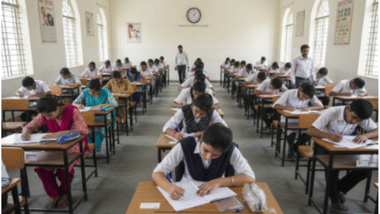
Maharashtra HSC Biology Exam 2026 is over! The total duration was three hours, and the exam ended at 2 PM. As per the reviews collected by actual test takers, the overall difficulty level of the Biology exam is reported to be "Easy to Moderate." Students were able to answer all MCQs correctly. Section B & C also included straightfoward questions, completely based on the prescribed syllabus, with no major surprises. The solved question paper and difficulty level has been shared here, based on feedback from students and expert analysis.
Maharashtra HSC Biology Exam 2026: Unofficial Answer Key
The unofficial Maharashtra HSC Biology Answer Key 2026 has been updated below:
Question | Answer |
|---|---|
| (i) A cell divides mitotically into two... Such growth is called: | (b) geometric growth |
| (ii) Transgenic Tomato contains transgene ______ for flavonoids. | (c) Chalcone isomerase |
| (iii) The cranial capacity of Neanderthal man was ______ C.C. | (c) 1400 |
| (iv) Organism meeting requirements by degrading detritus: | (d) Saprotrophs |
| (v) Identify the algae among the following: | (a) Spirulina spp. |
| (vi) Soluble food is always translocated in the form of: | (c) sucrose |
| (vii) Identify invasive plant species from the following: | (d) Parthenium |
| (viii) Mature plasma cell produces antibodies at the rate of: | (a) 2000 molecules/sec |
| (ix) Which is the largest WBC among the following? | (b) Monocyte |
| (x) Number of deaths under environmental pressures: | (c) realized mortality |
Stay tuned to the LIVE Blog for more updates on Maharashtra HSC Biology Exam 2026, answer key, reviews, paper analysis and more.
Maharashtra HSC Biology Exam 2026 LIVE
05 00 PM IST - 25 Feb'26
Maharashtra HSC Biology Exam Live Blog Ends
Maharashtra HSC Biology Exam 2026 live coverage now comes to an end. We’ve shared the paper analysis, answer key, and student reactions throughout the day. Stay connected for more updates on upcoming Maharashtra HSC exams and important announcements.
04 00 PM IST - 25 Feb'26
Upcoming Maharashtra HSC Exams
The next HSC exam is Book Keeping & Accountancy, scheduled for tomorrow, February 26, 2026. The timings are 11 AM to 2 PM.
03 10 PM IST - 25 Feb'26
HSC Biology 2026 Paper Analysis
As the exam concluded, we talked to multiple students and test takers. Most of them found the exam to be quite easy. Many questions were directly based on the textbook and previous year patterns. MCQs were very easy, while long-answer questions were clear and scoring overall.
02 05 PM IST - 25 Feb'26
Biology Exam Over!
Maharashtra HSC Biology Exam 2026 has concluded successfully. Students are now stepping out of exam centres after completing the paper. Stay tuned as we will soon share the detailed answer key, section-wise paper analysis, difficulty level, and student reactions shortly.
09 00 AM IST - 25 Feb'26
HSC Board Biology Exam 2026 Maharashtra: 2 Hours Left for the Exam to Commence
Candidates have started reporting to the examination hall for pre-identity verification formalities. The invigilator will check the documents, and the admit card before allowing the candidates to take the test.
08 30 AM IST - 25 Feb'26
Traffic "Rider" Assistance for Students
Recognizing the stress of reaching centers on time, local authorities (particularly in high-traffic zones like Thane and Mumbai) have deployed special measures.
Update: Traffic police have deployed "Rider Squads" to assist students stuck in congestion or vehicle breakdowns.
Emergency: If you are significantly delayed due to an accident or traffic, approach the nearest traffic constable. Students showing a valid Hall Ticket are being given priority passage and, in some cases, transport assistance to reach their center by the 10:30 AM cutoff.
08 00 AM IST - 25 Feb'26
HSC Board Biology Exam 2026 Maharashtra: 10-Minute Reading Time Clarification
There has been some confusion regarding the extra 10 minutes.
The Rule: MSBSHSE has confirmed that question papers will not be distributed early. Instead, students will be given 10 extra minutes at the end of the exam to complete their writing and review their paper.
Strategy: Do not wait for early distribution at 10:50 AM. The paper will start at 11:00 AM, and you will now have until 2:10 PM to finish.
07 30 AM IST - 25 Feb'26
The "Yellow Box" Alert (Section A & B)
The 18 marks in Section A (MCQs) and Section B (VSA) are increasingly being pulled from the "Do You Know," "Find Out," and "Always Remember" yellow boxes in the MSBSHSE textbook.
Focus Areas:
Scientific Names: Plasmodium vivax, Thermus aquaticus (Taq polymerase).
Hormone Sources: Which cells specifically secrete Testosterone (Leydig cells) or Estrogen (Graafian follicle)?
Pollination Terms: Definitions of Ornithophily (birds), Anemophily (wind), and Chiropterophily (bats).
07 00 AM IST - 25 Feb'26
HSC Board Biology Exam 2026 Maharashtra: Marking Scheme "Secret" for Section C
In the 3-mark questions (Section C), the Maharashtra Board follows a 1+2 or 1.5+1.5 split.
The Strategy: If a question asks to "Describe the structure and function of X," the diagram usually carries 1 to 1.5 marks, and the points carry the rest.
Live Tip: Never leave a Section C question as just text. Even a rough, correctly labeled schematic can get you that crucial 1.5-mark "cushion" even if your explanation is incomplete.
06 30 AM IST - 25 Feb'26
Strict Conduct & Prohibited Items
The Board has intensified its "Copy-Free Mission" for 2026.
Prohibited: Any digital/smartwatches, calculators (only Log Tables are allowed, if provided/permitted), and mobile phones.
Allowed: Transparent water bottles, basic stationery in a transparent pouch, and your original Hall Ticket.
Tip: Wear simple clothing without large pockets to speed up the frisking process at the gate.
06 00 AM IST - 25 Feb'26
HSC Board Biology Exam 2026 Maharashtra: Exam Today from 11 AM
Only a few hours is left for the test. The exam will begin today, February 25, from 11 AM, and conclude at 2 PM.
05 30 AM IST - 25 Feb'26
Maharashtra HSC Biology Exam 2026: "Section A" VSA (Very Short Answer) Traps
The 8 one-sentence questions in Section B of Section A are often "Definition" or "One-word" based. Focus on these 2026 "High-Probability" terms:
Capillarity: Regarding water transport in plants.
Statins: Mention they are blood-cholesterol-lowering agents produced by the yeast Monascus purpureus.
Biopiracy: Definition regarding unauthorized use of bio-resources.
Retrovirus: Definition in the context of HIV/AIDS.
05 00 AM IST - 25 Feb'26
Maharashtra HSC Biology Exam 2026: Biotechnology: The "Temperature & Enzyme" Rule
In the Biotechnology unit, specifically for PCR (Polymerase Chain Reaction), the Board is now looking for specific numerical and technical accuracy.
Precision Matters: You must mention the temperatures: Denaturation (91 degree celsius), Annealing (55 degree celsius), and Extension (72 degree celsius).
Enzyme Name: Always specify Taq Polymerase and mention it is derived from the bacterium Thermus aquaticus.
04 30 AM IST - 25 Feb'26
Maharashtra HSC Biology Exam 2026: Genetic Crosses: Scoring Without Errors
Section C often includes a 3-mark genetic problem.
Update: If asked for a Dihybrid Cross, do not skip the Punnett Square. Even if you write the phenotypic ratio (9:3:3:1) correctly, you will lose 2 marks if the checkerboard is missing.
Live Tip: Clearly mention the "Parents," "Gametes," and "F1/F2 Generations" on the left margin of your cross to get full marks for presentation.
04 00 AM IST - 25 Feb'26
Maharashtra HSC Biology Exam 2026: The "100% Guaranteed" Diagram Checklist
Based on paper-setting trends for 2026, the Board is leaning heavily toward Functional Anatomy. Ensure you can draw these four from memory in under 3 minutes each:
T.S. of Anther: Must show all four layers (Epidermis, Endothecium, Middle layers, and Tapetum).
Anatropous Ovule: Clearly label the Chalaza, Micropyle, and the 7-celled, 8-nucleate embryo sac.
Human Sperm: Essential for Section B or C. Label the Acrosome and Mitochondria (Nebenkern) clearly.
03 30 AM IST - 25 Feb'26
Maharashtra HSC Biology Exam 2026: Strict "Log Table" and Stationery Protocols
For the 2026 session, the Board has issued a final reminder on permitted materials.
Update: While Biology is less numerical, if any calculation is required (e.g., in Population Ecology or Genetics), you must only use the official Log Tables provided by the center.
Stationery: Only Blue or Black ink pens are allowed for writing. Use a pencil only for diagrams. Using a highlighter or sketch pen on the answer sheet is strictly prohibited and can lead to the paper being flagged.
03 00 AM IST - 25 Feb'26
Maharashtra HSC Biology Exam 2026: Handling the "Comparison" Questions
Section B and C are expected to have at least two "Distinguish Between" questions (e.g., Arteries vs. Veins or Innate vs. Acquired Immunity).
New Scoring Note: For full marks, the Board prefers point-wise tabular formats. Avoid writing comparisons in paragraphs.
Requirement: For a 2-mark question, provide 4 points; for a 3-mark question, provide 6 points.
02 30 AM IST - 25 Feb'26
Final Revision Strategy (Expert Tip 17) - Don't Ignore the "Ecology" Units
Chapters 13–15 are often neglected. They are easy, 12–14 marks of "pure theory." Revise Ecological Pyramids and Biodiversity Conservation to boost your final percentage.
02 00 AM IST - 25 Feb'26
Final Revision Strategy (Expert Tip 16) - The "Diagram Marathon"
Spend 1 hour tonight doing nothing but drawing and labeling the top 15 diagrams from your textbook without looking.
01 30 AM IST - 25 Feb'26
Final Revision Strategy (Expert Tip 15) - Solving Previous Papers (PYQs)
The Maharashtra Board frequently repeats concepts from the last 5 years. Solve the 2024 and 2025 papers today to get a feel for the "Difficulty Curve."
01 00 AM IST - 25 Feb'26
Maha HSC Biology Paper 2026: Final Revision Strategy (Expert Tip 14) - Handling "Describe" Questions
When a question says "Describe," it means: Definition + Diagram + Working/Function. Missing any of these three will result in a mark deduction.
12 30 AM IST - 25 Feb'26
Maha HSC Biology Paper 2026: Final Revision Strategy (Expert Tip 13) - The "Reverse Order" Option
If you are slow at writing, consider starting with Section D (Long Answers) while your energy and memory are fresh, then work back to Section B.
12 00 AM IST - 25 Feb'26
Maha HSC Biology Paper 2026: Final Revision Strategy (Expert Tip 12) - Section A Speed Run
Aim to finish the 10 MCQs and 8 VSAs in under 25 minutes. These are 18 "pure" marks that set the tone for your paper.
11 30 PM IST - 24 Feb'26
Final Revision Strategy (Expert Tip 11) - The "First 15 Minutes" Strategy
Use the reading time to identify which 8 out of 12 questions you will attempt in Sections B and C. Don't waste time on questions you're "50-50" about.
11 00 PM IST - 24 Feb'26
Final Revision Strategy (Expert Tip 10) - Biotechnology – The Step-by-Step Guide
Memorize the specific temperatures for the PCR cycle: Denaturation (91 degree celsius), Annealing (55 degree celsius), and Extension (72 degree celsius).
10 30 PM IST - 24 Feb'26
Final Revision Strategy (Expert Tip 9) - Control & Coordination – The Hormone Chart
Create a quick table for all Pituitary and Thyroid hormones, their functions, and disorders caused by their deficiency/excess.
10 00 PM IST - 24 Feb'26
Final Revision Strategy (Expert Tip 8) - Physiology – The Mechanism Mastery
For Respiration and Circulation, focus on the "Mechanism of Breathing" and the "Cardiac Cycle."
09 30 PM IST - 24 Feb'26
Final Revision Strategy (Expert Tip 7) - Molecular Biology – The "Process" Focus
Master the flowcharts for DNA Replication, Transcription, and Translation. If you forget the theory, drawing the flowchart correctly will still get you partial marks.
09 00 PM IST - 24 Feb'26
Final Revision Strategy (Expert Tip 6) - Genetics – Logic Over Rote Learning
Don't memorize crosses; understand the logic. Practice the Dihybrid Cross Punnett square at least twice before the exam.
08 30 PM IST - 24 Feb'26
Final Revision Strategy (Expert Tip 5) - Reproduction – The Diagram Mine
Focus on the Anatropous Ovule, T.S. of Anther, and the Human Sperm. These are "Board Favorites."
08 00 PM IST - 24 Feb'26
Final Revision Strategy (Expert Tip 4) - Comparison Tables
For "Distinguish between" questions, always use a table. It shows clarity of thought and is easier to grade.
07 45 PM IST - 24 Feb'26
MSBSHSE Class 12 Biology Exam 2026: Final Revision Strategy (Expert Tip 3) - Point-Wise Answers
Avoid long paragraphs. Break your answers into numbered points. For a 4-mark question, aim for at least 6–8 distinct, logical points.
07 30 PM IST - 24 Feb'26
Final Revision Strategy (Expert Tip 2) - Keyword Underlining
Examiners look for specific biological terms (e.g., Double Fertilization, Acrosome, Homeostasis). Highlight these to make their job easier and your marks higher.
07 15 PM IST - 24 Feb'26
MSBSHSE Class 12 Biology Exam 2026: Final Revision Strategy (Expert Tip 1) - Diagram-First Policy
In Sections C and D, a diagram is often mandatory. Even if not explicitly asked, a neat sketch can salvage a weak theoretical answer. Use a sharp pencil and label only on one side for a professional look.
07 00 PM IST - 24 Feb'26
Scoring Unit for Revision 6 - Genomics and HGP
Small but vital. Be ready for 1-mark or 2-mark questions on the "Goals of the Human Genome Project."
06 45 PM IST - 24 Feb'26
MSBSHSE Class 12 Biology Exam 2026: Scoring Unit for Revision 5 - Environmental Issues
Key areas include the Greenhouse Effect, Global Warming, and Eutrophication in water bodies.
06 30 PM IST - 24 Feb'26
Scoring Unit for Revision 4 - Biodiversity and Conservation
Understand the "Causes of Biodiversity Loss" and the difference between In-situ and Ex-situ conservation methods.
06 15 PM IST - 24 Feb'26
MSBSHSE Class 12 Biology Exam 2026: Scoring Unit for Revision 3 - Ecosystems and Energy Flow
Focus on the Pyramid of Energy (always upright) and the stages of Decomposition (Fragmentation, Leaching, Catabolism).
06 00 PM IST - 24 Feb'26
Scoring Unit for Revision 2 - Organisms and Populations
Theory-based. Memorize the types of Biotic Interactions: Mutualism, Commensalism, Parasitism, and Competition.
05 45 PM IST - 24 Feb'26
MSBSHSE Class 12 Biology Exam 2026: Scoring Unit for Revision 1 - Human Health and Diseases
Focus on the structure of an Antibody, types of Immunity (Innate vs. Acquired), and the life cycle of the Malaria Parasite.
05 30 PM IST - 24 Feb'26
High-Priority Unit for Revision 7 - Enhancement of Food Production
Focus on Plant Breeding, Tissue Culture (Totipotency), and the role of Microbes in Sewage Treatment.
05 15 PM IST - 24 Feb'26
High-Priority Unit for Revision 6 - Origin and Evolution of Life
Evolutionary theories. Key topics: Urey-Miller's Experiment and the Modern Synthetic Theory of Evolution.
05 00 PM IST - 24 Feb'26
High-Priority Unit for Revision 5 - Inheritance and Variation
Mendelian genetics. Focus on Dihybrid Crosses, Incomplete Dominance, and Sex-linked Inheritance (Haemophilia/Colour blindness).
04 45 PM IST - 24 Feb'26
High-Priority Unit for Revision 4 - Molecular Basis of Inheritance
Logic-driven. You must know the DNA Replication steps and the Lac Operon model in E. coli.
04 30 PM IST - 24 Feb'26
High-Priority Unit for Revision 3 - Plant Water Relation
High probability of questions on Plasmolysis, Imbibition, and the Cohesion-Tension Theory for the ascent of sap.
04 15 PM IST - 24 Feb'26
Maharashtra 12th Biology Exam 2026: High-Priority Unit for Revision 2 - Plant Growth and Mineral Nutrition
Focus on plant hormones (Auxins, Gibberellins, Abscisic Acid) and the biological Nitrogen Fixation process.
04 00 PM IST - 24 Feb'26
Maharashtra 12th Biology Exam 2026: High-Priority Unit for Revision 1 - Biotechnology
The most technical chapter. Focus on the PCR Technique (Denaturation, Annealing, Extension) and the application of Restriction Enzymes.
03 45 PM IST - 24 Feb'26
Most Important Unit for Revision 4 - Reproduction in Lower and Higher Plants
Botanical core. The Anatropous Ovule structure and Double Fertilization are the most likely 4-mark questions here.
03 30 PM IST - 24 Feb'26
Most Important Unit for Revision 3 - Reproduction in Lower and Higher Animals
Centric to human biology. Master the Menstrual Cycle phases, the histology of the Testis and Ovary, and the process of Fertilization.
03 15 PM IST - 24 Feb'26
Maharashtra 12th Biology Exam 2026: Most Important Unit for Revision 2 - Respiration and Circulation
Heavy focus on human physiology. Key topics include the Internal Structure of the Heart, Double Circulation, and the mechanism of Blood Clotting.
03 00 PM IST - 24 Feb'26
Most Important Unit for Revision 1 - Control and Coordination
This is the highest-weightage chapter. Focus on the structure of the Human Brain, the Reflex Arc, and the functional differences between the Cerebrum and Cerebellum.
02 45 PM IST - 24 Feb'26
Maharashtra 12th Biology Exam 2026: Final Unit-Wise Mastery Checklist
Unit Key Areas for 2026 Focus Level Reproduction Pollen-pistil interaction, IVF/ZIFT/GIFT, and Oogenesis. High Genetics Pedigree analysis symbols, HGP (Human Genome Project) goals. High Physiology C3/C4 pathways, Respiratory Quotient (RQ), and Osmoregulation. Medium Control/Coordination Hormones (Pituitary & Thyroid) and the Reflex Arc. High Ecology Successions (Hydrarch/Xerarch) and Greenhouse effect. Medium 02 30 PM IST - 24 Feb'26
Short Notes on Respiration and Circulation: Structure of Lungs & Alveoli
Alveoli: The structural and functional unit of the respiratory system. They are thin-walled, moist, and vascularized to facilitate the exchange of O2 and CO2 by simple diffusion.
02 15 PM IST - 24 Feb'26
Short Notes on Organisms and Populations: Biotic Interactions
Mutualism: Both species benefit (+,+) e.g., Lichens.
Competition: Both are harmed (-,-).
Parasitism/Predation: One benefits, one harmed (+,-).
Commensalism: One benefits, other unaffected (+,0) e.g., Orchid on a mango tree.
02 00 PM IST - 24 Feb'26
Maharashtra 12th Biology Exam 2026: Short Notes on Enhancement of Food Production: Single Cell Protein (SCP) & Biofortification
- SCP: Protein-rich microbial biomass (e.g., Spirulina) used as a food supplement to solve malnutrition.
Biofortification: Breeding crops with higher levels of vitamins, minerals, or proteins (e.g., Vitamin A enriched rice).
01 45 PM IST - 24 Feb'26
Short Notes on Plant Water Relations: Plasmolysis & Imbibition
- Imbibition: Adsorption of water by hydrophilic colloids (like seeds/dry wood), causing them to swell. Crucial for seed germination.
Plasmolysis: When a plant cell is placed in a hypertonic solution, water leaves the cell, and the protoplast shrinks away from the cell wall.
01 30 PM IST - 24 Feb'26
Short Notes on Human Health & Diseases: Vaccination & Malaria
Vaccination: The process of introducing a weakened or inactivated pathogen (vaccine) into the body to stimulate the immune system to produce antibodies and "memory cells."
Malaria Life Cycle: Caused by Plasmodium. Important stages: Sporozoites (infective stage) injected by female Anopheles mosquito -> Liver cells -> RBCs (rupture causes chills/fever) -> Gametocytes
01 15 PM IST - 24 Feb'26
Maharashtra 12th Biology Exam 2026: Short Notes on Common Human Diseases
Malaria: Caused by Plasmodium, spread by female Anopheles mosquito.
AIDS: Caused by HIV, attacks T-helper cells.
Cancer: Uncontrolled cell division (Metastasis is the spread to other organs).
01 00 PM IST - 24 Feb'26
Short Notes on Types of Immunity
Innate: Non-specific, present from birth (skin, tears, WBCs).
Acquired: Specific, developed after exposure to pathogens.
Active: Body produces its own antibodies (after infection or vaccine).
Passive: Ready-made antibodies are injected (Snake antivenom).
12 45 PM IST - 24 Feb'26
Maharashtra 12th Biology Exam 2026: Short Notes on Reflex Action
A sudden, involuntary response to a stimulus.
Reflex Arc: Receptor -> Sensory Neuron -> Spinal Cord (Interneuron) -> Motor Neuron -> Effector (Muscle).
Example: Withdrawing a hand from a hot object.
12 30 PM IST - 24 Feb'26
Short Notes on Structure of the Human Brain
The largest part of the brain responsible for intelligence, memory, and voluntary actions. It is divided into two hemispheres connected by the Corpus Callosum. It contains functional areas like the motor area, sensory area, and Broca’s area (speech).
12 15 PM IST - 24 Feb'26
Maharashtra 12th Biology Exam 2026: Short Notes on Biodiversity Conservation
In-situ: Conserving species in their natural habitat (National Parks, Sanctuaries).
Ex-situ: Conserving species outside their habitat (Zoos, Botanical Gardens, Seed Banks).
12 00 PM IST - 24 Feb'26
Short Notes on Ecological Pyramids
Graphical representations of trophic levels.
Pyramid of Numbers/Biomass: Usually upright but can be inverted (e.g., parasites on a single tree).
Pyramid of Energy: Always upright because energy is lost as heat at each transfer (10% Law).
11 45 AM IST - 24 Feb'26
Short Notes on Sewage Treatment
Primary Treatment: Physical removal of floating debris and grit.
Secondary (Biological) Treatment: Uses aerobic microbes (flocs) to reduce BOD (Biochemical Oxygen Demand).
Tertiary: Chemical treatment (chlorination) before releasing into water bodies.
11 30 AM IST - 24 Feb'26
Maharashtra HSC Biology Exam 2026: Short Notes on Tissue Culture (Totipotency)
The technique of growing plant cells/tissues in a sterile nutrient medium.
Explant: The part of the plant used for culture.
Callus: An undifferentiated mass of cells.
Application: Micropropagation (producing thousands of plants quickly) and producing virus-free plants.
11 15 AM IST - 24 Feb'26
Short Notes on Recombinant DNA Technology (rDNA)
The process of joining DNA molecules from two different species.
Tools: Restriction Endonucleases (molecular scissors), Ligases, and Vectors (Plasmids).
Steps: Isolation of gene -> Insertion into vector -> Transformation into host -> Selection of recombinants.
11 00 AM IST - 24 Feb'26
Maharashtra HSC Biology Exam 2026: Short Notes on Mechanism of Nerve Impulse Conduction
Resting Potential: Neuron is polarized (high Na+ outside, high K+ inside).
Depolarization: Stimulus causes Na+ channels to open; Na+ rushes in.
Repolarization: K+ rushes out to restore the potential.
Synaptic Transmission: Neurotransmitters (like Acetylcholine) cross the synaptic cleft.
10 45 AM IST - 24 Feb'26
Short Notes on Double Circulation in Humans
The blood flows through the heart twice for every complete circuit:
Pulmonary Circulation: Right ventricle -> Lungs -> Left atrium.
Systemic Circulation: Left ventricle -> Body tissues -> Right atrium.
Benefit: Prevents mixing of oxygenated and deoxygenated blood, ensuring high efficiency.
10 30 AM IST - 24 Feb'26
Short Notes on Transpiration Pull Theory
Also known as the Cohesion-Tension theory. It explains the ascent of sap in tall trees.
Cohesion: Attraction between water molecules.
Adhesion: Attraction between water and xylem walls.
Tension: Created by the evaporation of water from leaves (transpiration), pulling the water column upward.
10 15 AM IST - 24 Feb'26
Short Notes on Lac Operon
A functional unit of DNA in E. coli that regulates lactose metabolism.
In absence of Lactose: The repressor protein binds to the operator, switching the "Off" gene.
In presence of Lactose: Lactose acts as an inducer, binds to the repressor, and allows RNA polymerase to transcribe the structural genes ($z, y, a$).
10 00 AM IST - 24 Feb'26
Maharashtra HSC Biology Exam 2026: Short Notes on DNA Replication (Semi-Conservative)
- Occurs in the S-phase of the cell cycle.
- Enzymes: Helicase (unzips), Primase (RNA primer), DNA Polymerase (adds nucleotides), and Ligase (joins fragments).
- Leading vs. Lagging: The leading strand is continuous; the lagging strand is made of short Okazaki fragments.
09 45 AM IST - 24 Feb'26
Short Notes on Law of Independent Assortment
Mendel’s third law states that when two pairs of traits are combined in a hybrid, the segregation of one pair of characters is independent of the other pair. This is best demonstrated via a Dihybrid Cross, resulting in a 9:3:3:1 phenotypic ratio.
09 30 AM IST - 24 Feb'26
Short Notes on Menstrual Cycle
Divided into four phases:
Menstrual Phase: Shedding of the endometrium (Days 1–5).
Proliferative Phase: Follicle-stimulating hormone (FSH) leads to follicle growth and estrogen rise (Days 6–13).
Ovulatory Phase: LH surge causes the release of the egg (Day 14).
Luteal Phase: Corpus luteum secretes Progesterone to maintain the uterus for pregnancy.
09 15 AM IST - 24 Feb'26
Maharashtra HSC Biology Exam 2026: Short Notes on Double Fertilization
A unique feature of Angiosperms involving two fusions:
Syngamy: One male gamete fuses with the egg to form a diploid Zygote ($2n$).
Triple Fusion: The second male gamete fuses with two polar nuclei to form the triploid Primary Endosperm Nucleus ($3n$).
Significance: Ensures nutritive endosperm is formed only if fertilization is successful.
09 00 AM IST - 24 Feb'26
Most Expected Question for Revision 17
Q: What is Recombinant DNA technology? List the steps involved.
A: 1. Isolation of DNA. 2. Fragmentation by Restriction Enzymes. 3. Ligation of DNA fragment into a Vector. 4. Transferring DNA into a Host cell. 5. Selection and culturing of host cells.
08 45 AM IST - 24 Feb'26
Most Expected Question for Revision 16
Q: Describe the structure and function of the Human Heart.
A: Detail the four chambers (2 auricles, 2 ventricles), the role of valves (Tricuspid, Bicuspid), and the path of double circulation.
08 30 AM IST - 24 Feb'26
Maharashtra HSC Biology Exam 2026: Most Expected Question for Revision 15
Q: Explain the Law of Independent Assortment using a Dihyroid cross.
A: State the law and provide the Punnett square for a cross between Round Yellow (RRYY) and Wrinkled Green (rryy) seeds, showing the 9:3:3:1 ratio.
08 15 AM IST - 24 Feb'26
Most Expected Question for Revision 14
Q: Describe the Human Male Reproductive System.
A: Must include details on Testes (seminiferous tubules), Accessory ducts (Epididymis, Vas deferens), Glands (Seminal vesicles, Prostate), and External genitalia.
08 00 AM IST - 24 Feb'26
Most Expected Question for Revision 13
Q: Explain the mechanism of DNA Replication with a diagram.
A: Focus on: 1. Origin of replication, 2. Unwinding by Helicase, 3. Synthesis of Leading strand (continuous) and Lagging strand (discontinuous Okazaki fragments), and 4. Joining by DNA Ligase.
07 45 AM IST - 24 Feb'26
Maharashtra HSC Biology Exam 2026: Most Expected Question for Revision 12
Q: Briefly explain the Carbon Cycle.
A: Carbon enters the biotic world through photosynthesis and returns to the atmosphere through respiration, decomposition of organic matter, and combustion of fossil fuels.
07 30 AM IST - 24 Feb'26
Most Expected Question for Revision 11
Q: Describe the properties of Water that make it a significant biological molecule.
A: High specific heat, high heat of vaporization, acting as a universal solvent, and its cohesive and adhesive forces (capillarity) which help in the transport of sap in plants.
07 15 AM IST - 24 Feb'26
Most Expected Question for Revision 10
Q: What is the significance of "Double Fertilization" in Angiosperms?
A: It involves two fusions: Syngamy (forming a diploid Zygote) and Triple Fusion (forming a triploid Primary Endosperm Nucleus). It ensures that the nutritive tissue (endosperm) is formed only if fertilization occurs, preventing wastage of energy.
07 00 AM IST - 24 Feb'26
Maharashtra HSC Biology Exam 2026: Most Expected Question for Revision 9
Q: Explain the three steps of PCR (Polymerase Chain Reaction).
A: 1. Denaturation: DNA is heated to 91 degree celsius to separate strands.
2. Annealing: Primers are added at 55 degree celsius.
3. Extension: DNA polymerase (Taq) adds nucleotides at 72 degree celsius.
06 45 AM IST - 24 Feb'26
Most Expected Question for Revision 8
Q: Explain the process of Gel Electrophoresis.
A: It is a technique used to separate DNA fragments based on their size. DNA is negatively charged and moves toward the anode through an agarose gel matrix. Smaller fragments move faster and further than larger ones.
06 30 AM IST - 24 Feb'26
Most Expected Question for Revision 7
Q: Describe the structure of the Antibody with a labeled diagram.
A: An antibody is a Y-shaped glycoprotein (Immunoglobulin). It consists of four polypeptide chains: two heavy (H) and two light (L) chains held by disulfide bonds. It has an "Antigen-binding site" called the Paratope.
06 15 AM IST - 24 Feb'26
Maharashtra HSC Biology Exam 2026: Most Expected Question for Revision 6
Q: Define Biopiracy.
A: Biopiracy is the unauthorized use of bioresources by multinational companies or organizations without proper authorization or compensation to the country or people concerned.
06 00 AM IST - 24 Feb'26
Most Expected Question for Revision 5
Q: What are the two types of Nucleic Acids? Mention their basic units.
A: DNA (Deoxyribonucleic Acid) and RNA (Ribonucleic Acid). Their basic structural units are Nucleotides.
05 45 AM IST - 24 Feb'26
Most Expected Question for Revision 4
Q: Define "Linkage" as proposed by T.H. Morgan.
A: Linkage is the tendency of two or more genes present on the same chromosome to be inherited together in the next generation.
05 30 AM IST - 24 Feb'26
Maharashtra HSC Biology Exam 2026: Most Expected Question for Revision 3
Q: Distinguish between Analogous and Homologous organs.
A: Homologous: Same structural origin but different functions (e.g., Forelimbs of whale and cat). Analogous: Different structural origin but perform similar functions (e.g., Wings of butterfly and bird).
05 15 AM IST - 24 Feb'26
Most Expected Question for Revision 2
Q: What is the function of the Acrosome in human sperm?
A: The acrosome contains hyaluronidase and acrosin enzymes that dissolve the layers of the ovum (zona pellucida), allowing the sperm to penetrate and fertilize the egg.
05 00 AM IST - 24 Feb'26
Maharashtra HSC Biology Exam 2026: Most Expected Question for Revision 1
Q: Define Parthenocarpy and give an example.
A: Parthenocarpy is the development of fruit without fertilization. This results in seedless fruits. Example: Banana, Grapes.