


 TG Inter 1st Year Botany Paper Analysis 2026 Live Updates: Difficulty Level Details; Answer Key & Expert Analysis
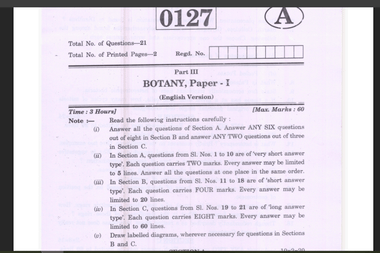
TG Inter 1st Year Botany 2026: The TG Inter 1st Year Botany Exam 2026 has been conducted today, March 2, 2026, from 9:00 AM to 12:00 Noon, as per the Telangana Board of Intermediate Education (TGBIE) schedule. The Botany exam is for 60 marks and is one of the most crucial science subjects in the Intermediate Public Exams. The question paper includes long answer questions, short answer questions, very short answer questions, and diagram-based questions. Through this live blog, students can go through the detailed question paper analysis (review) along with the solved answer key by a subject expert and student reviews on the difficulty level. The next important exam for 1st BPC students is Zoology, which is scheduled to be conducted on March 6.
| Link to Submit Student Reviews |
|---|
| Click Here to Submit Your Review on 1st Year Botany |
TG Inter 1st Year Botany Paper Analysis 2026
- Sahiti from Hyderabad shared that the paper was 'Moderate' and not too easy. However, it is a scoring paper
- Sindhu from Karimnagar shared that the paper was 'Average' and few questions seemed hard
- Kavitha from Hyderabad shared that the paper was 'Okay', but not easy
TG Inter 1st Year Botany Exam 2026: Quick Facts
Some of the details and facts related to TG Inter 1st Year Botany Exam 2026 can be found below:
Aspect | Details |
|---|---|
Exam Date | March 2, 2026 |
Exam Time | 9 AM to 12 PM |
Sections | Sections A, B, & C |
Questions and Marking Scheme |
|
Max Marks | 60 Marks |
Keep checking the live thread below to stay updated with the latest happenings of 1st Year Botany exam.
TG Inter 1st Year Botany Exam 2026 LIVE:
12 46 PM IST - 02 Mar'26
Students from Hyderabad share Review on Botany Difficulty Level
Students from Hyderabad have shared their review on Botany difficulty level. Out of 6 students who submitted the review, 4 students rated the paper as 'Average', but previous years' papers revision was enough to get good score.
12 23 PM IST - 02 Mar'26
Initial Reviews indicate 'Moderate' paper
Initial reviews indicate that the 1st Year Botany exam is 'Moderate', and the paper was not actually easy. So far, we received 4 reviews, and all these students rated the paper as 'average'.
12 06 PM IST - 02 Mar'26
Botany student reviews shortly
Students are coming out of exam centre. We will be collecting and adding the student reviews shortly.
12 00 PM IST - 02 Mar'26
TG Inter 1st Year Botany Exam Ends
The TG Inter 1st Year Botany Examination 2026 has concluded successfully across all examination centres. Students are expected to come out of the exam halls shortly. Initial student reactions, paper difficulty level analysis, and expert review will be updated soon in this LIVE blog.
11 40 AM IST - 02 Mar'26
Botany Exam to End Shortly
The TG Inter 1st Year Botany examination will conclude shortly. Students are expected to begin exiting examination centres after 12:00 Noon. Live student reactions and paper difficulty analysis will be updated here soon.
11 20 AM IST - 02 Mar'26
TG Inter 1st Year Botany Answer Key 2026 after 12 PM
Subject experts will analyse the Botany question paper once the exam concludes. The team is stationed at select centres to collect question papers and student feedback. The unofficial answer key and expert review will be available after 12 PM.
10 40 AM IST - 02 Mar'26
Medical Facilities at Examination Centres
Necessary medical facilities and first-aid support were arranged at examination centres to handle emergencies. Authorities ensured student safety and smooth conduct of the Botany examination across all centres.
09 30 AM IST - 02 Mar'26
Botany Exam Underway Smoothly
The TG Inter 1st Year Botany exam is being conducted smoothly across 1,537 examination centres under strict supervision. Section 144 restrictions were implemented around centres to maintain discipline and prevent disturbances.
09 00 AM IST - 02 Mar'26
TG Inter 2026 1st Year Botany Exam Begins
The TG Inter 1st Year Botany Exam 2026 has officially commenced across 1,537 examination centres in Telangana. Students have begun writing the paper under strict supervision. Authorities have implemented necessary arrangements, security measures, and examination protocols to ensure smooth and fair conduct of the examination.
08 30 AM IST - 02 Mar'26
Final 30-Minute Reminder
Revise only key formulas, definitions, and diagrams mentally. Do not panic or overthink. Maintain time management strategy — clear, neat answers with proper diagrams will ensure good scoring.
07 30 AM IST - 02 Mar'26
Final Revision & Confidence Check
With just a short time left for the Botany exam, students are advised to stay calm and confident. Quickly revise important diagrams, key definitions, and high-weightage topics instead of learning new concepts. Maintain a positive mindset, reach the exam centre early, and focus on time management while writing.
06 30 AM IST - 02 Mar'26
Exam Hall Preparation
Ensure hall ticket, stationery, and necessary materials are ready. Reach the examination centre early. Stay calm and avoid last-minute stress discussions.
Trust your preparation and stay positive. Read questions carefully in the exam hall before answering. Attempt known long answers first to build confidence.
05 30 AM IST - 02 Mar'26
Short Answer Boost
Go through 4-mark topics including Root Modifications, Types of Pollination, Prokaryotic vs Eukaryotic Cells, Hydrophyte Adaptations, and Alternation of Generations. Focus on point-wise presentation.
04 30 AM IST - 02 Mar'26
8-Mark Question Focus
Revise Double Fertilization, Fabaceae family, Secondary Growth, and Mitosis carefully. Practice the sequence of stages and diagram labelling. Structured answers with headings and diagrams can help secure maximum marks.
03 30 AM IST - 02 Mar'26
Early Morning Strategy
Early risers can revise diagrams such as Embryo Sac, Eukaryotic Cell, Dicot Stem, and Mitosis stages. Diagram clarity and correct labelling are crucial for scoring well.
02 30 AM IST - 02 Mar'26
Quick Definition Revision
Revise important 2-mark definitions like Pollination, Apomixis, Meiosis, Inflorescence, Cell Theory, Xerophytes, and Taxonomy. These are easy scoring if written accurately.
01 30 AM IST - 02 Mar'26
Smart Rest Reminder
Proper sleep is essential for concentration and memory retention. Students are advised to take sufficient rest instead of continuing heavy study at this hour. A fresh mind performs better in exams.
12 30 AM IST - 02 Mar'26
Final Late-Night Revision
Students are advised to revise only high-weightage chapters such as Sexual Reproduction, Cell Division, Taxonomy, and Plant Anatomy. Avoid starting new topics at this stage. Focus on important diagrams and key definitions for quick recall.
11 30 PM IST - 01 Mar'26
Most expected Very Short Answer (2 Marks)
Q.1 Explain the ecological adaptations of xerophytes.
Answer:
Xerophytes are plants adapted to dry environments. They have thick cuticle, reduced leaves or spines, sunken stomata, and deep root systems to reduce water loss. Succulent stems store water, helping plants survive in desert conditions. Example: Cactus.Q. 2 Differentiate between primary and secondary succession.
Answer:
Primary succession occurs on barren land where no life existed earlier, such as bare rocks. Secondary succession occurs in areas where vegetation previously existed but was disturbed by fire or floods. Secondary succession is faster due to the presence of soil and organic matter.Q. 3 Explain ecological services with examples.
Answer:
Ecological services are benefits provided by ecosystems to living organisms. These include oxygen production, soil formation, nutrient cycling, climate regulation, and water purification. Forests help maintain environmental balance and support biodiversity, making ecological services essential for survival.11 15 PM IST - 01 Mar'26
Most Expected 8-Mark Questions
Explain the ecological adaptations of xerophytes with examples.(High Chances)
Describe the process of ecological succession.
Explain different types of ecological adaptations.
11 00 PM IST - 01 Mar'26
Most Expected 4-Mark Questions
Write a note on hydrophyte adaptations.
Differentiate between primary and secondary succession.
Explain ecological services with examples.
Describe mesophytes briefly.
10 45 PM IST - 01 Mar'26
CHAPTER–13: Ecological Adaptations, Succession & Ecological Services
Important Topics to Prepare
Concept of Ecology
Ecological Adaptations
Hydrophytes
Xerophytes (most important)
Mesophytes
Morphological and anatomical adaptations
Ecological Succession – stages and types
Primary and Secondary succession
Ecological Services and their importance
10 30 PM IST - 01 Mar'26
Most Expected 4-Mark Questions
Differentiate between dicot and monocot stem.
Explain types of meristematic tissues.
Write a note on simple permanent tissues.
Describe complex tissues (xylem and phloem).
10 15 PM IST - 01 Mar'26
Most Expected 8-Mark Questions
Describe the anatomy of dicot stem with labelled diagram.
Explain secondary growth in dicot stem.
Describe the anatomy of dicot root with diagram.
10 00 PM IST - 01 Mar'26
Chapter–12: Histology and Anatomy of Flowering Plants: Most Important Topics
Anatomy of Dicot Stem – structure with labelled transverse section diagram.
Secondary Growth in Dicot Stem – role of vascular cambium and growth rings.
Anatomy of Dicot Root – arrangement of tissues and vascular bundles.
Types of Plant Tissues – meristematic and permanent tissues.
Complex Tissues (Xylem and Phloem) – structure and functions.
09 45 PM IST - 01 Mar'26
2-Mark Rapid Revision
Memorise important definitions: Pollination, Double Fertilization, Mitosis, Meiosis, Inflorescence, Cell Theory, Xerophytes, and Taxonomy. These questions are easy scoring if definitions are written accurately.
09 30 PM IST - 01 Mar'26
Summary of Phases of Cell Cycle
The cell cycle is the sequence of events through which a cell grows, duplicates its DNA, and divides into two daughter cells. It consists of Interphase and M Phase.
Interphase
Interphase is the longest phase of the cell cycle and includes three stages:
G₁ Phase (Gap 1):
The cell grows in size, synthesizes proteins, and performs normal metabolic activities.S Phase (Synthesis Phase):
DNA replication takes place, resulting in duplication of chromosomes.G₂ Phase (Gap 2):
The cell prepares for division by synthesizing proteins and organelles required for mitosis.
M Phase (Mitotic Phase)
This phase includes nuclear division (mitosis) followed by cytokinesis. Chromosomes separate equally into two daughter cells, ensuring equal distribution of genetic material.
- Interphase prepares the cell, while M phase completes cell division.
09 15 PM IST - 01 Mar'26
Cell Cycle and Cell Division: Short and Very Short Answers
Most Expected 4-Mark Questions
Differentiate between Mitosis and Meiosis.
Describe the Interphase of cell cycle.
Write a note on Meiosis I.
Explain the significance of Mitosis.
Very Short Answer (2 Marks)
Define Cell Cycle.
What is Interphase?
Define Mitosis.
Define Meiosis.
What is Cytokinesis?
09 00 PM IST - 01 Mar'26
CHAPTER–11: Cell Cycle and Cell Division
Most Expected 8-Mark Questions
Explain the stages of Mitosis with labelled diagram.
Describe the stages of Meiosis and mention its significance.
Explain the cell cycle phases in detail.
08 45 PM IST - 01 Mar'26
Final Revision Begins
Students should now focus only on high-weightage chapters like Sexual Reproduction, Cell Structure, Taxonomy, and Plant Anatomy. Avoid starting new topics. Revise diagrams and important definitions for quick scoring in tomorrow’s Botany examination.
08 30 PM IST - 01 Mar'26
Is Secondary Growth important for 8 marks?
Yes, Secondary Growth in dicot stem is a highly important long-answer topic. It frequently appears as an 8-mark question and requires a clear explanation of vascular cambium, growth rings, and formation of secondary xylem and phloem. A neat labelled diagram can help secure full marks.
08 15 PM IST - 01 Mar'26
Taxonomy Question Tip
Q. How should students answer Fabaceae family question effectively?
A. Write systematic position first, followed by vegetative characters, floral characters, floral formula, and economic importance. Draw floral diagram neatly. Present information under clear subheadings. Correct terminology and diagram labelling help in achieving maximum marks.08 00 PM IST - 01 Mar'26
Most Expected 4-Mark Questions
Differentiate between DNA and RNA.
Write a note on enzymes.
Explain the types of carbohydrates.
Describe the functions of lipids.
Write short notes on primary and secondary protein structure.
07 45 PM IST - 01 Mar'26
What are Macromolecules? (2 Marks)
Macromolecules are large, complex organic molecules formed by the polymerisation of smaller units called monomers. They have high molecular weight and play important roles in living organisms. Examples include proteins, nucleic acids, carbohydrates, and lipids.
07 30 PM IST - 01 Mar'26
Most Expected 8-Mark Questions
Describe the structure and classification of carbohydrates.
Explain the structure of proteins and levels of organisation.
Describe the structure of DNA and RNA.
Explain the structure and functions of enzymes.
07 15 PM IST - 01 Mar'26
Differentiate between DNA and RNA. (4 Marks)
DNA RNA DNA stands for Deoxyribonucleic Acid. RNA stands for Ribonucleic Acid. Contains the sugar deoxyribose. Contains the sugar ribose. Usually double-stranded structure. Usually single-stranded structure. Contains nitrogen bases A, T, G, C. Contains nitrogen bases A, U, G, C (Uracil replaces Thymine). Responsible for storage of genetic information. Involved in protein synthesis. 07 00 PM IST - 01 Mar'26
CHAPTER–10: Biomolecules: Important Topics to Prepare
Definition and types of Biomolecules
Carbohydrates – classification and functions
Proteins – structure and types
Lipids – structure and functions
Nucleic Acids (DNA & RNA)
Enzymes – properties and functions
Primary, secondary, tertiary structure of proteins
06 45 PM IST - 01 Mar'26
Anatomy Long Answer Tip
Q. How to write Dicot Stem Anatomy answer for full marks?
A. Begin with introduction, explain tissue layers from outer to inner region, and mention functions briefly. Add a well-labelled transverse section diagram. Avoid missing labels. Proper order and neat presentation are essential for scoring maximum marks.06 30 PM IST - 01 Mar'26
Define prokaryotic cell.
A prokaryotic cell is a cell that lacks a true nucleus and membrane-bound organelles. The genetic material is present in a nucleoid region. Examples include bacteria and cyanobacteria.
06 15 PM IST - 01 Mar'26
Describe the Structure of Nucleus with Diagram.
The nucleus is a membrane-bound organelle that controls all activities of the cell and contains genetic material. It is usually spherical in shape and is present in eukaryotic cells.
The nucleus consists of the following parts:
Nuclear Envelope: A double membrane that surrounds the nucleus and separates it from the cytoplasm. It has nuclear pores for exchange of materials.
Nucleoplasm: The semi-fluid substance present inside the nucleus.
Chromatin: Thread-like structures containing DNA and proteins; they form chromosomes during cell division.
Nucleolus: A dense, spherical body responsible for ribosome formation.
raw the diagram neatly with proper labelling to score full marks.
06 00 PM IST - 01 Mar'26
Most Expected 4-Mark Questions
Differentiate between Prokaryotic and Eukaryotic cells.
Explain cell theory.
Write short notes on mitochondria.
Write a note on plastids.
05 45 PM IST - 01 Mar'26
What are cell organelles?
Cell organelles are specialised structures present inside a cell that perform specific functions. Examples include mitochondria, ribosomes, endoplasmic reticulum, and plastids. They help in maintaining proper functioning and organisation of the cell.
05 30 PM IST - 01 Mar'26
Most Expected 8-Mark Questions
Describe the structure of a eukaryotic cell with labelled diagram.
Explain the structure and functions of cell organelles.
Describe the structure of nucleus with diagram.
05 15 PM IST - 01 Mar'26
CHAPTER–9: Cell — The Unit of Life: Important Topics to Prepare
Cell theory and discovery of cell
Prokaryotic and Eukaryotic cells
Structure of cell membrane
Structure and functions of cell organelles
Nucleus and nucleolus
Endomembrane system
Mitochondria and plastids
Ribosomes and cytoskeleton
05 00 PM IST - 01 Mar'26
Which diagrams should students practice before the exam?
Students should practise diagrams of structure of flower, embryo sac, stages of mitosis, dicot stem and root anatomy, eukaryotic cell, and floral diagram of Fabaceae. Proper labelling and clarity are essential to score full marks in diagram-based questions.
04 45 PM IST - 01 Mar'26
Which 2-mark questions are sure-shot scoring?
Definitions such as Pollination, Double Fertilization, Mitosis, Meiosis, Apomixis, Inflorescence, Taxonomy, Xerophytes, and Cell Theory are important. Students should memorise precise definitions with correct biological terms to secure easy marks in the very short answer section.
04 30 PM IST - 01 Mar'26
Tips to answer Double Fertilization for 8 marks?
Begin with definition, explain pollen tube entry, describe syngamy and triple fusion clearly, and conclude with significance. Draw a neat labelled diagram of embryo sac. Use headings and biological terms. Writing steps in sequence helps secure full marks easily.
04 15 PM IST - 01 Mar'26
How to score full marks in diagram questions?
To score full marks, draw diagrams neatly using pencil, label all parts clearly, and keep the diagram sufficiently large. Avoid overcrowding labels and ensure accuracy. Underline labels where required. A clean and well-presented diagram often helps examiners award full marks easily.
04 00 PM IST - 01 Mar'26
Which 4-mark questions are most probable?
Highly probable 4-mark questions include types of pollination, Apomixis and Parthenocarpy, Prokaryotic vs Eukaryotic cells, root modifications, hydrophyte adaptations, and alternation of generations. These topics require short, point-wise explanations with examples to secure maximum marks.
03 45 PM IST - 01 Mar'26
What short notes are expected from Sexual Reproduction?
Important short notes include Pollination, Pollen–Pistil Interaction, Structure of Ovule, Apomixis, and Polyembryony. These topics are commonly asked in 4-mark sections and require brief explanations with key points and correct terminology. Clear understanding of processes helps secure easy marks.
03 15 PM IST - 01 Mar'26
Is Double Fertilization expected in the long-answer section?
Yes, Double Fertilization is one of the most important and frequently asked 8-mark questions from Sexual Reproduction. It is a unique feature of angiosperms and usually requires a well-labelled diagram. Students should revise syngamy, triple fusion, and endosperm formation carefully for full marks.
03 00 PM IST - 01 Mar'26
Is Mitosis and Meiosis important for long answers?
Yes, both Mitosis and Meiosis are highly important and frequently appear as 8-mark questions. These topics usually require well-labelled diagrams and clear explanation of stages along with their significance. Students should revise the phases carefully and practice drawing neat diagrams to secure full marks.
02 45 PM IST - 01 Mar'26
Define Mitosis and Meiosis.
Mitosis
Mitosis is a type of cell division in which a parent cell divides to form two identical daughter cells, each having the same number of chromosomes as the parent cell.Meiosis
Meiosis is a type of cell division that reduces the chromosome number by half and produces four haploid daughter cells, which are genetically different from each other.02 30 PM IST - 01 Mar'26
Top 10 Important Questions
Describe the floral characters of Fabaceae with floral diagram and floral formula. (8 Marks)
Explain the characteristic features of Solanaceae family with examples. (8 Marks)
Describe the Liliaceae family and mention its economic importance. (8 Marks)
Write a short note on Fabaceae family. (4 Marks)
Explain the importance of floral formula and floral diagram. (4 Marks)
Differentiate between Solanaceae and Liliaceae families. (4 Marks)
Write a note on systems of classification in plants. (4 Marks)
Define taxonomy. (2 Marks)
What is binomial nomenclature? (2 Marks)
Define floral formula and give one example. (2 Marks)
02 15 PM IST - 01 Mar'26
CHAPTER–8: Taxonomy of Angiosperms: Important Topics to Prepare
Principles of plant classification
Systems of classification
Floral morphology and floral formula
Diagnostic features of plant families
Fabaceae (Very Important)
Solanaceae
Liliaceae
Economic importance of families
02 00 PM IST - 01 Mar'26
What mistakes should students avoid in long answers?
Students should avoid writing lengthy introductions, skipping diagrams when required, and incorrectly labelling figures. Writing irrelevant or unnecessary points should be avoided. Focus on covering key concepts clearly within the required length, maintain neat presentation, and organise answers using headings and points for better scoring.
01 45 PM IST - 01 Mar'26
Are diagram-based questions expected from Cell Structure?
Yes, diagrams such as eukaryotic cell structure and stages of mitosis are commonly asked and carry good scoring potential.
01 15 PM IST - 01 Mar'26
high-weightage chapters for Botany 2026?
The most important chapters include
- Sexual Reproduction in Flowering Plants,
- Cell Structure and Cell Division,
- Taxonomy of Angiosperms,
- Morphology of Flowering Plants, and
- Plant Anatomy.
These chapters frequently contribute to long-answer and diagram-based questions.
01 00 PM IST - 01 Mar'26
Which definitions are important for 2-mark questions?
Key definitions include Pollination, Double Fertilization, Apomixis, Polyembryony, Cell Theory, Mitosis, Meiosis, Inflorescence, Taxonomy, Xerophytes, and Ecosystem Services.
12 45 PM IST - 01 Mar'26
Chapter–7: Sexual Reproduction in Flowering Plants: Important Questions
Explain Double Fertilization in Angiosperms with labelled diagram. (8 Marks)
Describe the development of female gametophyte (Embryo sac) with diagram. (8 Marks)
Explain the structure and development of male gametophyte (Pollen grain). (8 Marks)
Describe the types of pollination with suitable examples. (4 Marks)
Write a short note on Pollen–Pistil Interaction. (4 Marks)
Explain Apomixis and Polyembryony with examples. (4 Marks)
12 30 PM IST - 01 Mar'26
What is Polyembryony?
Polyembryony is the phenomenon in which more than one embryo develops within a single seed. It occurs due to the formation of additional embryos either from the same zygote or from other cells of the ovule. This condition is commonly seen in plants like citrus and mango. As a result, a single seed may give rise to more than one seedling.
12 15 PM IST - 01 Mar'26
CHAPTER–7: Sexual Reproduction in Flowering Plants: Important Topics
Structure of flower (male & female parts)
Development of male gametophyte (pollen grain)
Development of female gametophyte (embryo sac)
Structure of ovule
Pollination and its types
Pollen–pistil interaction
Double fertilization ⭐
Post-fertilization events (endosperm, embryo development)
Apomixis and Polyembryony
12 00 PM IST - 01 Mar'26
Tips to Answer 4-Mark Questions
Start with a clear definition or introduction of the topic.
Write the answer in point-wise format instead of long paragraphs.
Use 4–6 important points covering the main concept.
Include headings or subheadings wherever possible.
Add examples or scientific terms to improve quality.
Draw a small neat diagram if relevant (helps scoring).
Underline keywords and important terms.
Maintain logical order and clarity in explanation.
Avoid writing unnecessary information beyond the question.
Keep the answer within 15–20 lines for proper time management.
11 45 AM IST - 01 Mar'26
Write a note on Lichens.
Lichens are symbiotic associations between an alga and a fungus. The algal component (phycobiont) prepares food by photosynthesis, while the fungal component (mycobiont) provides protection and absorbs water and minerals. Lichens grow on rocks, tree bark, and soil, and they are considered important indicators of air pollution.
11 30 AM IST - 01 Mar'26
TG Inter 1st Year Botany 2026: Top 4 Chapters for 8-Mark Questions
Sexual Reproduction in Flowering Plants (Chapter 7)
Double fertilization
Pre- and post-fertilization events
Female gametophyte (Embryo sac)
Cell – Structure and Functions (Chapters 9 & 11)
Structure of eukaryotic cell
Mitosis and Meiosis with diagrams
Taxonomy of Angiosperms (Chapter 8)
Fabaceae (floral characters, formula, diagram)
Solanaceae / Liliaceae
Internal Organisation of Plants (Chapter 12)
Anatomy of dicot stem/root
Secondary growth
11 15 AM IST - 01 Mar'26
Chapter–6: Modes of Reproduction — Top 10 Important Questions
Explain the types of reproduction in plants. (8 Marks)
Describe asexual reproduction in plants with suitable examples. (8 Marks)
Explain the life cycle of angiosperms with diagram. (8 Marks)
Differentiate between asexual reproduction and sexual reproduction. (4 Marks)
Explain vegetative propagation with examples. (4 Marks)
Write a note on sexual reproduction in flowering plants. (4 Marks)
What are the advantages of sexual reproduction? (4 Marks)
Define reproduction and mention its importance. (2 Marks)
What is asexual reproduction? (2 Marks)
Define vegetative propagation. (2 Marks)
11 00 AM IST - 01 Mar'26
Explain Taxonomic Categories with examples.
Taxonomic categories are the hierarchical levels used in biological classification to organise organisms based on similarities and differences. The major taxonomic categories are Kingdom, Phylum/Division, Class, Order, Family, Genus, and Species.
For example, the classification of mango is:
Kingdom – Plantae → Division – Angiospermae → Class – Dicotyledonae → Order – Sapindales → Family – Anacardiaceae → Genus – Mangifera → Species – Mangifera indica.10 45 AM IST - 01 Mar'26
What is Double Fertilization?
Double fertilization is a unique process that occurs in flowering plants (angiosperms) where two male gametes participate in fertilization. One male gamete fuses with the egg cell to form a zygote (syngamy), while the other male gamete fuses with the two polar nuclei to form the triploid endosperm (triple fusion). This process is called double fertilization.
10 30 AM IST - 01 Mar'26
Tips to Answer 8-Mark Questions
Start with a clear introduction or definition of the topic.
Write answers using headings and subheadings.
Explain the concept point-wise instead of long paragraphs.
Include important keywords and scientific terms.
Draw a neat, well-labelled diagram wherever required.
Underline key points to highlight important information.
Cover all parts of the question (definition, explanation, functions/significance).
Maintain logical order and clarity in explanation.
Avoid unnecessary or unrelated content.
End with a brief conclusion or significance of the topic.
10 15 AM IST - 01 Mar'26
FINAL 20 MUST-PREPARE QUESTIONS — BOTANY 2026
Long Answer (8 Marks) — VERY IMPORTANT
Explain Double Fertilization in Angiosperms with diagram.
Describe the Morphology of Flowering Plant with labelled diagram.
Explain the Floral Characters of Fabaceae with floral formula.
Describe the Structure of Eukaryotic Cell with diagram.
Explain Mitosis and its Significance.
Describe Secondary Growth in Dicot Stem.
Explain Ecological Adaptations in Xerophytes.
Short Answer (4 Marks) — HIGH PROBABILITY
Explain types of pollination.
Write short notes on Apomixis and Parthenocarpy.
Differentiate between Prokaryotic and Eukaryotic cells.
Explain modifications of root with examples.
Describe Hydrophyte adaptations.
Explain Alternation of Generations.
Write a note on Placentation.
Differentiate between Monocot and Dicot stem/root.
Very Short Answer (2 Marks) — SCORING
Define Apomixis.
What is Double Fertilization?
Define Cell Theory.
What are Xerophytes?
Define Inflorescence.
10 00 AM IST - 01 Mar'26
Chapter–5: Morphology of Flowering Plants: Most Important Questions
Explain the modifications of root with suitable examples.
Describe the types of root systems found in flowering plants.
Explain the modifications of stem with examples (underground, sub-aerial, aerial).
Describe the structure of a typical leaf.
Differentiate between simple leaf and compound leaf.
Explain phyllotaxy and its types with examples.
Describe the functions and modifications of leaf with suitable examples.
09 45 AM IST - 01 Mar'26
Important Differences to Revise
Revise differences between Monocot and Dicot Root.
Go through key differences in Monocot and Dicot Stem Anatomy.
Understand variations between Monocot and Dicot Leaf.
Compare Mitosis and Meiosis based on stages, chromosome number, and significance.
09 30 AM IST - 01 Mar'26
CHAPTER–4: PLANT KINGDOM – Important Topics
- Classification of Algae, Bryophytes, Pteridophytes
Characteristics of Gymnosperms and Angiosperms
Life cycle patterns in plants
Alternation of Generations
Differences between major plant groups
Economic importance of plant groups
09 15 AM IST - 01 Mar'26
High-Weightage Areas (Very Important)
Must-Revise Topics Before Exam
Double Fertilization – process and diagram in angiosperms
Fabaceae, Solanaceae, Liliaceae – floral characters, formula & diagrams
Cell Organelles – structure and functions (mitochondria, plastids, nucleus)
Mitosis & Meiosis – stages and significance with neat diagrams
Dicot vs Monocot Anatomy – root and stem differences
Xerophyte Adaptations – structural and physiological features
09 11 AM IST - 01 Mar'26
How to manage time in Botany exam?
Start by attempting the questions you know well, especially long-answer ones that require diagrams. Allocate fixed time for each section — avoid spending too much time on a single question. Write answers concisely and keep diagrams neat. Reserve the last 10 minutes to revise your answers, check diagrams, and ensure all questions are attempted properly.
09 00 AM IST - 01 Mar'26
Very Short Answer Focus
Define Apomixis.
What is Parthenocarpy?
Define Pollination.
State the Cell Theory.
What is Double Fertilization?
Define Mitosis.
What are Xerophytes?
Define Hydrophytes.
What is an Inflorescence?
Define Taxonomy.
08 45 AM IST - 01 Mar'26
Unit-III: Reproduction in Plants: Expected Questions
- Types of reproduction in plants.
Explain pollination and its types.
Describe double fertilization.
What are apomixis and parthenocarpy?
Pre-fertilization and post-fertilization events.
08 30 AM IST - 01 Mar'26
Important Diagrams to Practice
Draw and label the structure of a flower clearly.
Practice anatomy of dicot root and dicot stem with neat labelling.
Revise and draw the stages of mitosis (Prophase, Metaphase, Anaphase, Telophase).
Practice the diagram of the female gametophyte (embryo sac).
Prepare the floral diagram and floral formula of Fabaceae carefully.
08 15 AM IST - 01 Mar'26
Unit II – Morphology of Flowering Plants: Key Topics to prepare
Structure and functions of Root
Types of Root Systems (Tap root & Fibrous root)
Modifications of Root with examples
Structure and functions of Stem
Stem Modifications (underground, sub-aerial, aerial)
Structure and functions of Leaf
Leaf Modifications and venation types
Inflorescence – types and examples
Structure of Flower (Important Diagram)
08 00 AM IST - 01 Mar'26
Top 15 Most Expected Short Answer Questions (4 Marks)
Explain the modifications of root with suitable examples.
Describe the different modifications of stem with examples.
Explain the types of inflorescence in flowering plants.
Describe the different types of pollination with suitable examples.
Explain the process of double fertilization in angiosperms.
Differentiate between prokaryotic and eukaryotic cells.
Describe the structure and functions of mitochondria.
Write a short note on plastids and their types.
Explain the stages of mitosis and mention its significance.
Describe meiosis and state its importance.
Explain secondary growth in dicot stem.
Describe ecological adaptations of hydrophytes.
Explain ecological adaptations of xerophytes.
Write short notes on apomixis and parthenocarpy.
Describe the floral characters of Fabaceae family.
07 45 AM IST - 01 Mar'26
Key Topics to Prepare: Unit I & II
High Priority Areas in Units I and II are:
Unit I – Diversity in Living World
Five Kingdom Classification
Taxonomic Categories
Viruses, Viroids, Prions, Lichens
Unit II – Morphology of Flowering Plants
Modifications of Root, Stem, and Leaf
Types of Inflorescence
Structure of Flower (Diagram Important)
Types of Fruits and Seeds
07 30 AM IST - 01 Mar'26
Botany Exam Writing Instructions
Read the question paper carefully before attempting answers.
Follow the question number order properly.
Answer as per the marks allotted (long, short, very short).
Draw neat and properly labeled diagrams wherever required.
Underline the important keywords and scientific terms.
Write answers point-wise for better presentation.
Keep proper handwriting and spacing.
Do not go beyond the word limit unnecessarily.
Attempt known questions first to manage time properly.
07 15 AM IST - 01 Mar'26
Most Expected Long Answer (8 Marks) Questions
Explain Double Fertilization in Angiosperms with labelled diagram.
Describe the Morphology of Flowering Plant (root, stem, leaf) with diagrams.
Write the Floral Characters of Fabaceae with floral formula and diagram.
Explain the Structure of a Eukaryotic Cell with labelled diagram.
Describe Mitosis and its Significance.
Explain Meiosis and its Importance.
Describe the Anatomy of Dicot Stem with labelled diagram.
Explain Secondary Growth in Dicot Stem.
Write an account of Ecological Adaptations in Xerophytes.
Describe Pollination and its Types with advantages and disadvantages.
07 00 AM IST - 01 Mar'26
TG Inter 1st Year Botany: Most Important Chapters
Sexual Reproduction in Flowering Plants
Morphology of Flowering Plants
Taxonomy of Angiosperms (Fabaceae, Solanaceae, Liliaceae)
Cell: The Unit of Life
Cell Cycle and Cell Division (Mitosis & Meiosis)
Histology and Anatomy of Flowering Plants
Ecological Adaptations (Xerophytes & Hydrophytes)
03 30 PM IST - 27 Feb'26
Which topics from Morphology are frequently asked?
Frequently asked topics include modifications of root, stem, and leaf, types of inflorescence, phyllotaxy, and structure of flower. Difference-based questions like simple vs compound leaf also appear regularly. Diagrams from this chapter are highly scoring and should be practised neatly.