Ecological pyramids are simple yet scoring.
Points to Write:
Pyramid of numbers
Pyramid of biomass
Pyramid of energy
Energy pyramid always upright
Draw a small triangular diagram for clarity.



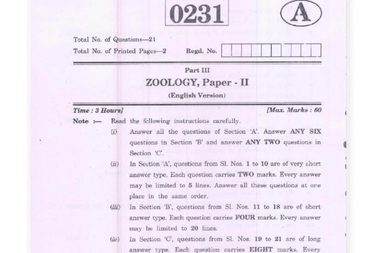 TG Inter Zoology Exam 2026
TG Inter Zoology Exam 2026: The TG Inter Zoology Examination 2026 is scheduled to be conducted on March 5 and 6 at 1495 examination centres across the state under the guidance of the TSBIE. With just a few hours left for the Biology (Zoology) paper, students have to focus on the important diagrams, short answers, and the long questions that are regularly repeated to score maximum marks.
As per the prescribed syllabus and blueprint, the paper will include concepts from the following topics: Human Anatomy & Physiology, Genetics, Evolution, Applied Biology, and Biotechnology. Here’s a comprehensive LIVE update including important questions, guess paper topics, and last-minute short notes for quick revision.
Some of the details and facts related to TG Inter 1st Year Zoology Exam 2026 can be found below:
Aspect | Details |
|---|---|
Exam Date | March 5 (first year) and March 6 (scond-year) |
Exam Time | 9 AM to 12 PM |
Sections | Sections A, B, & C |
Questions and Marking Scheme |
|
Max Marks | 60 Marks |
Stay Calm, stay focused, and give your best on March 5. All the best.
12 00 PM IST - 05 Mar'26
The Zoology examination has been successfully completed across all centres. Authorities confirmed smooth conduct of the exam, while students are now leaving centres. Live student reactions, expert analysis, and expected marks evaluation will be updated shortly.
11 30 AM IST - 05 Mar'26
The TG Inter 2nd Year Zoology examination will conclude at 12:00 Noon. Students are expected to begin exiting examination centres. Initial reactions and difficulty level analysis will be updated soon in this LIVE blog.
10 00 AM IST - 05 Mar'26
Examination centres across Telangana ensured proper hospitality and student support during the Zoology exam. Drinking water facilities, seating arrangements, and basic medical assistance were made available. Invigilators monitored the exam smoothly, ensuring a disciplined and stress-free environment for all candidates.
09 00 AM IST - 05 Mar'26
The TG Inter 2nd Year Zoology examination has officially commenced across examination centres in the state. Students began writing the paper under strict supervision. Authorities ensured smooth conduct and necessary arrangements at all centres. Initial reports suggest students were calm and confident while entering the examination halls.
08 30 AM IST - 05 Mar'26
With the exam about to begin, students should focus on:
Attempting known questions first
Dividing time equally across sections
Drawing diagrams neatly
Underlining key terms
Structured presentation and calm execution will help maximise scoring potential.
07 30 AM IST - 05 Mar'26
Students across Telangana are arriving at examination centres for the Zoology paper. Officials are ensuring smooth arrangements. Candidates are advised to carefully read the question paper during the initial reading time and plan answers section-wise.
06 30 AM IST - 05 Mar'26
Experts suggest focusing on answer presentation techniques rather than content overload. Proper structure can significantly enhance scoring.
Focus on:
Start 8-mark answers with a brief 2-line introduction
Use clear subheadings for systems (e.g., Foregut, Midgut, Hindgut)
Draw diagrams immediately after explanation
Keep 2-mark answers within 2–3 precise lines
Avoid overwriting and lengthy paragraphs
At this stage, clarity and structured writing matter more than memorizing additional content. A well-organised answer sheet often creates a strong impression on evaluators.
05 30 AM IST - 05 Mar'26
Students waking up early should focus on calm revision.
Do:
Go through key headings
Recall lifecycle stages
Revise short definitions
Avoid:
Panic discussions
Learning new content
Confidence and clarity matter most now.
04 30 AM IST - 05 Mar'26
Diagrams play a major role in scoring full marks.
Draw from Memory:
Digestive system of Periplaneta
Nitrogen cycle
Sigmoid population curve
Ommatidium structure
Ensure neat labelling and correct proportions.
03 30 AM IST - 05 Mar'26
Section A can be scoring if definitions are precise.
Revise:
Ecosystem
Biome
Carrying capacity
Nitrification
Denitrification
Parasitism
Keep answers within 2–3 lines using correct biological terminology.
02 30 AM IST - 05 Mar'26
Short-answer sections can significantly boost scores.
Revise 4M Topics:
Parasitic adaptations
Ecological pyramids
Population interactions
Lake ecosystem
Environmental pollution
Write answers in bullet format and include examples wherever possible.
01 30 AM IST - 05 Mar'26
Long-answer preparation should now be limited to recalling headings and diagrams.
Highly Probable 8M Areas:
Digestive system of Periplaneta
Respiratory system of Periplaneta
Lifecycle of Plasmodium vivax
Nitrogen cycle
Population growth curve
Mentally rehearse structured answers with subheadings and diagrams.
12 30 AM IST - 05 Mar'26
With a few hours left for the Zoology exam, students should now focus only on high-weightage areas from the syllabus
Revise Quickly:
Periplaneta systems
Nitrogen cycle
Population growth curve
Plasmodium lifecycle
Avoid new topics. Light revision and proper sleep are essential for better retention.
11 30 PM IST - 04 Mar'26
Essential Reminders:
Keep hall ticket ready.
Arrange pens, pencils, eraser, sharpener, scale neatly in advance.
Sleep at least 6 hours to maintain concentration and memory retention.
Stay calm and confident — avoid last-minute panic discussions.
Remember, a clear presentation, neat labelled diagrams, proper headings, and structured point-wise answers can significantly improve overall scoring potential. Confidence + clarity = better results.
11 15 PM IST - 04 Mar'26
Experts advise at least 6 hours of sleep. Over-revision may reduce retention. Confidence, clarity, and presentation will decide performance tomorrow.
11 00 PM IST - 04 Mar'26
Before sleeping, mentally revise:
Periplaneta systems
Plasmodium lifecycle
Nitrogen cycle
Population growth curve
Lake ecosystem
These are high-weightage areas.
10 45 PM IST - 04 Mar'26
From Human Welfare unit
Answer Points:
Health hazards
Addiction effects
Social impact
Preventive measures
Bullet format recommended.
10 30 PM IST - 04 Mar'26
With only a few hours left for the Zoology examination, students are advised not to start any new topics. Instead, focus on strengthening already prepared high-weightage areas.
Diagrams Practice
Periplaneta systems
Nitrogen cycle
Population growth curve
Lake ecosystem
Important Headings
Write key subheadings mentally for 8-mark answers
Recall structured answer format
Definitions (2 Marks Section)
Ecosystem
Biome
Nitrification
Parasitism
Carrying capacity
Population Growth Curve
Lag, Exponential, Stationary phases
Sigmoid graph with carrying capacity
Nitrogen Cycle
Fixation
Nitrification
Assimilation
Ammonification
Denitrification
10 15 PM IST - 04 Mar'26
With only a few hours left for the exam, students should quickly revise important ecological definitions that are frequently asked in Section A from the prescribed syllabus. These require short, clear, and textbook-based answers.
Q1: Define Ecosystem.
An ecosystem is a functional unit of nature where living organisms interact with one another and with the abiotic components of the environment.
Q2: What is a Biome?
A biome is a large ecological region characterized by a specific climate, vegetation, and animal life.
Q3: Define Carrying Capacity.
Carrying capacity is the maximum population size of a species that an environment can sustainably support with available resources.
10 00 PM IST - 04 Mar'26
Important from cockroach unit.
Include:
Spiracles
Tracheae
Tracheoles
Direct diffusion
Absence of respiratory pigment
Neat diagram
Focus on mechanism of gaseous exchange.
09 45 PM IST - 04 Mar'26
Answer:
1. Mutualism:
Both species benefit from the interaction.
Example: Lichen (association between algae and fungus).
2. Commensalism:
One species benefits, while the other is neither harmed nor benefited.
Example: Cattle egret feeding near grazing cattle.
3. Parasitism:
One organism (parasite) benefits, and the host is harmed.
Example: Plasmodium in humans.
4. Predation:
One organism (predator) kills and eats another organism (prey).
Example: Tiger hunting deer.
Note: Write definitions briefly and provide one clear example for each to secure full 4 marks.
09 30 PM IST - 04 Mar'26
Nutrient cycling is an important part of Ecology and frequently appears in Section A (Very Short Answer). Students must write precise, textbook-based definitions.
Q1: Define Nitrification.
Nitrification is the biological process by which ammonia (NH₃) is converted into nitrite (NO₂⁻) and then into nitrate (NO₃⁻) by nitrifying bacteria such as Nitrosomonas and Nitrobacter in soil.
Q2: Define Denitrification.
Denitrification is the process by which nitrates (NO₃⁻) are converted into nitrogen gas (N₂) by denitrifying bacteria like Pseudomonas, returning nitrogen to the atmosphere.
Note: Write in 2–3 precise lines mentioning bacteria names to secure full 2 marks.
09 15 PM IST - 04 Mar'26
Very high probability long answer
Key Aspects:
Foregut
Midgut (hepatic caeca)
Hindgut
Digestion & absorption
Labelled diagram
Structure answer under headings.
09 00 PM IST - 04 Mar'26
Ecology-based 4-mark question.
Include:
Abiotic components
Producers
Consumers
Decomposers
Energy flow
Draw small trophic level diagram for better scoring.
08 45 PM IST - 04 Mar'26
Quick recall:
Q: Name the causative organism of Malaria.
Plasmodium vivax.
Q: What is Pathogenicity?
Ability of an organism to cause disease.
Avoid lengthy explanation.
08 30 PM IST - 04 Mar'26
Highly scoring and predictable question.
Include:
Lag phase
Exponential phase
Stationary phase
Carrying capacity
Sigmoid curve diagram
Graph must be labelled properly.
08 15 PM IST - 04 Mar'26
Frequently repeated short-answer question.
Points to Write:
High reproductive capacity
Protective body covering
Hooks/suckers
Reduced digestive organs
Complex lifecycle
Write in bullet format with example.
08 00 PM IST - 04 Mar'26
Q1: What are Triploblastic animals?
Animals with three germ layers.
Q2: Define Coelom.
A fluid-filled body cavity lined by mesoderm.
Keep answers within two lines.
07 45 PM IST - 04 Mar'26
Answer must include:
Human host (asexual phase)
Mosquito host (sexual phase)
Liver stage
RBC stage
Gametocyte formation
Flow diagram
Mention both hosts clearly for full marks.
07 30 PM IST - 04 Mar'26
Environmental issues are frequently asked.
Answer Structure:
Air pollution – Causes & control
Water pollution – Effects & prevention
Role of public awareness
Control measures
Use bullet points instead of paragraphs.
07 15 PM IST - 04 Mar'26
Productivity: Rate of biomass production in ecosystem
Food Web: Network of interconnected food chains
Short, textbook-based answers secure easy Section A marks.
07 00 PM IST - 04 Mar'26
With limited hours left, focus on smart writing techniques:
Attempt long answers within 12–15 minutes
Draw diagrams immediately after theory
Underline scientific terms
Leave proper margins
Avoid overwriting
Good presentation can easily improve scores by 5–10 marks.
06 45 PM IST - 04 Mar'26
Highly expected long-answer area
.Include:
Open circulatory system
Dorsal tubular heart
Ostia
Haemolymph
Sinuses
Labelled diagram
Explain flow mechanism clearly in bullet format.
06 30 PM IST - 04 Mar'26
Carbon cycle is another important ecology question.
Key Points to Include:
Photosynthesis
Respiration
Decomposition
Fossil fuel combustion
Atmospheric CO₂
Draw a simple cyclic diagram with arrows for clarity.
06 15 PM IST - 04 Mar'26
Short questions from Periplaneta americana are very common.
Q1: How many pairs of spiracles are present in Periplaneta?
10 pairs.
Q2: What is Haemolymph?
The circulatory fluid in cockroach flowing in an open circulatory system.
Keep answers precise and avoid extra explanation.
06 00 PM IST - 04 Mar'26
Final preparation tips:
Underline keywords
Use subheadings
Draw diagrams neatly
Maintain time management
Attempt known questions first
Good presentation enhances examiner impression significantly.
05 45 PM IST - 04 Mar'26
Answer must include:
Open circulatory system
Haemolymph
Dorsal heart
Sinuses
Absence of RBC
Diagram
Explain flow of haemolymph clearly.
05 30 PM IST - 04 Mar'26
Causes (vehicles, industries)
Effects (respiratory issues)
Control measures (filters, green belts)
Public awareness
Bullet presentation recommended.
05 15 PM IST - 04 Mar'26
Q: Define Parasitism.
A relationship where one organism benefits and the host is harmed.
Q: What is Pathogenicity?
Ability of a microorganism to cause disease.
Keep answers short and scientific.
05 00 PM IST - 04 Mar'26
The following 10 diagrams are most frequently asked in 4M and 8M questions. Practising these neatly can significantly improve scoring.
1. Digestive System of Periplaneta americana
Foregut (mouth, pharynx, oesophagus, crop, gizzard)
Midgut (hepatic caeca)
Hindgut (ileum, colon, rectum)
One of the most repeated long-answer diagrams.
2. Respiratory System of Periplaneta americana
Spiracles
Tracheae
Tracheoles
Air sacs
Neatly show branching tracheal system.
3. Reproductive System of Periplaneta americana
Male system (testes, vas deferens, ejaculatory duct)
Female system (ovaries, oviducts, spermatheca)
Label clearly and separately.
4. Structure of Ommatidium
Corneal lens
Crystalline cone
Rhabdom
Retinal cells
Small but very important diagram.
5. Lifecycle of Plasmodium vivax (Flow Diagram)
Sporozoite
Liver stage
RBC stage
Gametocytes
Mosquito phase
Flow chart style diagram is sufficient.
6. Nitrogen Cycle
Nitrogen fixation
Nitrification
Assimilation
Ammonification
Denitrification
Clear cyclic arrow diagram required.
7. Population Growth Curve (Sigmoid Curve)
Lag phase
Exponential phase
Stationary phase
Carrying capacity
Graph must be properly labelled.
8. Lake Ecosystem
Abiotic components
Producers
Consumers
Decomposers
Trophic level representation recommended.
9. Ecological Pyramid
Pyramid of numbers
Pyramid of biomass
Pyramid of energy
Simple triangular diagram is enough.
10. Binary Fission in Paramecium
Macronucleus
Micronucleus
Transverse division
Daughter cells
Simple step-wise sketch is sufficient.
04 45 PM IST - 04 Mar'26
Protozoa & Animal Diversity
Define Pseudopodium.
What is Binary Fission?
What is Radial Symmetry?
Define Bilateral Symmetry.
What are Acoelomates?
Name two characteristics of Arthropoda.
Periplaneta americana
What is Ootheca?
How many pairs of spiracles are present in Periplaneta?
Define Haemolymph.
What is Ommatidium?
Human Health & Diseases
Name the causative organism of Malaria.
What is Pathogenicity?
Define Parasitism.
Name the vector of Wuchereria bancrofti.
Ecology & Environment
Define Ecosystem.
What is a Food Chain?
Define Ecological Pyramid.
What is Carrying Capacity?
Define Greenhouse Effect.
What is Ozone Depletion?
04 30 PM IST - 04 Mar'26
High-probability long answer.
Include:
Foregut (mouth to gizzard)
Midgut (hepatic caeca)
Hindgut (rectum)
Digestion & absorption
Labelled diagram
Avoid missing crop and gizzard explanation.
04 15 PM IST - 04 Mar'26
Structure answer clearly:
Abiotic components
Producers (algae)
Consumers (fish, zooplankton)
Decomposers (bacteria)
Energy flow
Draw simple trophic level diagram.
04 00 PM IST - 04 Mar'26
Quick revision set:
Define:
Ammonification – Conversion of organic nitrogen to ammonia
Assimilation – Uptake of nitrates by plants
Short definitions are sufficient.
03 45 PM IST - 04 Mar'26
Include:
Spiracles (10 pairs)
Tracheae and tracheoles
Direct diffusion of gases
Absence of respiratory pigment
Neat diagram
Keep explanation focused on mechanism.
03 30 PM IST - 04 Mar'26
Common 4-mark descriptive question.
Key Points:
High reproductive rate
Protective body covering
Hooks and suckers
Reduced locomotory organs
Complex lifecycle
Write in bullet format for examiner-friendly presentation.
03 15 PM IST - 04 Mar'26
Revise these definitions:
Acoelomate: No body cavity (e.g., Platyhelminthes)
Pseudocoelomate: False body cavity (e.g., Nematoda)
Write germ layer involvement for clarity.
03 00 PM IST - 04 Mar'26
Frequently repeated long-answer area.
Answer must include:
Human as primary host
Mosquito as secondary host
Sporozoite stage
Liver & RBC stages
Gametocyte formation
Flow diagram
Mention both asexual and sexual phases clearly.
02 45 PM IST - 04 Mar'26
Ecological pyramids are simple yet scoring. Points to Write: Pyramid of numbers Pyramid of biomass Pyramid of energy Energy pyramid always upright Draw a small triangular diagram for clarity.
02 30 PM IST - 04 Mar'26
Short answers from Protozoa are predictable.
Q: Define Pseudopodium.
Temporary cytoplasmic projection used for movement and feeding.
Q: What is Binary Fission?
Asexual reproduction where one organism divides into two equal daughter cells.
Keep answers within two lines.
02 15 PM IST - 04 Mar'26
Highly scoring long-answer question.
Include in Answer:
Lag phase
Exponential phase
Stationary phase
Carrying capacity
Logistic (sigmoid) curve diagram
Draw a neat labelled sigmoid curve to secure full marks.
02 00 PM IST - 04 Mar'26
Answer Points:
Mutualism – Both species benefit (e.g., Lichen)
Commensalism – One benefits, other unaffected
Parasitism – Parasite benefits, host harmed
Predation – One organism kills another for food
Write with examples for better scoring.
01 45 PM IST - 04 Mar'26
Quick revision of key ecological terms can secure easy marks.
Q1: Define Greenhouse Effect.
The trapping of heat in the Earth’s atmosphere due to gases like CO₂ and methane.
Q2: What is Ozone Depletion?
Reduction in ozone layer thickness due to chlorofluorocarbons (CFCs).
Keep definitions precise and scientific.
01 30 PM IST - 04 Mar'26
The lake ecosystem is a commonly asked 4-mark question from Ecology. Students should present the answer in structured bullet points and, if possible, draw a small labelled diagram for better scoring.
Answer Structure:
Abiotic factors
Producers
Primary consumers
Secondary consumers
Decomposers
Energy flow diagram
Small labelled diagram recommended.
01 15 PM IST - 04 Mar'26
Q1: Define Productivity.
Productivity is the rate at which organic matter (biomass) is produced by organisms in an ecosystem per unit area per unit time. It is mainly of two types: primary productivity and secondary productivity.
Q2: What is an Ecological Pyramid?
An ecological pyramid is a graphical representation that shows the relationship between different trophic levels in an ecosystem in terms of number, biomass, or energy. Energy pyramid is always upright.
Q3: Define Food Web.
A food web is a network of interconnected food chains in an ecosystem, showing multiple feeding relationships and pathways of energy flow among organisms.
These short, point-wise definitions are sufficient for full 2 marks if written clearly.
01 00 PM IST - 04 Mar'26
From Ecology unit
Revise:
Air pollution & control
Water pollution & control
Ozone depletion
Greenhouse effect
Organic farming case study
Bullet format answers score better than paragraphs.
12 45 PM IST - 04 Mar'26
Highly expected long question.
Answer Must Include:
Male reproductive organs
Female reproductive organs
Ootheca formation
Fertilisation
Diagram
Write in headings and subheadings format. Avoid mixing male and female systems.
12 30 PM IST - 04 Mar'26
Questions may ask explanation of interactions.
Include:
Mutualism
Commensalism
Parasitism
Predation
Provide examples such as lichen (mutualism). Use bullet format for clarity.
12 15 PM IST - 04 Mar'26
Quick revision list:
Biome – Large ecological region with specific climate
Ecosphere – Global ecosystem
Landscape – Mosaic of interacting ecosystems
Precise one-line answers are sufficient.
12 00 PM IST - 04 Mar'26
Q: Explain Binary Fission in Paramecium.
Include:
Transverse division
Macronucleus & micronucleus role
Cytokinesis
Formation of two daughter cells
Simple labelled sketch improves scoring.
11 45 AM IST - 04 Mar'26
Cockroach systems are repeatedly asked.
Key Aspects:
Open circulatory system
Haemolymph
Dorsal heart with ostia
Sinuses
Absence of respiratory pigment
Diagram
Mention flow of haemolymph clearly and neatly label parts.
11 30 AM IST - 04 Mar'26
Population Ecology frequently appears in short sections.
Define:
Natality – Birth rate in a population
Mortality – Death rate in a population
Carrying Capacity – Maximum population size environment can support
Keep answers brief but scientifically accurate.
11 15 AM IST - 04 Mar'26
The nitrogen cycle is a highly expected long-answer question.
Include in Answer:
Nitrogen fixation (Rhizobium)
Nitrification
Assimilation
Ammonification
Denitrification
Neat cyclic diagram
Ensure flow is explained step-wise. Diagram presentation is mandatory for full marks.
11 00 AM IST - 04 Mar'26
Ecology is a strong scoring unit..
Q: Differentiate between Food Chain and Food Web.
Food chain – Linear energy flow
Food web – Interconnected feeding network
Energy decreases at each trophic level
Producers form base
Draw a simple diagram to enhance clarity.
10 45 AM IST - 04 Mar'26
Ecology definitions are direct scoring.
Q1: Define Nitrification.
Conversion of ammonia into nitrites and nitrates by bacteria.
Q2: Define Denitrification.
Conversion of nitrates into atmospheric nitrogen.
Short definitions from nutrient cycles often appear in Section A.
10 30 AM IST - 04 Mar'26
Animal Diversity from Invertebrates to Chordata carries multiple short and long questions.
Revise Characteristics of:
Porifera
Arthropoda
Mollusca
Echinodermata
Mammalia
Comparison-based 4M questions like Chondrichthyes vs Osteichthyes are very common. Present differences in table format for better marks.
10 15 AM IST - 04 Mar'26
Periplaneta americana is a high-weightage unit. Long answers from cockroach systems are common.
Key Aspects to Include:
Supra-oesophageal ganglion (brain)
Ventral nerve cord
Segmental ganglia
Sense organs
Structure of ommatidium
Neat labelled diagram
Avoid unnecessary introduction; focus on labelled structure and functions.
10 00 AM IST - 04 Mar'26
Symmetry is frequently asked in 4-mark sections.
Q: Explain types of symmetry in animals.
Include:
Asymmetry – No definite body shape (e.g., Sponges)
Radial symmetry – Body parts around central axis (Cnidaria)
Bilateral symmetry – Divisible into two equal halves (Humans)
Write with examples and structured bullet points for clarity.
09 45 AM IST - 04 Mar'26
As students continue revision, Structural Organisation in Animals remains important for short answers. These questions are easy scoring if definitions are precise.
Important 2M Questions:
Define Diploblastic animals.
Animals with two germ layers – ectoderm and endoderm.
What are Coelomates?
Animals possessing a true body cavity lined by mesoderm.
Keep answers strictly textbook-based and concise.
09 30 AM IST - 04 Mar'26
Key points:
Tracheal system
Spiracles (10 pairs)
Tracheae & tracheoles
Direct diffusion
No respiratory pigment
Diagram essential
Structured headings improve clarity.
09 15 AM IST - 04 Mar'26
Lag phase
Exponential phase
Stationary phase
Carrying capacity
Sigmoid curve diagram
Diagram increases scoring chances.
09 00 AM IST - 04 Mar'26
Q: What is Pseudopodium?
Temporary cytoplasmic projection for movement and feeding.
Q: Define Binary Fission.
Asexual reproduction where one organism divides into two.
Keep answers crisp.
08 45 AM IST - 04 Mar'26
Prepare characteristics of:
Porifera
Arthropoda
Mollusca
Echinodermata
Mammalia
Comparison tables help answer 4-mark questions quickly.
08 30 AM IST - 04 Mar'26
Revise thoroughly:
Food chains & food webs
Ecological pyramids
Nitrogen & Carbon cycles
Population growth curve
Greenhouse effect
Simple diagrams can boost marks significantly.
08 15 AM IST - 04 Mar'26
Q1: Explain Parasitic Adaptations.
High reproductive capacity
Protective body covering
Hooks/suckers for attachment
Reduced digestive system
Q2: Describe Ecological Pyramids.
Pyramid of numbers
Pyramid of biomass
Pyramid of energy
Energy pyramid is always upright.
08 00 AM IST - 04 Mar'26
Draw and practice:
Ommatidium
Digestive system of Cockroach
Lake ecosystem
Nitrogen cycle
Frog classification under Chordata
Neat labelling = extra marks.
07 45 AM IST - 04 Mar'26
Q1: Define Pseudopodia.
Pseudopodia are temporary cytoplasmic projections used for locomotion and feeding in Amoeba.
Q2: What is Radial Symmetry?
Radial symmetry is a body plan where body parts are arranged around a central axis.
Q3: Define Food Chain.
A food chain is a linear sequence of organisms where energy flows from producers to consumers.
07 30 AM IST - 04 Mar'26
Answer Highlights:
Primary host: Human
Secondary host: Female Anopheles mosquito
Asexual phase in liver & RBC
Sexual phase in mosquito
Diagram compulsory for full marks.
07 15 AM IST - 04 Mar'26
Q: Describe the Digestive System of Periplaneta americana with neat labelled diagram.
Key Points to Write:
Foregut: Mouth → Pharynx → Oesophagus → Crop → Gizzard
Midgut: Hepatic caeca
Hindgut: Ileum → Colon → Rectum
Presentation Tip: Draw a clear longitudinal diagram.
07 00 AM IST - 04 Mar'26
Students must prioritise:
Animal Diversity (Invertebrates & Chordata)
Periplaneta americana (Cockroach Type Study)
Human Health & Diseases
Ecology & Environment
Locomotion & Reproduction in Protozoa
Focus on diagrams and lifecycle-based questions.
Next Story 
Typical response between 24-48 hours
Get personalized response
Free of Cost
Access to community