


 AP Inter 1st Year Commerce Exam 2026 LIVE
Key Event


- 8 hours ago
AP Inter 1st Year Commerce 2026 Exam Day Checklist
- 10 mins ago
List of Short Answer Type Questions on Business Activities
- 25 mins ago
List of Essay Type Questions on Business Activities
- 40 mins ago
Key Comparison between Industry, Trade and Commerce (1/3)
- 55 mins ago
Key Comparison between Industry, Trade and Commerce (1/2)
- 1 hour ago
AP Inter 1st Year Commerce Exam 2026: Types of Partners
- 1 hour ago
The "Must-Do" 4-Mark Questions
- 1 hour ago
List of 8-Marks Questions
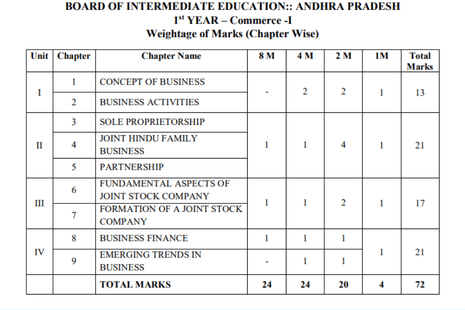
AP Inter 1st Year Commerce Exam 2026 LIVE: The AP Inter 1st Year Commerce exam 2026 will be held on March 12, 2026, from 9 AM to 12 PM . Candidates who will be appearing for the AP Inter 1st Year Commerce exam can refer to the experts’ guidance, short notes on the important tips, and the guess paper here. As per the paper pattern, the candidates will get 1 mark, 2 marks, 4 marks, and 8 marks questions in the AP Inter 1st Year Commerce exam. Total weightage of the paper is 72 marks, and the candidates will get 3 hours to answer the paper. Business Finance, Emerging Trends in Business, Sole Proprietorship, and Joint Hindu Family Business are the high-weightage chapters, from which the candidates will get 21 marks. During the last minute preparation, the candidates should revise these chapters with extra effort, so that they can score well in the AP Inter 1st Year Commerce exam.
AP Inter 1st Year Commerce Exam 2026: Major Highlights
Find out the major highlights related to the AP Inter 1st Year Commerce exam 2026 here in the following table:
Particulars | Details |
|---|---|
AP Inter 1st Year Commerce Exam 2026 date | March 12, 2026 |
Exam time | 9 AM to 12 PM |
Marks distribution | 1 mark, 2 marks, 4 marks and 8 marks |
High weightage chapters |
|
Section-wise total marks |
|
Total marks | 72 marks |
Time duration | 3 hours |
Negative marking | No negative marking is there for the incorrect answers |
Candidates will also find out the AP Inter 1st Year Commerce unofficial answer key, along with the students’ feedback, here.
Also read l
AP Inter Result Date 2026 Prediction
AP Inter 1st Year Commerce Exam 2026 LIVE
06 00 AM IST - 12 Mar'26
AP Inter 1st Year Commerce 2026 Exam Day Checklist
- Candidates should carry the hall ticket of the AP Inter 1st year exam in a transparent folder. It is advised to keep a photocopy of the hall ticket at home.
- Bring at least two blue pens and one black pen
- An eraser and a sharpener
- A long scale and a sharpened pencil
- Carry your own College ID card
- An analog watch
02 00 PM IST - 11 Mar'26
List of Short Answer Type Questions on Business Activities
- What do you understand by Commerce?
- State the Types of Foreign Trade.
- How Foreign Trade is classified?
- Why Communication is required as an Aid to Trade?
- Why warehousing is needed?
- Explain the Classification of Industries.
01 45 PM IST - 11 Mar'26
List of Essay Type Questions on Business Activities
- What is meant by industry? Explain various types of industries with suitableexamples.
- Define Trade and explain the various types of aids to trade.
- Narrate the importance of Commerce.
- Explain the hindrances involved in Commerce.
- What is Commerce? Describe the various branches of Commerce.
01 30 PM IST - 11 Mar'26
Key Comparison between Industry, Trade and Commerce (1/3)
Feature Industry Trade Commerce Elements - Extractive
- Construction
- Genetic
- Manufacturing
- Trade
- Aids to trade
- Home trade
- Foreign trade
Ownership and Control By industrialists By merchants By traders 01 15 PM IST - 11 Mar'26
Key Comparison between Industry, Trade and Commerce (1/2)
Feature Industry Trade Commerce Risk High risk (production/machinery) Risk of price fluctuations Risk involved in transit/storage Place Conducted in factories/farms Conducted in markets/shops Conducted through various agencies 01 00 PM IST - 11 Mar'26
Key Comparison between Industry, Trade and Commerce (1/1)
Feature Industry Trade Commerce Focus Production of goods Sale and purchase Distribution of goods Capital Requires huge fixed capital Requires more working capital Requires moderate capital 12 45 PM IST - 11 Mar'26
AP Inter 1st Year Commerce Exam 2026: Types of Partners
Based on the extent of Participation:
- ‘Active Partners’ or ‘Working Partners’
- Sleeping Partners
Based on Sharing of Profits:
- Nominal Partners
- Partners in Profits
Based on Liability:
- Limited Partners
- General Partners
Based on the Behaviour and Conduct Exhibited:
- Partner by Estoppel
- Partner by Holding out
12 30 PM IST - 11 Mar'26
The "Must-Do" 4-Mark Questions
- Sole Proprietorship: Features, merits, and demerits.
- Joint Hindu Family Business: Role of Karta and features.
- Types of Entrepreneurs: Innovative, Fabian, Drone, and Imitative.
- Equity Shares vs. Preference Shares: Differences in voting rights and dividends.
- Partnership Deed: What is it and what are its contents?
- E-Business: Benefits to the modern consumer.
- Wholesaler vs. Retailer: Differences in the chain of distribution.
12 15 PM IST - 11 Mar'26
List of 8-Marks Questions
Functions of Commercial Banks: Master both Primary (Deposits/Loans) and Secondary (Agency/Utility) functions.
SEBI Functions: Protective, Regulatory, and Developmental functions.
Money Market vs. Capital Market: A comparison based on duration, instruments, and risk.
Principles of Insurance: Explain at least 7 principles (Utmost Good Faith, Insurable Interest, Indemnity, etc.).
12 00 PM IST - 11 Mar'26
What are the processes of registration of Partnership?
- To apply to the Registrar of Firms, the candidates should do it in the prescribed form
- Candidates should fill out the details like the following in the registration form and then send it to the Registrar of firms. The form should be accompanied by a fee of Rs 3.
- The name of the firm
- Location of the firm
- Names of other places where the firm carries on business
- The name in full and the addresses of the partners
- The date on which various partners joined the firm
- The duration of the firm
- The duly formed document must be signed by all the partners
11 45 AM IST - 11 Mar'26
Practice Questions on Fundamental Aspects of Joint Stock Company (1/3)
Ques. The 'Common Seal' of a company serves as its:
Answer. Physical Signature
Ques. Which type of company prohibits any invitation to the public to subscribe for its securities?
Answer. Private Limited Company
Ques. The Board of Directors is elected by the shareholders to fulfill which role?
Answer. To manage and control the affairs of the company
11 30 AM IST - 11 Mar'26
Practice Questions on Fundamental Aspects of Joint Stock Company (1/2)
Ques. What is the minimum number of members required to form a 'Public Limited Company'?
Answer. 7
Ques. The liability of a shareholder in a Joint Stock Company is generally:
Answer. Limited to the face value of the shares held
Ques. Which document acts as the 'Charter' of the company and defines its external powers and objects?
Answer. Memorandum of Association
11 15 AM IST - 11 Mar'26
Practice Questions on Fundamental Aspects of Joint Stock Company (1/1)
Ques. Which Act currently governs the formation and regulation of Joint Stock Companies in India?
Answer. The Companies Act, 2013
Ques. A Joint Stock Company is often defined as an 'Artificial Person.' What does this mean?
Answer. It exists only in the eyes of the law and can own property and sue others
Ques. What is meant by the 'Perpetual Succession' of a company?
Answer. The company continues to exist despite changes in membership
11 00 AM IST - 11 Mar'26
What are the classification of companies?
- Chartered Companies
- Statutory Company
- Registered Company
- Government Company
- One Person Company
10 45 AM IST - 11 Mar'26
Which Factors Determine the Choice of Sources of Finances
- Cost
- Financial strength and stability of operations
- Form of organisation and legal status
- Purpose and time period
- Risk profile
- Control
- Effect on creditworthiness
- Flexibility and ease
- Tax benefits
10 30 AM IST - 11 Mar'26
Important "2-Mark" Terms (VSAQs) on Emerging Trends in Business
- Smart card, which is a plastic card with a built-in microprocessor, is used only for financial transactions.
- ATM, which is an Automated Teller Machine, allows consumers to perform banking transactions like cash withdrawal 24/7.
- Knowledge Process Outsourcing (KPO) is the outsourcing of high-end, knowledge-based tasks which are required for technical skills.
- E-Commerce, which is the process of buying and selling goods and services over the internet
10 15 AM IST - 11 Mar'26
Important Practice Questions on Emerging Trends in Business (1/3)
Ques. What is a 'Digital Wallet' primarily used for in the emerging trends of business?
Answer. Making electronic payments and storing funds for future use.
Ques. One of the social benefits of E-Business is that it:
Answer. Reduces traffic and environmental pollution by minimizing the need for travel.
Ques. In the emerging business context, what does an 'OTP' (One Time Password) provide?
Answer. Enhanced security for electronic transactions.
10 00 AM IST - 11 Mar'26
Important Practice Questions on Emerging Trends in Business (1/2)
Ques. In the outsourcing industry, how does Knowledge Process Outsourcing (KPO) differ from Business Process Outsourcing (BPO)?
Answer. KPO involves high-end expertise and information work, while BPO is for routine processes.
Ques. Which payment method is most commonly associated with a mobile-based instant transfer system in India?
Answer. UPI
Ques. A consumer selling a second-hand item to another person on an online platform like OLX is an example of which E-Business category?
Answer. Consumer to consumer
09 45 AM IST - 11 Mar'26
Important Practice Questions on Emerging Trends in Business (1/1)
Ques. In the context of emerging business trends, what is the primary scope of 'E-Business' compared to 'E-Commerce'?
Answer. E-Business includes E-Commerce along with internal business processes.
Ques. A business firm interacting with its own employees electronically for training or payroll is an example of which E-Business relationship?
Answer. Intra-B Commerce
Ques. Why do many modern companies choose to 'Outsource' their non-core activities like payroll or customer support?
Answer. To focus on core competencies and improve efficiency
09 30 AM IST - 11 Mar'26
Final Strategy for Business Finance
- To answer any difference between questions, candidates should use tables. Do not write it in paragraphs.
- To answer the "Sources of Finance" question, the candidates should draw a quick tree diagram.
09 15 AM IST - 11 Mar'26
"Gunshot" 2-Mark Definitions for Business Finance
Candidates should not lose their marks to answer the following technical terms:
- Venture Capital
- Lease Financing
- Bridge Finance
- ICD (Inter-Corporate Deposits)
09 00 AM IST - 11 Mar'26
The "Big Three" Long Answer Topics for Business Finance
- Equity Shares vs. Preference Shares
- Retained Earnings (Ploughing back of profits)
- Role of SEBI
08 45 AM IST - 11 Mar'26
"Expert Tips" and High-Yield Structures for Business Finance (1/2)
The "Sources of Finance" Hierarchy
- By Ownership:
- Owner's Funds: Equity Shares, Retained Earnings (No fixed obligation to pay).
- Borrowed Funds: Debentures, Loans, Public Deposits (Mandatory interest payment).
- By Period:
Long-term: Shares, Debentures, Financial Institutions (IFCI, ICICI).
Short-term: Trade Credit, Bank Overdraft, Commercial Papers.
- By Ownership:
08 30 AM IST - 11 Mar'26
"Expert Tips" and High-Yield Structures for Business Finance (1/1)
Master the "Fixed vs. Working Capital"
- Fixed Capital: Fund for the long-term assets, such as Machinery and Land.
- Determinants: Nature of business (Manufacturing needs more than Trading), Scale of operations, Technology used.
- Working Capital: Fund is required for day-to-day operations (Salaries, Raw materials)
- Determinants: Length of operating cycle, Credit policy, Seasonal factors.
- Fixed Capital: Fund for the long-term assets, such as Machinery and Land.
08 15 AM IST - 11 Mar'26
AP Inter 1st Year Commerce Exam 2026: Business Finance Practice Questions (1/1)
Ques. Which type of capital is required for purchasing fixed assets like land, buildings, and machinery?
Ans. Fixed Capital
Ques. The capital raised through the issue of shares is known as:
Ans. Ownership Capital
Ques. What happens to the 'Working Capital' requirement if a business has a very long production cycle?
Ans. It increases
Ques. The 'Money Market' deals with financial instruments that have a maturity period of:
Ans. Up to one year
08 00 AM IST - 11 Mar'26
AP Inter 1st Year Commerce Exam 2026: Partnership Practice Questions (1/3)
Question. In the event of a partner's retirement, the 'Revaluation Account' is prepared to:
Answer. Find the profit ot loss on the change in value of assets and liabilities.
Question. Registration of a partnership firm in Andhra Pradesh is:
Answer. Optional/ Voluntary
07 45 AM IST - 11 Mar'26
AP Inter 1st Year Commerce Exam 2026: Partnership Practice Questions (1/2)
Question. If the Partnership Deed is silent on the profit-sharing ratio, how should profits be distributed among partners?
Answer. Equally
Question. What type of partner does not contribute capital or participate in management but allows the firm to use their name?
Answer. Nominal Partner
Question. A minor can be admitted to a partnership only for:
Answer. The benefits of partnership
07 30 AM IST - 11 Mar'26
AP Inter 1st Year Commerce Exam 2026: Partnership Practice Questions (1/1)
Question. According to the Indian Partnership Act, 1932, what is the 'true test' of a partnership?
Answer. Mutual Agency
Question. What is the maximum number of partners allowed in a firm as per the Companies Act, 2013?
Answer. 50
Question: The written document containing the terms and conditions of a partnership is known as:
Answer. Partnership Deed
07 15 AM IST - 11 Mar'26
AP Inter 1st Year Commerce Exam 2026: Types of Partners
- Active partner
- Sleeping (Dormant) Partner, that means it contributes capital and shares profit; however, they cannot participate in management
- Nominal Partner; only lends their names to the firm. However, they don't contribute capital or share profits, but are liable to the outsiders
- Minor partners (who are under 18 years) are admitted only for the benefit of the business
07 00 AM IST - 11 Mar'26
Pros and Cons of Partnerships
Pros Cons No complex legal registration is required Personal assets are at risk for firm debts Larger capital; more partners mean more funding is required compared to sole trading Business may end if a partner dies or retires Losses are divided among all partners Differences in opinion lead to conflicts 06 45 AM IST - 11 Mar'26
AP Inter 1st Year Commerce Exam 2026: Essential Features of Partnerships
- Partnership is always made by an agreement between the partners. The document is called the Partnership Deed.
- There must be at least 2 people. As per the Companies Act, the maximum limit of the partnership is 50.
- The partnership must be carried out as a legal business with the intention of earning a profit
- Partners should agree to share profits and losses in an agreed ratio. If no ratio is mentioned, then the share will be equal
06 30 AM IST - 11 Mar'26
Pro Tips for Answering 4 Marks Questions
Here is the writing format of the 4-mark questions:
- Introduction: One line for defining the term
- Body: Use 5 bulleted side headings. It is wise to bold the headings
- Diagram: Use a simple "Star" or "Flowchart" for showing the features
06 15 AM IST - 11 Mar'26
Sole Proprietorship Practice Questions: Very Short Answer Type
- What is "Unlimited Liability"?
Define a "Sole Trader."
Why is "Secrecy" an advantage in sole proprietorship?
06 00 AM IST - 11 Mar'26
Sole Proprietorship Practice Questions: Short Answer Type
- Define Sole Proprietorship and explain its key features.
- Discuss the advantages (merits) of a Sole Trading business.
- What are the limitations (disadvantages) of a sole proprietorship?
05 45 AM IST - 11 Mar'26
Quick Comparison between Sole Proprietorship and Joint Hindu Family Business
Particulars Sole Proprietorship JHF Business Membership Only 1 At least 2 (Male/Female) Liability Unlimited Karta: Unlimited; Others: Limited Act/Law No specific Act Hindu Law / Succession Act Control Sole Proprietor Karta 05 30 AM IST - 11 Mar'26
AP Inter 1st Year Commerce Exam 2026: Essential Features of Joint Hindu Family Business
- JHF is created by the birth status in the family, not by agreement or contract
- The eldest family member takes ownership of handling the business, and hence, he has unlimited liability
- If the other family members have an equal share in the property, they will have limited liability for their share
- After the death of the karta, the next eldest member will take over the business
- A person will become a member by birth, so that a minor person can also be a part of the business
05 15 AM IST - 11 Mar'26
AP Inter 1st Year Commerce Exam 2026: Merits and Demerits of Sole Proprietorship
Advantages Disadvantages Quick Decision Making Limited Resources Business secrets are kept safe by the owner Personal assets are at risk 100% profits will be added to the owner Limited managerial skill since one person is not enough to be an expert in all the fields Ease of Formation Business depends solely on the owner's death 05 00 AM IST - 11 Mar'26
AP Inter 1st Year Commerce Exam 2026: Essential Features of Sole Proprietorship
For answering the 4-mark short notes, the candidates are advised to include the following essential features.
- Single ownership: The individual will provide all the capital and own the assets of the business.
- Unlimited Liability: If the business fails, then the owner's personal property will be sold to pay off the business debt.
- Lack of Business Continuity: The death, insolvency, or illness of the owner leads to the end of the business.
- Individual Risk Bearing: The sole trader is the sole beneficiary and sole sufferer of losses if the business incurs profits or suffers losses, respectively.
- No Separate Legal Entity: As per the law, the owner and business are the same.