

 CBSE Class 12 Hindi Answer Key 2026 OUT
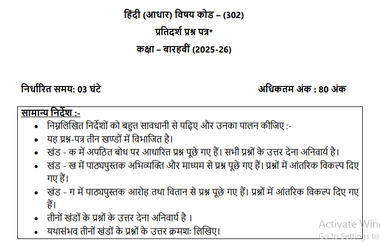
CBSE Class 12 Hindi Answer Key 2026 LIVE: If you appeared for Hindi Core (302) or Hindi Elective (002) examination held on March 16, 2026, from 10:30 AM to 1:30 PM , this live guide is all you need. Overall, the paper is described as balanced but lengthy. While the literature section was direct, the unseen passages required deeper analytical thinking than previous years. Check our LIVE coverage comprising unofficial answer key solutions for Set 1, 2, and 3, detailed exam analysis, and initial student feedback. The paper has three sections: Section A (Reading): 18–20 Marks (Unseen passages); Section B (Creative Writing & Media): 20–22 Marks; Section C (Literature): 40 Marks.
CBSE Class 12 Hindi Answer Key 2026 Available
Our Collegedekho experts are providing unofficial answer keys for Hindi Core (302) and Hindi Elective (002) examinations below.Answer Key for Hindi (Elective) 29/2/1
| Question | Answer |
|---|---|
| खंड क Q1 (i) | (B) तालाब |
| (ii) | (C) जल आपूर्ति का मुख्य स्रोत होने की |
| (iii) | (B) भारतीय संस्कृति में तालाबों की महत्ता देखने के लिए |
| Q2 (i) | (B) सर्वहारा वर्ग को उनके अधूरे दिलवाने के लिए |
| (ii) |
1. कंधा दूं (ii) सहारा देना
2. पीठ सहलाना (i) दर्द बांटना 3. बाहों में उठाना (iii) अपनाना |
| (iii) | (A) सर्वहारा वर्ग की |
| (iv) | रोशनी से अभिप्राय आशा, जागरूकता और सकारात्मकता परिवर्तन से है |
| (v) |
काव्यांश में कवि/संवेदनशील व्यक्ति पुनर्जन्म लेने की बात कर रहा है।
दो विशेषताएँ: 1. वह दुखी और पीड़ित लोगों की सहायता करना चाहता है। 2. वह अनसुनी आवाज़ों और कराहों को दुनिया तक पहुँचाना चाहता है। |
| (vi) | इसका अभिप्राय है कि कवि पीड़ित और दुखी लोगों की वेदना और भावनाओं को प्रेम और संवेदना के साथ व्यक्त करना चाहता है, ताकि उनकी पीड़ा दुनिया तक पहुँच सके। |
| खंड ख 3 (i) |
टी.वी. कार्यक्रम में प्रसारित होने वाली मूल या वास्तविक ध्वनि को 'नेट' या 'नेट साउंड' कहते हैं।
यह ध्वनि दृश्य को अधिक वास्तविक और प्रभावशाली बनाती है तथा दर्शकों को घटना से जुड़ने में सहायता करती है। |
| 3 (ii) |
इंटरनेट पत्रकारिता के मुख्यतः तीन रूप हैं-
1. ऑनलाइन समाचार-पत्र 2. वेब पोर्टल 3. ब्लॉग या व्यक्तिगत वेबसाइट इन माध्यमों से समाचार, लेख, विचार और जानकारी तुरंत इंटरनेट के माध्यम से पाठकों तक पहुँचाई जाती है। |
| 3 (iii) |
किसी महत्वपूर्ण घटना या विषय पर गहराई से जानकारी देकर तैयार की गई रिपोर्ट को विशेष रिपोर्ट कहते हैं।
इसे तैयार करने के लिए पहले विषय का चयन किया जाता है, फिर जानकारी एकत्र की जाती है, तथ्यों का विश्लेषण किया जाता है और अंत में उसे रोचक व स्पष्ट भाषा में प्रस्तुत किया जाता है। |
| 4 (i) | वर्तमान समय में भारत में हिंदी नेट पत्रकारिता तेजी से विकसित हो रही है। इंटरनेट और स्मार्टफोन के बढ़ते उपयोग से हिंदी समाचार वेबसाइटें और पोर्टल अधिक लोकप्रिय हो गए हैं। अब लोग तुरंत समाचार पढ़ और देख सकते हैं। इससे सूचना का प्रसार तेज हुआ है तथा हिंदी भाषा को भी व्यापक मंच मिला है। |
| 4 (ii) | नगर के आदर्श विद्यालय में 7 सितंबर से 14 सितंबर तक हिंदी सप्ताह उत्साहपूर्वक मनाया गया। इस अवसर पर भाषण, निबंध, कविता पाठ और वाद-विवाद प्रतियोगिताएँ आयोजित की गई। विद्यार्थियों ने बढ़-चढ़कर भाग लिया। समापन समारोह में विजेताओं को पुरस्कार प्रदान किए गए और हिंदी भाषा के महत्व पर प्रकाश डाला गया |
| 4 (iii) | आर्थिक समाचार लिखते समय विशेष सावधानी आवश्यक होती है क्योंकि इसमें ऑकड़ों, तथ्यों और आर्थिक नीतियों की सही जानकारी देना जरूरी होता है। छोटी-सी गलती भी पाठकों को अमित कर सकती है। इसलिए स्पष्ट भाषा, सही आंकड़े और विश्वसनीय स्रोतों का प्रयोग करना आवश्यक होता है। |
| खंड ग 7 (i) | (B) पवन के झकोरे |
| (ii) | (A) विरहिणी की विरह-वेदना को बढ़ा रही हैं। |
| (iii) | (D) कथन तथा कारण दोनों सही हैं तथा कारण कथन की सही व्याख्या |
| (iv) |
1. शरीर को जलाकर राख कर देना - (iii) सर्वस्व त्याग और समर्पण की भावना
2. वृक्षों से झरे पीले पत्ते -(1) रानी नागमती का कांतीहीन शरीर 3. सबक चाँचरि जोर कर खेलना - (II) होली के अवसर पर प्रसन्नता व्यक्त करना सही विकल्पः (B) (1-iii), (2-i), (3-ii) |
| (v) | (A) फागुन आते ही सब रेशमी वस्त्र धारण कर श्रृंगार करने लगते हैं। |
Answer Key for Hindi (Elective) 2/1/3
| Question | Answer |
|---|---|
| खंड क Q1 (i) | (B) सभ्यता की अपेक्षा अत्यंत सूक्ष्म होते हैं| |
| (ii) | (D) मनुष्य का भौतिक विकास का क्रम |
| (iii) | (C) कथन और करण दोनों सही हैं तथा करण, कथन का सही वाक्य है| |
| (iv) | मोटर कार या हवाई जहाज का होना 'सभ्यता' है, लेकिन उस मोटर को बनाने की कला और उसकी तकनीक में निहित सोच 'संस्कृति' है। इसी प्रकार, अच्छा भोजन उपलब्ध होना सभ्यता है, परंतु उस भोजन को तैयार करने का विशेष ढंग और उसे सलीके से खाने की कला संस्कृति कहलाती |
| (v) | मनुष्य का विकास केवल भौतिक साधनों से पूरा नहीं होता, उसे मानसिक और आत्मिक संतुष्टि भी चाहिए। जब मनुष्य ने खेती करना और घर बनाना सीखा (सभ्यता), तो साथ ही उसने भोजन को कलात्मक ढंग से पकाना और रहने के स्थान को सुरुचिपूर्ण बनाना (संस्कृति) भी सीखा। आज के युग में यदि हमारे पास बड़ी सड़कें और मकान (सभ्यता) हैं, तो उन्हें उपयोग करने का हमारा ढंग और उनके प्रति हमारा नजरिया (संस्कृति) ही हमें पूर्ण विकसित मानव बनाता है। अतः भौतिक प्रगति और वैचारिक परिपक्वता साथ-साथ चलती है। |
| (vi) | यह कथन इस बात पर बल देता है कि सभ्यता का संबंध शरीर की सुख-सुविधाओं (जैसे बढ़िया शाक, मकान) से है, लेकिन संस्कृति का निवास मनुष्य के अंतर्मन में होता है। गद्यांश स्पष्ट करता है कि ममता, परोपकार और कला से आनंद लेने की योग्यत्ता आत्मा के गुण हैं। जिस प्रकार शरीर केवल ढांचा है और आत्मा उसकी शक्ति, उसी प्रकार सभ्यता बाहरी ढांचा है और संस्कृति उस ढांचे के भीतर प्राण फूंकने वाली वह सूक्ष्म शक्ति है जो मनुष्य को संवेदनशील और संस्कारित बनाती है। |
| Q2 (i) | (A) चांदी की साड़ी के रूप में |
| (ii) | (A) धूप |
| (iii) | (B) खेतों के ऊपर उड़ते पक्षियों के मीठे स्वरों की |
| (iv) | जिस प्रकार एक कौआ सूखे पेड़ के ठूंठ पर चुपचाप और गुमसुम बैठकर टकटकी लगाकर देखता है, उसी प्रकार 'काल' भी जीवन के ढलते समय (दिवावसान) को अपनी सोई हुई आँखों से स्तब्ध होकर देख रहा है। यह जीवन की नश्वरता और समय की स्थिरता को दर्शाता है। |
| खंड ग 9 |
(i) (C) महामारी के कारण गाँव वालों की असहाय स्थिति से दुखी होने के कारण
(ii) (B) क-(ii), ख-(iii), ग-(i) (iii) (A) महामारी की भयानकता और दुष्प्रभाव का उल्लेख करने हेतु (iv) (C) उत्तेजना युक्त उत्साह (v) (B) मृत्यु या अनिष्ट की आहट |
Answer Key for Hindi (Core) 2/5/1
| Question | Answer |
|---|---|
| खंड क Q1 (i) | (D) रज और तम |
| (ii) | (B) जागने की |
| (iii) | (C) कथन और करण दोनों सही हैं तथा करण, कथन का सही व्याख्या करता है| |
| (iv) | जागृति जीवन और अभ्युदय (प्रगति) निद्रा वतन और हारा |
| Q2 (i) | (C) भूमि पर सबका समान अधिकार |
| (ii) | (D) सामूहिक स्वामित्व |
| (iii) | (B) वनों की अंधाधुंध कटाई |
| खंड ख (i) | (D) यह सूजन कर्म के शाश्वत भाव की कविता है। |
| (ii) | (C) भावनाओं का आवेग |
| (iii) | (B) विचारों के |
| (iv) | (B) कृषि-कर्म से |
| (v) | (C) साहित्य कालजयी |
| Q9 (i) | (B) लोभ से बचने हेतु साधन को ही नष्ट कर देना |
| (ii) | (C) इससे मन जड़ हो जाता है। |
| (iii) | (B) अपूर्णता के बोध से| |
| (iv) | (B) मन को भरा रखना |
| (v) | (C) कथन I और III सही हैं। |
CBSE Class 12 Hindi Answer Key 2026: Initial Student Feedback
Find the initial student responses shared by test takers across test centres with our Collegedekho team.
- "The Literature section was exactly as I expected! Bhakti and Bazar Darshan had direct questions. However, the unseen poem was quite tricky to interpret." — Aryan Sharma, Delhi
- "I spent too much time on the 'Abhivyakti aur Madhyam' section. The questions on journalism were a bit technical this year. I barely managed to finish my creative writing piece!" — Priyanka Verma, Lucknow
- "The paper was moderate. If you practiced the sample papers, the format was very similar. I'm just worried about the spelling mistakes I might have made in a hurry." — Ishaan Malhotra, Chandigarh
- " The 15-minute reading time was a lifesaver. I mapped out the entire Unseen Passage section, then, which helped me start the writing phase with confidence." — Ananya Iyer, Bengaluru
Detailed CBSE Class 12 Hindi Exam Analysis 2026
Based on initial reviews from subject teachers and top-performing students, here is the section-wise breakdown of the paper's difficulty and nature.
Section | Topic | Difficulty Level | Analysis & Key Highlights |
|---|---|---|---|
Section A | Reading Skills (Unseen) | Moderate to Hard | The prose passage was manageable, but the poetry section (Kavyansh) featured abstract metaphors that confused many students. |
| Section B | Creative Writing & Media | Moderate | Questions on Inverse Pyramid Style were direct. Creative writing topics like "Digital Citizenship" were contemporary and allowed for good expression. |
| Section C | Literature (Aroh/Antra) | Easy to Moderate | Most questions were from the 'Most Important' lists. Extracts from Tulsidas and Harivansh Rai Bachchan were standard. |
CBSE Class 12 Hindi Answer Key 2026:What Next?
The upcoming CBSE Class 12 Economics paper, scheduled for Wednesday, March 18, 2026, consists of two 40-mark sections: Introductory Macroeconomics and Indian Economic Development. To succeed, you must balance the numerical precision required for Macroeconomics, specifically in National Income and the Investment Multiplier, with the descriptive clarity needed for Indian Economic history and current challenges. High scores often depend on your ability to draw accurate AD-AS diagrams, differentiate between "stock" and "flow" concepts, and provide real-world examples for government budget objectives.Also read | CBSE Class 12 Result 2026 Release Date Prediction
Stay tuned to the live blog to access unofficial CBSE Class 12 Hindi Answer Key 2026 easily, initial student reviews, detailed exam analysis, and more!
CBSE Class 12 Hindi Exam 2026 LIVE
09 00 PM IST - 16 Mar'26
Final Strategy: Master the AD-AS Graphs & Hindi Live Coverage Concludes
The "Determination of Income and Employment" unit is the backbone of Macroeconomics. Practice drawing the AD-AS approach and the S-I (Savings-Investment) approach with a sharp pencil and clear labeling. Remember, a well-labeled diagram in Economics can often fetch full marks even if the explanation is brief. Get 8 hours of sleep tonight—your brain needs to be fresh for tomorrow's intense full-syllabus revision.
08 00 PM IST - 16 Mar'26
For the IED section, focus on the "Development Experience (1947-90)" and "Economic Reforms since 1991" tonight.
This section is memory-intensive. Create a quick timeline of the Five-Year Plans, the Green Revolution's phases, and the specific reasons for the 1991 LPG (Liberalization, Privatization, Globalization) reforms. Pay close attention to the Navratnas and Maharatnas status of PSUs. Being able to cite specific years and policy names will elevate your answers from average to excellent.
07 00 PM IST - 16 Mar'26
Tonight’s priority "National Income and Related Aggregates" unit, which carries significant weightage.
Success in Economics starts with high-yield topics. Spend the next two hours practicing the three methods of calculating National Income: Value Added, Income, and Expenditure. Ensure you memorize the "Precautions" for each method, as these are frequently asked in 3-mark or 4-mark theoretical questions. Don't just read the formulas—write them down and solve at least two numericals from each method.
06 00 PM IST - 16 Mar'26
Spotlight shifts to upcoming Economics paper on March 18.
The 48-hour countdown has begun. Students are advised to put away their Hindi books and stop obsessing over the answer key once they have a rough estimate. Economics is a high-scoring subject that requires a different mental framework—shifting from literary metaphors to logical graphs and mathematical derivations. Tonight's goal: A light review of the syllabus and organizing all essential diagrams.
05 00 PM IST - 16 Mar'26
An in-depth look reveals that Section B (Creative Writing) was the "Dark Horse" of today's Hindi examination
Data collected from student polls suggests that the Aalekh (Article) and Feature writing topics were contemporary, focusing on digital literacy and environmental consciousness. Section A (Reading) is being rated 4/5 on difficulty, while Section C (Literature) is a comfortable 2/5. Most students expect to lose 2–4 marks in the grammar/MCQ section but hope to make it up with expressive answers in the descriptive portion.
04 00 PM IST - 16 Mar'26
The first set of unofficial Answer Keys for Hindi Core Sets 1, 2, and 3 updated by subject experts
Students can now begin cross-checking their 40 marks worth of Objective/MCQ questions. While these keys are highly reliable for Section A and grammar, remember that the subjective answers in Section C (Literature) and Section B (Writing) will be evaluated based on the official CBSE marking descriptors. We recommend focusing on the MCQ tally first to get a baseline of your performance.
03 00 PM IST - 16 Mar'26
Educationists and senior Hindi PGT teachers have reviewed the 2026 sets and labeled the paper as "Student-Friendly" with high scoring potential.
Experts suggest that the internal choices provided in the Abhivyakti aur Madhyam section were excellent, allowing students to choose topics they were most comfortable with. The poetry metaphors in the Elective paper were described as "standard," following the pattern of previous years' sample papers. Teachers advise students not to fret over minor spelling errors, as the CBSE marking scheme generally prioritizes content and expression over minor linguistic slips in long-form answers.
02 00 PM IST - 16 Mar'26
First-hand feedback indicates that while the paper was "NCERT-aligned," the passage-based MCQs required deep analytical thinking.
Students appearing for the Hindi Core (302) paper noted that the Reading section (Section A) was lengthier than expected, taking up nearly 50–60 minutes for many. However, the Literature section (Section C) brought smiles to faces, with direct questions from popular chapters like Bhaktin and Aatmaparichay. The overall consensus at 2:00 PM is that the paper was "Moderate" but required disciplined time management to finish the creative writing section.
01 45 PM IST - 16 Mar'26
Students Exit Centers with Mixed Emotions
Initial reports from centers in Delhi, Mumbai, and Lucknow suggest that the exam concluded smoothly without any technical glitches or paper leaks. Students are seen discussing the "Apathit Gadyansh" (unseen passages) which many claimed were slightly more philosophical this year. Most students expressed relief as they headed home, marking the completion of a major language paper in the 2026 board season.
01 30 PM IST - 16 Mar'26
Exam Concludes: Pens Down And Post-Exam Relief
The bell marks the end of the CBSE Class 12 Hindi Exam 2026. Hand over your script and exit calmly. Do not engage in a thorough discussion of the paper; mistakes cannot be changed now. Focus on rehydrating, resting, and preparing for your next subject.
01 00 PM IST - 16 Mar'26
Final Revision And Spelling Accuracy Check
Use the last 30 minutes for a "Vartani" (spelling) scan. Check that you haven't missed any 1-mark objective questions. Underline keywords with a pencil and ensure your roll number is on every additional sheet used. This is where you turn an 85 into a 95 through sheer presentation.
12 00 PM IST - 16 Mar'26
Literature Analysis: Navigating The Home Stretch
This is the "deep dive" into your textbooks (Aroh/Vitan). Use high-level vocabulary like ‘Adhyatmik’ or ‘Manovigyan’. Ensure your character sketches for Bhakti or Yashodhar Babu are detailed and use specific instances from the text. Keep your handwriting legible as the examiner's fatigue might set in here.
11 00 AM IST - 16 Mar'26
Peak Writing Flow: Section A And B Completion
You should be wrapping up the Unseen Passages and moving into Abhivyakti aur Madhyam. Ensure your Letter Writing follows the left-aligned format strictly. If writing a Feature, focus on a narrative style; if writing an Aalekh, keep it factual. Aim to finish Section B by 11:15 AM.
10 30 AM IST - 16 Mar'26
The Pen Hits The Paper: Official Commencement Of Writing
The invigilators have given the signal to start writing. Most students are beginning with Section A: Reading Skills. Based on early reports of the paper structure, the Apathit Gadyansh (Unseen Passage) focuses on contemporary social issues, while the Apathit Kavyansh (Unseen Poem) requires a deep understanding of metaphors.
10 00 AM IST - 16 Mar'26
Strategic Reading Time: Decoding The Unseen Passages
The question paper is distributed. Use the 15-minute reading window specifically for Section A. Identify the central themes of the Apathit Gadyansh and Kavyansh. By 10:15 AM, you should have a mental map of which MCQs to pick, saving you significant time during the writing phase.
09 00 AM IST - 16 Mar'26
Final Entry And OMR Sheet Precision
Once you are in your seat, check the desk for any scribbles. When the OMR answer booklet arrives, fill in your Roll Number and Subject Code (Core 302 / Elective 002) with extreme care. A calm start here sets the tone for the rest of the three-hour paper.
08 00 AM IST - 16 Mar'26
Arrival At The Center And Seating Verification
Centers typically open their gates now. Locate your room and seat number on the notice board. Avoid "last-minute panic groups" where students discuss difficult questions. Stay in your zone, keep your breathing steady, and visualize a successful, stress-free exam session.
07 00 AM IST - 16 Mar'26
The Commute And Positive Mental Warm-Up
On your way to the center, avoid listening to loud music or engaging in stressful discussions. Instead, mentally outline a few points for a potential Aalekh (Article) on modern topics like "Digital Literacy" or "Environment." This "mental rehearsal" primes your brain for the writing tasks ahead.
06 00 AM IST - 16 Mar'26
Nourish The Brain And Verify Your Toolkit
Have a light, healthy breakfast to maintain steady energy levels. Conduct your final "Gear Check": ensure your transparent pouch has at least three blue pens, your Original Admit Card, School ID, and a ruler. Check that your pens are flowing smoothly—dry pens can cost you precious time.
05 00 AM IST - 16 Mar'26
Revisit High-Value Poetic Devices And Metaphors
Spend 20 minutes reviewing the Kavyasaundarya (poetic beauty) of Tulsidas and Harivansh Rai Bachchan. Ensure you can identify Roopak, Upma, and Utpreksha alankars. This quick visual refresh ensures technical terms are ready for the "Saprasang Vyakhya" (Contextual Explanation) questions.
04 00 AM IST - 16 Mar'26
The Early Bird Window For Light Recall
If you have started your day, use this time for a "passive scan." Glance at your Format Sheets for Patra Lekhan (Letter Writing) and Vigyapti (Notice). This is not the time for deep reading but for reinforcing the visual structure of your answers to ensure you don't lose marks on layout.
03 00 AM IST - 16 Mar'26
Physical Rest To Combat Exam Hall Fatigue
The Hindi exam involves three hours of intensive writing. Physical rest now prevents hand cramps and mental burnout during the final hour of the exam tomorrow. Keep your environment dark and quiet to maximize the quality of your REM sleep.
02 00 AM IST - 16 Mar'26
Subconscious Consolidation Of Literary Themes
While you sleep, your mind is organizing the complex philosophical arguments of ‘Bazar Darshan’ and the emotional depth of ‘Aatmaparichay’. Avoid checking your phone or notes if you wake up; staying in a relaxed state ensures you don't trigger pre-exam anxiety prematurely.
01 00 AM IST - 16 Mar'26
Prioritize Deep Sleep For Cognitive Clarity
At this hour, rest is more valuable than revision. Sleep allows your brain to transition information from short-term to long-term memory. A well-rested mind is essential for the "Creative Writing" section of the Hindi paper, where you will need to think of original ideas and maintain a smooth linguistic flow.
12 00 AM IST - 16 Mar'26
Trust Your Preparation And Sign Off For The Night
It is officially the day of the exam. All the "Topic-wise Short Notes" and "Most Important Questions" you have reviewed today are now stored. Your subconscious will continue to organize this data while you sleep. Set an alarm for 6:00 AM to give yourself a relaxed morning window, and go to bed with the confidence that you have covered every essential aspect of the CBSE Class 12 Hindi syllabus.
11 00 PM IST - 15 Mar'26
Conduct A Final Stationery And Document Audit
Ensure your transparent pouch contains at least three reliable blue ballpoint pens—avoid using brand-new pens tonight; use ones that are already "broken in" for smoother writing. Verify that your Original Admit Card is safe and not just a digital copy on your phone. Checking these details now prevents a panicked search in the morning, keeping your cortisol levels low for optimal memory recall.
10 00 PM IST - 15 Mar'26
Perform A Final Verification Of Writing Skill Formats
Take five minutes to visualize the "Skeleton" of a formal letter and an official notice (Vigyapti). Confirm the placement of the date, subject, and salutation in your mind. Remember that in the 2026 format, the Sender’s Address and the Receiver’s Designation must be perfectly aligned on the left margin. This mental walkthrough prevents "Format Fog" during the first few minutes of the exam.
09 30 PM IST - 15 Mar'26
Anchor Key Poetic Themes Through Mental Visualization
Instead of reopening books, try to mentally recite the "Kendriya Bhaav" (Central Idea) of major poems like ‘Aatmaparichay’ and ‘Kavitavali’. Visualizing the contrast between the poet’s internal world and the external society helps solidify your understanding for "Saprasang Vyakhya" (Contextual Explanations). If you can summarize a poem in three sentences in your head, you are ready to write a full page on it tomorrow.
09 00 PM IST - 15 Mar'26
Prepare Your Exam Kit And Wind Down For Restful Sleep
The most important revision is a sharp mind. Lay out your uniform, Admit Card, school ID, and stationery (transparent pouch with blue/black pens). Stop all screen time and studying by 10 PM. A 7-8 hour sleep cycle is proven to improve memory retrieval by up to 20%. Trust your preparation—you’ve got this!
08 30 PM IST - 15 Mar'26
Finalize Your Time-Management Plan For Tomorrow’s Three Hours
Allocate your time strictly: 30 minutes for Section A, 45 minutes for Section B, and 90 minutes for Section C, leaving 15 minutes for final revision. Mentally commit to not spending more than 5 minutes on any 2-mark question. Speed is essential, but legibility is the priority for the first two sections.
08 00 PM IST - 15 Mar'26
Review High-Value Keywords For Literature Answers
To score a 5/5 on long answers, you must use "Aanchalik" or chapter-specific vocabulary. For Bazar Darshan, use ‘Man ka khali-pan’. For Pahalwan ki Dholak, use ‘Jeevan-shakti’. Create a "Vocabulary Bank" of 10-15 high-level Hindi words that show the examiner you have read the original text thoroughly.
07 30 PM IST - 15 Mar'26
Execute A Final Drill On Sentence Reordering And Syntax
Hindi syntax (Pad-Kram) can be tricky in the heat of the exam. Practice arranging jumbled words into coherent, grammatically correct sentences. Ensure you are comfortable with the placement of the "Ney" (ने) particle, as errors here are the most common reason for grammar mark deductions.
07 00 PM IST - 15 Mar'26
Decode The Character Arc Of The Protagonist In Joojh
Trace the journey of the narrator from the sugarcane fields to the classroom. Memorize the names of his supporters, like Desai Sarkar and the teacher Sondalgekar. Be ready to write about how poetry became a tool for the protagonist to overcome his loneliness and physical labor.
06 30 PM IST - 15 Mar'26
Analyze The Cultural Significance Of Mohenjo-Daro’s Artifacts
In Ateet Mein Dabe Paon, focus on the significance of the "Dancing Girl" statue and the painted pottery. Understand why the author calls this civilization "Low Profile"—it lacked grand palaces or tombs, focusing instead on utility and community welfare. This "utility vs. grandeur" debate is a common long-answer theme.
06 00 PM IST - 15 Mar'26
Audit The Format Of Internal Correspondence And Official Notices
Quickly scan the templates for Vigyapti (Notice), Paripatra (Circular), and Karyalay Gyapan (Office Memorandum). Note the specific placement of the reference number (Patrank) and the date. In the 2026 exam, accuracy in the "Officialese" or formal tone of these documents is a high-scoring area.
05 30 PM IST - 15 Mar'26
Review The Different Categories Of Freelance And Full-Time Journalism
In the Abhivyakti aur Madhyam section, be clear on the definitions of Purnkalik (Full-time), Alpkalik (Part-time), and Freelancer (Free-agent) journalists. Understand the "Watchdog" role of the press and how "Advocacy Journalism" differs from mainstream reporting by taking a specific stand on public issues.
05 00 PM IST - 15 Mar'26
Interpret The Metaphorical Layers In Gajanan Madhav Muktibodh’s Poetry
Focus on the poem ‘Sahars Swikara Hai’. Understand the poet's acceptance of both joy and sorrow. Pay close attention to the "Dark Caves" imagery—what do they represent in the context of the soul? This poem is a favorite for testing a student's ability to interpret deep emotional abstractness.
04 30 PM IST - 15 Mar'26
Master The Technical Glossary Of Kavyasaundarya
Review the specific poetic devices used across the Aroh and Antra collections. You must be able to distinguish between Punrukti Prakash (repetition for effect) and Anupras (alliteration). Create a mental map of which poems use Khadi Boli and which use Awadhi or Braj Bhasha, as this is a frequent 1-mark "Vishesh" question.
04 00 PM IST - 15 Mar'26
Review The Ethics And Responsibilities Of Modern Journalism
Refresh your notes on Patrakariya Ethics. Know the importance of "Objectivity," "Fairness," and "Fact-checking." Questions may ask about the role of media as the "Fourth Pillar of Democracy" or the dangers of "Yellow Journalism" (Peet Patrakarita).
03 40 PM IST - 15 Mar'26
Distinguish Between Interactive And Creative Elements In Feature Writing
A Feature should read like a story. Unlike a news report, you can use emotional language here. Practice descriptive writing—instead of saying "It was a beautiful morning," describe the "golden rays of the sun touching the dew on the leaves."
03 20 PM IST - 15 Mar'26
Drafting Compelling Introductions For Aalekh Lekhan
An Aalekh (Article) must be serious and informative. Practice writing "Hook" sentences for topics like "The Impact of Social Media on Teenagers." Start with a factual statement or a shocking statistic to immediately engage the reader’s interest
03 00 PM IST - 15 Mar'26
Improve Speed In Objective Type Multiple Choice Questions
Section A is now largely MCQ-based. Practice the "Process of Elimination." If two options look similar, re-read the specific line in the passage. Often, a single word like ‘Keval’ (Only) or ‘Adhikansh’ (Mostly) changes the correct answer choice.
02 40 PM IST - 15 Mar'26
Decode The Layers Of Meaning In Apathit Kavyansh
Unseen poetry can be tricky. Look for the "Bhaav" (Emotion) first—is it patriotic, mournful, or celebratory? Identify the Alankars used within the unseen lines, as specific questions often ask for the poetic device used in a particular phrase.
02 20 PM IST - 15 Mar'26
Practice The Keyword Extraction Technique For Apathit Gadyansh
In the reading section, the answer is right in front of you. Practice reading a passage and identifying the "Central Message" (Mukhya Sandesh) in under 2 minutes. This section accounts for nearly 20% of your total marks, so do not take it lightly.
02 00 PM IST - 15 Mar'26
Master The Use Of Punctuation Marks For Effective Writing
Correct use of Virampard (Comma), Purn-Viram (Full stop), and Vismayadi-Bodhak (Exclamation) adds maturity to your creative writing. In Section B, ensure your quotes are properly enclosed in Uddharan Chinh (Inverted commas) to make them stand out.
01 40 PM IST - 15 Mar'26
Eliminate Common Spelling Errors In High-Frequency Hindi Words
The "Vartani" (spelling) of technical words like ‘Ujjwal’, ‘Aashirwad’, and ‘Kavitri’ is frequently tested. Mark these down today. Examiners deduct half a mark for every 3–4 spelling mistakes, which can quickly pull your 95+ score down to an 85.
01 20 PM IST - 15 Mar'26
Refine Your Understanding Of Pad-Parichay And Sentence Transformation
For those taking Hindi Elective, Pad-Parichay is crucial. Practice identifying the grammatical category (Noun, Verb, Adjective, etc.) and its relationship with other words in a sentence. For Core students, focus on transforming Saral (Simple), Sanyukt (Compound), and Mishrit (Complex) sentences accurately.
01 00 PM IST - 15 Mar'26
Contrast Traditionalism And Modernity In Silver Wedding
Yashodhar Babu’s internal conflict is the soul of this story. Note down specific instances where he feels "out of place" (Samhow Improper) at his own party. Understand the symbol of the "Silver Wedding" as a bridge he is unwilling to cross into the Westernized lifestyle of his children.
12 40 PM IST - 15 Mar'26
Analyze The Theme Of Educational Struggle In The Chapter Joojh
Focus on the protagonist’s determination to go to school despite his father's opposition. Study the role of the teacher Sondalgekar, who used rhythm and melody to make poetry accessible. This chapter often serves as a base for questions on "Perseverance" and "Self-Motivation."
12 20 PM IST - 15 Mar'26
Explore The Urban Planning Of Mohenjo-Daro In Ateet Mein Dabe Paon
This chapter in Vitan is a favorite for 5-mark descriptive questions. Memorize the details of the "Great Bath," the drainage system, and the grid pattern of the streets. Be prepared to compare the ancient city's planning with modern urban challenges.
12 00 PM IST - 15 Mar'26
Quick Recall Of The Vitan Supplementary Reader Highlights
Don't let Vitan slip. Re-read the summary of ‘Silver Wedding’, specifically the clash between the values of the narrator’s son and Yashodhar Babu. For ‘Joojh’, remember the names of the influential characters like the teacher Sondalgekar, who inspired the protagonist toward poetry.
11 40 AM IST - 15 Mar'26
Brainstorm Outlines For Rachanatmak Lekhan On Current Affairs
Spend 10 minutes looking at 2026’s trending topics: "Digital Etiquette," "Climate Anxiety," or "The Future of AI in Indian Villages." Create a "Content Bank" of 3 universal quotes (like those by Mahatma Gandhi or Premchand) that can fit into multiple topics to save time during the exam.
11 20 AM IST - 15 Mar'26
Audit Your Formal Letter Layout For Maximum Marks
In Patra Lekhan, the layout is as important as the content. CBSE 2026 marking schemes emphasize the Left-Aligned Format. Ensure there is a clear space between the Receiver's Address, the Subject (Vishay), and the Salutation (Mahoday). If the question asks for a "Letter to the Editor," include a strong concluding request for publication.
11 00 AM IST - 15 Mar'26
Review The Roles Of Gatekeepers And Editors In Modern Media
Understand the function of an Editor—checking for accuracy, ethics, and language. Be prepared for a 2-mark question on "What is a Beat?" (The specialized area assigned to a reporter, like Sports, Crime, or Education).
10 40 AM IST - 15 Mar'26
Differentiate Between Editorial Writing And Feature Writing
An Editorial (Sampadkiya) represents the voice of the newspaper on a current issue, while a Feature is an individual, creative, and colorful piece of writing. Remember: A Feature should have an "Element of Interest" (Ruchikar) and doesn't follow the rigid inverted pyramid structure.
10 20 AM IST - 15 Mar'26
Decode The Mechanics Of The Inverted Pyramid Style
For the Abhivyakti aur Madhyam section, the Ulta Pyramid Shaili is non-negotiable. Remember the hierarchy: Intro/Mukhda (The most important facts), Body (The details), and Conclusion. Draw a small triangle in your rough notes now to visualize the "6 Kakars" (Who, What, When, Where, Why, How).
10 00 AM IST - 15 Mar'26
Character Analysis Of Bhaktin: A Study In Resilience
Mahadevi Varma’s ‘Bhakti’ is a staple for character-based questions. Focus on her struggle against social norms and her fierce sense of independence. Write down 4 key traits: Loyalty, Stubbornness, Simplicity, and Self-respect. Use these as sub-headings if a long-form question appears.
09 40 AM IST - 15 Mar'26
Evaluate The Symbolic Elements In Shamsher Bahadur Singh’s Usha
Review the "New Images" used in this poem. The transition from the "Blue Conch" to the "Wet Slate" represents the rural morning. Ensure you can explain the Maanavikaran (Personification) used when the sun "breaks the spell" of the morning.
09 20 AM IST - 15 Mar'26
Master The Philosophy Of Bazar Darshan And Consumerism
Start your morning by analyzing Jainendra Kumar’s ‘Bazar Darshan’. In 2026, competency-based questions often link this chapter to modern e-commerce habits. Understand the difference between ‘Mun ki Riktta’ (Emptiness of mind) and ‘Jeb ki Garmi’ (Power of money). This is a top contender for a 5-mark analytical question.
09 00 AM IST - 15 Mar'26
The Golden Rules For Presentation And Time Management
A clean paper is a high-scoring paper. Always leave a two-line gap between different answers and draw a line with a pencil after completing a section. If you get stuck on a 2-mark question, move on immediately—do not let it eat into the time for your 5-mark long answers. Aim to finish the paper 10 minutes early to allow for a final "revision run" to check for spelling errors (Vartani ki ashuddhiyan), which are the biggest cause of mark deductions in Hindi.
08 40 AM IST - 15 Mar'26
Master The 15-Minute Reading Time Strategy For Unseen Passages
When the paper is handed out at 10:15 AM, do not start writing. Use this "Golden Window" to tackle the Apathit Gadyansh (Unseen Passage). Instead of reading the text first, read the questions first. This allows your brain to act as a "search engine," identifying the answers as you go through the paragraphs. This technique can save you up to 15 minutes of writing time later in the exam.
08 20 AM IST - 15 Mar'26
Complete Your Exam Toolkit And Essential Document Check
Before leaving home, double-check your transparent stationery pouch. You need at least two high-quality blue ballpoint pens (one for backup), a black gel pen for distinctive headings, a long ruler for margins, and a sharp pencil for underlining keywords in the passage. Most importantly, verify that your Admit Card and School ID are with you. Ensure you have a clear water bottle and a simple analog watch to keep track of time, as smartwatches are strictly prohibited.
08 00 AM IST - 15 Mar'26
Final Scan Of Vitan: Silver Wedding And Joojh Analysis
The Vitan book contains long-answer questions that carry significant weight. In Silver Wedding, focus on the duality of Yashodhar Babu—his desire for family affection versus his rigid adherence to old-school principles. In Joojh, analyze the protagonist's struggle against his father's wishes to pursue education; this chapter often features questions about "Resilience" and "Hard Work." Don't forget Ateet Mein Dabe Paon—be ready to describe the sophisticated drainage and street planning of Mohenjo-daro.
07 40 AM IST - 15 Mar'26
Strategic Content Generation For Rachanatmak Lekhan
Creative writing (120 words) tests your ability to think on your feet. For 2026, topics like "The Role of Youth in Digital India" or "Sustainable Living" are highly probable. Start with a relevant Suvachan (proverb) or a couplet from Kabir or Rahim to impress the examiner immediately. Divide your content into three clear parts: a gripping introduction, a body discussing the pros and cons, and a positive, solution-oriented conclusion.
07 20 AM IST - 15 Mar'26
Perfecting The Formal Letter Layout In Patra Lekhan
Accuracy in the format of Aupcharik Patra (Formal Letters) is a guaranteed way to secure 5 marks. Ensure the sender's address (Preshak ka Pata) is at the top left, followed by the date in a standard format (e.g., 15 मार्च, 2026). The Vishay (Subject) should be a single, underlined line that summarizes the grievance or request. End the letter with Bhavdiya (Yours sincerely) and a signature. Avoid using personal names unless provided in the question; use Ka, Kha, Ga instead.
07 00 AM IST - 15 Mar'26
Identify The Six Kakars Of News Journalism
Memorize the Chah Kakar: Kya, Kaun, Kahan, Kab, Kyun, and Kaise. You must know which four are used in the 'Mukhda' and which two are used in the 'Body' of a news story.
06 40 AM IST - 15 Mar'26
Differentiate Between Feature Writing And Special Reporting
A Feature is subjective and creative (Atmanishth), while news reporting is objective and factual. Note that a Feature does not have a fixed formula like the Inverted Pyramid.
06 20 AM IST - 15 Mar'26
Review The Structure Of The Inverted Pyramid Style Of News Writing
The Ulta Pyramid Shaili is the most important concept in the Media section. Remember the three parts: Mukhda (Lead), Body, and Samapan (Conclusion). This is a guaranteed 2 or 3-mark question.
06 00 AM IST - 15 Mar'26
Explore The Generation Gap Conflict In Silver Wedding
Yashodhar Babu is the quintessential traditionalist. Study his catchphrase "Jo hua hoga" and "Samhow improper." Questions often focus on the irony of a man celebrating a Westernized "Silver Wedding" while hating modern changes.
05 40 AM IST - 15 Mar'26
Understand The Psychology Of Consumerism In Bazar Darshan
Jainendra Kumar’s essay is more relevant than ever in 2026. Focus on the concept of "Money Power" and the difference between "Need-based" vs. "Lust-based" shopping. Key term to remember: Anavashyak Khari-daari.
05 20 AM IST - 15 Mar'26
Analyze The Character Of Bhaktin Through The Lens Of Mahadevi Varma
Bhaktin isn't just a servant; she is a symbol of rural struggle and fierce loyalty. Be ready to discuss her "four sections of life" and her stubborn yet endearing logic regarding religious traditions.
05 00 AM IST - 15 Mar'26
Decode The Surrealist Imagery In Shamsher Bahadur Singh’s Usha
This poem is all about visual metaphors. Remember the "Blue Water," "Black Slate," and "Red Chalk" imagery. Practice explaining how the "Sankh" (Conch) represents the purity of the early morning sky.
04 40 AM IST - 15 Mar'26
Master The Kavyasaundarya Of Tulsidas And Kavita-Vali
Examiners love the Braj and Awadhi nuances. Ensure you can identify the Kavit and Savaiya meters. Note down the specific instances of Anupras (Alliteration) used to describe the social conditions of Tulsidas's era.
04 20 AM IST - 15 Mar'26
Start Your Revision With Harivansh Rai Bachchan’s Atmaparichay
Focus on the theme of "Individual vs. Society." Pay close attention to the oxymorons used in the poem, such as "Unmado mein avsad" (Sorrow in madness). This is a high-probability area for RTC (Reference to Context) questions.
04 00 AM IST - 15 Mar'26
Rise And Shine: High-Weightage Poetry Analysis
The quiet early morning is the best time to absorb the metaphorical depth of the Kavya-Khand. For Hindi Core, focus on the contrasting emotions in ‘Atmaparichay’ and the surreal imagery of ‘Usha’. For Elective, ensure you can identify the Chhand and Alankar in the works of Tulsidas and Prasad. Pay close attention to Kavyasaundarya—this is where students often miss out on the final 2 marks of a 5-mark question.