
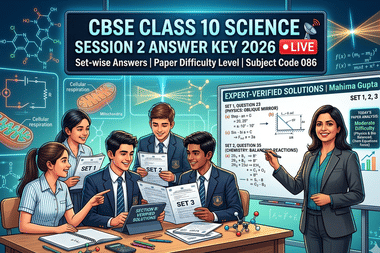
CBSE Class 10 Science Session 2 Answer Key 2026 (OUT): Set-Wise Solved Paper, Analysis

Mahima Gupta

Updated On: May 18, 2026 04:33 PM

CBSE Class 10 Science Session 2 Answer Key 2026 (Released): Download expert-verified, set-wise unofficial answer keys and solved question paper PDFs for Subject Code 086 right here. Check post-exam analysis, student reviews, moderate-level good attempts, and passing criteria here.
CBSE Class 10 Science Session 2 Answer Key 2026 (OUT): Set-Wise Solved Paper, AnalysisCBSE Class 10 Science Session 2 Answer Key 2026 (OUT): Set-Wise Solved Paper, Analysis
FREE WORKSHOP

Want to unlock the other 99%?

Join our live, hands-on session and watch Claude build apps, dashboards & campaigns in real time.

  • SESSIONClaude Live Session by Experts
  • WHENSat, 13 June · 11 AM – 1 PM
  • FORMATPractical · No theory · Live demos

CBSE Class 10 Science Session 2 Answer Key 2026 (OUT): Welcome to CollegeDekho’s live coverage of CBSE Class 10 Science Session 2 (Improvement/Compartment) Exam 2026! The overall Science paper( Subject Code 086) concluded today, Monday, May 18, 2026, was rated Moderate based on initial student reviews . Thousands of students across India have successfully wrapped up the three-hour examination, which ran from 10:30 AM to 1:30 PM. To help you evaluate your performance immediately, our team of subject-matter experts has begun releasing the highly anticipated, unofficial CBSE Class 10 Science Second Exam Answer Key 2026 across all distributed question paper sets. Keep refreshing this page for instant access to expert-verified set-wise answers, real-time student feedback, and an in-depth paper difficulty level analysis!

CBSE Class 10 Science Session 2 Answer Key 2026: Set-Wise Solutions

Our CollegeDekho Board Expert, Mahima Gupta , is preparing the unofficial answer keys for all question paper sets distributed in the exam today.
Answer Key for Set Code (31/8/1)

Questions

Answer Key Solutions

Section B (Chemistry) 17. How many bonds can one carbon atom form in a compound? (C) 4
18. Which of the following salts do not contain water of crystallization? (D) (i) and (ii)
19. Identify the unsaturated compounds from the following: (D) (ii) and (iii)
20. During the preparation of hydrogen chloride gas on a humid day, the gas is usually passed through a guard tube containing calcium chloride. The role of CaCl₂ taken in guard tube is to (C) Absorb moisture from the gas
21. In the compound CH 3 -C-CH, which of the following functional group is present? (D) Ketone
22. Which of the following statements about the given reaction are correct? (A) (i) (ii) and (iii)
23. Which of the following acid-base indicators will be used by a visually challenged student to detect the presence of acid in a given solution? (B) Clove oil
24. Assertion (A): Sodium acetate is a basic salt.
Reason (R): It is because it is a salt of weak acid and strong base
(A) Both the Assertion (A) and Reason (R) are true, and the Reason (R) is the correct explanation of the Assertion (A)
25. Write chemical equations for the reactions taking place when :
(i) Manganese dioxide is heated with aluminium powder.
(ii) Steam is passed over red hot iron.
MnO 2 + Al _____Al 2 O 3 + Mn
Fe + H 2 O (Steam) ______ Fe 3 O 4 + H 2

Section A: Q.1 Select the correct option that shows the path of flow of only the deoxygenated blood through the human circulatory system

(D) Body ___Right atrium------Right ventricle----- Lungs

Q2.Which of the following groups consists entirely of substances that are broken down by an enzyme, lipase? (B) Fats, Oil and Ghee
Q3. Identify the gland that enables the human beings to deal with an emergency situation. (C) Adrenal Gland
Q4.Examine the given food chains to establish the correct one in an ecosystem: (B) Algae--------Small fish------large fish-------------hawk
Q5. 5. A man underwent MRI of brain which shows some defects in the cerebellum of his brain. Which activity that person will be affected by? (D) Walking in straight line
Q6. During the process of exhalation, air follows a definite path from lungs to outside.
Choose the correct option showing the path of exhaled air.
(A) Alveoli -----Trachea---------Larynx-----Pharynx-------------Nostril
Q7. Two pea plants one with round green seeds (RRyy) and another with wrinkled yellow seeds (rrYY) were crossed. All the seeds of F₁ progeny have round, yellow seeds (RrYy). When F₁ plants are self-pollinated, the
F₂ progeny will have new combination of characters.
(i) Round, yellow
(ii) Round, green
(iii) Wrinkled, yellow
(iv) Wrinkled, green
Choose the option
(B) (i) and (iv)
Q8. Assertion (A): In regeneration, organisms have the ability to give to new individual organisms from their body parts.
Reason (R) : Simple animals like Hydra and Planaria regeneration
(B) Both the Assertion (A) and Reason (R) are true, and the Reason (R) is the incorrect explanation of the Assertion (A)
Q9. Assertion (A): In human beings, the respiratory pigment is haemo present in red blood cells.
Reason (R): Haemoglobin has a very high affinity for carb
(C) Assertion (A) is true, but Reason (R) is false
Q10. Assertion (A): The energy transferred to a lion when it eats a deer is only a small fraction of the deer's total energy content.
Reason (R): Energy transfer is efficient at all trophic levels with nearly 90% of energy passed on to the next level.
(C) Assertion (A) is true, but Reason (R) is false
Section C- Physics 30. When a convergent beam------is (D) 30 cm

Answer Key for Set Code (31/8/2)

Questions

Answer Key Solutions

Section B Chemistry 17. The number of isomers of butane is: (B) 2
18. Which of the following compound is formed when CO 2 gas is passed through ammoniacal brine solution (D) NaHCO 3
19. Which of the following compounds will undergo addition reaction? (B) C 4 H 8
22. Which of the following aqueous solution reacts with crushed egg shells to give a gas that turns lime water milky? (B) HCL

CBSE Class 10 Science Session 2 Paper Analysis 2026: Difficulty Level & Student Reviews

After the exam, both educators and students agreed that the Subject Code 086 Science paper was moderately difficult. It covered Physics, Chemistry, and Biology in line with the NCERT pattern, but some questions demanded deep analytical thinking. Here's feedback from students across the country about their performance.

  • Rohan Sharma (New Delhi): "The paper was extremely fair, but it felt longer than the mock tests we practiced. Section A was highly scoring, though two Assertion-Reason questions in Chemistry were slightly confusing. Overall, it was a solid improvement over the Session 1 paper."
  • Ananya Nair (Bengaluru): "Physics numerical problems from the Electricity unit required explicit formula substitution, which took up a lot of my time. Thankfully, the Biology section was straight from the NCERT textbook. The diagrams were easy to label, making up for the tricky bits in Physics."
  • Priyanth Das (Kolkata): "I was mostly worried about the long-answer questions in Section D, but they were quite direct. For me, Section E's case-based questions were the real challenge today because they demanded a lot of reading and practical application. Still, I expect a much better score this time."
  • Mehak Preet (Chandigarh): "Chemistry equations were beautifully balanced and didn't deviate from past trends. Anyone who thoroughly revised the NCERT exemplars could easily score above 60 marks today. I'm satisfied with how I managed my time."

CBSE Class 10 Science Passing Marks 2026 for Theory Paper

Students taking the Session 2/Improvement exams must achieve a minimum of 33% overall in each subject to pass Class 10, according to CBSE guidelines. For the 80-mark theory paper, aim for at least 26 to 27 marks, along with the minimum passing marks in internal assessments.

Component

Maximum Marks

Minimum Passing Marks (33%)

Theory Paper

80 Marks

26 - 27 Marks

Internal Assessment / Practical

20 Marks

07 Marks

Grand Total

100 Marks

33 Marks

CBSE Class 10 Science Expected Section-wise Good Attempts

The CBSE Class 10 Science question paper (Subject Code 086) had 39 questions across five sections. Based on feedback indicating a moderate difficulty level, the board expert has revised the optimal attempt guidelines for each section.

Section & Question Type

Total Questions

Expected Good Attempts (For a 60+ Score)

Safe Attempts (To Pass Comfortably)

Section A: MCQs & Assertion-Reason (Q1–20)

20 Questions (1 mark each)

15 – 17 Questions

11 – 12 Questions

Section B: Very Short Answer (Q21–25)

5 Questions (2 marks each)

4 Questions

2 – 3 Questions

Section C: Short Answer (Q26–31)

6 Questions (3 marks each)

4 – 5 Questions

3 Questions

Section D: Long Answer (Q32–34)

3 Questions (5 marks each)

2 Questions

1 – 2 Questions

Section E: Case-Based/Source-Based (Q35–37)

3 Questions (4 marks each)

2 Questions

1 Question

Overall Paper

39 Questions (80 Marks)

28+ Questions

18+ Questions

CBSE Class 10 Science Session 2 Answer Key 2026 Live Updates

  • 04 31 PM IST - 18 May'26

    CBSE Class 10 Science Live Coverage Concludes: Final Wishes From CollegeDekho

    We are wrapping up our dedicated live tracking for CBSE Class 10 Science Session 2 Answer Key 2026. From early-morning center reports to real-time student reviews and expert-verified set-wise PDF solutions, we hope our coverage helped clear your post-exam anxieties today. Make sure to check the active solution from our dashboard to compute your estimated scores. CollegeDekho wishes all Class 10 candidates the absolute best for their upcoming results!

  • 04 00 PM IST - 18 May'26

    Next Steps For Class 10 Students: What To Expect Next?

    With the core Science theory examination out of the way, students can now take a breather. For those appearing exclusively for this improvement or compartment schedule to clear their baseline metrics, the focus will now shift toward internal tracking. According to internal academic timelines, the central board is expected to fast-track the evaluation of these Session 2 answer scripts to ensure results are processed smoothly ahead of regular academic streams.

  • 03 40 PM IST - 18 May'26

    Comprehensive Post-Exam Summary: Moderate Complexity Marks Session 2

    As we close out our peak live analysis window, the collective verdict on the CBSE Class 10 Science Session 2 paper stands at a firm Moderate. It was an academically fair paper that successfully balanced easy, direct definitions with moderate, competency-based application questions. All primary set-wise answer key links (Set 1, Set 2, and Set 3) are now fully active or undergoing final verification adjustments in the table above.

  • 03 20 PM IST - 18 May'26

    Evaluation Spotlight: How Steps In Physics Numericals Will Secure Marks

    As our experts finalize the solutions for the Physics portion of Section D, a crucial reminder for students checking their answers: CBSE follows a strict step-marking evaluation pattern. Even if your final calculated arithmetic value for a lens magnification or circuit resistance question is slightly off due to a calculation error, writing down the correct formula, listing the given variables, and showing the substitution steps will still secure you up to 70% to 80% of the marks allocated to that specific question.

  • 03 00 PM IST - 18 May'26

    Teachers' Verdict: Well-Balanced Paper Tailored For Improvement Candidates

    Senior Science educators from leading CBSE schools have shared their initial feedback on today's Subject Code 086 paper. The general consensus is that the paper was highly balanced and student-friendly, perfectly tailored for an improvement session. Teachers noted that the blueprint guidelines were strictly maintained, meaning students who focused on high-weightage topics like Metals and Non-metals and Life Processes will comfortably cross their target scores.

  • 02 45 PM IST - 18 May'26

    Biology Section Review: Diagram Accuracy Key to Maximum Scoring

    According to preliminary expert insights, the Biology section acted as a major relief for the majority of candidates today. Questions covering Life Processes, Reproduction, and Heredity leaned toward standard textbook expectations. However, sub-questions tracking specific physiological systems required crisp, point-wise conceptual explanations. Students who supplemented their descriptive answers with clean structural diagrams are expected to score exceptionally well.

  • 02 30 PM IST - 18 May'26

    Chemistry Section Review: Balancing Equations Emerges as Major Highlight

    The Chemistry section focused heavily on fundamental chemical property tests and observation-based deductions. Core application questions tested student clarity on the reactivity series, properties of carbon compounds, and functional group identifications. Expert analysis indicates that writing fully balanced chemical equations was highly instrumental for pulling full marks in the 3-mark and 5-mark question frameworks.

  • 02 15 PM IST - 18 May'26

    Physics Section Review: Numericals Demand Strict Formula Substitution

    A deep dive into the Physics segment of today's paper reveals a balanced mix of diagrammatic representations and analytical numerical calculations. Questions centered around Electricity and Light - Reflection and Refraction required precise application of lens formulas, magnification properties, and sign conventions. Teachers reviewing the paper note that students who systematically presented their steps—separating formulas, values substitution, and final SI units—will secure maximum marks.

  • 02 00 PM IST - 18 May'26

    Sourcing Question Paper Sets: Expert Analysis Initiated

    Our team has successfully sourced copies of the question booklets across primary regional distributions, including Set 1, Set 2, and Set 3. CollegeDekho Board Expert, Mahima Gupta, has initiated a comprehensive breakdown of the structural questions. Preliminary review indicates that the core distribution matches the official CBSE blueprint framework perfectly. Work on creating the verified set-wise solutions has begun, and the link active placeholders will update shortly.

  • 01 54 PM IST - 18 May'26

    Section-Wise Difficulty Breakdown

    Our board expert, Mahima Gupta, has mapped out the sectional complexity as follows:

    • Section A (Objective): Easy to Moderate. Straightforward MCQs with a couple of tricky conceptual traps.
    • Section B & C (Short Answers): Easy. Heavily reliant on direct definition frameworks and standard differences.
    • Section D (Long Answers): Moderate. Lengthy, but highly systematic and balanced.
    • Section E (Case-Based): Moderate to Difficult. Required a strong analytical grasp of practical real-world science applications.

  • 01 45 PM IST - 18 May'26

    Early Student Reactions: Moderate Paper with Lengthy Competency Questions

    Early feedback from emerging students indicates that today’s Class 10 Science paper fell into the Moderate category. While direct conceptual questions from NCERT texts offered easy scores, a significant portion of students noted that the case-based competency questions were slightly time-consuming. Most candidates are reporting that the Biology section was highly scoring, whereas the application-heavy Physics numerical assignments required careful arithmetic calculation.

  • 01 30 PM IST - 18 May'26

    Science Session 2 Examination Concludes Nationally

    The clock strikes 1:30 PM, and the CBSE Class 10 Science Session 2 paper has officially concluded. Invigilators are actively collecting answer scripts across all examination centers. Students are starting to exit the exam halls, indicating an end to the intensive three-hour session. CollegeDekho’s structural team is currently interacting with early exits to bring you immediate student feedback and initial reactions regarding the overall difficulty parameters.

  • 01 15 PM IST - 18 May'26

    Final Warning Bell Rings Across Examination Halls

    The final fifteen minutes of the CBSE Class 10 Science Session 2 exam are now in progress. Invigilators have sounded the warning bell, prompting students to immediately bind their supplementary answer sheets. Students are scrambling to finalize their long-answer explanations and ensure all specific sub-questions are numbered correctly. Outside the centers, parents and teachers have gathered as the three-hour testing window draws to a close.

  • 01 00 PM IST - 18 May'26

    The Final Count Down: Revision Protocols And Answer Set Mapping

    We are down to the final thirty minutes of the examination inside the halls. Invigilators have issued the warning bell, and students are entering the final push. This crucial window is ideally reserved for verifying question attempt numbers, ensuring all section headers are marked clearly, double-checking mathematical calculations in Physics numerical formulas, and tying loose ends. Meanwhile, here at the CollegeDekho newsroom, our board expert, Mahima Gupta, has initiated preliminary coordination to source the physical question paper sets. Stay tuned, as the comprehensive set-wise unofficial answer keys and live difficulty reviews will drop right here starting at 1:30 PM sharp!

  • 12 45 PM IST - 18 May'26

    Final Section Challenge: Tackling Section E Case-Based Questions

    With only 45 minutes left on the clock, students are moving into Section E, the final segment of the question booklet. Section E features 3 source-based or case-based assessment questions worth 4 marks each. These questions test a student's core competency and analytical thinking by presenting real-world scientific scenarios, data tables, or case studies, requiring them to deduce logical conclusions based on their textbook knowledge.

  • 12 30 PM IST - 18 May'26

    One Hour To Go: Students Move To Section D Long Answers

    The final, high-stakes hour of the CBSE Class 10 Science Session 2 exam has officially commenced. Students are now facing Section D, which contains 3 extensive, long-answer questions carrying 5 marks each (totaling 15 marks). This section requires comprehensive deep dives, often incorporating structured sub-questions (a, b, c) across complex topics like the human excretory system, carbon allotropes, or complex circuit diagram analysis. Strategic distribution of points here can make or break a first-division score aggregate.

  • 12 15 PM IST - 18 May'26

    Understanding The Threshold: Passing Criteria For Science Theory Paper

    For many anxiety-laden parents and students monitoring this live blog, understanding the baseline safety net is essential. To successfully clear the CBSE Class 10 Science paper, a candidate must secure an overall 33% score. Out of the 80 marks allocated to today’s written theory paper, students must aim to hit a minimum absolute score of 26 to 27 marks. When combined with the internal assessment or practical scores out of 20, crossing this threshold ensures an official pass or a successful upgrade in their improvement marks matrix.

  • 12 00 PM IST - 18 May'26

    Two Hours Remaining: Crucial Transition To High-Weightage Short Answers

    It is 12 PM, marking the completion of the first half of the examination. Students have exactly two hours remaining to complete the paper. The focus has now universally shifted toward Section C, which contains 6 questions of 3 marks each, totaling 18 marks. This section typically introduces mid-level comparative analysis, such as distinguishing between aerobic and anaerobic respiration, or calculating lens power and focal lengths using specific sign conventions.

  • 11 45 AM IST - 18 May'26

    Decoupling Section B: Scoring High On Very Short Answer Questions

    Students are focused on Section B, which has 5 questions worth 2 marks each. To earn full marks, answers should be clear and concise, using scientific terminology and neat chemical equations, all within a 30-to-50-word limit. This approach helps secure 10 marks efficiently.

  • 11 30 AM IST - 18 May'26

    Mid-Exam Strategy: Managing Time Between Physics Numericals And Biology Diagrams

    We have reached the one-hour mark of the examination. At this point, ideal time management dictates that students should be transitioning out of Section A and actively diving into Section B (Very Short Answer Type Questions) and Section C (Short Answer Type Questions). Experts emphasize that balancing time between lengthy Physics numerical formulas (from Electricity and Magnetic Effects of Electric Current) and crisp, structured Biology explanations (from Life Processes) is the absolute key to preventing a last-minute time crunch.

  • 11 15 AM IST - 18 May'26

    Blueprint Check: Chemistry Unit Carries Maximum Evaluation Weight

    As students progress through the early stages of the paper, a glance at the official CBSE Class 10 Science blueprint highlights that Unit I: Chemical Substances - Nature & Behaviour commands the maximum weightage along with Biology, standing at a massive 25 marks. This unit includes core chapters such as Acids, Bases and Salts, Metals and Non-metals, and Carbon and its Compounds. Scoring well in the chemical reaction equations and properties sections under this unit is highly instrumental for students aiming to cross the passing threshold comfortably today.

  • 11 00 AM IST - 18 May'26

    Focus Shifts To Section A: Navigating MCQs And Assertion-Reasoning

    Inside the exam halls, students are currently immersed in Section A, which forms the foundation of the question paper. This section comprises 20 objective-type questions, including 1-mark Multiple Choice Questions (MCQs) and critical Assertion-Reasoning questions. While Section A offers an excellent opportunity to secure a quick 20 marks, it can often feature tricky, conceptual trap choices designed to test a student's fundamental clarity in NCERT concepts, particularly in chapters like Chemical Reactions and Equations and Light - Reflection and Refraction.

  • 10 45 AM IST - 18 May'26

    Writing Time Begins: Students Tackle The 80-Mark Paper

    The 15-minute reading time is over, and students have begun writing their responses for the Class 10 Science paper, which is worth 80 marks and lasts 3 hours, ending at 01:30 PM. There are 39 mandatory questions, and students should start with the high-scoring Objective Type questions in Section A before tackling the heavier descriptive sections.

  • 10 30 AM IST - 18 May'26

    Science Session 2 Exam Commences; Question Papers Distributed

    The clock strikes 10:30 AM, and the CBSE Class 10 Science Session 2 exam is officially underway across the country. Invigilators have distributed the question booklets across various sets (Set 1, Set 2, and Set 3). Students are now entering their crucial 15-minute reading window, which lasts until 10:45 AM. During this period, candidates are strictly instructed not to write anything on their answer scripts but to comprehensively analyze the structure of the paper, identify optional questions, and plan their time management strategy across the five distinct sections.

  • 10 21 AM IST - 18 May'26

    Live Blog Active: CBSE Class 10 Science Session 2 Coverage Begins

    The final countdown is officially underway for the CBSE Class 10 Science Session 2 (Improvement/Compartment) examination. With just 10 minutes left before candidates are handed their question papers, thousands of students across India have already entered their respective examination halls and taken their seats. Today’s paper (Subject Code 086) holds immense importance for those aiming to clear their compartment boundaries or significantly boost their overall aggregate percentages. CollegeDekho's dedicated exam desk is live, and our board expert, Mahima Gupta, is stationed to bring you the fastest, most accurate set-wise unofficial answer keys immediately after the conclusion of the exam at 01:30 PM. Ensure you bookmark this URL now to receive instantaneous access to question paper PDFs, real-time student feedback, and deep-dive difficulty analyses!

/articles/cbse-class-10-science-session-2-answer-key-2026-live/

Do you have a question? Ask us.

  • Typical response between 24-48 hours

  • Get personalized response

  • Free of Cost

  • Access to community

Top