


 Maharashtra HSC Economics Exam 2026 LIVE
Maharashtra HSC Economics Exam 2026 is over!
The three hour long exam ended at 2 PM. As per reviews and reactions colllected by actual test takers, the
overall difficulty level of the Economics exam is reported to more on the easier side.
1-mark questions and MCQs were quite direct, easy, and syllabus-based. Some students also found the paper to be moderate in difficulty.
Through this live blog, question-wise answers, student reactions and the opinion of the subject expert on the difficulty level have been provided. Maharashtra State Board does not officially release an answer key for Economics. Therefore, unoffiical keys provided through this live blog will be helpful to students in analyzing their exam performance. Stay Tuned!
Maharashtra HSC Economics 2026 Unofficial Answer Key
The unofficial Maharashtra HSC Economics Answer Key 2026 has been updated below:
Question | Answer |
|---|---|
Q1. (A) Complete the Correlation:
(ii) Price rises : _____ :: Price falls : Contraction of supply (iii) Salt : Essential good :: Diamond : _____ (iv) _____ : Base year price :: P₁ : Current year price (v) Money market : Short term funds :: _____ : Long term funds |
(i) Lumping method
(ii) Expansion of supply (iii) Luxury goods (iv) P₀ (v) Capital market |
(B) Give economic terms: (i) Capacity of a commodity to satisfy human want. (ii) A branch of economics which does microscopic study of the economy. (iii) Cost incurred on fixed factors. (iv) The cost incurred by the firm to promote sales. (v) A budget in which estimated revenue and expenditure of the government are equal. |
(i) Utility
(ii) Microeconomics (iii) Fixed Cost (iv) Selling Cost (v) Balanced Budget |
(C) Find the odd word:
(i) Types of utility:
(ii) Exceptions to the Law of supply:
(iii) Selling cost:
(iv) Determinants of demand:
Selection Index Number, Price Index Number, Value Index Number, Quantity Index Number |
(i) Commodity utility
(ii) Giffen’s goods (iii) Patents (iv) Cost of production (v) Selection Index Number |
(D) Choose the correct option: (i) Demand curve is parallel to Y-axis – (ii) Revenue per unit of output sold – (iii) Statements that are incorrect in relation to index numbers – (iv) Obligatory functions of the government – (v) Examples of competitive demand are – |
(i) (4) only a
(ii) (3) only c (iii) (2) a, b (iv) (3) only b (v) (2) a, c |
The difficulty level of Maharashtra HSC Economics Exam 2026 was at par with the last few years’ HSC Economics papers. The overall difficulty level was reported to be "Easy to Moderate." The question paper was very direct and strictly based on the prescribed syllabus.
Stay tuned to the LIVE Blog for more updates on Maharashtra HSC Economics Exam 2026, unofficial answer key, student feedback, etc.
Maharashtra HSC Economics Exam 2026 LIVE
05 00 PM IST - 24 Feb'26
Maharashtra HSC Economics Exam Live Blog Ends.
Thank you for following our real-time coverage - more updates on next exams coming up soon. Best of luck to all HSC students writing their exams!
04 00 PM IST - 24 Feb'26
Maharashtra HSC Upcoming Exams
MSBSHSE will conduct the following HSC exams on Wednesday, February 25, 2026, from 11:00 a.m. to 2:00 p.m.
- Biology
- History & Development of Indian Music
03 05 PM IST - 24 Feb'26
HSC Economics Exam Student Reviews and Reactions
Most students found the HSC Economics paper easy and quite direct. Many said that the questions were mostly from the textbook and followed familiar patterns from previous years and sample papers.
Several students shared that the paper was well-balanced, with straightforward theory-based questions and manageable numericals. Overall, students described the exam as scoring, simple, and less confusing, with no major surprises.
02 15 PM IST - 24 Feb'26
Answer Key, Student Reviews, Paper Analysis Soon!
The exam has just concluded, and our team is now working on bringing you the answer key, detailed paper analysis, and real student reactions shortly. Stay tuned for section-wise difficulty level, expert insights, and what students are saying about today’s paper.
02 00 PM IST - 24 Feb'26
Maharashtra HSC Economics Exam 2026 Concludes
The Maharashtra HSC Economics Exam 2026 has concluded at 2:00 PM. Students are exiting examination centres. Paper analysis, difficulty level, and student reactions will be posted here soon!
01 00 PM IST - 24 Feb'26
Final Hour in Progress!
The last hour of the Maharashtra HSC Economics exam is now underway. Students are expected to complete remaining answers and begin revising their answer sheets carefully.
12 00 PM IST - 24 Feb'26
One Hour Completed
One hour of the exam has been completed. Students are likely attempting long-answer questions and analytical sections.
11 00 AM IST - 24 Feb'26
Maharashtra HSC Economics Exam 2026 Begins
The Economics paper has officially begun across Maharashtra. Students have started writing the exam. The paper duration is three hours.
10 00 AM IST - 24 Feb'26
Students Reaching Exam Centres
Students have started arriving at examination centres. Entry procedures and verification are underway.
09 00 AM IST - 24 Feb'26
Students Begin Leaving for Exam Centres
Across Maharashtra, students have started leaving for their allotted examination centres. Parents are accompanying many candidates to ensure timely arrival.
08 00 AM IST - 24 Feb'26
Traffic and Travel Advisory
Students appearing for the Maharashtra HSC Economics exam should check traffic conditions before leaving home. Metro cities may witness morning rush hour congestion.
07 00 AM IST - 24 Feb'26
Timing Reminder for HSC Economics Paper
Students are advised to reach the exam centre at least 30 to 45 minutes before reporting time to complete verification formalities smoothly.
06 00 AM IST - 24 Feb'26
Good Morning Students, Exam Day Is Here
Today is the Maharashtra HSC Economics Exam 2026. The exam will begin at 11:00 AM and conclude at 2:00 PM. Students should start their day calmly and avoid last-minute panic revision.
05 00 AM IST - 24 Feb'26
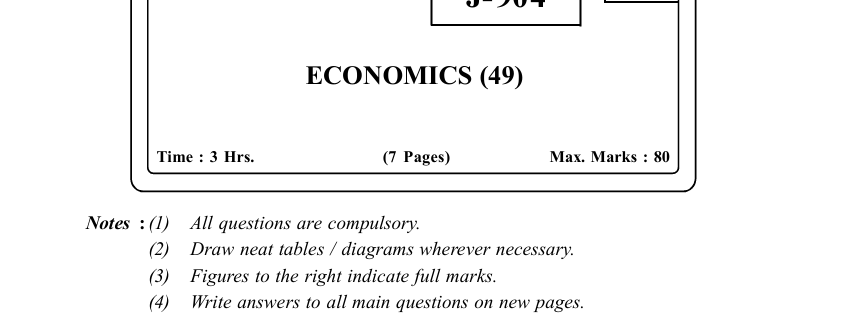
Quick Glimpse of the Economics Paper Instructions Page
Check out the official first page of the exam you might encounter today:
04 00 AM IST - 24 Feb'26
2-Mark Distinguishing Terms for Revision
These terms can be asked to distinguish between in the Economics exam, each carrying 2 marks. Study them now:
- Desire and Demand
- Internal trade and International trade
- Money market and Capital market
- Oilgopoly and Monopoly
03 00 AM IST - 24 Feb'26
Economic Terms for Quick Revision
Some statements along with their economic terms are given below. You can revise them for the upcoming exam:
Statement
Economic Term
More quantity is demanded due to changes in the favourable factors determining demand other than price.
Increase in demand
Deposits that are withdrawable on demand.
Demand deposits
Charging different prices to different consumers for the same product or services.
Price discrimination
Net addition made to total cost by producing one more unit of output.
Marginal cost
Degree of responsiveness of quantity demanded to change in income only.
Income elasticity of demand
02 00 AM IST - 24 Feb'26
4-Mark Questions to Solve
- Explain any four types of demand.
- Explain any four problems of capital market in India.
- Explain any four features of utility.
- Explain any four reasons for the growth of public expenditure.
- Explain any four features of macro economics.
01 00 AM IST - 24 Feb'26
Total utility vs Marginal utility
Check out the difference between Total utility and Marginal utility. This might be asked as a 2-3 mark question in the exam:
Basis of Difference
Total Utility (TU)
Marginal Utility (MU)
Meaning
The total satisfaction obtained from consuming all units of a good.
The additional satisfaction gained from consuming one more unit of a good.
Calculation
Sum of utilities of all units consumed.
Change in total utility ÷ Change in quantity.
Nature
Increases at a decreasing rate and may eventually fall.
Continuously decreases as more units are consumed (Law of Diminishing Marginal Utility).
Measurement
Measured in total utils.
Measured in utils per additional unit.
Relation
TU increases when MU is positive.
MU becomes zero when TU is maximum.
12 00 AM IST - 24 Feb'26
8-Mark Questions to Study
Check out some questions below that might be asked for 8 marks each in the exam. Try revising the concepts
- Explain the concept of price elasticity with its types.
- Explain the concept of National income and explain the practical difficulties involved in the measurement of National income.
11 00 PM IST - 23 Feb'26
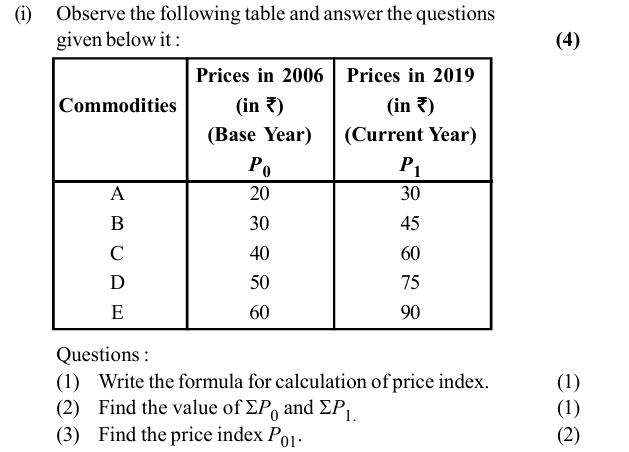
Important 4-Mark Question
Given below is a 4-mark question you should practice:
10 00 PM IST - 23 Feb'26
Recurring deposits and Fixed deposits
To understand the concept of RD and FD, check out the table below:
Basis of Difference
Recurring Deposit (RD)
Fixed Deposit (FD)
Meaning
A deposit scheme where a fixed amount is deposited every month.
A deposit scheme where a lump sum amount is deposited at one time.
Investment Pattern
Monthly installments.
One-time investment.
Suitable For
People who want to save small amounts regularly.
People who have surplus money to invest at once.
Interest Calculation
Interest is calculated on each monthly installment.
Interest is calculated on the entire deposited amount.
Maturity Amount
Depends on monthly deposit + interest earned.
Depends on principal amount + interest earned.
Flexibility
Requires regular monthly payment.
No need for monthly deposits after initial investment.
Best For
Salaried individuals with fixed monthly income.
Individuals with lump sum savings.
09 00 PM IST - 23 Feb'26
Important Topics to Quickly Revise Tonight
- National Income
- Money and Banking
- Indian Economic Development
- Balance of Payments
- Government Budget
08 00 PM IST - 23 Feb'26
Sleep on Time for Better Performance
Experts advise students to avoid late-night studying. Proper sleep improves memory and concentration. A calm and rested mind performs better in theory exams like Economics.
07 00 PM IST - 23 Feb'26
Keep Exam Essentials Ready
Before sleeping, students should keep all required items ready, including the hall ticket, a valid ID (if required), stationery, and a water bottle (if permitted). Check the exam centre location once again to avoid confusion in the morning.
06 00 PM IST - 23 Feb'26
Final Revision Reminder for Tomorrow’s Economics Exam
Maharashtra HSC Economics Exam 2026 will be conducted tomorrow from 11:00 AM to 2:00 PM. Students are advised to focus only on revision tonight. Avoid starting new topics.
05 00 PM IST - 23 Feb'26
Some More Economic Terms to Revise
Check some more economic terms that might be asked in the HSC Economics exam:
Statement
Economic Term
Elasticity resulting from a proportionate percentage change in the quantity demanded due to a proportionate percentage change in price.
Price Elasticity of Demand
The difference between the value of a country's exports and imports for a given period.
Balance of Trade
04 30 PM IST - 23 Feb'26
Last Minute Tips for Maharashtra HSC Economics Exam 2026
- Do not rely on random videos or social media posts claiming they have the “original paper” or “guaranteed questions.”
- There is no leaked paper. Trust only your textbook and proper revision. Avoid wasting time on rumours.
- Do not start learning completely new topics or new formulas at the last moment. This may create confusion and reduce your confidence.
- Focus only on revising what you have already studied.
- Revise important definitions, diagrams, index number formulas, elasticity concepts, and key points from each chapter.
- Since the paper provides plenty of internal choices and is strictly syllabus-based, attempt the questions you are most confident about.
04 00 PM IST - 23 Feb'26
Check Economic Terms for Revision
Given below are some of the important economic terms you should be aware of:
Statement
Economic Term
A desire which is backed by willingness to purchase and ability to pay.
Demand
Deposits that are withdrawable on demand.
Demand Deposits
Wear and tear of capital assets, due to their use in the process of production.
Depreciation
03 30 PM IST - 23 Feb'26
Some More "Agree or Disagree" Questions
This question usually carries 12 marks in total, with each explanation worth 4 marks. You will be given an option to choose 3-4 out of the total. Answer accordingly.
(i) Demand Curve slopes downward from the left to the right.
(ii) There are no limitations to the Index numbers.
(iii) Elasticity of demand depends upon several factors.
(iv) There are some exceptions to the law of supply.
(v) Capital market plays very important role in Indian economy.03 00 PM IST - 23 Feb'26
Law of Diminishing Marginal Utility with Assumptions
Statement of the Law: The Law of Diminishing Marginal Utility states that as a consumer consumes more and more units of a commodity, the marginal utility derived from each additional unit goes on decreasing, other things remaining constant (Ceteris Paribus). In simple words, satisfaction from each extra unit keeps decreasing.
Suppose a person eats slices of pizza.
- 1st slice - Very high satisfaction
- 2nd slice - Less satisfaction
- 3rd slice - Further less satisfaction
- 4th slice - Very little satisfaction
Thus, Marginal Utility (MU) goes on diminishing as consumption increases.
Assumptions of the Law:
- The consumer acts rationally and aims at maximum satisfaction.
- All units of the commodity consumed must be identical in size, quality and shape.
- Units must be consumed continuously without a long time gap.
- Consumer’s income remains constant.
- Tastes, habits and preferences of consumers remain unchanged.
- Price of the commodity remains constant.
- There should be no change in fashion, climate or other external conditions.
- 1st slice - Very high satisfaction
02 30 PM IST - 23 Feb'26
Quantity Index Number vs Value Index Number
Check below the difference between Quantity Index Number and Value Index Number:
Basis of Difference
Quantity Index Number
Value Index Number
Meaning
Measures the relative change in physical quantity of goods over a period of time.
Measures the relative change in total value (Price × Quantity) over a period of time.
What it Measures
Change in quantity only.
Change in total value of goods.
Formula
Q₁ / Q₀ × 100
(P₁Q₁) / (P₀Q₀) × 100
Use
Used to measure change in production, sales volume, etc.
Used to measure change in total expenditure or total sales value.
Effect of Price
Does not consider price directly.
Includes both price and quantity changes.
Example
Measuring increase in agricultural output over years.
Measuring increase in total sales revenue of a company.
02 00 PM IST - 23 Feb'26
Role of Foreign Trade in India
Foreign Trade plays a very important role in the economic development of India. It helps in increasing production, generating employment and improving the standard of living of the people. The role of foreign trade in India can be explained as follows:
- Earning Foreign Exchange: Foreign trade helps India to earn foreign exchange by exporting goods and services to other countries. This foreign exchange is used to pay for imports such as petroleum, machinery and other essential goods. It also helps in maintaining balance of payments.
- Optimum Utilisation of Resources: India has abundant natural and human resources. Through foreign trade, the country produces and exports goods in which it has comparative advantage. This leads to proper and efficient use of available resources.
- Import of Capital Goods and Technology: India imports advanced machinery, equipment and modern technology from developed countries. This helps in industrialisation, increases productivity and promotes economic development.
- Expansion of Market: Foreign trade expands the market for Indian producers beyond domestic boundaries. Access to international markets increases demand for Indian goods, which leads to large-scale production and growth of industries.
- Increase in National Income: Growth in exports leads to higher production. Increased production generates more employment opportunities in industries, agriculture and services sector. As employment and income rise, national income of the country also increases.
- Availability of Variety of Goods: Through imports, Indian consumers get access to goods that are not produced domestically or are produced in limited quantity. This increases consumer choice and ensures availability of better quality goods.
- Improvement in Standard of Living: Foreign trade provides better quality goods at competitive prices. As a result, the standard of living of the people improves.
- Stability in Prices: Imports help to control scarcity of essential goods in the domestic market. When there is shortage of goods, imports increase supply and help in stabilising prices, thereby controlling inflation.
- Economic Growth and International Relations: Foreign trade promotes specialization and efficiency. It strengthens economic relations with other countries and encourages international cooperation. It plays an important role in overall economic growth and development of India.
- Economic Growth and Development: Foreign trade encourages specialization, efficiency and international cooperation. It plays a significant role in accelerating economic growth of India.
01 30 PM IST - 23 Feb'26
Some More "Find the Odd Word" Questions
You can find below some more find the odd word questions to practice and learn:
Question
Odd Word
(i) Durable Goods: Furniture, Cupboard, Washing Machine, Fish
Fish (It is a perishable good, not durable)
(ii) Cost Concepts: Total cost, Average cost, Marginal cost, Selling cost
Selling cost (This is a concept of Monopolistic Competition, not a basic production cost concept like the others)
(iii) Legal Monopoly: Patent, OPEC, Copyright, Trademark
OPEC (This is a Cartel/Joint Monopoly, not a legal monopoly)
(iv) Theory of Economic Welfare: Theory of Income and Employment, Efficiency in Production, Efficiency in Consumption, Overall Economic Efficiency
Theory of Income and Employment (This is a part of Macroeconomics; the others are parts of Welfare Economics/Microeconomics)
(v) Exceptions to the Law of Demand: Giffen's paradox, Prestige goods, Price illusion, Supply of labour
Supply of labour (This is an exception to the Law of Supply)
01 00 PM IST - 23 Feb'26
Some More 8-Mark In-Depth Questions to Practice
- State and explain the law of diminishing marginal utility with its assumptions.
- State the meaning of National Income and explain the features of National Income.
12 30 PM IST - 23 Feb'26
Maharashtra HSC Economics Notes on Features of Macro Economics
- Study of Aggregates: Macro economics studies the economy as a whole. It deals with aggregate concepts such as national income, national output, national employment, general price level and business cycles.
- Income Theory: Macro economics studies national income, its elements, methods of measurement and social accounting. It explains fluctuations in national income which lead to inflation and deflation.
- General Equilibrium Analysis: Macro economics studies general equilibrium which deals with behaviour of demand, supply and prices in the whole economy.
- Interdependence: Macro analysis considers interdependence between aggregate variables like income, output, employment, investment and price level. A change in one variable affects others.
- Lumping Method: Macro economics uses lumping method. It studies the whole economy as one unit rather than dividing it into small parts.
- Growth Models: Macro economics studies factors responsible for economic growth and development. It helps in developing growth models such as the Mahalanobis growth model.
- General Price Level: Macro economics studies determination and changes in general price level, which is the average of prices of goods and services in the economy.
- Policy-oriented: Macro economics is policy-oriented. It suggests suitable economic policies to promote growth, generate employment, and control inflation and depression.
12 00 PM IST - 23 Feb'26
4-Mark Solved Numerical To Practice
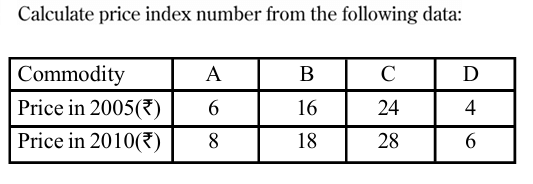
Since only prices are given, we use Simple Aggregative Price Index formula.
Price Index (P₀₁) = (ΣP₁ / ΣP₀) × 100
Where,
ΣP₁ = Sum of current year prices (2010)
ΣP₀ = Sum of base year prices (2005)ΣP₀ = 6 + 16 + 24 + 4
ΣP₀ = 50ΣP₁ = 8 + 18 + 28 + 6
ΣP₁ = 60Price Index (P₀₁) = (60 / 50) × 100
Price Index (P₀₁) = 1.2 × 100
Price Index (P₀₁) = 120The Price Index Number for 2010 (Base Year 2005 = 100) is 120.
11 30 AM IST - 23 Feb'26
Some "Complete the Correlation" Questions with the Answer
Given below are some Complete the Correlation questions that might come in the Economics exam this year, along with their answers:
Question
Correct Answer
(i) Internal Trade : Home Trade : : International Trade : ______
Foreign Trade (or External Trade)
(ii) Discriminated prices : ______ : : Single price : Perfect competition
Monopoly
(iii) ______ : Central Bank : : SBI : Commercial Bank
RBI (Reserve Bank of India)
(iv) Output method : ______ : : Income method : Factor cost method
Inventory method (or Product method)
(v) The period of Inflation : Surplus Budget : : The Period of Depression : ______
Deficit Budget
11 00 AM IST - 23 Feb'26
Perfectly Elastic Demand vs Perfectly Inelastic Demand
The basic difference between Perfectly Elastic and Inelastic Demand is explained below:
Basis of Difference
Perfectly Elastic Demand
Perfectly Inelastic Demand
Meaning
A very small change in price leads to an infinite change in quantity demanded.
Change in price does not cause any change in quantity demanded.
Elasticity Coefficient (Ed)
Ed = ∞ (Infinity)
Ed = 0
Effect of Price Change
Even a slight increase in price reduces demand to zero.
Demand remains constant even if price increases or decreases.
Nature of Demand Curve
Horizontal straight line parallel to X-axis.
Vertical straight line parallel to Y-axis.
Consumer Reaction
Consumers are highly sensitive to price change.
Consumers are not affected by price change.
Example
Products in perfectly competitive market (theoretical case).
Life-saving medicines (theoretical case).
10 30 AM IST - 23 Feb'26
A 4-Mark Passage-Based Question To Practice
Read the given passage and answer the following questions : (4 Marks)
The Government of India and various agencies continuously monitor and calculate the National Income using different methods such as the output method, income method and expenditure method. These methods help in providing a comprehensive picture of India’s economic performance.
From 2001 to 2021, India’s GDP grew at an average annual rate of around 6 to 7%. The country saw a significant shift from a primarily agriculture-based economy to a more diverse economy, with the services and industrial sectors playing a more prominent role in GDP composition.
However, it is important to note that there were fluctuations and challenges along the way, including the global financial crisis in 2008 and the COVID-19 pandemic in 2020, which temporarily disrupted growth trends.
In recent years, India has aimed for sustainable economic development, focusing on information technology. Initiatives such as “Make in India” and “Digital India” have been launched to boost economic activities and create employment opportunities, which in turn positively impact the National Income.
Questions:
(1) What is the average annual growth rate of India for the period from 2001 to 2021? (1)
(2) Which factors disrupted the growth trends of India’s National Income? (1)
(3) Express your opinion about the given passage. (2)
10 00 AM IST - 23 Feb'26
Features of Microeconomics
- Study of Individual Units: Micro economics studies the behaviour of small individual economic units such as individual consumer, individual firm, individual industry, individual price, and individual household.
- Price Theory: Micro economics deals with the determination of prices of goods and services as well as factors of production. Therefore, it is also known as Price Theory.
- Partial Equilibrium: Micro economic analysis studies partial equilibrium. It analyses the equilibrium position of an individual unit while isolating it from other forces. It studies equilibrium of individual consumer, firm or industry separately.
- Based on Certain Assumptions: Micro economics is based on the assumption of “Other things remaining constant” (Ceteris Paribus). It assumes perfect competition, laissez-faire policy, pure capitalism, full employment, etc., to simplify analysis.
- Slicing Method: Micro economics uses slicing method. It divides the whole economy into small units and studies each unit separately. For example, study of individual demand out of aggregate demand.
- Use of Marginalism Principle: Micro economics uses the principle of marginalism. The term ‘marginal’ means change in total due to an additional unit. Consumers and producers take decisions based on marginal cost and marginal utility.
- Analysis of Market Structure: Micro economics studies different market structures such as Perfect Competition, Monopoly, Monopolistic Competition and Oligopoly.
- Limited Scope: The scope of micro economics is limited to individual units. It does not deal with national problems like inflation, deflation, unemployment, poverty, population, balance of payments, etc.
09 30 AM IST - 23 Feb'26
Solved 4-Mark Question for Exam Prep
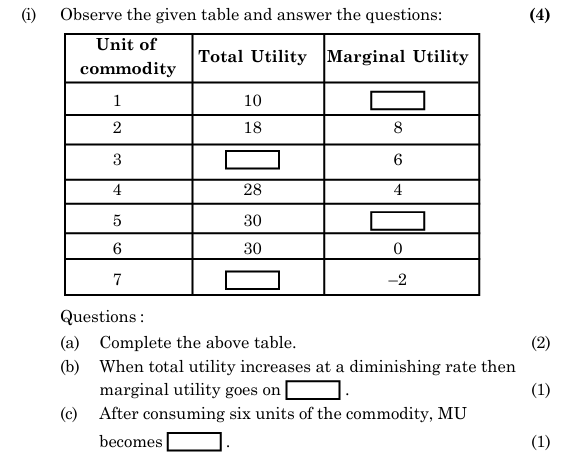
Formula:
Marginal Utility (MU) = Change in Total Utility (TU)
MUₙ = TUₙ − TUₙ₋₁
Calculations:
- MU₁ = 10 − 0 = 10
- TU₃ = 18 + 6 = 24
- MU₅ = 30 − 28 = 2
- TU₇ = 30 − 2 = 28
(b) When total utility increases at a diminishing rate, marginal utility goes on decreasing.
(c) After consuming six units of the commodity, MU becomes zero.
09 00 AM IST - 23 Feb'26
Maharashtra HSC Economics Notes on Internal Debt vs External Debt
The difference between Internal and External Debt is given below:
Basis of Difference
Internal Debt
External Debt
Meaning
Loans raised by the government from sources within the country.
Loans raised by the government from foreign countries or international institutions.
Source of Borrowing
Borrowed from citizens, commercial banks, financial institutions, etc., within the country.
Borrowed from foreign governments, foreign banks, and international institutions like World Bank and International Monetary Fund.
Currency of Repayment
Repaid in domestic currency.
Repaid in foreign currency.
Impact on Foreign Exchange
Does not directly affect foreign exchange reserves.
Affects foreign exchange reserves as repayment is made in foreign currency.
Burden of Debt
Burden remains within the country.
Burden involves repayment to foreign countries or institutions.
Example
Government issuing bonds or treasury bills within India.
Government taking a loan from the World Bank or IMF.
08 30 AM IST - 23 Feb'26
8-Mark In-Depth Questions for HSC Economics Exam
The following questions might come in the exam for 8 marks each:
- State and explain the law of demand with its assumptions.
- Explain the factors influencing the elasticity of demand.
- Explain the reasons for the growth in public expenditure in India.
08 00 AM IST - 23 Feb'26
Maharashtra HSC Admit Card
You must carry your Maharashtra HSC 2026 admit card to the exam centre without fail. The hall ticket is a mandatory document issued. Without the admit card, entry to the exam hall will not be permitted. Also, keep a valid ID proof along with it.
07 30 AM IST - 23 Feb'26
HSC Economics Exam 2026 Reaching Time Alert!
Students appearing for the Maharashtra HSC Economics 2026 exam tomorrow are advised to reach their examination centres at least 30-40 minutes before the reporting time. The exam will be conducted from 11 AM to 2 PM. This means you should aim to reach by 10:20 or 10:30 max!
07 00 AM IST - 23 Feb'26
Some 4-Mark Questions for Economics Exam
- Explain any four features of Microeconomics.
- Explain any four features of perfect competition.
- Explain any four functions of the Reserve Bank of India.
- Explain the two-sector model of the circular flow of National Income.
- Explain the types of Index Numbers
06 00 AM IST - 23 Feb'26
Maharashtra HSC Economics 2026 Last Day Alert!
Today is the final day of preparation for the Maharashtra HSC Economics 2026 exam. The paper will be conducted tomorrow by the Maharashtra State Board of Secondary and Higher Secondary Education. Use this last day to revise important concepts and formulas!
05 00 AM IST - 23 Feb'26
More 2-Mark Concept-Based Solved Questions for Economics Exam Prep
Swara receives a monthly pension of 8,000 from the State Government of Maharashtra.
Tushar deposited a lump sum amount of 1,00,000 in the bank for a period of three years.
Sharad was able to supply less paper to the market due to technical problems in paper making factory, although the price of paper remained constant.
- Concept: Transfer Income / Transfer Payment
Transfer income refers to income received without rendering any productive service. Pension is a transfer payment given by the government to individuals. It is not included in the National Income because no current production of goods or services takes place.
- Concept: Fixed Deposit
A Fixed Deposit is a type of bank deposit where a lump sum amount is deposited for a fixed period at a fixed rate of interest. The amount cannot be withdrawn before maturity without penalty. It encourages savings and provides assured returns.
- Concept: Decrease in Supply
A decrease in supply refers to a situation where a smaller quantity is supplied at the same price due to non-price factors. Here, technical problems in the factory reduced production. Since price remained constant, it is a decrease in supply and not a contraction of supply.
04 00 AM IST - 23 Feb'26
Public Finance vs Private Finance
You need to understand the basic differences of Public Finance vs Private Finance, as it might come in the exam:
Basis
Public Finance
Private Finance
Meaning
Finance of the government.
Finance of an individual or private firm.
Objective
Welfare of the public.
Profit maximization or personal benefit.
Source of Income
Taxes, fees, loans, etc.
Salary, business income, rent, etc.
Budget
The government can have a deficit budget.
Individuals usually try to avoid a deficit.
03 00 AM IST - 23 Feb'26
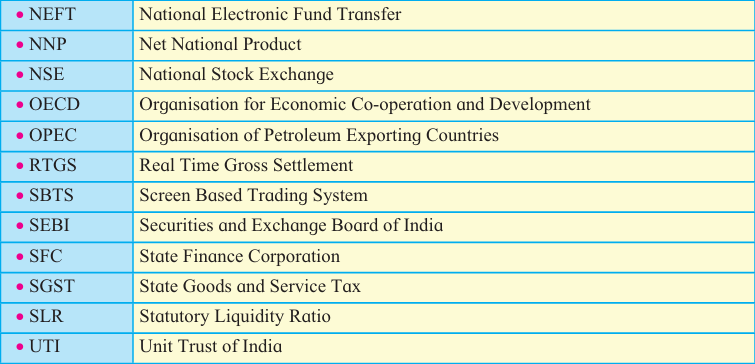
Some More Economics-Related Abbreviations
Given below are some more of the abbreviations you should know:
02 00 AM IST - 23 Feb'26
Simple Index Number vs Weighted Index Number
The key differences between Simple Index Number and Weighted Index Number are:
Basis
Simple Index Number
Weighted Index Number
Meaning
An index number calculated without giving importance (weight) to any item.
An index number calculated by giving importance (weight) to different items.
Importance
All items are treated equally.
Items are given different importance based on use.
Accuracy
Less accurate.
More accurate and reliable.
Example
Simple average of prices of rice, wheat, sugar, etc.
Consumer Price Index (CPI), where items have different weights.
01 00 AM IST - 23 Feb'26
Some Concept-Based Solved Questions for Economics Exam Prep (2-Mark Questions)
Raju collected the information about total consumption, total savings and total investment of Indian economy.
Rise in price by 20% of a commodity ‘X’ leads to fall in the demand of the same commodity ‘X’ by 20%.
- Concept: National Income Accounting
National Income Accounting refers to the systematic recording of total consumption, total savings, total investment and other economic activities of a country during a given period of time. It helps to measure the overall economic performance of the country. In India, such data is used to calculate aggregates like National Income, Gross Domestic Product (GDP), etc.
- Concept: Unitary Elastic Demand
When a proportionate change in price leads to an equal proportionate change in quantity demanded, it is called Unitary Elastic Demand. Here, price rises by 20% and demand falls by 20%. Hence, elasticity of demand is equal to one (Ed = 1).
12 00 AM IST - 23 Feb'26
"Find The Odd Word" Questions
Check below some of the questions that have come under the section “Find The Odd Word” in previous years:
Question
Odd Word
(i) Types of utility
Marginal utility
(ii) Determinants of demand
Giffen’s paradox
(iii) Methods of measuring price elasticity
Income method
(iv) Exceptions to the law of supply
Prestige goods
(v) Non-Tax Revenue Sources
Custom duty
10 40 PM IST - 22 Feb'26
Maharashtra HSC Economics 2026 Syllabus Direct Link
You can directly download the complete syllabus for HSC Economics Exam 2026 from here!
10 20 PM IST - 22 Feb'26
Stock vs Supply
Maharashtra HSC Economics Notes on Stock and Supply are given below:
Basis
Stock
Supply
Meaning
Total quantity of goods available with the seller.
Quantity of goods offered for sale at a given price and time.
Relationship with Price
Stock is not directly related to price.
Supply is directly related to price.
Scope
Stock can be equal to or greater than supply.
Supply is always a part of stock.
Example
1,000 kg wheat in warehouse is stock.
600 kg wheat kept for sale is supply.
10 00 PM IST - 22 Feb'26
"Complete the Following Statements" Questions to Practice
Given below are some statement-based questions that might come in the Economics exam this year, for 1 mark:
Question
Correct Answer
(i) Microeconomics is also known as ______.
Price Theory
(ii) When total utility is maximum then marginal utility is ______.
Zero
(iii) Demand curve is parallel to ‘X’ axis in case of ______.
Perfectly elastic demand
(iv) In India, National Income is estimated by CSO using ______.
Combination of Output and Income method
(v) A market for lending and borrowing of short term funds is known as _____.
Money market
09 40 PM IST - 22 Feb'26
Exceptions to the Law of Demand
1) Giffen’s Paradox
Inferior or low-quality goods are those goods whose demand does not increase even if their price falls. Sometimes, demand may even decrease when their price falls.
Sir Robert Giffen observed this in England in relation to bread. When the price of bread declined, people did not buy more bread. Due to increase in their real income, they preferred superior goods like meat. This situation is known as Giffen’s Paradox.
2) Prestige Goods
Expensive goods such as diamonds and gold are considered status symbols. Rich people buy more of these goods even when their prices are high. Therefore, demand increases with a rise in price.
3) Speculation
When people expect prices to rise further in future, they buy more even at higher prices.
For example, prices of oil and sugar tend to rise before Diwali. Consumers purchase more at high prices because they expect prices to rise further.
4) Price Illusion
Consumers sometimes believe that high-priced goods are of better quality. Due to this illusion, demand for such goods increases when price rises.
For example, expensive branded products are demanded even at high prices.
5) Ignorance
Due to ignorance, consumers may buy more of a commodity at a higher price. This happens when they are unaware of lower prices available in other markets.
6) Habitual Goods
In case of habitual goods like tea, coffee, etc., people continue to purchase them in required quantities even if the price rises. Therefore, the law of demand does not apply strictly in such cases.
09 20 PM IST - 22 Feb'26
Expansion of demand vs Increase in demand
Given below are some differences between Expansion of demand and Increase in demand:
Basis
Expansion of Demand
Increase in Demand
Meaning
Rise in quantity demanded due to fall in price.
Rise in demand due to factors other than price.
Cause
Change in price only.
Change in income, taste, population, etc.
Curve Movement
Movement along the same demand curve.
Rightward shift of the demand curve.
Example
When price of sugar falls, people buy more sugar.
When income increases, people buy more branded clothes even if price is same.
09 00 PM IST - 22 Feb'26
Some Other Economic Terms You Should Know
- The gross market value of all final goods and services produced within the domestic territory of a country during a period of one year. Gross Domestic Product (GDP)
- Buying and selling of goods and services within the boundaries of a nation. Internal Trade (or Domestic Trade)
08 40 PM IST - 22 Feb'26
What is the Law of Demand?
The Law of Demand states that other things remaining constant, when the price of a good increases, its quantity demanded decreases, and when the price decreases, its quantity demanded increases. In simple words, price and quantity demanded have an inverse relationship.
The law can be expressed in functional form as:
Dx = f (Px)
Where:
- Dx = Demand for commodity X
- Px = Price of commodity X
- f = Functional relationship
This shows that demand depends on the price of the commodity. According to the law, the relationship between Dx and Px is inverse (negative).
08 20 PM IST - 22 Feb'26
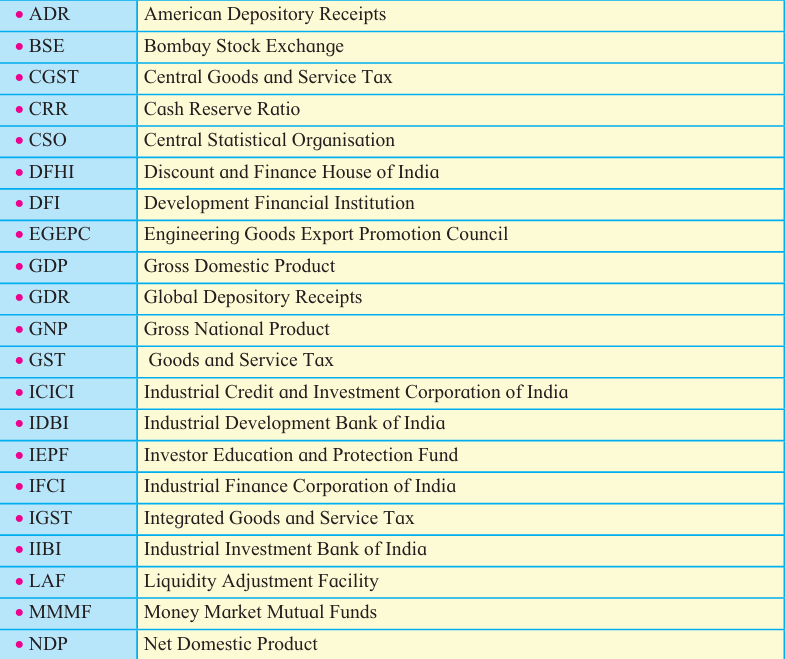
Some Economics-Related Abbreviations
Given below are some of the abbreviations you should know:
08 00 PM IST - 22 Feb'26
Economic Terms to Remember for Exam Preparation
Some of the economic terms you need to know for the HSC Economics exam are listed below:
Description
Economic Term
(i) A desire which is backed by a willingness to purchase and the ability to pay.
Demand
(ii) The net addition made to total cost by producing one more unit of output.
Marginal Cost
(iii) The type of market where there are few sellers.
Oligopoly
07 40 PM IST - 22 Feb'26
Some Agree or Disagree Questions for HSC Economics Exam 2026
This question might carry 12 marks in total, with each explanation worth 4 marks. You will be given an option to choose 3-4 out of the total. Answer accordingly. State with reasons whether you agree or disagree with the following statements.:
- There are no real exceptions to the law of Diminishing Marginal Utility.
- There are many features of monopolistic competition.
- There are no limitations of Index Number.
- The money market plays an important role in India.
- There is no difference between the concepts of Balance of Trade and Balance of Payments
07 20 PM IST - 22 Feb'26
Slicing method vs Lumping method
Check out the differences between Slicing method and Lumping method:
Basis
Slicing Method
Lumping Method
Meaning
In this method, data is divided into small equal parts (class intervals).
In this method, data is grouped together without dividing into small parts.
Use
Used when detailed classification is required.
Used when broad grouping is enough.
Accuracy
Gives more accurate and detailed information.
Gives less detailed information.
Example
Dividing income into ₹0-10,000, ₹10,000-20,000, etc.
Grouping all low-income people together in one category.
07 00 PM IST - 22 Feb'26
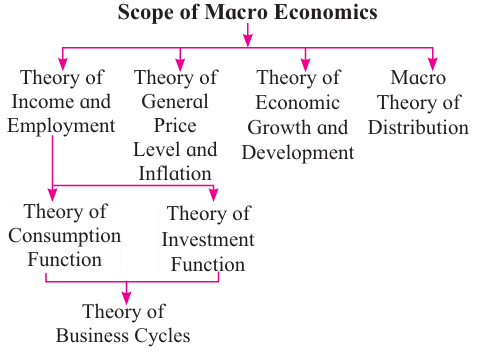
Scope of Macro Economics
The diagram below depicts the scope of macroeconomics:
06 40 PM IST - 22 Feb'26
Some Solved 1-Mark MCQs
The table below provides some of the MCQs that have appeared in the Economics exam, along with their answers:
Question
Correct Answer
(i) Methods adopted in microeconomic analysis
Slicing method
(ii) Under perfect competition, sellers are
Price takers
(iii) Statements that are correct in relation to Index Numbers
Index numbers measure relative changes in an economic variable and are specialized averages.
(iv) Obligatory functions of the government
Protection from external attacks and maintaining internal law and order.
(v) Types of foreign trade
Import trade, Export trade, and Entrepot trade.
06 20 PM IST - 22 Feb'26
Types of 1-Mark Questions to Expect in the Exam
- Choose the correct options
- Give economic terms
- Complete the statements
- Find the odd word
- Complete the correlation
06 04 PM IST - 22 Feb'26
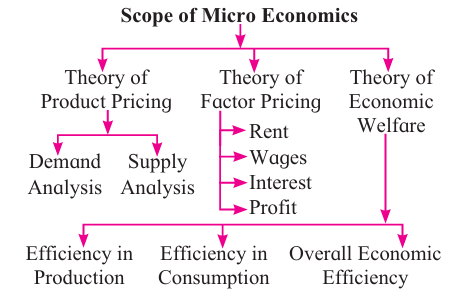
Scope of Microeconomics
The diagram below depicts the scope of microeconomics:
06 04 PM IST - 22 Feb'26
Expected Difficulty Level of Economics Exam
The table below provides the expected difficulty level of the HSC Economics exam 2026:
Difficulty Level
Approx. Weightage
Description
Easy
0.3
Direct theory, definitions, diagrams, and straightforward concepts
Moderate
0.5
Application-based questions, reasoning, graphs, and interpretation-type questions
Difficult
0.2
Analytical questions, numerical interpretation, case-based or multi-concept answers
06 04 PM IST - 22 Feb'26
HSC Economics Chapter-Wise Weightage 2026
The expected topic-wise weightage for this year’s Class 12 Economics exam, based on previous trends, is given below:
Sr. No.
Unit / Chapter
Total Marks
Marks With Option
1
Introduction to Micro and Macro Economics
7 marks
10 marks
2
Utility Analysis
7 marks
10 marks
3
Demand Analysis
7 marks
10 marks
4
Elasticity of Demand
7 marks
10 marks
5
Supply Analysis
7 marks
10 marks
6
Forms of Market
7 marks
10 marks
7
Index Numbers
8 marks
12 marks
8
National Income
8 marks
12 marks
9
Public Finance in India
8 marks
12 marks
10
Money Market and Capital Market
8 marks
11 marks
11
Foreign Trade in India
4 marks
6 marks
06 04 PM IST - 22 Feb'26
Topics Included in Economics Syllabus
- Introduction to Micro and Macro Economics
- Utility Analysis
- Demand Analysis
- Elasticity of Demand
- Supply Analysis
- Forms of Market
- Index Numbers
- National Income
- Public Finance in India
- Money Market and Capital Market in India
- Foreign Trade of India


