

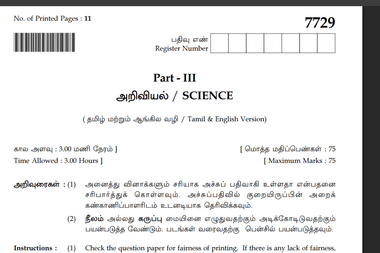
 Tamil Nadu SSLC Science Answer Key 2026 LIVE: Subject Expert Unofficial Key; Question Paper Analysis
Tamil Nadu SSLC Science Exam 2026 has been conducted successfully in the state, and students are now eager to test their performance. For the ease of students in quick evaluation, subject experts at CollegeDekho have provided the Tamil Nadu SSLC Science Unofficial Answer Key 2026, which offers accurate and authentic solutions for the questions that were asked in the examination. Through this LIVE blog, students will be able to get detailed solutions for the unofficial answer key along with an in-depth analysis of the question paper, which will include information about the difficulty level of questions in each section, important questions, and other key information.
Tamil Nadu SSLC Science Answer Key 2026 (Unofficial)
Here is the unofficial Tamil Nadu SSLC Science Answer Key 2026:
| Q. No. | Question | Correct Answer |
|---|---|---|
| 1 | If the earth shrinks to 50% of its radius, its mass remaining the same, the weight of a body on the Earth will.... | D – Increase by 300% |
| 2 | Magnification of a convex lens is: | C – Either positive or negative |
| 3 | In a simple circuit, why does the bulb glow when you close the switch? | B – Closing the switch completes the circuit |
| 4 | In the nuclear reaction: X → Y + α (decay), the value of A and Z is: | B – 8,4 |
| 5 | The basis of modern periodic law is: | A – Atomic number |
| 6 | Solubility of NaCl in 100 ml water is 36 g. If 12 g of salt is dissolved in 100 ml water, how much salt is required for saturation? | B – 24 g |
| 7 | Powdered CaCO₃ reacts more rapidly than flaky CaCO₃ because of: | A – Large surface area |
| 8 | Which of the following pairs can be successive members of a homologous series? | A – C₂H₆ and C₃H₈ |
| 9 | The starch condition is the characteristic feature of: | B – Stem |
| 10 | The loss of one or more chromosomes in a ploidy is called: | B – Aneuploidy |
| 11 | Excessive consumption of alcohol leads to: | B – Cirrhosis of liver |
| 12 | Which is used to edit programs? | B – Script editor |
Tamil Nadu SSLC 2026 Science Exam: Quick Facts
Some of the details and facts related to Tamil Nadu SSLC 2026 Science Exam can be found below:
Aspect | Details |
|---|---|
Exam Date | March 30, 2026 |
Exam Time | 10 AM to 1 PM |
Sections | Part I, II, III, & IV |
Questions and Marking Scheme |
|
Max Marks | 75 Marks |
Tamil Nadu SSLC Science Exam 2026 LIVE:
01 00 PM IST - 30 Mar'26
Exam Concluded; Paper Analysis and Student Reviews – Answer Key Soon
The Tamil Nadu SSLC Science Exam 2026 has concluded successfully across all centres with smooth conduct reported throughout. Paper Analysis, Student Reviews, and Unofficial answer keys, along with detailed solutions, will be available soon, helping students to evaluate their performance and estimate their scores.
12 40 PM IST - 30 Mar'26
Final Phase Approaching – Time Monitoring in Focus
As the exam approaches its final phase, time management becomes crucial within the examination halls.
Current Status:
- Invigilators reminding time intervals
- Answer booklet completion in progress
- Final questions being attempted
The exam continues in an orderly manner.
11 40 AM IST - 30 Mar'26
Mid-Exam Phase – Answer Writing in Full Swing
The exam has entered its mid-phase, with candidates focusing on completing descriptive and long-answer questions.
Updates:
- Writing process progressing steadily
- Additional answer sheets being provided
- Invigilators ensuring proper conduct
The examination environment remains controlled and disciplined.
11 00 AM IST - 30 Mar'26
Examination Process Underway Smoothly Across Centres
The Tamil Nadu SSLC Science Exam 2026 is progressing smoothly across all examination centres. Invigilators are actively monitoring the halls, ensuring discipline and adherence to guidelines.
Observations:
- No reports of disruptions
- Question paper distribution completed on time
- Proper seating and supervision in place
The examination environment remains calm and well-organized.
10 00 AM IST - 30 Mar'26
Tamil Nadu SSLC Science Exam 2026 Begins
The Science examination has officially commenced across all centres. Students have started attempting the paper, beginning with MCQs and short answer sections.
Initial Approach:
- Attempt easy questions first
- Read questions carefully
- Manage time effectively
The exam is progressing smoothly so far.
09 30 AM IST - 30 Mar'26
Final 30 Minutes Strategy Inside Exam Hall
The last 30 minutes should be used wisely to improve accuracy.
Focus On:
- Revising answers
- Checking calculations
- Verifying diagrams and labels
- Ensuring all questions are attempted
This final check can help in correcting minor errors.
08 30 AM IST - 30 Mar'26
Final Checklist Before Leaving for Exam Centre
Before heading to the exam centre, ensure all essential items are ready to avoid last-minute stress.
Checklist:
- Hall ticket (mandatory)
- Required stationery (pens, pencil, eraser, scale)
- Transparent pouch
- Water bottle (if allowed)
Avoid carrying prohibited items like mobile phones. Reaching early helps in a relaxed start.
07 30 AM IST - 30 Mar'26
Common Mistakes to Avoid During Exam
Avoiding small mistakes can make a big difference in scoring.
Mistakes to Avoid:
- Leaving questions unanswered
- Writing wrong units
- Skipping diagram labels
- Overwriting answers
Careful writing ensures better presentation and marks.
06 30 AM IST - 30 Mar'26
Diagram Writing Tips for Full Marks
Diagram-based questions require neatness and accuracy.
Tips:
- Draw using pencil
- Label all parts clearly
- Maintain proper size and proportion
- Add a brief explanation below
Neatly drawn diagrams can significantly improve scoring.
05 30 AM IST - 30 Mar'26
Writing Tips for 4-Mark Questions
Descriptive answers should be structured and detailed.
Tips:
- Start with a definition
- Explain in points
- Add examples where required
- Include diagrams if relevant
Presentation and clarity are key to scoring full marks in this section.
04 30 AM IST - 30 Mar'26
Writing Tips for 2-Mark Questions
Short answers require clarity and precision.
Tips:
- Stick to the definition or key concept
- Avoid unnecessary explanations
- Use correct scientific terms
- Keep answers within 2–3 lines
Well-structured short answers can fetch full marks easily.
03 30 AM IST - 30 Mar'26
Frequently Asked “State the Law” Questions
Questions asking to state laws are common in Physics and Biology.
Important Laws:
- Newton’s Laws of Motion
- Ohm’s Law
- Mendel’s Laws of inheritance
Answers should include:
- Proper statement
- Formula (if applicable)
- Brief explanation
Writing complete statements helps in securing full marks.
02 30 AM IST - 30 Mar'26
Important “Name the Following” Questions
“Name the following” questions are frequently asked in one-mark sections and require quick recall.
Examples:
- Unit of resistance → Ohm
- Blood pigment → Haemoglobin
- Cell organelle for photosynthesis → Chloroplast
- Scientist who proposed atomic theory → Dalton
These questions are direct and can be answered quickly with proper preparation.
01 40 AM IST - 30 Mar'26
Frequently Asked “Complete the Table” Questions
Table completion questions test understanding of differences and classifications.
Examples:
- Acid vs Base properties
- Metal vs Non-metal characteristics
- Aerobic vs Anaerobic respiration
Answers should be written in a clear tabular format with correct headings to score full marks easily.
12 45 AM IST - 30 Mar'26
Important Matching-Type Questions to Practice
Matching-type questions are often included in MCQs or short sections to test conceptual clarity across chapters.
Examples to Practice:
- Pituitary gland → Master gland
- Chloroplast → Photosynthesis
- Concave lens → Myopia correction
- Gene → Unit of heredity
Understanding relationships between concepts is key rather than rote memorization.
11 50 PM IST - 29 Mar'26
Frequently Asked “Expand the Term” Questions
“Expand the term” questions are commonly asked in the 1-mark or 2-mark sections and are easy scoring if memorised correctly.
Important Expansions:
- DNA → Deoxyribonucleic Acid
- RNA → Ribonucleic Acid
- SI → International System of Units
- AIDS → Acquired Immunodeficiency Syndrome
Accurate spelling and full forms are important to avoid losing marks in these straightforward questions.
11 00 PM IST - 29 Mar'26
Final Revision Strategy for Maximum Score
The final hours of preparation should focus on strengthening important areas rather than learning new topics.
Focus Areas:
- High-weightage chapters
- Important formulas and definitions
- Diagrams and chemical equations
Maintaining a calm and focused approach will help in better recall during the exam.
10 40 PM IST - 29 Mar'26
High Probability Long Answer Questions for Final Revision
Long answer questions carry significant weightage and require detailed explanations.
Important Topics:
- Structure and function of human heart
- Photosynthesis process
- Newton’s laws of motion
Answers should be well-structured with headings, points, and diagrams where necessary.
10 20 PM IST - 29 Mar'26
Application-Based Questions – Real-Life Concepts
Application-based questions are designed to test how well concepts are understood in real-life scenarios.
Examples:
- Uses of ethanol in daily life
- Applications of sound waves
- Importance of electricity
Answers should include practical examples and clear explanations.
10 00 PM IST - 29 Mar'26
Graph-Based Questions – Key Focus Areas
Graph-based questions are sometimes asked in Physics and require proper representation.
Important Graphs:
- Voltage vs Current (Ohm’s Law)
- Distance vs Time
- Temperature-related graphs
Draw graphs neatly with labeled axes and correct units to secure full marks.
09 40 PM IST - 29 Mar'26
Practical-Based Questions – Important Experiments
Practical-based questions are often included to test application skills and understanding of experiments.
Important Experiments:
- Determination of focal length of convex lens
- Photosynthesis experiment
- Resistivity experiment
Answers should include aim, materials, procedure, and result for complete scoring.
09 20 PM IST - 29 Mar'26
Important Scientists and Their Contributions
Questions related to scientists and their discoveries are frequently asked in MCQs and short answers.
Key Scientists:
- Mendel → Father of Genetics
- Newton → Laws of motion
- Dalton → Atomic theory
Remembering their contributions helps in answering conceptual and factual questions easily.
09 00 PM IST - 29 Mar'26
Important Units and SI Conversions to Remember
Correct units play a crucial role in Physics answers and numericals. Missing or incorrect units can lead to loss of marks.
Important Units:
- Force → Newton
- Power → Watt
- Current → Ampere
- Energy → Joule
Always write units clearly and ensure consistency while solving numerical problems.
08 40 PM IST - 29 Mar'26
Frequently Asked “Give Reason” Questions
“Give reason” questions are commonly asked in short answer sections and test conceptual understanding.
Examples:
- Why does iron rust in moist air?
- Why is the sky blue?
- Why is pH important in daily life?
Answers should include scientific reasoning and proper explanation instead of one-line responses.
08 20 PM IST - 29 Mar'26
Key Biological Processes to Focus for Long Answers
Biology long answers often revolve around important life processes that require step-wise explanations.
Important Processes:
- Photosynthesis
- Respiration
- Blood circulation
- Transpiration
While answering, include:
- Definition
- Steps involved
- Diagrams (if needed)
This structured approach ensures better presentation and maximum marks.
08 00 PM IST - 29 Mar'26
Important Differences Between Key Concepts
Difference-based questions are frequently asked in 2-mark sections and should be answered in a clear tabular format.
Important Differences:
- Atom vs Molecule
- Acid vs Base
- Aerobic vs Anaerobic respiration
- Convex lens vs Concave lens
Writing answers in points or tables improves clarity and helps secure full marks quickly.
07 40 PM IST - 29 Mar'26
Expected Assertion-Reason Questions and Approach
Assertion-reason questions test conceptual clarity and are commonly asked in MCQ sections. These questions require students to evaluate both the statement and the reasoning carefully.
Example Pattern:
- Assertion: Metals conduct electricity
- Reason: They contain free electrons
Approach:
- Read both statements carefully
- Identify if both are correct
- Check if reason explains assertion
Strong conceptual understanding is key to answering these correctly.
07 20 PM IST - 29 Mar'26
Important Chemical Equations to Revise for Full Marks
Chemical equations are an essential part of the SSLC Science exam and are often asked in both short and long answer formats. Writing balanced equations with correct symbols can fetch full marks easily.
Must Revise Equations:
- Rust formation: Iron + Oxygen + Water → Iron oxide
- Photosynthesis equation
- Esterification reaction
- Neutralization reaction
Ensure equations are balanced and include correct state symbols wherever required.
07 00 PM IST - 29 Mar'26
High-Scoring Biology One-Liners
Biology includes many direct questions.
Important Points:
- Photosynthesis occurs in chloroplast
- Gene is unit of heredity
- Pituitary is master gland
- Blood carries oxygen
These are frequently asked as MCQs.
06 45 PM IST - 29 Mar'26
Key Formula Sheet for Quick Revision
Formulas are essential for solving numericals and MCQs.
Important Formulas:
- V = IR
- P = VI
- 1/f = 1/v + 1/u
- Speed = Distance/Time
Memorising formulas ensures quick problem-solving.
06 30 PM IST - 29 Mar'26
Important Laws and Principles to Revise
Scientific laws are frequently asked in exams.
Must Revise:
- Newton’s Laws of Motion
- Ohm’s Law
- Laws of reflection and refraction
- Mendel’s laws
Always include statement + explanation + example.
06 15 PM IST - 29 Mar'26
Common Mistakes to Avoid in Science Exam
Avoiding common mistakes can improve scores significantly.
Mistakes:
- Writing incorrect units
- Missing diagram labels
- Not balancing equations
- Writing lengthy answers for short questions
Clarity and accuracy are more important than length.
06 00 PM IST - 29 Mar'26
Biology: High-probability questions
- Explain photosynthesis process
- Structure and functions of human heart
- What is DNA fingerprinting? Applications
- Define respiratory quotient
- What is metastasis?
- Explain pollination and fertilization in plants
05 45 PM IST - 29 Mar'26
Chemistry: High-probability questions
- What is Avogadro’s number? Explain its significance
- Define pH scale and solve numerical problems
- Explain types of chemical reactions with examples
- What is corrosion? Methods to prevent it
- Write equation for rust formation
- Define homologous series
05 30 PM IST - 29 Mar'26
Physics: High-probability questions
- Define Inertia and explain its types with examples
- State and explain Newton’s Laws of Motion
- Derive Lens Formula and explain sign convention
- What is Ohm’s Law? State its applications
- Explain Heating effect of current (Joule’s law)
- What are the conditions for hearing an echo?
05 15 PM IST - 29 Mar'26
Most Repeated Numerical Problems
Numericals are mainly asked from Physics and Chemistry.
Focus Areas:
- Ohm’s Law calculations
- Electric power and energy
- pH calculations
- Lens formula problems
Step-wise solving and correct units are important for full marks.
05 00 PM IST - 29 Mar'26
Frequently Asked Definitions Across Chapters
Definitions are frequently asked in 1 and 2-mark questions. Writing exact textbook definitions helps secure full marks.
Important Definitions:
- Force, inertia, momentum
- pH scale, mole concept
- Photosynthesis, respiration
- Gene, chromosome
Precise wording and correct scientific terms are essential.
04 45 PM IST - 29 Mar'26
Chemistry Diagrams
1. Electrolysis Setup
Shows electrodes and electrolyte.2. Atomic Structure
Nucleus with electrons in shells.3. pH Scale Representation
Acidic to basic range (0–14).4. Arrangement of Elements (Periodic Table)
Groups and periods.5. Rusting Process Diagram
Shows iron reacting with oxygen and moisture.6. Homologous Series Structure
Shows difference by –CH₂ group.7. Carbon Compounds (Structural Formulas)
Ethane, ethanol structures.8. Types of Chemical Reactions (Diagrammatic)
Combination and decomposition.9. Solubility Experiment Setup
Practical-based diagram.10. Exothermic vs Endothermic Reaction Setup
Heat release and absorption.04 30 PM IST - 29 Mar'26
Physics Diagrams
1. Convex Lens Ray Diagram
Shows image formation for different object positions.2. Concave Lens Ray Diagram
Always forms virtual image.3. Refraction of Light
Shows bending of light in different media.4. Electric Circuit Diagram
Includes battery, resistor, switch.5. Ohm’s Law Graph (V-I graph)
Straight line graph showing proportionality.6. Reflection of Sound
Shows incident and reflected waves.7. Dispersion of Light (Prism)
Splitting of white light into spectrum.8. Heating Effect Setup
Electric circuit showing heat production.9. Nuclear Radiation (Alpha, Beta, Gamma)
Penetration and properties.10. Echo Reflection Diagram
Distance and reflection path.04 15 PM IST - 29 Mar'26
Biology Diagrams (High Weightage)
1. Human Heart
Shows four chambers, valves, and blood flow. Label atria, ventricles, aorta, vena cava.2. Neuron (Nerve Cell)
Structure includes dendrites, axon, and cell body. Important for nervous system questions.3. Structure of DNA
Double helix model with base pairs (A-T, G-C). Frequently asked in genetics.4. Human Eye
Label retina, lens, optic nerve. Important for vision-related questions.5. Flower Structure
Shows reproductive parts – stamen and pistil. Common in reproduction chapter.6. Chloroplast
Site of photosynthesis. Label grana and stroma.7. Human Heart Blood Flow Path
Shows circulation sequence clearly.8. Thyroid Gland
Endocrine gland diagram (seen in model paper).9. Ovule Structure
Important for plant reproduction.10. Human Sperm
Label head, middle piece, and tail.04 00 PM IST - 29 Mar'26
Top 20 One-Mark MCQs for SSLC Science 2026
One-mark questions are crucial for securing easy marks. These MCQs are based on model paper trends and frequently repeated concepts.
Physics MCQs:
- Inertia depends on → Mass
- SI unit of force → Newton
- Unit of electrical energy → kWh
- Speed of sound in air → 343 m/s
- Lens used for myopia → Concave lens
Chemistry MCQs:
- Avogadro number → 6.023 × 10²³
- pH < 7 indicates → Acidic
- Rust is → Iron oxide
- Type of reaction: A + B → AB → Combination
- Ethanol formula → C₂H₅OH
Biology MCQs:
- Master gland → Pituitary gland
- Unit of heredity → Gene
- Photosynthesis occurs in → Chloroplast
- Blood pigment → Haemoglobin
- DNA full form → Deoxyribonucleic Acid
More Important MCQs:
- Echo requires distance → 17 m
- SI unit of current → Ampere
- Gas law constant → 8.31 J/mol/K
- Functional group of alcohol → –OH
- Father of Genetics → Mendel
03 45 PM IST - 29 Mar'26
Explain Heating Effect of Electric Current
When electric current flows through a conductor, heat is produced. This is called the heating effect of current.
Joule’s Law: Heat produced ∝ I²Rt
Applications include electric heaters, irons, and bulbs.03 30 PM IST - 29 Mar'26
Explain Photosynthesis Process
Photosynthesis is the process by which green plants prepare their food using sunlight, carbon dioxide, and water in the presence of chlorophyll.
Equation:
CO₂ + H₂O → Glucose + O₂
This process occurs in chloroplasts and is essential for life as it produces oxygen and food.03 15 PM IST - 29 Mar'26
Final Guess Paper 2026 (Very High Accuracy)
Based on syllabus weightage and model paper analysis, the following questions are most likely to appear in the exam.
Part I – MCQs (Expected Areas):
- Electricity (units, formulas)
- Genetics (DNA, genes)
- Chemical reactions
- Sound and optics
Part II – 2 Marks (Expected Questions):
- Define inertia
- What is pH scale?
- Define Avogadro number
- What is echo?
- Define homologous series
Part III – 4 Marks (Expected Questions):
- Explain types of inertia
- Describe photosynthesis
- State Ohm’s Law with explanation
- Explain Mendel’s laws
- Types of chemical reactions
Part IV – Long Answers (Highly Expected):
- Human heart structure with diagram
- Photosynthesis process
- Echo and sound applications
- Carbon compounds (ethanol + reactions)
Key Highlights:
- Physics + Biology dominate long answers
- Chemistry dominates short answers
- Diagrams are highly expected
These questions are strongly aligned with model paper patterns and repeated trends
03 00 PM IST - 29 Mar'26
State and Explain Ohm’s Law
Ohm’s Law states that current is directly proportional to voltage at constant temperature.
Formula: V = IR
Where V = voltage, I = current, R = resistance.
It is used in electrical circuits to calculate current, voltage, and resistance.02 45 PM IST - 29 Mar'26
Explain Types of Inertia
Inertia is classified into three types:
- Inertia of Rest: A body at rest tends to remain at rest. Example: A person falls backward when a bus suddenly starts.
- Inertia of Motion: A moving body continues its motion. Example: Passengers fall forward when a bus stops suddenly.
- Inertia of Direction: A body resists change in direction. Example: A stone tied to a string moves in circular motion.
02 30 PM IST - 29 Mar'26
Most Frequently Asked 2-Mark Questions (with Answers)
Q1: Define Inertia
? Inertia is the property of a body to resist any change in its state of rest or uniform motion in a straight line. It depends on the mass of the object.Q2: What is pH scale?
The pH scale is used to measure the acidity or alkalinity of a solution. It ranges from 0 to 14. Values less than 7 indicate acidic solutions, 7 is neutral, and values greater than 7 indicate basic solutions.Q3: What is Avogadro number?
Avogadro number is the number of particles (atoms, molecules, or ions) present in one mole of a substance. Its value is 6.023 × 10²³.02 15 PM IST - 29 Mar'26
Important 2-Mark Questions with Answers
Short answer questions require accuracy and clarity.
Q1: What is inertia?
Inertia is the property of a body to resist change in its state of rest or motion.Q2: Define pH scale
pH scale measures acidity or alkalinity of a solution (0–14 scale).Q3: What is echo?
Reflection of sound heard after a delay.Q4: Define Avogadro number
Number of particles in one mole (6.023 × 10²³).These questions are frequently asked in Part II.
02 00 PM IST - 29 Mar'26
Top 20 Most Important Questions for SSLC Science 2026
Based on previous paper trends, these questions are highly expected:
Physics:
- Define inertia and types
- State Ohm’s Law
- Conditions for echo
Chemistry:
- Define pH scale
- What is homologous series?
- Explain corrosion
Biology:
- Explain photosynthesis
- Structure of DNA
- Function of heart
Additional High-Probability Questions:
- Define Avogadro number
- Types of chemical reactions
- Mendel’s laws
- Respiratory quotient
- Deforestation effects
These questions are repeatedly observed across sections in model papers
01 45 PM IST - 29 Mar'26
Section-Wise Preparation Strategy (Part I–IV)
Understanding section-wise weightage helps in better answer planning.
Section Breakdown:
- Part I (12 marks): MCQs → Focus on formulas & definitions
- Part II (14 marks): 2-mark questions → Short, precise answers
- Part III (28 marks): 4-mark questions → Detailed explanations
- Part IV (21 marks): Long answers → Diagrams + concepts
Strategy:
- Attempt MCQs quickly
- Write clear and direct answers in Part II
- Use diagrams and structured answers in Part III & IV
01 30 PM IST - 29 Mar'26
Top 10 MCQs for Quick Revision
Important MCQs likely to appear in Part I:
- Inertia depends on → Mass
- Unit of electrical energy → kWh
- Universal gas constant → 8.31 J/mol/K
- Master gland → Pituitary gland
- Enzyme cutting DNA → Restriction endonuclease
- pH < 7 indicates → Acidic solution
- Lens used for myopia → Concave lens
- SI unit of current → Ampere
- Avogadro number → 6.023 × 10²³
- Echo requires minimum distance → 17 m
These MCQs are directly aligned with exam pattern.
01 15 PM IST - 29 Mar'26
Diagram-Based Important Questions with Explanation
Diagram questions are crucial for scoring full marks.
Important Diagrams:
- Human heart → Shows chambers and blood flow
- Neuron → Structure and function
- Flower → Reproductive parts
- Lens ray diagram → Image formation
Key Tip:
- Use proper labels
- Maintain neatness
- Add explanation for full marks
01 00 PM IST - 29 Mar'26
Important 4-Mark Questions with Answers
Descriptive answers must be structured and explained clearly.
Q1: Explain types of inertia
- Inertia of rest
- Inertia of motion
- Inertia of direction
Each with suitable examples.
Q2: Explain photosynthesis
The process by which green plants prepare food using sunlight, CO₂, and water.
Equation: CO₂ + H₂O → Glucose + O₂Q3: State Ohm’s Law
Current is directly proportional to voltage at constant temperature (V = IR).These questions are commonly asked in Part III.
12 45 PM IST - 29 Mar'26
Environmental Science – Important Questions
Environmental topics are application-based and scoring.
Important Questions:
- Effects of deforestation
- Renewable vs non-renewable resources
- Causes of water pollution
- Conservation methods
Focus:
- Write point-wise answers
- Use real-life examples
12 30 PM IST - 29 Mar'26
Genetics – Important Questions
Genetics is a high-weightage Biology unit.
Important Questions:
- Mendel’s laws of inheritance
- Structure of DNA
- Monohybrid and dihybrid cross
- Sex determination in humans
Focus:
- Use diagrams
- Explain laws clearly
12 15 PM IST - 29 Mar'26
Human Physiology – Important Questions
Human Physiology is important for both theory and diagrams.
Important Questions:
- Structure and function of human heart
- Explain blood circulation
- Endocrine glands and their functions
- Blood groups
Focus:
- Practice diagrams
- Write functions clearly
12 00 PM IST - 29 Mar'26
Plant Physiology – Important Questions
This is a key Biology chapter with descriptive questions.
Important Questions:
- Explain photosynthesis process
- Define respiratory quotient
- Factors affecting photosynthesis
- Types of respiration
Focus:
- Use diagrams if needed
- Write equations properly
11 45 AM IST - 29 Mar'26
Atoms and Molecules – Important Questions
This chapter includes basic Chemistry concepts and numericals.
Important Questions:
- Define mole concept
- What is Avogadro number?
- Difference between atoms and molecules
- Simple numerical problems
Focus:
- Learn definitions clearly
- Practice calculations
11 30 AM IST - 29 Mar'26
Carbon and its Compounds – Important Questions
Organic chemistry is frequently asked in exams.
Important Questions:
- Define homologous series
- Properties and uses of ethanol
- Explain esterification reaction
- Functional groups and examples
Focus:
- Write chemical equations
- Include examples
11 15 AM IST - 29 Mar'26
Chemical Reactions & pH – Key Questions
This chapter is important for both MCQs and short answers.
Important Questions:
- Types of chemical reactions with examples
- Define pH scale
- What is ionic product of water?
- Numerical problems on pH
Focus:
- Write balanced equations
- Use correct scientific terms
11 00 AM IST - 29 Mar'26
Acoustics – Important Questions
Acoustics is concept-based and often appears in long answers.
Important Questions:
- What is echo? Conditions required
- Laws of reflection of sound
- Applications of sound waves
- Difference between sound and light waves
Focus:
- Use definitions + examples
- Write conditions clearly
10 45 AM IST - 29 Mar'26
Electricity – High-Scoring Questions
Electricity is one of the most scoring chapters with numericals and definitions.
Important Questions:
- State and explain Ohm’s Law
- Define electric power and electrical energy
- Explain heating effect of current (Joule’s Law)
- Solve simple numerical problems
Focus:
- Learn formulas
- Practice unit-based questions
10 30 AM IST - 29 Mar'26
Optics – Important Questions & Concepts
Optics includes both theory and diagram-based questions.
Important Questions:
- State laws of refraction
- Explain lens formula and sign convention
- Image formation in convex and concave lenses
- Defects of vision and their correction
Focus:
- Practice ray diagrams
- Write formulas accurately
10 15 AM IST - 29 Mar'26
Laws of Motion – Important Questions
Laws of Motion is a high-weightage Physics chapter with strong presence in both short and long answers.
Important Questions:
- Define inertia and explain its types with examples
- State and explain Newton’s First, Second, and Third Laws
- Derive F = ma
- Difference between mass and weight
Focus:
- Use real-life examples
- Clearly explain each law for full marks
10 00 AM IST - 29 Mar'26
Important 2-Mark Questions
Short answers are easy scoring when answered correctly.
Important Questions:
- Define inertia
- What is pH scale?
- What is echo?
Keep answers precise and to the point.
09 45 AM IST - 29 Mar'26
Environmental Science & Health
Application-based questions are expected from this unit.
Important Topics:
Deforestation
Pollution
Diseases (Cancer, AIDS)
Expected Questions:
Effects of deforestation
Causes of water pollution
09 30 AM IST - 29 Mar'26
Plant Physiology – Key Questions
Biology descriptive questions often come from this unit.
Focus Topics:
- Photosynthesis
- Respiration
- Respiratory quotient
Expected:
- Explanation-based questions
09 15 AM IST - 29 Mar'26
Diagram-Based Questions – Must Practice
Diagrams are essential for scoring full marks in long answers.
Important Diagrams:
- Human heart
- Thyroid gland
- Neuron
- Flower
Key Tip:
- Label clearly and neatly
09 00 AM IST - 29 Mar'26
Human Physiology – Important Areas
This unit includes both conceptual and diagram-based questions.
Key Topics:
- Human heart structure
- Blood circulation
- Endocrine glands
Important MCQ:
- Master gland → Pituitary gland
08 45 AM IST - 29 Mar'26
Genetics – High Weightage Chapter
Genetics plays a crucial role in both MCQs and long answers.
Focus Areas:
- Mendel’s laws
- DNA structure
- Inheritance
MCQ Example:
- Enzyme that cuts DNA → Restriction endonuclease
08 30 AM IST - 29 Mar'26
Optics & Acoustics – Key Concepts
Concept-based questions dominate these chapters.
Important Topics:
- Lens formula
- Dispersion of light
- Echo
Expected Questions:
- Conditions for hearing echo
- Applications of sound
08 15 AM IST - 29 Mar'26
Chemistry MCQs & Short Answers
Short answers are scoring when written precisely.
Important Points:
- Avogadro number → 6.023 × 10²³
- pH < 7 → Acidic
Expected Questions:
- What is rust?
- Define pH scale
- Types of chemical reactions
08 00 AM IST - 29 Mar'26
Carbon and Its Compounds – Important Topics
Organic chemistry carries consistent weightage in the exam.
Focus Topics:
- Homologous series
- Functional groups
- Ethanol properties
- Esterification reaction
Expected:
- Equation-based questions
- Application-based questions
07 45 AM IST - 29 Mar'26
Laws of Motion – 2 & 4 Mark Focus
Questions from this chapter often appear in descriptive sections.
Key Questions:
- Define inertia
- Types of inertia with examples
- Newton’s Laws (with explanation)
Answer Tip:
- Use real-life examples to score full marks
07 30 AM IST - 29 Mar'26
Electricity – Key Formulas & Expected Questions
Electricity is one of the most reliable scoring units with direct numerical and theory-based questions.
Important Formulas:
- Ohm’s Law: V = IR
- Power: P = VI
- Energy: E = Pt
Expected Questions:
- Define Ohm’s Law
- Unit of electrical energy (kWh)
- Heating effect of current
07 15 AM IST - 29 Mar'26
Physics MCQs – Quick Practice for 1 Mark Questions
One-mark questions play a crucial role in boosting overall score. Important MCQs include:
- Inertia depends on → Mass of the object
- Universal gas constant → 8.31 J mol⁻¹ K⁻¹
- Unit of electrical energy → kWh
These are directly aligned with Part I of the question paper, which carries 12 marks
07 00 AM IST - 29 Mar'26
Early Morning Revision Begins – Focus on High-Scoring Chapters
The final revision phase should begin with high-weightage chapters, as they contribute significantly to the overall score across Part I–IV. Prioritising these units ensures better time utilisation and higher scoring potential.
Focus Areas with Approximate Weightage:
- Electricity (6–8 marks): MCQs, numericals, and short answers frequently asked
- Carbon and its Compounds (6–7 marks): Equations, applications, and organic reactions
- Genetics (5–6 marks): MCQs + descriptive questions (DNA, Mendel’s laws)
- Laws of Motion (5–6 marks): Definitions, derivations, and examples