

3π+2⋅6π=3π+3π=32π
Through this live blog, students can check the Maharashtra HSC Maths Answer Key 2026 prepared by a subject expert along with the detailed student reviews. The exam concluded at 2 PM.
 Maharashtra HSC Maths Answer Key 2026 LIVE: Unofficial key to be provided after 2 PM; Student reviews
Maharashtra HSC Maths Exam 2026 was successfully conducted on February 21, 2026, in the morning shift from 11 AM to 2 PM . The unofficial answer key of the same has been provided here. The exam was of Moderate difficulty level. The MCQs were doable and easy but the Section D had lengthy calculations. Keep in mind that the syllabus and question papers are different for Arts & Science and Commerce streams, so the unofficial answer key added here shall vary for both streams. HSC board does not release an official answer key for the Mathematics exam, and the unofficial key provided on this live blog shall help students in predicting their performance.
- Click Here to Submit Your Review on the Exam
Maharashtra HSC Maths Answer Key 2026 Unofficial
The unofficial answer key of Maharashtra HSC Maths 2026 is provided below:
Questions | Answers |
|---|---|
Section A | |
The converse of contrapositive of -p ---> q is? | c) p ---> q |
If tan^-1(2x) + tan^-1 (3x) = π/4, then x= ? | b) 1/6 |
If y= sec(tan^-1x), then dy/dx at x=1, is? | c) 1/root 2 |
The approx value of the function f(x)= x^3-3x+5 at x=1.99 is? | b) 6.91 |
If the p.d.f. of a continuous r.v.X is f(x)= x+2/18, for -2<x<4=0, otherwise, then PIXI<1=? | b) 2/9 |
Write the dual of (p v q) v r = pv (qvr) | (p∧q)∧r=p∧(q∧r) |
Evaluate : Cos^-1(1/2) + 2sin^-1(1/2) | |
Section B | |
Construct the switching circuit of the statment pattern: (∼p ∧ q) v (p ∧ ∼r) |
┌── [ p (NC) ] ── [ q (NO) ] ──┐
|
A stone is dropped in to a quiet lake and waves in the form of circles are generated, radius of the circular wave increases at the rate 5 cm/sec. At the instant when the radius of the circular wave is 8 cm, how fast the area enclosed is increasing? | 80π cm2/sec or approx. 251.2 cm2/sec |
Given that, X∼B (n,p), if n= 10, E (X) =8, then find Var (X)? | Var(X)=1.6 |
Section C | |
Find the area enclosed between the circle x^2 + y^2=1 and the line x+y=1 lying in the first quadrant | π/4−1/2 |
Solve the differential equation x^2.dy/dx= x^2+ xy+ y^2. | tan−1(y/x)=ln∣x∣+C |
Solve the DE 3e^x tan ydx + (1+e^x) sec^y dy = 0 | tan y (1+ e^x)^3 = C |
Find E(X) and V (X), where X is the number obtained on uppermost face, when a fair die is thrown. | E(X)= 7/2, V(X)=35/12 |
A pair of dice is thrown 4 times. If getting a doublet is considered as success, find the probability of two successes. | 25/216 |
Maharashtra HSC Maths 2026 Quick Facts
Check below some of the facts and important details related to the Maharashtra HSC Maths Exam 2026:
Aspect | Details for HSC Maths Arts & Science | Details for HSC Maths Commerce |
|---|---|---|
Chemistry exam date | February 21, 2026 | February 21, 2026 |
Exam time | 11:00 AM to 2:00 PM | 11:00 AM to 2:00 PM |
Maximum marks | 80 Marks | 80 Marks |
Total No. of sections | Sections A, B, C, and D | Sections A & B (6 Questions divided into two Sections) |
Total No. of MCQs | 8 MCQs in Section A | 2 objective questions (Q1 & Q4) with six MCQs each |
Marks Distribution |
|
|
Additional Instructions |
|
|
What's next after the Maharashtra HSC Maths Exam 2026?
The next important exam for Maharashtra HSC students is Economics. Arts, Science and Commerce students (who opted for this subject) will have this paper. The subject code is '49' for Economics. Students preparing for the exam can go through the Maharashtra HSC Economics Chapter-Wise Weightage 2026 to understand the high-priority and low-priority topics. Additionally, students can check the previous year's Economics exam analysis to understand the difficulty level aspect.
Maharashtra HSC Maths Exam 2026 LIVE
06 45 PM IST - 21 Feb'26
Maharashtra HSC Maths Exam 2026 Live Coverage Ends
Maharashtra HSC Maths Answer Key 2026 has been provided above. With this, the live coverage comes to an end!
06 15 PM IST - 21 Feb'26
Predicted Question Paper
Several questions in Section C had predicted questions and pattern. Many questions were similar to previous years' papers and students who practiced past board papers benefitted from that.
05 15 PM IST - 21 Feb'26
Calculus had High Weightage
As predicted, chapters like Differentiation and Integration dominated the exam. Both had high weightage and tested students on standard theorems and the u.v rule.
04 45 PM IST - 21 Feb'26
Subject Expert's Analysis
As per the experts, the paper was well-balanced. Questions were directly from the MSBSHSE syllabus. Some of scoring topics were Truth Tables, Vectors and Adjoint Matrices. They provided good scoring opportunities if a students is well prepared for the exam.
04 15 PM IST - 21 Feb'26
Students' Review on Maharashtra HSC Maths Exam 2026
Students found the initial sections of the exam doable and easy, but, Section D was a bit of challenge. The exam required management of time because it had lengthy calculations in differential equations and integration!
03 45 PM IST - 21 Feb'26
Overall difficulty level
The overall difficulty level of the exam was Moderate. As per the students, most of the MCQs were straight forward, but section D had lengthy questions!
03 00 PM IST - 21 Feb'26
Maharashtra HSC Maths Exam Pattern 2026
Here is the exam pattern:
Particulars
Details
Total Marks
100
Theory Paper
80
Internal/Practical Assessment
20
Exam Duration
3 Hrs
Mode
Offline (pen and paper)
02 30 PM IST - 21 Feb'26
Unofficial Answer Key OUT!
The unofficial answer key of Maharashtra HSC Maths Exam 2026 has been released! It contains questions asked in the exam along with their correct responses.
02 05 PM IST - 21 Feb'26
Exam over, unofficial key to be out soon
The exam was successfully conducted on February 21, from 11 AM to 2 PM. Tje unofficial answer key will be provided here soon!
12 06 PM IST - 21 Feb'26
HSC Maths Exam 2026: List of resources to be provided after the exam
The following resources shall be provided to students here after the exam -
- Unofficial Answer Key prepared by CollegeDekho Maths subject expert - Samiksha Rautela
- Detailed stduent reviews
- Expert opinion on difficulty level of question paper
11 00 AM IST - 21 Feb'26
Exams About to Start!
Students are taking their seats and doing some last-minute revision. The Maharashtra HSC Maths Exam 2026 is about to begin.
10 00 AM IST - 21 Feb'26
Students Arriving at HSC Exam Centres
Students are starting to reach their schools. Teachers and staff are helping everyone get inside and settle down.
09 00 AM IST - 21 Feb'26
Traffic Congestion Alert!
Roads near schools are a bit crowded as students and parents head to exam centers. It’s a good idea to leave early to avoid delays.
08 00 AM IST - 21 Feb'26
Students Hit the Road
Many students are leaving for their exam centers, carrying admit cards, stationery, and water. Families are cheering them on.
07 00 AM IST - 21 Feb'26
The Big Day is Here
Today is the big day! Students across Maharashtra are gearing up for the HSC Maths Exam 2026. Best of luck to everyone appearing. Stay calm and focused! Also, try reaching 30-40 minutes before the scheduled time.
06 00 AM IST - 21 Feb'26
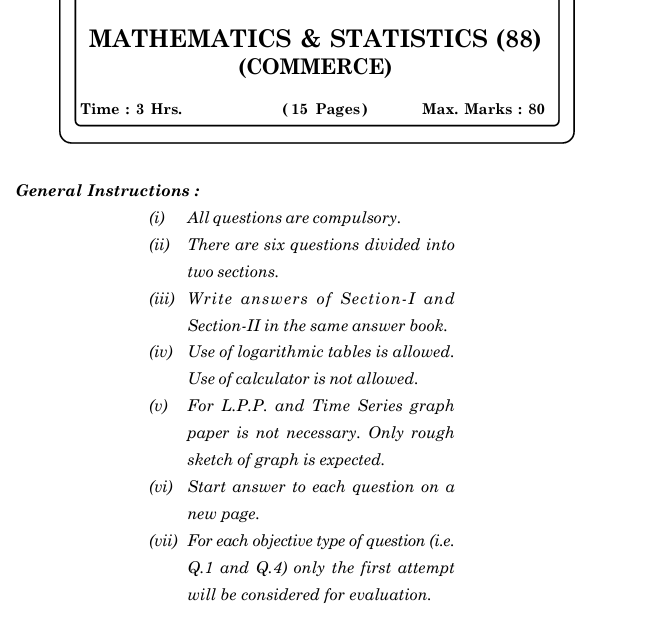
Quick Glimpse of the Official Instructions Page for HSC Maths Commerce
You can check out the official instructions page for the HSC Maths Commerce paper below:
05 00 AM IST - 21 Feb'26
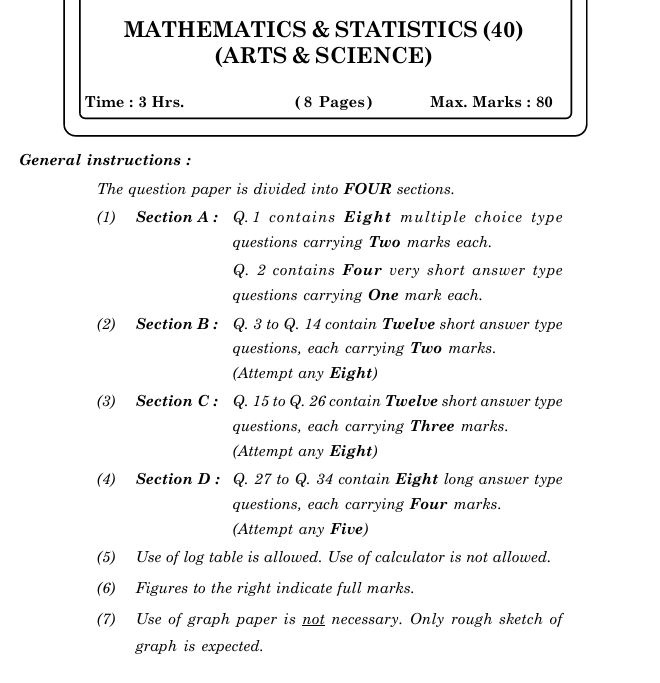
Quick Glimpse of the Official Instructions Page for HSC Maths Arts & Science
You can check out the official instructions page for the HSC Maths Arts & Science paper below:
04 00 AM IST - 21 Feb'26
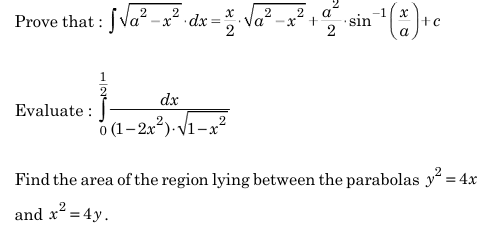
Last minute Practice - Some Important 4-Marks Questions for Arts & Science
As the exam approaches, practice some more high-weightage questions below:
03 00 AM IST - 21 Feb'26
Some More 3-Marks Practice Questions for HSC Maths (Arts & Science)
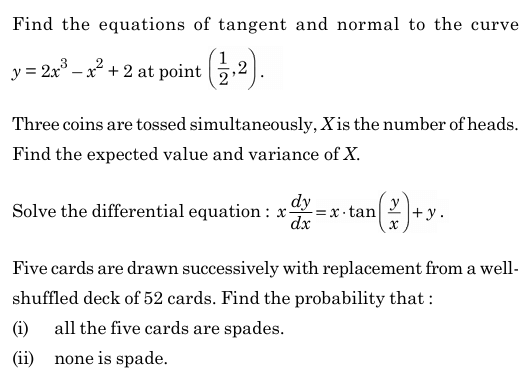
A few more 3-marks questions for you to practice are given below:
02 00 AM IST - 21 Feb'26
What is the slope of tangent at any point (a, b) is called?
The slope of the tangent at any point (a,b) on a curve is called the derivative of the curve at that point.
01 00 AM IST - 21 Feb'26
Important Binomial Distribution Numerical
Q: A pair of dice is thrown 4 times. If getting a doublet is considered a success, find the probability of two successes.
Given:
A pair of dice is thrown 4 times.
Getting a doublet (same numbers on both dice) is considered a success.Step 1: Find probability of success (p)
Total outcomes when two dice are thrown = 36
Doublets are:
(1,1), (2,2), (3,3), (4,4), (5,5), (6,6)Number of doublets = 6
So,
p = 6/36
p = 1/6Probability of failure:
q = 1 − p
q = 1 − 1/6
q = 5/6Step 2: Apply Binomial Formula
Number of trials, n = 4
Number of successes, r = 2Formula:
P(X = r) = nCr × p^r × q^(n − r)
P(X = 2) = 4C2 × (1/6)^2 × (5/6)^2
Step 3: Calculate
4C2 = 6
So,
P(X = 2) = 6 × (1/36) × (25/36)
= 6 × 25 / 1296
= 150 / 1296
= 25 / 216
Probability of getting exactly two doublets = 25/216
12 00 AM IST - 21 Feb'26
What is Lagrange’s Mean Value Theorem?
If a function f(x) satisfies the following two conditions on a closed interval [a, b]:
- f(x) is continuous on [a, b]
- f(x) is differentiable on (a, b)
Then there exists at least one number c in (a, b) such that:
f'(c) = [f(b) − f(a)] / (b − a)
In simpler terms, if a function is continuous and differentiable in an interval, then at some point between a and b, the instantaneous rate of change (derivative) is equal to the average rate of change over the interval.
- f(x) is continuous on [a, b]
10 30 PM IST - 20 Feb'26
1-Mark Numerical from Differential Equations with Answer
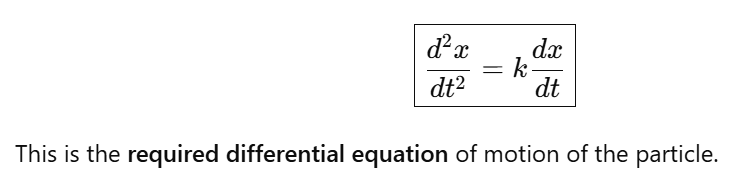
Q: A particle is moving along X-axis. Its acceleration at time t is proportional to its velocity at that time. Find the differential equation of the motion of the particle.
09 30 PM IST - 20 Feb'26
Suggested Night-Time Routine for Students
Make sure you get proper sleep tonight. Sleep by 10 PM, set alarm for 7 AM. Pack hall ticket, ID, log table, pens, & water bottle. No gadgets tomorrow. Stay calm - you're ready!
09 00 PM IST - 20 Feb'26
Night Before Maharashtra HSC Maths Exam
Students, the Maharashtra HSC Maths 2026 exam is scheduled for tomorrow, February 21, 2026, in the morning shift from 11:00 AM to 2:00 PM. This is the right time to stop learning anything new and focus only on revising key formulas, important theorems, and frequently asked problems.
08 00 PM IST - 20 Feb'26
Important Probability Numerical to Solve
Q: Eggs are drawn successively with replacement from a lot containing 10% defective eggs. Find the probability that there is at least one defective egg in a lot of 10 eggs.
Your answer should come out to be probability that there is at least one defective egg ≈ 0.6513.
07 30 PM IST - 20 Feb'26
Solved Numerical from Linear Programming / Sequencing
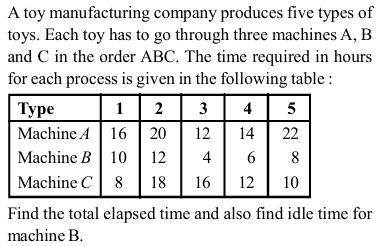
Since processing order is fixed (A → B → C), we compute the schedule step by step.
Machine A completion times (cumulative):
Job 1: 16
Job 2: 16 + 20 = 36
Job 3: 36 + 12 = 48
Job 4: 48 + 14 = 62
Job 5: 62 + 22 = 84So Machine A finishes at 84 hours.
Machine B schedule:
Job 1:
Starts at 16, finishes at 16 + 10 = 26Job 2:
Starts at max(36, 26) = 36
Finishes at 36 + 12 = 48Job 3:
Starts at max(48, 48) = 48
Finishes at 48 + 4 = 52Job 4:
Starts at max(62, 52) = 62
Finishes at 62 + 6 = 68Job 5:
Starts at max(84, 68) = 84
Finishes at 84 + 8 = 92Machine C schedule:
Job 1:
Starts at 26, finishes at 26 + 8 = 34Job 2:
Starts at max(48, 34) = 48
Finishes at 48 + 18 = 66Job 3:
Starts at max(52, 66) = 66
Finishes at 66 + 16 = 82Job 4:
Starts at max(68, 82) = 82
Finishes at 82 + 12 = 94Job 5:
Starts at max(92, 94) = 94
Finishes at 94 + 10 = 104Total elapsed time = 104 hours
Idle time of Machine B:
Machine B finishes at 92 hours.
Total elapsed time = 104 hours.Idle time after last job = 104 − 92 = 12 hours
Also initial idle time before first job = 16 hours
Total idle time of Machine B = 16 + 12 = 28 hours
Total elapsed time = 104 hours
Idle time of Machine B = 28 hours07 00 PM IST - 20 Feb'26
More 3-Mark Questions for Commerce Stream Students
- Deepak's salary was increased from ₹4,000 to ₹5,000. The sales being the same, due to reduction in the rate of commission from 3% to 2%, his income remains unchanged. Find his sales.
- For a bivariate data, the regression coefficient of Y on X is 0.4 and the regression coefficient of X on Y is 0.9. Find the value of variance of Y if variance of X is 9.
06 30 PM IST - 20 Feb'26
Solved Applications of Trigonometry Numerical for Practice
Q: In ABC, if a = 2, b = 3, c = 4 , then prove that the triangle is obtuse angled.
Given:
In triangle ABC,
a = 2, b = 3, c = 4Step 1: Identify the largest side
Here, the largest side is c = 4.
If the square of the largest side is greater than the sum of the squares of the other two sides, then the triangle is obtuse angled.Step 2: Compare squares
c² = 4² = 16
a² + b² = 2² + 3²
= 4 + 9
= 13Step 3: Compare values
c² > a² + b²
16 > 13
Since the square of the largest side is greater than the sum of the squares of the other two sides, the triangle is obtuse angled.
Therefore, triangle ABC is an obtuse-angled triangle.
06 00 PM IST - 20 Feb'26
Important Applications of Derivatives Numerical with Solution
Q: Water is being poured at the rate of 27 m3/sec into a cylindrical vessel of base radius 3 m. Find the rate at which the water level is rising.
Given:
Rate of change of volume, dV/dt = 27 m³/sec
Radius of cylindrical vessel, r = 3 mWe have to find the rate at which the water level is rising, that is dh/dt.
Step 1: Write formula for volume of cylinder
V = πr²h
Since r is constant,
V = π(3)²h
V = 9πhStep 2: Differentiate with respect to time t
dV/dt = 9π dh/dt
Step 3: Substitute given value
27 = 9π dh/dt
dh/dt = 27 / (9π)
dh/dt = 3/π
Step 4: Approximate value
Since π ≈ 3.14
dh/dt ≈ 3 / 3.14
dh/dt ≈ 0.955 m/sec
The water level is rising at the rate of 3/π m/sec or approximately 0.955 m/sec.
05 30 PM IST - 20 Feb'26
1-Mark Propositional Logic Question
Q: Write the compound statement ‘Nagpur is in Maharashtra and Chennai is in Tamilnadu’ symbolically., which topic, write solution as well.
Let:
- ppp = “Nagpur is in Maharashtra”
- qqq = “Chennai is in Tamil Nadu”
The word “and” indicates a conjunction.
- Symbol for “and” = ∧
P∧q
Where p = “Nagpur is in Maharashtra”
q = “Chennai is in Tamil Nadu”
- ppp = “Nagpur is in Maharashtra”
04 30 PM IST - 20 Feb'26
4-Mark Question from Applications of Derivatives with Solution
Q: The consumption expenditure Ec of a person with income x is given by Ec = 0.0006x² + 0.003x. Find average propensity to consume (APC), marginal propensity to consume (MPC) when his income is ₹200. Also find his marginal propensity to save (MPS).
Given,
Ec = 0.0006x² + 0.003x- Average Propensity to Consume (APC)
APC = Ec / x
APC = (0.0006x² + 0.003x) / x
APC = 0.0006x + 0.003At x = 200,
APC = 0.0006(200) + 0.003
APC = 0.12 + 0.003
APC = 0.123- Marginal Propensity to Consume (MPC)
MPC = dEc/dx
dEc/dx = 0.0012x + 0.003
At x = 200,
MPC = 0.0012(200) + 0.003
MPC = 0.24 + 0.003
MPC = 0.243- Marginal Propensity to Save (MPS)
MPS = 1 − MPC
MPS = 1 − 0.243
MPS = 0.75704 00 PM IST - 20 Feb'26
Question to Understand Mathematical Logic - Implication and Contrapositive
Q: Consider the following statements:
(a) If D is a dog, then D is very good.
(b) If D is very good, then D is a dog.
(c) If D is not very good, then D is not a dog.
(d) If D is not a dog, then D is not very good.Identify the pairs of statements having the same meaning. Justify.
Let
p: D is a dog
q: D is very goodThen the statements become:
(a) p → q
(b) q → p
(c) ¬q → ¬p
(d) ¬p → ¬qWe know that:
A statement and its contrapositive are logically equivalent.The contrapositive of p → q is ¬q → ¬p.
Therefore:
(a) p → q and (c) ¬q → ¬p have the same meaning.Similarly,
The contrapositive of q → p is ¬p → ¬q.Therefore:
(b) q → p and (d) ¬p → ¬q have the same meaning.The pairs of statements having the same meaning are:
(a) and (c)
(b) and (d)Because each pair consists of a statement and its contrapositive.
03 00 PM IST - 20 Feb'26
1-Mark Fill In The Blanks Questions
Question
Answer
The average revenue RA is 50 and elasticity of demand is 5, the marginal revenue RM is _____.
40
d/dx (1/x) = _____
−1/x²
If ∫ f(x) dx = 5x² + C and f(0) = 1, then f(x) = _____
10x + 1
02 30 PM IST - 20 Feb'26
Discrete vs Continuous Random Variable
Feature
Discrete Random Variable
Continuous Random Variable
Values
Countable (0,1,2,…)
Uncountable, any value in interval
Origin
Counting
Measuring
Probability
P(X=x)
P(a≤X≤b)
Example
- Number of students in a class with marks > 80.
- Number of heads when tossing 3 coins.
- Number of cars passing a signal in an hour.
- Height of students in a class.
- Time taken by a bus to reach a stop.
- Weight of fruits in a basket.
02 00 PM IST - 20 Feb'26
What is a Random Variable?
A random variable is a variable that takes numerical values based on the outcome of a random experiment.
- It assigns a number to each outcome of a random process.
- Usually denoted by X, Y, Z) etc.
Example: Rolling a die: Let XXX = number on the die. Here XXX can be 1, 2, 3, 4, 5, or 6.
01 30 PM IST - 20 Feb'26
3-4 Mark Question from Financial Mathematics To Solve
Q: A person wants to create a fund of ₹6,96,150 after 4 years at the time of his retirement. He decides to invest a fixed amount at the end of every year in a bank that offers him interest of 10% p.a. compounded annually. What amount should he invest every year?
[ Given: (1.1)⁴ = 1.4641 ]
Answer should come out to be ₹1,50,000 every year.01 00 PM IST - 20 Feb'26
Important 3-Mark Numerical with Solution
Q: A metal wire of 36 cm length is bent to form a rectangle. Find its dimensions when its area is maximum.
Let the length of the rectangle = l
Let the breadth of the rectangle = bGiven perimeter = 36 cm
2(l + b) = 36
l + b = 18
b = 18 − lArea of rectangle,
A = l × b
A = l(18 − l)
A = 18l − l²To maximize area, differentiate A with respect to l:
dA/dl = 18 − 2l
For maximum area,
18 − 2l = 0
2l = 18
l = 9Then,
b = 18 − 9
b = 9Answer:
The rectangle has maximum area when
Length = 9 cm
Breadth = 9 cmHence, the rectangle is a square of side 9 cm.
12 30 PM IST - 20 Feb'26
What to Carry Along with the Admit Card? Checklist
- School/College ID Card (wear it visibly).
- School Uniform (required dress code).
- Black/blue ballpoint pen, pencil, eraser, sharpener, scale.
- Log table
- Water bottle
- Transparent geometry box (if needed).
12 00 PM IST - 20 Feb'26
Maharashtra HSC Maths 2026 Hall Ticket
Maharashtra HSC Hall Tickets for 2026 exams are already OUT
- Regular students: Collect from your school/college TODAY - must be signed & stamped by principal.
- Private students: Download from mahahsscboard.in using your login.
No hall ticket = No entry to Maths exam tomorrow!
11 30 AM IST - 20 Feb'26
Probability Questions to Practice for HSC Maths 2026 Exam
- Find the probability distribution of:
(i) Number of heads in two tosses of a coin.
(ii) Number of tails in the simultaneous tosses of three coins.
(iii) Number of heads in four tosses of a coin. - Find the probability distribution of the number of successes in two tosses of a die, where a success is defined as a number greater than 4 appearing on a die.
- From a lot of 30 bulbs which include 6 defective bulbs, a sample of 4 bulbs is drawn at random with replacement. Find the probability distribution of the number of defective bulbs.
- A coin is biased so that a head is three times as likely to occur as a tail. If the coin is tossed twice, find the probability distribution of the number of tails.
- Find the probability distribution of:
10 00 AM IST - 20 Feb'26
Properties of the transpose of a matrix
The following are properties of transpose of matrices:
- If A and B are two matrices of the same order, then (A + B)ᵀ = Aᵀ + Bᵀ
- If A is a matrix and k is a constant, then (kA)ᵀ = kAᵀ
- If A and B are conformable for the product AB, then (AB)ᵀ = BᵀAᵀ
09 30 AM IST - 20 Feb'26
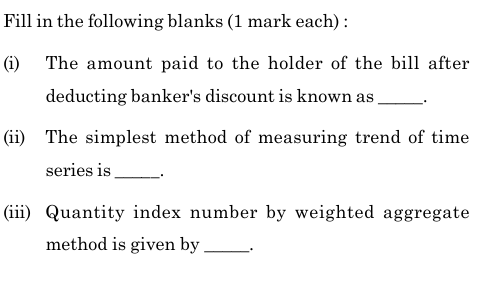
Important Fill In The Blanks Question for Maths
HSC Mathematics exam also includes some fill-in-the-blanks questions, that carry one mark each. Check some questions below:
09 00 AM IST - 20 Feb'26
Question to Understand Mathematical Logic - Implications and Compound Statements
Q: Write the converse, inverse and contrapositive of the statement "If a triangle is equilateral then it is equiangular"
Given Statement:
If a triangle is equilateral, then it is equiangular.Converse:
If a triangle is equiangular, then it is equilateral.Inverse:
Contrapositive:
If a triangle is not equilateral, then it is not equiangular.
If a triangle is not equiangular, then it is not equilateral.08 30 AM IST - 20 Feb'26
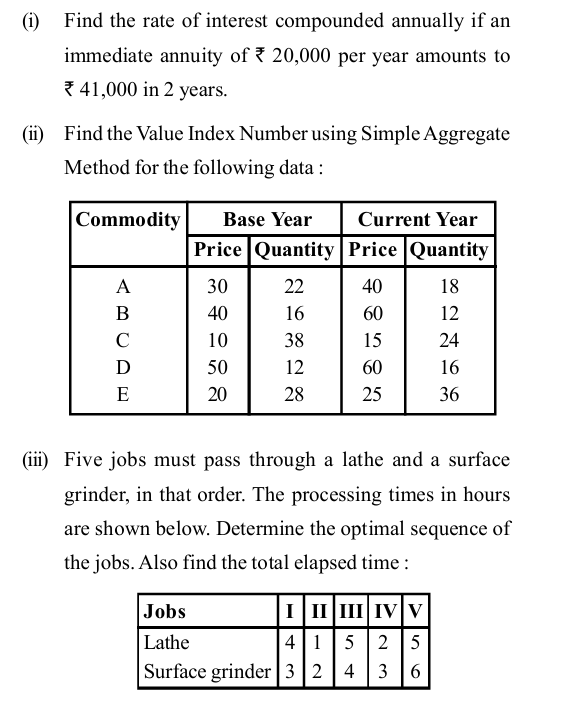
Some Important 3-Mark Questions for Commerce Stream Students to Practice
The questions given below have appeared as 3-mark questions in previous year papers. Check them out:
08 00 AM IST - 20 Feb'26
How many questions should I prepare for the Maharashtra HSC Math exam?
Practice as many questions as you can from past papers and sample sets. Focus on high-weightage chapters like Vectors, Trigonometric Functions, Differentiation, and Indefinite Integration.
07 00 AM IST - 20 Feb'26
HSC Mathematics Statistics Syllabus PDF Links
07 00 AM IST - 20 Feb'26
HSC Mathematics Statistics Syllabus PDF Links
The syllabus is different for both streams: Arts & Science and Commerce. Seperate PDF links are given below:
06 00 AM IST - 20 Feb'26
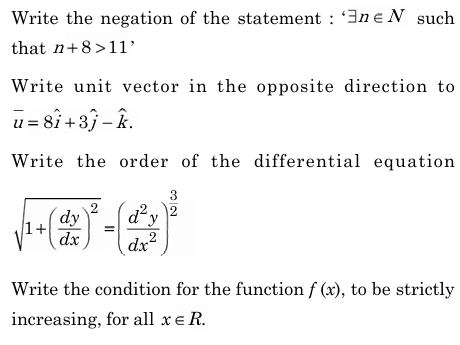
Some More 1-Mark Practice Questions for Maths (Arts & Science)
Check out some MCQs to practice, based on the Maths Arts & Science Syllabus:
05 00 AM IST - 20 Feb'26
Last Prep Day Alert for Maths Exam!
Tomorrow is your Maharashtra HSC Maths exam on February 21, 2026 (11:00 AM - 2:00 PM). This is your final prep day! Pull up
04 00 AM IST - 20 Feb'26
A Solved Binomial Distribution Numerical
Q: Five cards are drawn successively with replacement from a well-shuffled deck of 52 cards. find the probability that
(i) all the five cards are spades
(ii) only 3 cards are spades
(iii) none is a spade.
Given:
A well-shuffled deck has 52 cards.
Number of spades = 13Probability of getting a spade in one draw:
p = 13/52
p = 1/4Probability of not getting a spade:
q = 1 − p
q = 1 − 1/4
q = 3/4Since cards are drawn with replacement, the trials are independent.
Number of trials, n = 5Formula:
P(X = r) = nCr × p^r × q^(n − r)
(i) Probability that all five cards are spades
Here, r = 5
P(X = 5) = 5C5 × (1/4)^5 × (3/4)^0
= 1 × (1/1024) × 1
= 1/1024
(ii) Probability that exactly 3 cards are spades
Here, r = 3
P(X = 3) = 5C3 × (1/4)^3 × (3/4)^2
5C3 = 10
= 10 × (1/64) × (9/16)
= 90/1024
= 45/512
(iii) Probability that none is a spade
Here, r = 0
P(X = 0) = 5C0 × (1/4)^0 × (3/4)^5
= 1 × 1 × (243/1024)
= 243/1024
03 00 AM IST - 20 Feb'26
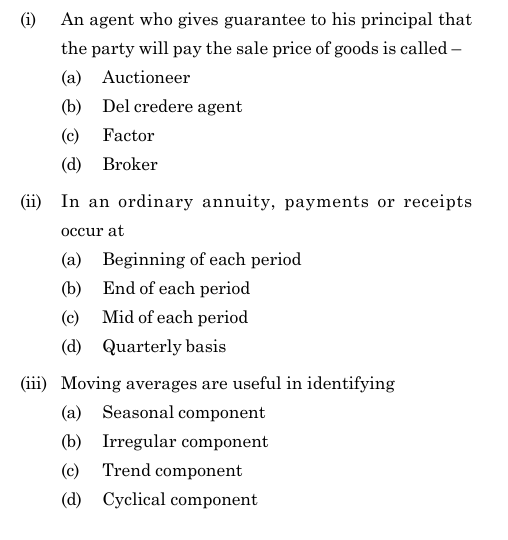
Some more MCQs for HSC Maths (Commerce)
Listed below are some 1-mark MCQs take from HSC Maths Commerce-Based Papers:
02 00 AM IST - 20 Feb'26
What is Rolle's Theorem?
Rolle’s Theorem states that if a function f(x) satisfies the following three conditions on a closed interval [a, b]:
f(x) is continuous on [a, b]
f(x) is differentiable on (a, b)
f(a) = f(b)
Then there exists at least one number c in (a, b) such that:
f'(c) = 0
In simple words, if a function starts and ends at the same value and has no break or sharp corner in between, then there is at least one point between a and b where the tangent to the curve is horizontal.
01 00 AM IST - 20 Feb'26
Another Important Probability Question with Solution

In each question, there are 3 possible answers.
Probability of correct answer by guessing:
p = 1/3Probability of wrong answer:
q = 2/3This follows Binomial Distribution.
Here,
n = 5 (total questions)
r = 4 (correct answers)Formula:
P(X = r) = nCr × p^r × q^(n − r)P(X = 4) = 5C4 × (1/3)^4 × (2/3)^1
= 5 × (1/81) × (2/3)
= 10/243
P(getting 4 correct answers) = 10/24312 00 AM IST - 20 Feb'26
Important Applications of Derivatives / Financial Mathematics Numerical with Solution
Q: Find the rate of interest compounded annually if an immediate annuity of 20,000 per year amounts to 41,000 in 2 years
Given:
An immediate annuity = ₹20,000 per year
Total amount after 2 years = ₹41,000
Interest compounded annuallyLet rate of interest = r per annum
Step 1: Write amount formula for annuity (2 years)
Amount = 20000(1 + r) + 20000
Because:
First year payment earns interest for 1 year → 20000(1 + r)
Second year payment earns no interest → 20000Total amount:
20000(1 + r) + 20000 = 41000
Step 2: Simplify
20000 + 20000r + 20000 = 41000
40000 + 20000r = 41000
20000r = 1000
r = 1000 / 20000
r = 0.05
Step 3: Convert into percentage
r = 5%
The rate of interest compounded annually is 5% per annum.11 00 PM IST - 19 Feb'26
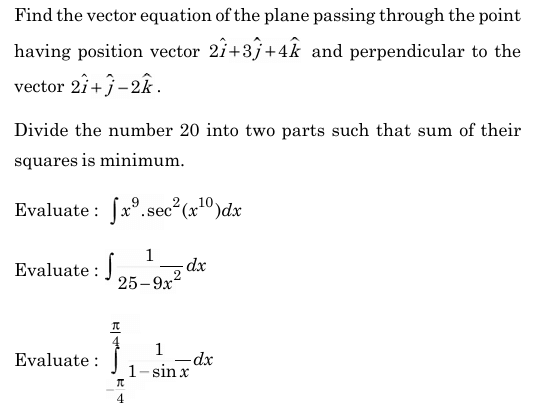
Some More Important 2-Mark Questions to Practice for HSC Maths (Arts & Science) Students
Check out some questions below that have appeared for 2 marks in previous HSC maths papers:
10 40 PM IST - 19 Feb'26
Some Definite Integration Theorems to Remember
Theorem 1:
If f and g are real-valued integrable functions of x, then
∫ [f(x) + g(x)] dx = ∫ f(x) dx + ∫ g(x) dx
This means the integral of the sum of two functions is equal to the sum of their integrals.
Theorem 2:
If f and g are real-valued integrable functions of x, then
∫ [f(x) − g(x)] dx = ∫ f(x) dx − ∫ g(x) dx
This means the integral of the difference of two functions is equal to the difference of their integrals.
Theorem 3:
If f is a real-valued integrable function of x and k is a constant, then
∫ k f(x) dx = k ∫ f(x) dx
This means a constant multiplier can be taken outside the integral sign.
10 20 PM IST - 19 Feb'26
Important Numerical from Linear Programming Problem
A firm manufactures two products A and B on which profit earned per unit are 3 and 4 respectively. Each product is processed on two machines M1 and M2. The product A requires one minute of processing time on M1 and two minutes on M2, while product B requires one minute on M1 and one minute on M2. Machine M1 is available for use not more than 450 minutes, while M2 is available for 600 minutes during any working day. Find the number of units of products A and B to be manufactured to get maximum profit.
10 00 PM IST - 19 Feb'26
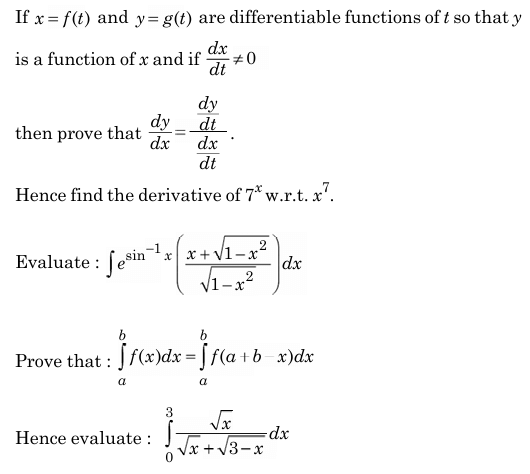
Some Other 4-Marks Questions for Maths (Arts & Science)
These 4-mark questions have appeared in PYQs, and they will help in your preparations for the exam. Practice them now!
09 40 PM IST - 19 Feb'26
Some Important Questions from Integration (might come for 3 or 4 marks)
- A body cools according to Newton’s Law of Cooling from 100°C to 60°C in 20 minutes. If the temperature of the surroundings is 20°C, how long will it take to cool down to 30°C?
- A right circular cone has height 9 cm and radius of the base 5 cm. It is inverted and water is poured into it. If at any instant the water level rises at the rate of (π/A) cm per second, where A is the area of the water surface at that instant, show that the vessel will be full in 75 seconds.
- Assume that a spherical raindrop evaporates at a rate proportional to its surface area. If its radius is originally 3 mm and after 1 hour it is reduced to 2 mm, find an expression for the radius of the raindrop at any time t.
- The rate of growth of the population of a city at any time t is proportional to the size of the population. For a certain city, the constant of proportionality is 0.04. Find the population of the city after 25 years if the initial population is 10,000.
09 20 PM IST - 19 Feb'26
Solved MCQs for Applications of Definite Integration
- The area bounded by the region 1 ≤ x ≤ 5 and 2 ≤ y ≤ 5 is given by: 12 sq. units
- The area of the region enclosed by the curve y = 1/x and the lines x = e, x = e² is given by: 1 sq. unit
- The area bounded by the curve y = x³, the X-axis and the lines x = −2 and x = 1 is: 17/4 sq. units
- The area enclosed between the parabola y² = 4x and the line y = 2x: 1/3 sq. unit
09 00 PM IST - 19 Feb'26
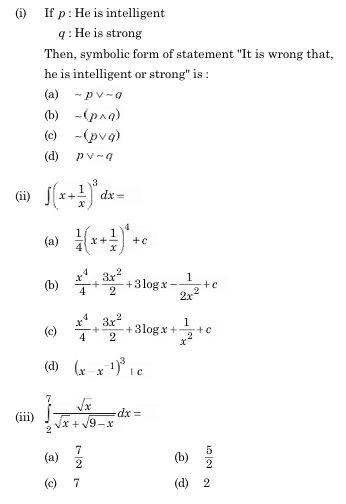
Some more Important MCQs for HSC Maths (Commerce)
Practice these 1-mark MCQs for your prep:
08 40 PM IST - 19 Feb'26
Solved Three Dimensional Geometry Numerical
Q: Find the equation of the plane passing through the intersection of the planes x + 2y + 3z + 4 = 0 and 4x + 3y + 2z + 1 = 0 and the origin
Given planes:
Plane 1:
x + 2y + 3z + 4 = 0Plane 2:
4x + 3y + 2z + 1 = 0Step 1: Equation of plane passing through the line of intersection
The required plane can be written as:
(x + 2y + 3z + 4) + λ(4x + 3y + 2z + 1) = 0
Step 2: Expand
x + 2y + 3z + 4 + 4λx + 3λy + 2λz + λ = 0
(1 + 4λ)x + (2 + 3λ)y + (3 + 2λ)z + (4 + λ) = 0
Step 3: Since the plane passes through the origin (0, 0, 0)
Substitute x = 0, y = 0, z = 0:
4 + λ = 0
λ = −4
Step 4: Substitute λ = −4
1 + 4(−4) = 1 − 16 = −15
2 + 3(−4) = 2 − 12 = −10
3 + 2(−4) = 3 − 8 = −5
So the equation becomes:
−15x − 10y − 5z = 0
Divide by −5:
3x + 2y + z = 0
The required equation of the plane is 3x + 2y + z = 0
08 20 PM IST - 19 Feb'26
Some Other Trigonometric Substitutions to Remember
- For expressions of the form 2x / (1 + x²), substitute x = tan θ.
- For expressions of the form (1 − x²) / (1 + x²), substitute x = tan θ.
- For expressions of the form 3x − 4x³ or 1 − 2x², substitute x = sin θ.
- For expressions of the form 4x³ − 3x or 2x² − 1, substitute x = cos θ.
- For expressions of the form (3x − x³) / (1 − 3x²), substitute x = tan θ.
- For expressions of the form 2f(x) / (1 + [f(x)]²) or (1 − [f(x)]²) / (1 + [f(x)]²), substitute f(x) = tan θ.
08 00 PM IST - 19 Feb'26
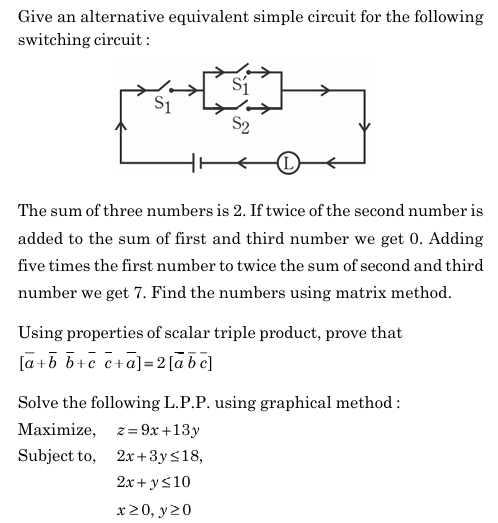
Important 4-Mark Questions to Practice for Maths (Arts & Science)
These questions might come in the Maths exam for 4-marks:
07 40 PM IST - 19 Feb'26
Derivatives of Implicit Functions
- Differentiate both sides of the given equation with respect to x (the independent variable), treating y as a differentiable function of x.
- After differentiation, collect all the terms containing dy/dx on one side of the equation and then solve to find the value of dy/dx.
07 20 PM IST - 19 Feb'26
What are Implicit Functions?
In Mathematics, an implicit function is a function where the dependent variable is not directly expressed in terms of the independent variable.
In simple words, when y is not written clearly as y = f(x), but both x and y are mixed in one equation, the function is called an implicit function.
Example: ?2 + ?2 = 25
07 00 PM IST - 19 Feb'26
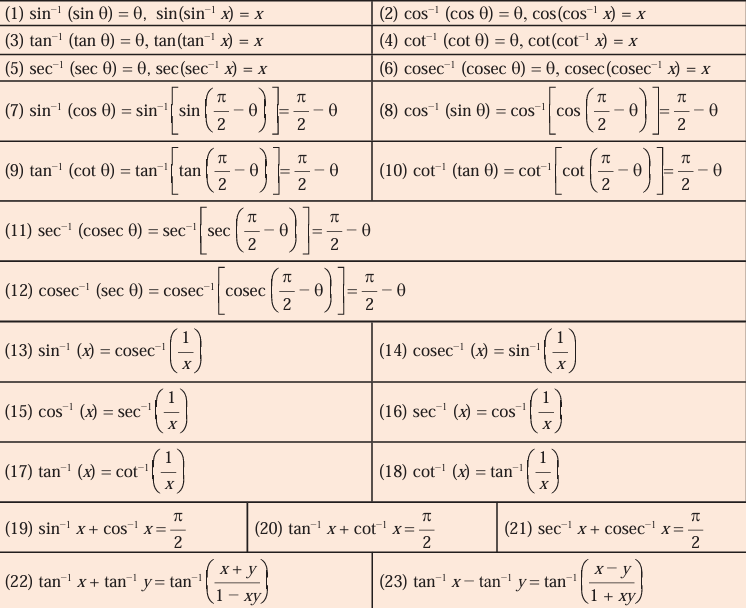
Some Important Formulae for Inverse Trigonometric Functions
The formulas are listed here:
06 40 PM IST - 19 Feb'26
4- Mark Maxima and Minima Numerical To Solve
A box with a square base is to have an open top. The surface area of box is 147 sq.cm. What should be its dimensions in order that the volume is largest?
Answer is Base side: x=7 cm, Height: h=3.5 cm
06 20 PM IST - 19 Feb'26
Numerical For You to Understand Mathematical Logic
Q: Find the truth value of each of the following statements:
(i) It is not true that 3 − 7i is a real number.
(ii) If a joint venture is a temporary partnership, then discount on purchase is credited to the supplier.
(iii) Every accountant is free to apply his own accounting rules if and only if machinery is an asset.
(iv) Neither 27 is a prime number nor divisible by 4.
(v) 3 is a prime number and an odd number.
(i) 3 − 7i is a complex number, not a real number.
So the statement “3 − 7i is a real number” is false.Since it says “It is not true that…”, the negation of false is true.
Truth Value: True
(ii) A joint venture is indeed a temporary partnership.
But discount on purchase is credited to the purchaser, not the supplier.So,
p = True
q = FalseIn implication, if p is true and q is false, the statement is false.
Truth Value: False
(iii) Machinery is an asset. So this part is true.
But every accountant is not free to apply his own accounting rules.So,
p = False
q = TrueIn “if and only if” (biconditional), both parts must have the same truth value.
Here they are different.Truth Value: False
(iv) 27 is not a prime number. (True)
27 is not divisible by 4. (True)So both parts are true.
Hence the compound statement is true.Truth Value: True
(v) 3 is a prime number and an odd number.
3 is prime. (True)
3 is odd. (True)Since both are true and connected by “and”, the statement is true.
Truth Value: True
06 00 PM IST - 19 Feb'26
Statement vs True Value of Statement
Statement: A statement is a declarative sentence that is either true or false, but not both.
Examples:
- 2 + 3 = 5 (This is a statement.)
- The sun rises in the west. (This is also a statement.)
Truth Value of a Statement: The truth value of a statement tells whether the statement is True (T) or False (F).
For example:
- 2 + 3 = 5 Truth value: True
- 7 is an even number Truth value: False
A statement is the sentence itself. The truth value tells whether that sentence is true or false.
05 40 PM IST - 19 Feb'26
Important Mathematical Logic Question To Practice
Write converse, inverse and contrapositive of the following statement : If the train reaches on time then I can catch the connecting flight.
05 20 PM IST - 19 Feb'26
Important 4-Mark Numerical for Commerce Students
Q: In a certain culture of bacteria, their rate of increase is proportional to the number present. If it is found that the number doubles in 4 hours, find the number of times the bacteria are increased in 12 hours.
A: Given:
Rate of increase of bacteria is proportional to the number present.
So, dN/dt = kN
Step 1: Separate variables
dN/N = k dt
Integrate:
∫ (1/N) dN = ∫ k dt
ln N = kt + C
N = Ae^(kt)
Step 2: Use given condition
Number doubles in 4 hours.
Let initial number be N₀.
After 4 hours:
2N₀ = N₀ e^(4k)
Divide by N₀:
2 = e^(4k)
Take log:
ln 2 = 4k
k = (ln 2) / 4
Step 3: Find increase in 12 hours
After 12 hours:
N = N₀ e^(12k)
Substitute k:
N = N₀ e^(12 × (ln 2)/4)
N = N₀ e^(3 ln 2)
N = N₀ (e^(ln 2))³
N = N₀ (2)³
N = 8N₀
In 12 hours, the bacteria increase 8 times the original number.
04 40 PM IST - 19 Feb'26
Important 4-Mark Numerical from Vectors
Q: In a triangle ABC, D and E are points on BC and AC respectively such that BD = 2DC and AE = 3EC. Let P be the point of intersection of AD and BE. Find ratio BP method.
A: Given:
In triangle ABC,
D is a point on BC such that BD = 2DC
E is a point on AC such that AE = 3EC
AD and BE intersect at PWe have to find the ratio BP : PE.
Step 1: Assign position vectors
Let position vectors of A, B and C be
A = a, B = b, C = cStep 2: Find position vector of D
Since BD = 2DC
So BD : DC = 2 : 1
Using section formula,
D = (2c + b) / 3
Step 3: Find position vector of E
Since AE = 3EC
So AE : EC = 3 : 1
Using section formula,
E = (3c + a) / 4
Step 4: Let P divide BE in the ratio m : n
So, P = (mE + nB) / (m + n)
Substitute E,
P = [m(3c + a)/4 + nb] / (m + n)
Multiply numerator:
P = [m(3c + a) + 4nb] / 4(m + n)
Step 5: Also P lies on AD
Let P divide AD in ratio x : y
So, P = (xD + yA) / (x + y)
Substitute D,
P = [x(2c + b)/3 + ya] / (x + y)
Multiply numerator:
P = [x(2c + b) + 3ya] / 3(x + y)
Step 6: Compare coefficients of a, b and c
On simplifying and comparing coefficients, we get m : n = 3 : 1
Therefore, BP : PE = 3 : 1
04 20 PM IST - 19 Feb'26
Some Standard Trigonometric Substitutions to Remember
- For expressions of the form √(1 − x²), substitute x = sin θ or x = cos θ.
- For expressions of the form √(1 + x²), substitute x = tan θ or x = cot θ.
- For expressions of the form √(x² − 1), substitute x = sec θ or x = cosec θ.
- For expressions of the form (a + x)/(a − x) or (a − x)/(a + x), substitute x = a cos 2θ or x = a cos θ.
- For expressions of the form (1 + x)/(1 − x) or (1 − x)/(1 + x), substitute x = cos 2θ or x = cos θ.
- For expressions of the form (a + x²)/(a − x²) or (a − x²)/(a + x²), substitute x² = a cos 2θ or x² = a cos θ.
03 40 PM IST - 19 Feb'26
Higher Order Derivatives Numerical with Solution
Q: Find the nth order derivative of log x.
A: Given:
y = log x
Step 1: Find first few derivatives
First derivative:
y' = 1/x
Second derivative:
y'' = −1/x²
Third derivative:
y''' = 2/x³
Fourth derivative:
y⁽⁴⁾ = −6/x⁴
Step 2: Observe the pattern
Numerators follow factorial pattern:
1 = 0!
1 = 1!
2 = 2!
6 = 3!Signs alternate as:
+, −, +, −, ...
Denominator is xⁿ
Step 3: Write general formula
The nth order derivative of log x is:
dⁿ/dxⁿ (log x) = (−1)ⁿ⁻¹ (n − 1)! / xⁿ
The nth derivative of log x is (−1)ⁿ⁻¹ (n − 1)! / xⁿ
03 20 PM IST - 19 Feb'26
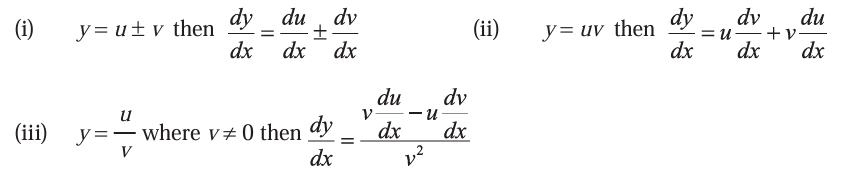
Rules of Differentiation
If u and v are differentiable functions of x such that:
02 40 PM IST - 19 Feb'26
Important Maxima and Minima Numerical
Q: Divide the number 20 into two parts such that sum of their squares is minimum.
A: The number 20 is to be divided into two parts such that the sum of their squares is minimum.
Step 1: Let one part be x
Then the other part will be 20 − x
Step 2: Form the function
Let the sum of squares be:
S = x² + (20 − x)²
Expand:
S = x² + (400 − 40x + x²)
S = 2x² − 40x + 400
Step 3: Differentiate
dS/dx = 4x − 40
For minimum value, set derivative equal to zero:
4x − 40 = 0
4x = 40
x = 10
Step 4: Find second part
Second part = 20 − 10 = 10
Step 5: Second derivative test
d²S/dx² = 4
Since 4 > 0, the value is minimum.
Final Answer: The number 20 should be divided into two equal parts: 10 and 10
So that the sum of their squares is minimum.
02 20 PM IST - 19 Feb'26
Differential Equations - Newton’s Law of Cooling Numerical
Q: If a body cools from 80ºC to 50ºC at room temperature of 25ºC in 30 minutes, find the temperature of the body after 1 hour.
Given:
Initial temperature, T₀ = 80°C
Room temperature, Tₛ = 25°C
Temperature after 30 minutes = 50°CAccording to Newton’s Law of Cooling:
T − Tₛ = (T₀ − Tₛ)e^(−kt)
Step 1: Form the equation
T − 25 = (80 − 25)e^(−kt)
T − 25 = 55e^(−kt)Step 2: Use condition at t = 30 minutes
50 − 25 = 55e^(−30k)
25 = 55e^(−30k)25/55 = e^(−30k)
5/11 = e^(−30k)Taking log on both sides:
−30k = ln(5/11)
k = −(1/30) ln(5/11)
Step 3: Find temperature after 60 minutes
T − 25 = 55e^(−60k)
But
e^(−60k) = (e^(−30k))²= (5/11)²
= 25/121
So,
T − 25 = 55 × (25/121)
T − 25 = 1375/121
T − 25 ≈ 11.36
T ≈ 36.36°C
01 40 PM IST - 19 Feb'26
Important Probability Question with Solution
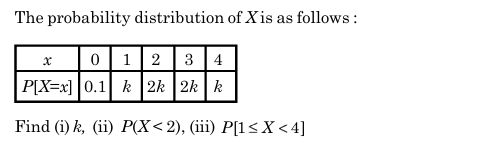
(i) To find k
Since total probability = 1
0.1 + k + 2k + 2k + k = 1
0.1 + 6k = 1
6k = 0.9
k = 0.15
(ii) Find P(X < 2)
P(X < 2) = P(0) + P(1)
= 0.1 + k
= 0.1 + 0.15
= 0.25
(iii) Find P(1 ≤ X < 4)
P(1 ≤ X < 4) = P(1) + P(2) + P(3)
= k + 2k + 2k
= 5k
= 5 × 0.15
= 0.75
01 20 PM IST - 19 Feb'26
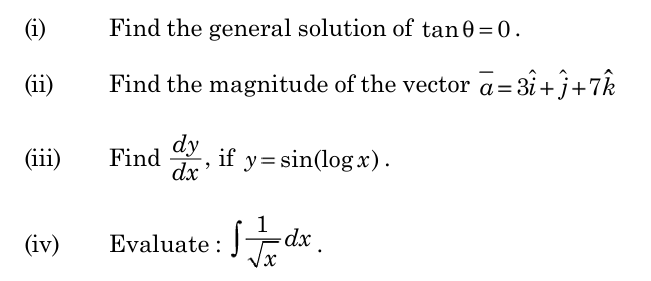
1-Mark Practice Questions for Maths (Arts & Science)
01 00 PM IST - 19 Feb'26
Some Important MCQs for HSC Maths (Arts & Science) with Solutions
Question
Answer
Inverse of (p∨q)→(p∧q)
(∼p∧∼q)→(∼p∨∼q)
In ΔABC, a=2,b=3,sinA=32. Find ∠B.
π/2
For A={1,2,3,4,5}, which is not true?
∀x∈A,x+6≥9 (False for x=1,2)
Value of (a+b)cosC+(b+c)cosA+(c+a)cosB.
a+b+c
12 40 PM IST - 19 Feb'26
Some Low-Weightage Chapters for Maharashtra HSC Maths 2026
- Linear Programming (LPP)
- Application of Definite Integration
- Probability Distribution
- Binomial Distribution
12 20 PM IST - 19 Feb'26
Some High-Weightage Chapters for Maharashtra HSC Maths 2026
- Vectors
- Trigonometric Functions
- Differentiation
- Indefinite Integration
12 00 PM IST - 19 Feb'26
Expected Chapter-Wise Weightage for Maths Exam 2026
Chapter No.
Chapter Name
Marks with Option
1
Mathematical Logic
8
2
Matrices
6
3
Trigonometric Functions
10
4
Pair of Straight Lines
6
5
Vectors
12
6
Line and Plane
10
7
Linear Programming (LPP)
4
8
Differentiation
9
9
Applications of Derivatives
9
10
Indefinite Integration
10
11
Definite Integration
6
12
Application of Definite Integration
4
13
Differential Equations
8
14
Probability Distribution
5
15
Binomial Distribution
5
11 40 AM IST - 19 Feb'26
HSC Maths Exam Pattern Reminder
Keep in mind that the exam pattern for both streams of Mathematical Statistics is different. Check below for both:
Aspect
HSC Maths Arts & Science
HSC Maths Commerce
Maximum marks
80 Marks
80 Marks
Total No. of sections
Sections A, B, C, and D
Sections A & B (6 Questions divided into two Sections)
Total No. of MCQs
8 MCQs in Section A
2 objective questions with six MCQs each
Marks Distribution
- Objective: 16 marks
- Short answers: 44 marks
- Long answers: 20 marks
- Two Questions: 12 Marks
- Four Questions: 14 Marks
11 20 AM IST - 19 Feb'26
Mathematical Statistics (Commerce) Syllabus 2026
- Mathematical Logic
- Matrices
- Differentiation
- Applications of Derivatives
- Integration
- Definite Integration
- Application of Definite Integration
- Differential Equation and Applications
11 00 AM IST - 19 Feb'26
Mathematical Statistics (Arts & Science) Syllabus 2026
- Differentiation
- Applications of Derivatives
- Indefinite Integration
- Definite Integration
- Application of Definite Integration
- Differential Equations
- Probability Distributions
- Binomial Distribution