


 AP Inter 2nd Year Maths 2A Answer Key 2026 (OUT) Live Updates: Paper Moderately Tough; Solved Question Paper
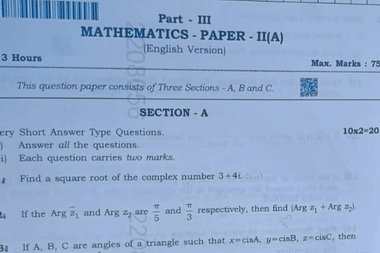
AP Inter 2nd Year Maths 2A Exam 2026: The Board of Intermediate Education, Andhra Pradesh (BIEAP) has conducted the AP Inter 2nd Year Maths 2A Examination 2026 today, March 4, 2026, at different exam centres in the state. It is a crucial paper for the overall Intermediate examination results, and students from the MPC and MEC streams are appearing in large numbers. Through this live blog, a detailed unofficial answer key prepared by our Mathematics SME, Mahima Gupta, shall be provided after 12 PM, along with the paper analysis section-wise.
| Link to Submit Student Reviews |
|---|
| Click Here to Submit Your Review on Maths 2A Exam |
AP Inter 2nd year Maths 2A Answer Key Solutions 2026 (Unofficial)
PDF Download Link - AP Inter 2nd Year Maths 2A Answer Key 2026Answer Key prepared by Subject Expert for Section A |
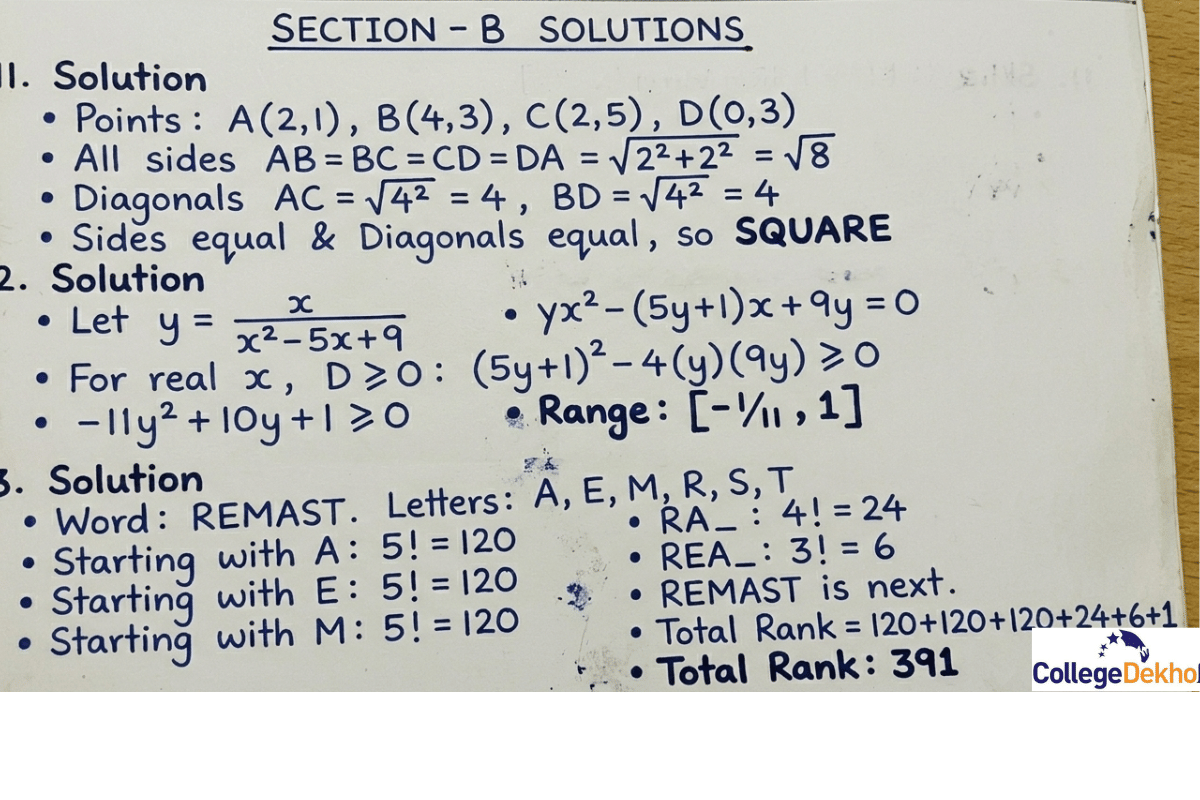
Solution for Question Numbers 11, 12 and 13
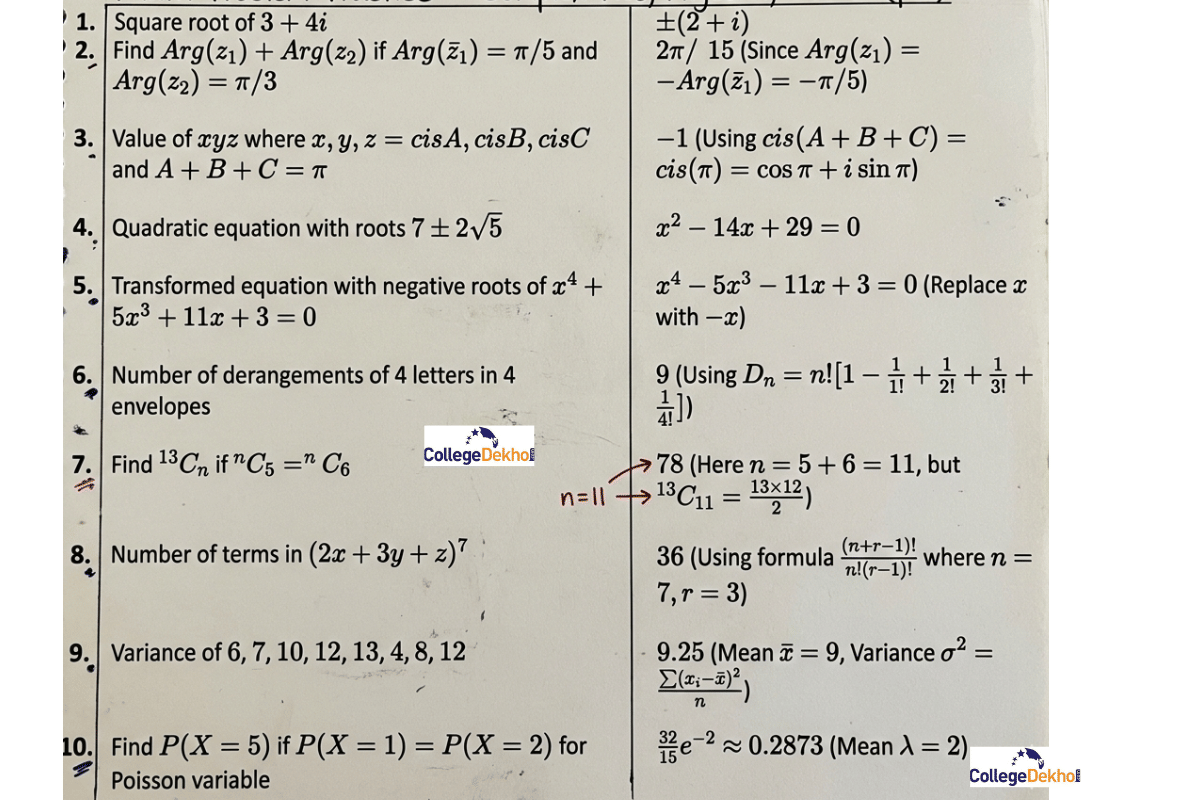
| Question Number | Question | Answer |
|---|---|---|
| Section A - 1 | Square root of 3+4i | ±(2+i) |
| Section A - 2 | Find Arg(z1)+Arg(z2) if Arg(z1ˉ)=π/5 and Arg(z2)=π/3 | 2π/15 (Since Arg(z 1 )=−Arg(z 1 ˉ)=−π/5) |
| Section A - 3 | Value of xyz where x,y,z=cisA,cisB,cisC and A+B+C=π | −1 (Using cis (A+B+C)=cis (π) =cos π+i sin π) |
| Section A - 4 | Quadratic equation with roots 7±25 | x 2 −14x + 29 = 0 |
| Section A - 5 | Transformed equation with negative roots of x4+5x3+11x+3=0 | x 4 −5x 3 −11x +3 =0 (Replace x with −x) |
| Section A - 6 | Number of derangements of 4 letters in 4 envelopes | 9 (Using D n =n! [1−1!1+2!1−3!1+4!1]) |
| Section A - 7 | Find 13Cn if nC5=nC6 | 78 (Here n=5+6=11, but 13C11=213×12) |
| Section A - 8 | Number of terms in (2x+3y+z)7 | 36 (Using formula n!(r−1)!(n+r−1)! where n=7,r=3) |
| Section A - 9 | Variance of 6,7,10,12,13,4,8,12 | 9.25 (Mean xˉ=9, Variance σ2=n∑(xi−xˉ)2) |
| Section A - 10 | Find P(X=5) if P(X=1)=P(X=2) for Poisson variable | 1532e−2≈0.2873 (Mean λ=2) |
What's Next after AP Inter 2nd Year Maths 2A Exam 2026?
The upcoming major exam for MPC and MEC students is 'Mathematics 2B'. The exam is scheduled to be conducted on March 9 (Monday). As there is 5 days gap for the exam, students are advised to do the last-minute revision thoroughly. You can go through the 2nd Year Maths 2B Chapter-Wise Weightage Marks 2026 to enhance the last minute prepration and understand the list of high-priority topics.
AP Inter 2nd Year Mathematics Exam 2026 Quick Facts
Some of the details and facts related to AP Inter 2nd Year Maths Exam 2026 can be found below:
Aspect | Details |
|---|---|
Exam Date | March 4, 2026 |
Exam Time | 9 AM to 12 PM |
Sections | Sections A, B, & C |
Questions and Marking Scheme |
|
Max Marks | 75 Marks |
Mathematics 2A has a reputation as a full-scoring subject, particularly for those who prepare strategically and practice regularly. Maths differs from theory-heavy papers in that it rewards clarity, step-wise presentation, and formula accuracy.
AP Inter 2nd Year Maths 2A Exam 2026 LIVE:
12 38 PM IST - 04 Mar'26
Students from Mangalagiri share reviews
Karthik, Manmitha and Lahari from Mangalagiri shared their review on the 2A Maths question paper. All three students rated the papers slightly tough and time-consuming. The long answer questions took time to solve and 2 mark questions were tricky to.
12 08 PM IST - 04 Mar'26
CollegeDekho Team Receives Question Paper: Paper Moderate to Tough
CollegeDekho team has received the question paper and initial reviews suggest that the paper was 'Moderate to Tough' with respect to difficulty level.
12 04 PM IST - 04 Mar'26
Student reviews shortly
Students will be coming out of the exam centres shortly, and the reviews shall be collected. CollegeDekho team is waiting at an exam centre located in Mangalagiri to collect student reviews and question paper.
12 00 PM IST - 04 Mar'26
AP Inter Maths 2A Exam 2026 Concludes Successfully
The Mathematics 2A examination has concluded across Andhra Pradesh. Authorities confirmed smooth conduct of the exam, while students are now leaving centres. Live student reactions, expert analysis, and expected marks evaluation will be updated shortly.
11 30 AM IST - 04 Mar'26
Maths 2A Exam to Conclude Shortly
The AP Inter 2nd Year Mathematics 2A examination will conclude shortly. Students are expected to begin exiting examination centres after 12:00 Noon. Initial reactions and difficulty level analysis will be updated soon in this LIVE blog.
10 30 AM IST - 04 Mar'26
Examination Progresses Without Disruptions
Officials report that the Maths 2A exam is progressing peacefully with no major issues reported from centres. Basic facilities including drinking water, ventilation, and seating arrangements have been adequately maintained to ensure a comfortable exam environment for students.
09 30 AM IST - 04 Mar'26
Maths 2A Exam Underway Smoothly Across Centres
The AP Inter 2nd Year Mathematics 2A examination is being conducted smoothly across examination centres in the state. Students began writing the paper under strict invigilation, and authorities ensured timely distribution of question papers and proper seating arrangements.
09 00 AM IST - 04 Mar'26
Maths 2A Exam Begins
The AP Inter 2nd Year Mathematics 2A Examination 2026 has officially commenced across examination centres. Students have begun writing the paper under supervision. Stay tuned for section-wise analysis and important questions asked in the exam.
08 00 AM IST - 04 Mar'26
Reach Exam Centre Early
Students are advised to reach the examination centre at least 30 minutes before reporting time. Carry required materials and maintain calmness.
07 00 AM IST - 04 Mar'26
Exam Attempt Order Strategy
Exam strategy reminder:
Attempt 2-mark questions first
Move to known 4-mark questions
Attempt the strongest long answer first
06 00 AM IST - 04 Mar'26
Final Revision Capsule
Students should now focus on confidence-building rather than new learning. Mathematics 2A is a step-based paper and rewards clarity.
05 00 AM IST - 04 Mar'26
Morning Confidence Booster
Wake-up revision capsule:
• Demoivre’s Theorem statement
• Independent term problems
• Reciprocal roots problems
• Mean and variance steps04 00 AM IST - 04 Mar'26
Early Morning Mental Revision
Early morning revision tip: Go through important long-answer headings mentally rather than re-solving entire questions.
03 00 AM IST - 04 Mar'26
Late Night Revision Advice
If students are awake, revising, and focus only on short notes and previously solved examples. Avoid lengthy problem-solving at this hour.
02 00 AM IST - 04 Mar'26
Presentation Matters in Maths
Experts emphasize that neat presentation plays a key role in Mathematics exams. Write steps clearly and box final answers in the exam.
01 00 AM IST - 04 Mar'26
Quick Binomial Theorem Reminder
Quick formula checklist before sleep:
• nPr and nCr formulas
• Independent term condition
• Conditional probability formula
• Variance and standard deviation formula12 00 AM IST - 04 Mar'26
Midnight Checklist for Exam Day
Midnight reminder: Keep hall ticket, stationery, and necessary documents ready. Avoid last-minute stress in the morning.
Small revision builds confidence.
11 00 PM IST - 03 Mar'26
Sleep Strategy for Better Performance
Students are encouraged to get adequate sleep. Proper rest improves concentration and reduces calculation errors during the exam.
10 00 PM IST - 03 Mar'26
Stop Learning New Topics Now
Final night preparation should now focus only on formula revision and reviewing solved examples. Avoid solving completely new model papers at this hour to prevent confusion.Shift to revision mode only.
Note: Avoid heavy problem solving late night.
09 40 PM IST - 03 Mar'26
Final Formula Check Before Night Break
Students must revise key formulas now.
Practice Question:
Find mean of 2, 4, 6.Solution:
Mean = 4.Note: Statistics formulas should be memorised.
09 20 PM IST - 03 Mar'26
Important Long Answer Strategy for Tonight
Experts suggest solving at least two long-answer questions before ending preparation.
Practice Question:
Find independent term in (x + 2/x) power 10.Solution:
General term power of x becomes zero when r = 5.
Independent term = 10C5 × 2 power 5 = 8064.09 00 PM IST - 03 Mar'26
Start Final Revision with High-Weightage Chapters
With the Mathematics 2A exam approaching, students should begin final preparation by focusing on Binomial Theorem and Probability, which traditionally carry higher marks.
Quick Practice Problem:
Find coefficient of x2 in (1 + x) power 4.Solution:
Coefficient = 4C2 = 6.08 40 PM IST - 03 Mar'26
ONE-PAGE QUICK REVISION SHEET (All Important Formulas)
1. Complex Numbers
Modulus = √(a² + b²)
Polar form = r (cos θ + i sin θ)2. Demoivre’s Theorem
(cos θ + i sin θ)^n = cos nθ + i sin nθ
3. Quadratic Equation
Discriminant D = b² − 4ac
Sum of roots = −b/a
Product of roots = c/a4. Permutations & Combinations
nPr = n! / (n − r)!
nCr = n! / [r!(n − r)!]nCr = nC(n − r)
5. Binomial Theorem
(a + b)^n = Σ nCr a^(n − r) b^r
General term T(r+1) = nCr a^(n − r) b^r
Number of terms = n + 1
6. Partial Fractions
Proper fraction: degree numerator < degree denominator
7. Measures of Dispersion
Mean = Σfx / N
Variance = Σ(x − x̄)² / N
Standard Deviation = √Variance
Step deviation:
SD = h √[ (Σfu² / N) − (Σfu / N)² ]8. Probability
P(A') = 1 − P(A)
Addition theorem:
P(A ∪ B) = P(A) + P(B) − P(A ∩ B)Conditional probability:
P(A|B) = P(A ∩ B) / P(B)9. Random Variables
E(X) = Σ x p(x)
Variance = E(X²) − [E(X)]²
08 20 PM IST - 03 Mar'26
Top 20 Very Short Real Model Questions
Find modulus of 3 + 4i.
Find argument of 1 + i.
Convert 1 + i into polar form.
Find square roots of -4.
Find discriminant of 2x2 - 4x + 5 = 0.
Find nature of roots of x2 - 4x + 4 = 0.
Evaluate 5P2.
Evaluate 6C3.
Find general term in expansion of (x + 1) power 5.
Find coefficient of x2 in (1 + x) power 4.
Resolve (2x + 3) divided by (x - 1) into partial fractions.
Find mean of data 2, 4, 6, 8.
Find variance of numbers 1, 2, 3.
Find probability of getting head when a coin is tossed once.
If P(A) = 1/3, find P(A complement).
If P(A) = 1/2 and P(B) = 1/3, find P(A union B) when A and B are mutually exclusive.
Verify whether 1/4, 1/4, 1/2 form a probability distribution.
Find expected value if X takes values 0, 1 with probabilities 1/2, 1/2.
Find value of 4 factorial.
Find number of terms in expansion of (a + b) power 7.
08 00 PM IST - 03 Mar'26
Section-wise Attempt Order Strategy
Step 1: Attempt Very Short Answers First
Quick scoring (confidence boost)
Step 2: Attempt Known 4-Mark Questions
Choose direct formula-based problems
Step 3: Attempt Strongest Long Answer First
Prefer Binomial Theorem or Probability
Step 4: Leave Toughest Question for Last
Do not waste early time on one problem
07 40 PM IST - 03 Mar'26
Probability: Short Answer problems (4M)
Find probability of head in coin toss.
Find probability of drawing red card.
Compute P(A ∪ B).
Find complementary probability.
Check independence of events.
07 20 PM IST - 03 Mar'26
Partial Fractions: Short Answer problems (4M)
Resolve simple rational fraction.
Find constants A and B.
Decompose (x + 3)/(x − 2).
Write partial fraction form.
Simplify rational expression.
07 00 PM IST - 03 Mar'26
Combinations: Short Answer problems (4M)
Evaluate 6C2.
Evaluate 8C3.
Write relation between permutation and combination.
Show nC1 = n.
Compute 5C0.
06 40 PM IST - 03 Mar'26
Last 12 Hours Strategy Before Maths 2A Exam
- Revise Binomial Theorem formulas (general term, middle term, independent term)
- Solve 2–3 problems from Probability (conditional & addition theorem)
- Practise 1 long answer from Theory of Equations
- Revise Permutations & Combinations formulas
06 20 PM IST - 03 Mar'26
Permutations: Short Answer problems (4M)
Evaluate 6P3.
Evaluate 5P2.
Arrange 4 persons in a row.
Number of permutations of 5 objects.
Write permutation formula.
06 00 PM IST - 03 Mar'26
Quadratic Expression & Quadratic Equation: Short Answer problems (4M)
Find discriminant of x² − 6x + 9 = 0.
Find sum and product of roots of x² − 8x + 12 = 0.
Determine nature of roots of x² + 4x + 5 = 0.
Find quadratic equation with roots 3 and 4.
Write relation between roots and coefficients.
05 40 PM IST - 03 Mar'26
Complex Numbers: Short Answer problems (4M)
Find modulus and argument of 3 + 4i.
Express (1 + i) / (1 − i) in a + ib form.
Find multiplicative inverse of 7 + 24i.
Find conjugate of (5 − 3i) and verify z × conjugate(z).
Find real and imaginary parts of (a + ib) / (a − ib).
05 20 PM IST - 03 Mar'26
CollegeDekho Expert Strategy to Maximise Marks
- Strong focus on Binomial + Probability
- Practice 2 long answers daily
- Do not lose 2-mark questions
- Show steps clearly
- Revise formulas last 30 minutes
05 00 PM IST - 03 Mar'26
Exam Tips for chapters 10,11
Probability + Random Variables & Probability Distribution
Write probability formulas before solving
Addition theorem and conditional probability are must.Use complement rule for “at least” questions
It saves time and reduces mistakes.Check total probability equals 1
Especially in distribution questions.Find E(X²) before variance
Students often forget this step.Be careful with fraction calculations
Avoid small arithmetic errors.Practice one binomial distribution application problem
It is frequently repeated.04 40 PM IST - 03 Mar'26
Random Variables & Probability Distribution: Long Answer problems (7M)
Verify probability distribution.
Find mean and variance of distribution.
Binomial distribution application problem.
AP condition in binomial probabilities.
Expected value problem.
04 20 PM IST - 03 Mar'26
Probability: Long Answer problems (7M)
Prove Addition Theorem of Probability.
Solve conditional probability problem.
Independent events problem.
Probability using complement rule.
Application problem using probability laws.
04 00 PM IST - 03 Mar'26
Exam Tips for chapters 7,8,9
Binomial Theorem + Partial Fractions + Measures of Dispersion
Memorise general term formula T(r+1)
This alone can secure 7–8 marks.In independent term problems, equate power to zero correctly
Most students make mistake here.In Partial Fractions, write assumed form clearly first
Then compare coefficients step-by-step.For Measures of Dispersion, follow fixed order:
Mean → Variance → Standard Deviation.Draw proper tables in statistics questions
Neat tables fetch full marks.Practice at least one full long answer from each chapter
These chapters are high scoring.03 40 PM IST - 03 Mar'26
Measures of Dispersion: Long Answer problems (7M)
Find variance and standard deviation for grouped data.
Find mean deviation about mean.
Solve using step deviation method.
Find coefficient of variation.
Compare two distributions using CV.
03 20 PM IST - 03 Mar'26
Partial Fractions: Long Answer problems (7M)
Resolve (3x + 5)/((x − 1)(x + 2)).
Resolve (2x + 1)/(x² − 1).
Decompose rational function into partial fractions.
Resolve with repeated linear factors.
Solve algebraic fraction decomposition.
03 00 PM IST - 03 Mar'26
Binomial Theorem: Long Answer problems (7M)
Expand (x + 2)^10 using binomial theorem.
Find general term of (1 + x)^n.
Find independent term in (x + 2/x)^10.
Find middle term of (x + 1)^8.
Find coefficient of x³ in (1 + 3x)^8.
02 40 PM IST - 03 Mar'26
Exam Tips for chapters 4,5,6
Theory of Equations + Permutations + Combinations
Memorise root–coefficient relations and nPr / nCr formulas
These are direct scoring areas.Identify whether it is selection or arrangement
Students lose marks by confusing permutation and combination.For transformation problems, proceed slowly and clearly
Write each substitution properly.Factorial calculation must be accurate
Remember 0! = 1 and simplify carefully.Practice identity-based problems
They are easy marks if formulas are remembered.Avoid skipping algebra steps in cubic equations
Step marks matter in long answers.02 20 PM IST - 03 Mar'26
Combinations: Long Answer problems (7M)
In how many ways can a committee of 3 be formed from 7 persons?
Prove nCr = nC(n − r).
Select 4 students from 10 students.
Number of selections of 5 books from 12.
Committee formation including particular member.
02 00 PM IST - 03 Mar'26
Permutations: Long Answer problems (7M)
Find number of arrangements of word BANANA.
In how many ways can 6 persons sit around a circular table?
Find number of arrangements of MATHS.
Find number of permutations of 7 objects taken 3 at a time.
Find arrangements when vowels come together.
01 40 PM IST - 03 Mar'26
Theory of Equations: Long Answer problems (7M)
If α and β are roots of x² − 5x + 6 = 0, find equation whose roots are 1/α and 1/β.
Solve x³ − 6x² + 11x − 6 = 0.
Find equation whose roots are squares of roots of x² − 4x + 3 = 0.
If α, β, γ are roots of cubic equation, prove relation between roots and coefficients.
Find equation whose roots are increased by 2.
01 20 PM IST - 03 Mar'26
Exam Tips for chapters 1,2,3
Complex Numbers + Demoivre’s Theorem + Quadratic Expression & Quadratic Equation
Master the core formulas first
Modulus and argument formula
Demoivre’s Theorem formula
Discriminant and root-coefficient relations
Always write formula before substitution
This gives step marks even if calculation mistake happens.Practice one full long answer from each chapter
Square root of complex number
Demoivre’s proof
Formation of quadratic equation
Be careful with signs and angles
Most mistakes happen in angle calculation and discriminant sign.Show step-by-step simplification
Do not skip intermediate steps, especially in transformation problems.Revise common repeated models
Roots of unity
Reciprocal roots
Nature of roots questions
01 00 PM IST - 03 Mar'26
Theory of Equations: Long Answer problems (7M)
Form quadratic equation whose roots are 2 + √3 and 2 − √3.
Find quadratic equation whose roots are reciprocals of roots of x² − 5x + 6 = 0.
Find nature of roots of 2x² − 4x + 5 = 0 using discriminant.
If α and β are roots of x² − 7x + 10 = 0, find equation whose roots are α² and β².
Find equation whose roots are increased by 3 from roots of x² − 3x + 2 = 0.
12 40 PM IST - 03 Mar'26
Demoivre’s Theorem: Long Answer problems (7M)
State and prove Demoivre’s Theorem.
Find the 4th roots of unity.
Show that (1 + i)^n + (1 − i)^n = 2^((n + 2)/2) cos(nπ/4).
If alpha and beta are roots of x^2 − 2x + 4 = 0, prove that α^n + β^n = 2^(n+1) cos(nπ/3).
Find cube roots of unity using Demoivre’s Theorem.
12 20 PM IST - 03 Mar'26
Complex Numbers: Long Answer problems (7M)
Find the square roots of −5 + 12i.
Express −√7 + i√21 in polar form and find its argument.
Show that the points represented by 2+2i, −2−2i, 2√3+2√3i form an equilateral triangle.
If z1 and z2 are complex numbers such that z1z2 + z2z1 = 0, prove that angle between them is 90 degrees.
Find the locus of z satisfying |z − 2| = |z + 2|.
12 00 PM IST - 03 Mar'26
Random Variables & Probability Distribution – Important Question 2
Q 2. In the experiment of tossing a coin nnn times,
If X denotes the number of heads and
P(X=4), P(X=5), P(X=6)are in arithmetic progression,
Find n.
11 40 AM IST - 03 Mar'26
Random Variables & Probability istribution – Important Question 1
11 20 AM IST - 03 Mar'26
How to score 90+ in Maths 2A? Expert strategy
1. Revise high-weightage chapters first
Binomial Theorem
Probability
Theory of Equations
Measures of Dispersion
Random Variables
2. Prepare important long answers (7/8 marks)
Practice step-wise solutions
Remember key proofs & formulas
3. Score full in 4-mark questions
Permutations & Combinations
Partial Fractions
Binomial problems
Probability models
4. Don’t lose 2-mark questions
Revise formulas daily
Definitions & identities
Relations between roots
5. Follow exam attempt order
First → 2-mark questions
Next → 4-mark questions
Last → Long answers
6. Maintain neat presentation
Write formula first
Show steps clearly
Box final answers
11 00 AM IST - 03 Mar'26
Most Repeated Theory Questions in Public Exam
- State and prove Demoivre’s Theorem
- State Binomial Theorem
- Prove Addition Theorem of Probability
- Write relation between roots and coefficients
- Write formula for variance
10 40 AM IST - 03 Mar'26
Presentation Tips for Full Marks
- Draw proper table columns
- Write headings clearly: x,f,d,fd,fd
² - Show formula before substitution
- Box the final answers
- Write units if given
- Even if calculation has a small mistake, correct steps fetch most marks.
- Clear step-wise presentation = Full Marks Guaranteed.
10 20 AM IST - 03 Mar'26
Exam Tip (Very Important) — Measures of Dispersion
In Maths 2A Public Exam, the long answer question from Measures of Dispersion almost always follows a fixed solving pattern.
Always use the Step Deviation Method
Follow this exact order while writing:
1. Find Mean (xˉ)
2. Calculate Deviations d=x−A or u=(x−A)/h
3. Find Varianceσ²=∑fd²/N(or Step Deviation formula)
4. Find Standard Deviation
σ= √σ²10 00 AM IST - 03 Mar'26
Mean Deviation: Important Question no: 3
Calculate variance and standard deviation for discrete frequency distribution
xi 4 8 11 17 20 24 32 fi 3 5 9 5 4 3 1 Solution
Total frequency: N=30
Mean: xˉ=13
Variance:
σ²=36Standard deviation: σ=6
Variance = 36
Standard Deviation = 609 40 AM IST - 03 Mar'26
Mean Deviation: Important Question no: 2
Q. Calculate variance and standard deviation of continuous frequency distribution
Class Interval 30–40 40–50 50–60 60–70 70–80 80–90 90–100 Frequency 3 7 12 15 8 3 2 Solution (Step Deviation Method):
Step 1: Find class mid values (x)
30–40 → 35
40–50 → 45
50–60 → 55
60–70 → 65
70–80 → 75
80–90 → 85
90–100 → 95Assumed Mean A = 65
Class width h = 10Step 2: Calculate u = (x − A) / h
x : 35, 45, 55, 65, 75, 85, 95
u : −3, −2, −1, 0, 1, 2, 3Step 3: Prepare Table
f : 3, 7, 12, 15, 8, 3, 2
fu values:
3(−3) = −9
7(−2) = −14
12(−1) = −12
15(0) = 0
8(1) = 8
3(2) = 6
2(3) = 6Sum of fu = −15
fu² values:
3×9 = 27
7×4 = 28
12×1 = 12
15×0 = 0
8×1 = 8
3×4 = 12
2×9 = 18Sum of fu² = 105
Total frequency N = 50
Step 4: Mean
Mean = A + h (Sum fu / N)
Mean = 65 + 10(−15/50)
Mean = 65 − 3
Mean = 62Step 5: Variance
Variance = h² [ (Sum fu² / N) − (Sum fu / N)² ]
Variance = 100 [ (105/50) − (−15/50)² ]
Variance = 100 [ 2.1 − 0.09 ]
Variance = 100 × 2.01
Variance = 201
Step 6: Standard Deviation
Standard Deviation = square root of 201
Standard Deviation ≈ 14.18
Final Answer:
Variance = 201
Standard Deviation ≈ 14.1809 20 AM IST - 03 Mar'26
Mean Deviation: Important Question no:1
Q. Find the mean deviation about the mean for the following data
Marks 0–10 10–20 20–30 30–40 40–50 No. of Students 5 8 15 16 6 Solution:
Step 1: Find mid values (x)
0–10 → 5
10–20 → 15
20–30 → 25
30–40 → 35
40–50 → 45Step 2: Calculate fx
x : 5, 15, 25, 35, 45
f : 5, 8, 15, 16, 6fx values:
5 × 5 = 25
8 × 15 = 120
15 × 25 = 375
16 × 35 = 560
6 × 45 = 270Sum of f = 50
Sum of fx = 1350Mean = 1350 / 50
Mean = 27Step 3: Calculate f |x − Mean|
|5 − 27| = 22 → 5 × 22 = 110
|15 − 27| = 12 → 8 × 12 = 96
|25 − 27| = 2 → 15 × 2 = 30
|35 − 27| = 8 → 16 × 8 = 128
|45 − 27| = 18 → 6 × 18 = 108Sum of f |x − Mean| = 472
Mean Deviation = 472 / 50
Mean Deviation = 9.44Final Answer:
Mean Deviation about Mean = 9.4409 00 AM IST - 03 Mar'26
How many long answer questions expected from Probability & Binomial Theorem?
Based on previous exam patterns:
Binomial Theorem → Usually 1 or 2 long answer questions (7 marks)
Probability → Usually 1 long answer question (7 marks)
So, students can expect at least 2 to 3 long answer questions combined from these two chapters.
08 40 AM IST - 03 Mar'26
Which chapters guarantee passing marks in Maths 2A?
If students prepare smartly, the following chapters can secure safe passing marks (35+):
Binomial Theorem – High weightage, predictable models
Probability – Regular long + short answer questions
Complex Numbers – Sure short answers + one descriptive
Permutations & Combinations – Direct formula-based problems
Partial Fractions – Easy 4-mark scoring area08 20 AM IST - 03 Mar'26
TOP 25 very important questions
Students can click here to view the top 25 important questions for AP Inter 2nd Year Maths 2A Exam
Top 25 important questions for AP Inter 2nd Year Maths 2A Exam
08 00 AM IST - 03 Mar'26
Polar Form: Important solved problem
Question:
Express 2 + 2i in polar form.
Solution:
Given z = 2 + 2i
Modulus
r = √ (4 + 4)
r = √ 8
r = 2√2Argument
tan θ = 2 / 2 = 1
θ = 45°
Polar form
z = 2√2 (cos 45°+ i sin 45°)
07 40 AM IST - 03 Mar'26
Most Repeated Exam Areas (From Previous Papers)
According to AP Inter important questions collections, the most repeated areas are:
- Polar form
- Locus problems
- Argand geometry
- Square roots of complex numbers
- Real & imaginary parts
- Multiplicative inverse
07 20 AM IST - 03 Mar'26
Complex Numbers – Important Questions
1. Argand Diagram Problem
Question: Find the modulus of the complex number 3 + 4i and represent it on the Argand plane.
Solution:
Given complex number z = 3 + 4i
Modulus of z = square root of (3 squared + 4 squared)
= square root of (9 + 16)
= square root of 25
= 5
On the Argand plane, the point representing z is (3, 4).
Final Answer:
Modulus = 5
Point on Argand plane = (3, 4)2. Real & Imaginary Parts
Question:
a+ib/a−ib
Find real and imaginary parts ofAnswer:
(a+ib)2/a2+b2
Multiply by conjugate:Real part:
a2−b2/a2+b2Imaginary part:
2ab/a2+b2
07 00 AM IST - 03 Mar'26
Theory of Equations:Important Questions & Solutions
Question Answer / Solution Summary Solve x4+4x3−2x2−12x+9=0 (two pairs of equal roots) Let roots be α,α,β,β. Use S1=−4 and S4=9. Solving gives roots 1,1,−3,−3. Solve 4x3−24x2+23x+18=0 (roots in A.P.) Let roots be a−d,a,a+d. Sum of roots 3a=24/4=6, so a=2. Solving gives roots −1/2,2,9/2. Solve 3x3−26x2+52x−24=0 (roots in G.P.) Let roots be a/r,a,ar. Product a3=24/3=8, so a=2. Solving gives roots 2/3,2,6. If roots of x3+3px2+3qx+r=0 are in A.P., show 2p3−3qp+r=0 Let roots be a−d,a,a+d. Sum 3a=−3p⇒a=−p. Since a is a root, substitute x=−p into the equation to get the result. Solve x4−4x2+8x+35=0 given one root is 2+i3 Conjugate root is 2−i3. Quadratic factor is (x−2)2+3=x2−4x+7. Divide original poly to find other factor x2+4x+5; roots are −2±i. Find eq. whose roots are translates of x5−4x4+3x2−4x+6=0 by −3 Use Horner’s method of synthetic division successively with h=−3 to find new coefficients. Prove C0Cr+C1Cr+1+⋯+Cn−rCn=(n+r2n) Equate the coefficient of xn+r in the expansion of (1+x)n⋅(x+1)n=(1+x)2n. 06 40 AM IST - 03 Mar'26
Demoivre’s Theorem – Important Problems
Question: If cosα+cosβ+cosγ=0=sinα+sinβ+sinγ, show that:i) ∑cos3α=3cos(α+β+γ)ii) ∑sin3α=3sin(α+β+γ)iii) ∑cos(α+β)=0
Solution Summary:
Let a=cisα, b=cisβ, c=cisγ.
Since ∑a=0, then a3+b3+c3=3abc.
Applying De Moivre's, cis3α+cis3β+cis3γ=3cis(α+β+γ).
Equating real and imaginary parts proves (i) and (ii). Part (iii) follows from the identity ∑a1=0.
Question: Find all the roots of the equation x11−x7+x4−1=0
Solution Summary:
Factorize the equation as (x7+1)(x4−1)=0.
The roots are found by solving x7=−1 and x4=1.
Use the general formula x=[cis(π+2kπ)]1/7 for the first part and
x=[cis(2kπ)]1/4 for the second.
06 20 AM IST - 03 Mar'26
Demoivre’s Theorem – Important Problems
Question Question If n is a positive integer, show that: (1+i)n+(1−i)n=22n+2cos4nπ Convert (1±i) to polar form: 2(cos4π±isin4π). Applying De Moivre's: 2n/2(cos4nπ+isin4nπ+cos4nπ−isin4nπ). Result: 2n/2⋅2cos4nπ=22n+2cos4nπ. If n is a positive integer, show that: (1+i)2n+(1−i)2n=2n+1cos2nπ Similar to 1(i), but using power 2n. The magnitude becomes (2)2n=2n. The angle becomes 42nπ=2nπ. Result: 2n(2cos2nπ)=2n+1cos2nπ. Show that (1+cosθ+isinθ)n+(1+cosθ−isinθ)n=2n+1cosn(2θ)cos(2nθ) Use identities: 1+cosθ=2cos2(2θ) and sinθ=2sin(2θ)cos(2θ). Factor out [2cos(2θ)]n. Apply De Moivre's to (cos2θ±isin2θ)n. The imaginary parts cancel. If ∑cosα=0 and ∑sinα=0, prove ∑cos2α=23 and ∑sin2α=23 Let x=eiα,y=eiβ,z=eiγ. Then x+y+z=0. Squaring gives x2+y2+z2+2(xy+yz+zx)=0. Since 1/x+1/y+1/z=0, then xy+yz+zx=0. Thus ∑ei2α=0. Equating real parts, ∑cos2α=0⇒∑(2cos2α−1)=0⇒∑cos2α=3/2. If α,β are roots of x2−2x+4=0, show αn+βn=2n+1cos3nπ Solve for x using the quadratic formula: x=22±4−16=1±i3. Convert to polar: 2(cos3π±isin3π). Applying De Moivre's to αn+βn: 2n(cos3nπ+isin3nπ+cos3nπ−isin3nπ)=2n+1cos3nπ. 06 00 AM IST - 03 Mar'26
Standard Deviation: Important problem
Q: Find variance and standard deviation for: 2, 4, 6, 8, 10
Solution:
Mean: xˉ =30/5 = 6
x x−xˉ (x−xˉ)2 2 -4 16 2 -2 4 6 0 0 8 2 4 10 4 16
∑ (x−xˉ)2 = 40Variance: σ² =40/5 = 8
Standard Deviation: σ=√8=2√2
Variance = 8
Standard Deviation = 2√205 40 AM IST - 03 Mar'26
Coefficient of Variation: Important problem
Question:
Mean = 40, Standard deviation = 5. Find Coefficient of Variation.Solution:
Solution:
Formula: Coefficient of Variation (C.V.) = (Standard Deviation / Mean) × 100
Substitute the given values:
C.V. = (5 / 40) × 100
C.V. = 0.125 × 100
C.V. = 12.5 percent
Final Answer:
Coefficient of Variation = 12.5 percent05 20 AM IST - 03 Mar'26
Most Repeated Problems from Random Variables & Probability Distribution
Students should revise questions related to discrete random variables, probability distribution tables, mean (E(X)), variance calculations, and expected value problems. Finding probabilities from given distributions and verifying whether a function represents a valid probability distribution are among the most repeated exam questions.
05 00 AM IST - 03 Mar'26
Expected Long Answers from Theory of Equations
Long-answer questions are commonly asked on relations between roots and coefficients, formation of equations when roots are modified, symmetric functions of roots, and solving higher-degree equations using transformations. Problems based on sum and product of roots remain highly predictable every year.
04 40 AM IST - 03 Mar'26
Last-Minute Formulas from Probability Chapter
During final revision, students must remember key probability formulas:
P(A) = Number of favourable outcomes / Total outcomes
P(A′) = 1 − P(A)
P(A ∪ B) = P(A) + P(B) − P(A ∩ B)
Conditional Probability: P(A|B) = P(A ∩ B) / P(B)
Independent Events: P(A ∩ B) = P(A) × P(B)
04 20 AM IST - 03 Mar'26
Important 7-Mark Questions from Binomial Theorem
Students should focus on frequently asked long-answer models from the Binomial Theorem. Expected areas include general term (Tᵣ₊₁) problems, middle term identification, binomial expansion using powers, finding independent terms, and coefficient-based questions. Questions involving binomial expansion for fractional or negative indices are also repeatedly asked in public exams.
04 00 AM IST - 03 Mar'26
Which chapter carries highest weightage in Maths 2A 2026?
Based on previous examination patterns and weightage trends, the chapter that generally carries the highest weightage in Maths 2A is:
Binomial Theorem – Around 16 Marks
Over the years, Binomial Theorem has consistently featured:
Long answer (7-mark) questions
Applications-based problems
Short answer components
It is considered one of the most scoring and high-priority chapters.
Close behind is:
Probability – Around 15 Marks
Probability usually includes:
One major long-answer question
Multiple 4-mark problems
Concept-based applications
So, based on previous patterns, Binomial Theorem and Probability together form the most crucial and high-scoring portion of the Maths 2A question paper. Students should prioritise these chapters during last-minute revision.


