


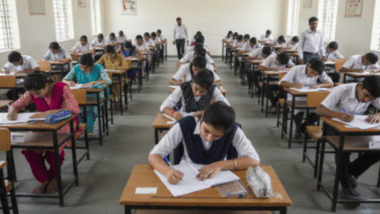
 ICSE Environmental Science Exam 2026 LIVE
ICSE Environmental Science Exam 2026 LIVE : The Indian Certificate of Secondary Education will conduct ICSE Environmental Science Exam 2026 on March 30, from 11 AM to 1 PM. Since only a day is remaining for the test, candidates can check out the important questions and last-minute priority topics, with short notes on the page below to fine-tune their preparation for the examination. Additionally, an overview of the exam has also been provided to help candidates understand what kind of questions they can expect in the test.
ICSE Environmental Science Exam 2026: Quick Facts
The following table displays the quick facts pertaining to ICSE Environmental Science Exam 2026:
Particulars | Details |
|---|---|
Name of the Exam | Indian Certificate of Secondary Education (ICSE) Class 10 |
Conducting Body | Council for the Indian School Certificate Examinations (CISCE) |
Exam Mode | Offline (Pen and Paper) |
Exam Date | March 30, 2026 |
Exam Time | 11 AM to 1 PM |
Question Paper Type | Objective (MCQs) and Subjective (Short & Long Answers) |
Total Number of Questions | Approximately 10–12 main questions (Section A: Compulsory; Section B: Choice-based) |
Section-Wise Questions |
|
Total Marks | 100 Marks (80 Theory + 20 Internal) |
Section-Wise Marks |
|
Negative Marking | No negative marking |
Stay tuned to LIVE Blog for more updates on ICSE Environmental Science Exam 2026 important questions, last-minute priority topics with short notes.
ICSE Environmental Science Exam 2026 LIVE
01 00 PM IST - 30 Mar'26
Exam Has Concluded
The examination has concluded. Candidates are coming out of the exam hall. The student feedback will be shared on the page shortly, as soon as we collect them. Along with it, the unofficial answer key will also be provided for the objective questions, upon receiving the question paper from the test-takers. Stay tuned!
12 00 PM IST - 30 Mar'26
1 Hour Left
Only 1 hour is left for the exam to conclude. Candidates are answering the second part of the question paper.
11 00 AM IST - 30 Mar'26
ICSE Environmental Science Exam 2026: Exam Has Started
The ICSE Board has started the ICSE Environmental Science Exam 2026 at 11 AM today. The examination will get over at 1 PM.
10 00 AM IST - 30 Mar'26
Reporting Time
Candidates are reporting to the exam venue with their admit cards for pre-verification processes. Invigilators are scanning the admit card, and allowing the eligible students to take seats in the exam hall.
09 00 AM IST - 30 Mar'26
ICSE Environmental Science Exam 2026: Short Notes on The Montreal Protocol (1987)
A global agreement designed to protect the ozone layer by phasing out the production of substances like CFCs.
08 00 AM IST - 30 Mar'26
Short Notes on Electrostatics Precipitators
Devices used in industries to remove dust and smoke particles from exhaust gases using electrical energy.
07 00 AM IST - 30 Mar'26
ICSE Environmental Science Exam 2026: Important Topic 17 to Revise
Sustainable Cities
Characteristics of a green city: efficient transport, waste management, and energy use.
06 00 AM IST - 30 Mar'26
Important QnA 17
Question: What is 'Sustainable Development'?
Answer: Development that meets the needs of the present without compromising the ability of future generations to meet their own needs.
05 00 AM IST - 30 Mar'26
ICSE Board Environmental Science Exam 2026: Short Notes on Biomagnification
The increasing concentration of toxic substances (like DDT or Mercury) in the tissues of organisms at higher levels in a food chain.
04 00 AM IST - 30 Mar'26
Important Topic 16 to Revise
Remote Sensing
Use of satellite imagery in monitoring deforestation, floods, and droughts.
03 00 AM IST - 30 Mar'26
ICSE Board Environmental Science Exam 2026: Important QnA 16
Question: Explain the 'Greenhouse Effect'.
Answer: It is the process by which radiation from the earth's atmosphere warms the planet's surface to a temperature above what it would be without its atmosphere.
02 00 AM IST - 30 Mar'26
Short Notes on Leachate
The toxic liquid that drains or "leaches" from a landfill, potentially contaminating groundwater if not managed properly.
01 00 AM IST - 30 Mar'26
ICSE Board Environmental Science Exam 2026: Important Topic 15 to Revise
Land Reforms in India
Measures taken to distribute land to the landless and its environmental impact.
12 00 AM IST - 30 Mar'26
Exam Today
ICSE Board will conduct ICSE Class 10 Environmental Science Group II Elective Exam 2026 today, March 29, from 11 AM to 1 PM. The examination will be held in offline mode.
11 00 PM IST - 29 Mar'26
ICSE Board Class 10 Environmental Science Group II Elective Exam 2026: Important QnA 15
Question: Mention the '4 Rs' of waste management.
Answer: Refuse, Reduce, Reuse, and Recycle.
10 00 PM IST - 29 Mar'26
Short Notes on Eutrophication
The process where water bodies become overly enriched with nutrients (nitrates/phosphates), leading to excessive algae growth and oxygen depletion.
09 00 PM IST - 29 Mar'26
ICSE Board Class 10 Environmental Science Group II Elective Exam 2026: Important Topic 14 to Revise
Alternative Technology
Examples like Solar energy or Electric Vehicles (EVs) as substitutes for fossil fuels.
08 00 PM IST - 29 Mar'26
Important QnA 14
Question: What is 'Vermiculture'?
Answer: The process of using earthworms to decompose organic waste into nutrient-rich manure (vermicompost).
07 00 PM IST - 29 Mar'26
ICSE Board Class 10 Environmental Science Group II Elective Exam 2026: Short Notes on Wildlife Corridors
Strips of natural habitat that connect fragmented populations of wildlife, allowing animals to migrate and maintain genetic diversity.
06 00 PM IST - 29 Mar'26
Important Topic 13 to Revise
Debt Trap
How international debt affects the environment in developing countries (exploitation of resources).
05 00 PM IST - 29 Mar'26
ICSE Board Class 10 Environmental Science Exam 2026: Important QnA 13
Question: Define 'Bioremediation'.
Answer: The use of microorganisms (bacteria/fungi) to consume and break down environmental pollutants, like oil spills or contaminated groundwater.
04 40 PM IST - 29 Mar'26
Short Notes on Endemic Species
Species that are native to and restricted to a specific geographical area (e.g., the Lion-tailed Macaque in the Western Ghats).
04 20 PM IST - 29 Mar'26
ICSE Board Class 10 Environmental Science Exam 2026: Important Topic 12 to Revise
Project Tiger (1973)
A frequently asked national conservation strategy. Focus on its objectives and success.
04 00 PM IST - 29 Mar'26
Important QnA 12
Question: Name the international treaty signed in 1971 to protect wetlands.
Answer: The Ramsar Convention.
03 40 PM IST - 29 Mar'26
ICSE Board Class 10 Environmental Science Exam 2026: Short Notes on Wetlands
Areas where water covers the soil, such as marshes and swamps. They act as "nature’s kidneys" by filtering pollutants and preventing floods.
03 20 PM IST - 29 Mar'26
Important Topic 11 to Revise
Vermiculture
The process of composting using specific earthworm species to create organic manure.
03 00 PM IST - 29 Mar'26
ICSE Board Class 10 Environmental Science Group II Elective Exam 2026: Important QnA 11
Question: What is the significance of the 'Red Data Book'?
Answer: It is a public document established by the IUCN for recording rare and endangered species of animals, plants, and fungi.
02 40 PM IST - 29 Mar'26
Short Notes on Gene Banks
Facilities that preserve genetic material (seeds, pollen, or tissue) at very low temperatures to protect against the extinction of plant species.
02 20 PM IST - 29 Mar'26
ICSE Board Class 10 Environmental Science Group II Elective Exam 2026: Important Topic 10 to Revise
Greenhouse Effect
Be ready to explain the mechanism and identify primary greenhouse gases (CO2, CH4).
02 00 PM IST - 29 Mar'26
Important QnA 10
Question: Differentiate between In-situ and Ex-situ conservation.
Answer: In-situ is conservation of species in their natural habitat (e.g., National Parks). Ex-situ is conservation outside their natural habitat (e.g., Zoological Parks, Gene Banks).
01 40 PM IST - 29 Mar'26
ICSE Board Class 10 Environmental Science Group II Elective Exam 2026: Short Notes on Social Forestry
The management and protection of forests with the involvement of local communities to meet their fuel, fodder, and timber needs.
01 20 PM IST - 29 Mar'26
Important Topic 9 to Revise
Counter-Urbanization
Reasons why people move back to rural areas (pollution, high cost of living).
01 00 PM IST - 29 Mar'26
ICSE Board Class 10 Environmental Science Exam 2026: Important QnA 9
Question: Define 'Trickle Drip Irrigation'.
Answer: A system that delivers water directly to the base of the plant through a network of valves and pipes, minimizing water wastage.
12 40 PM IST - 29 Mar'26
Short Notes on Drip-Irrigation
A water-conserving method where water is delivered slowly and directly to the root zone of plants through a network of pipes and emitters.
12 20 PM IST - 29 Mar'26
ICSE Board Class 10 Environmental Science Exam 2026: Important Topic 8 to Revise
MNCs & Environment
Focus on the Bhopal Gas Tragedy case study and regulatory measures for MNCs.
12 00 PM IST - 29 Mar'26
Important QnA 8
Question: State one advantage and one disadvantage of HYV (High Yielding Variety) seeds.
Answer: Advantage: Significantly increases crop yield. Disadvantage: Requires heavy use of chemical fertilizers and abundant water.
11 40 AM IST - 29 Mar'26
ICSE 10th Environmental Science Group II Elective Exam 2026: Short Notes on Integrated Pest Management
An eco-friendly approach to controlling pests that combines biological, cultural, and chemical tools while minimizing environmental risk.
11 20 AM IST - 29 Mar'26
Important Topic 7 to Revise
Bioremediation
The use of microbes to treat contaminated soil or water (e.g., oil spills).
11 00 AM IST - 29 Mar'26
ICSE 10th Environmental Science Group II Elective Exam 2026: Important QnA 7
Question: What is 'Integrated Pest Management' (IPM)?
Answer: An ecosystem-based strategy that focuses on long-term prevention of pests through a combination of techniques such as biological control, habitat manipulation, and use of resistant varieties.
10 40 AM IST - 29 Mar'26
Short Notes on Green Revolution
A period of intense agricultural growth in India (starting in the 1960s) using HYV seeds, chemical fertilizers, and controlled irrigation.
10 20 AM IST - 29 Mar'26
ICSE 10th Environmental Science Group II Elective Exam 2026: Important Topic 6 to Revise
Trickle Drip Irrigation
Explain how this system saves water and its operational advantages in dry farming.
10 00 AM IST - 29 Mar'26
Important QnA 6
Question: List two objectives of 'Integrated Rural Development'.
Answer: (1) To provide employment opportunities to the rural poor. (2) To improve rural infrastructure like water supply and sanitation.
09 40 AM IST - 29 Mar'26
ICSE 10th Environmental Science Exam 2026: Short Notes on Debt-for-Nature Swaps
A financial mechanism where a portion of a developing nation's foreign debt is forgiven in exchange for local investments in environmental conservation.
09 20 AM IST - 29 Mar'26
Important Topic 5 to Revise
The Montreal Protocol
Key details: Year (1987), objective (Ozone layer protection), and CFC reduction.
09 00 AM IST - 29 Mar'26
ICSE 10th Environmental Science Exam 2026: Important QnA 5
Question: What are 'Windbreaks'?
Answer: Rows of trees or shrubs planted to provide shelter from the wind and to protect soil from erosion.
08 40 AM IST - 29 Mar'26
Short Notes on Slums
Squatter settlements characterized by substandard housing, lack of basic amenities (water/sanitation), and high population density.
08 20 AM IST - 29 Mar'26
ICSE 10th Environmental Science Exam 2026: Important Topic 4 to Revise
In-situ vs. Ex-situ
Differentiate between National Parks (In-situ) and Gene Banks/Zoological Parks (Ex-situ).
08 00 AM IST - 29 Mar'26
Important QnA 4
Question: Distinguish between 'Contour Ploughing' and 'Terracing'.
Answer: Contour ploughing involves farming across a slope following its elevation lines to slow water runoff. Terracing involves carving "steps" into steep slopes to create flat areas for farming and prevent soil erosion.
07 40 AM IST - 29 Mar'26
ICSE Class 10 Environmental Science Group II Elective Exam 2026: Short Notes on Satellite Towns
Smaller municipalities that are adjacent to a major city but are self-contained. They help de-congest the main "mother city."
07 20 AM IST - 29 Mar'26
Important Topic 3 to Revise
Integrated Pest Management
A high-priority topic. Focus on its aims, advantages, and biological control methods.
07 00 AM IST - 29 Mar'26
ICSE Class 10 Environmental Science Group II Elective Exam 2026: Important QnA 3
Question: What is 'Counter-urbanization'?
Answer: It is a demographic process where people move from urban areas to rural areas, often to escape pollution and congestion.
06 40 AM IST - 29 Mar'26
Short Notes on Counter-Urbanization
A process where people move from large cities to smaller towns or rural areas to avoid congestion and pollution.
06 20 AM IST - 29 Mar'26
ICSE Class 10 Environmental Science Group II Elective Exam 2026: Important Topic 2 to Revise
Secondary Cities
Understanding the role of satellite towns in reducing the burden on Tier-1 metros.
06 00 AM IST - 29 Mar'26
Important QnA 2
Question: State two ways private enterprises can help in improving cities.
Answer: (1) Investing in sustainable infrastructure (e.g., green buildings). (2) Participating in Waste Management through Corporate Social Responsibility (CSR).
05 40 AM IST - 29 Mar'26
ICSE Class 10 Environmental Science Exam 2026: Short Notes on Exodus
The mass movement of rural populations to urban areas, usually driven by "push factors" like poverty or "pull factors" like better jobs.
05 20 AM IST - 29 Mar'26
Important Topic 1 to Revise
Zoning Strategy
Learn how land-use planning (industrial vs. residential) reduces air pollution.
05 00 AM IST - 29 Mar'26
ICSE Class 10 Environmental Science Exam 2026: Important QnA 1
Question: Define 'Exodus' in the context of rural-urban migration.
Answer: It refers to the mass departure of people from rural areas to urban centers in search of better employment, education, and healthcare.


