
- We’re on your favourite socials!


 Chandrapur (Maharashtra)

Related News

KEAM 2026 Expected Good Score for B.Tech Admission
You have just finished your KEAM 2026 exam and you are frantically attempting to determine whether you have the score to be able to get admission in B.Tech. You are not the only one with this question in mind. It is truly one of the most searched questions immediately after the exam - and the answer to this question does not depend on a single number. The score in KEAM 2026 exam, your Class 12 marks, category and the branch you are aiming all contribute to your landing point. Let us understand this in detail.
Related Articles:

KEAM 2026 April 19 Question Paper with Answer Key
Minutes after the exam is over, we are sure that you must be wanting to cross check all the answers to make sure that you score well. To calm your post exam anxiety, we will be mentioning the KEAM 2026 April 19 question paper with answer key soon after the paper's conclusion. Going through this article will help you not only in matching your answers with those mentioned here, but also in getting an estimate of your exam. Know that the answer key provided on this page will be tentative. The CEE KEAM 2026 official answer key will be released soon after the exam is over.

BITSAT 2026 Session 2 Applications Open April 20: Did Not Score Well in Session 1? Apply Again
BITSAT 2026 Session 2 Registration: The online submission of applications for Birla Institute of Technology and Science Admission Test (BITSAT) 2026 Session 2 will be open from April 20, a crucial second opportunity for BITS aspirants seeking admission into undergraduate programmes in BITS campuses. Candidates who are not satisfied with their performance in Session 1 — or those who missed applying earlier, can also apply again for Session 2. Most importantly, candidates appearing for both sessions will have their best score considered for admission, which means there is absolutely no loss to those who give both sessions.
Also Check | BITSAT 2026 Cutoff Analysis: Course-wise Cutoff Marks

AP POLYCET Hall Tickets 2026 Download Link Activated @polycetap.ap.gov.in
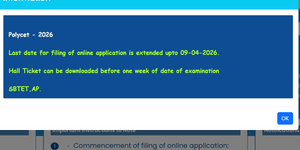
AP POLYCET Hall Tickets 2026: The download link for AP POLYCET 2026 Hall tickets has been activated by the State Board of Technical Education and Training, Andhra Pradesh. Registered candidates can download the halla tickets on the official website. The AP POLYCET (Andhra Pradesh Polytechnic Common Entrance Test) is a state-level entrance test conducted for admission into the diploma courses in any branches of Engineering and Non-Engineering in all polytechnic Institutions across the State. The Examination will take place on April 25, 2026, in offline mode. Candidates must carry their hall tickets to the examination centre.

What to Expect for 2,00,000 Rank in JEE Main 2026?
A 2,00,000 rank in JEE Main 2026 typically translates to a percentile ranging from 86 - 86.65+ and 84 - 86.75 marks. This performance does not suffice for admission to the top tier NITs/ IIITs, however, you still can secure admission to the newer NITs, lower tier GFTIs, or state level engineering colleges. If you are targeting the GFTIs for 2,00,000 rank in India, then it is possible at Assam University, SLIET Longowal, JK Institute, etc. This guide walks you through the expected JEE Main 2,00,000 rank percentile, probable colleges for such rank, and more.
Top Courses at Shri Sai College of Engineering & Technology
Related Questions
Admission Updates for 2026
Sanjay Ghodawat University
Kolhapur (Maharashtra)
Jawaharlal Darda Institute of Engineering and Technology
Yavatmal (Maharashtra)
Alard University
Pune (Maharashtra)
MIT ADT University
Pune (Maharashtra)
NIT's Late Annasaheb Patil Polytechnic College
Nashik (Maharashtra)
Related News







Similar Colleges














Explore More Engineering Colleges in Maharashtra
By Degree
By Specialization

