
- We’re on your favourite socials!


 Popular
 Gurgaon (Haryana)
 Gallery

GD Goenka University Launches Clinical Psychology Programmes with Fortis
GD Goenka University has partnered with Fortis Healthcare to launch a suite of Clinical Psychology programmes under its School of Liberal Arts. These include the two-year full-time MA in Clinical Psychology (conditionally approved by the Rehabilitation Council of India), a one-year Professional Diploma in Clinical Psychology (PDCP), and a four-year B.Sc. (Hons.) Clinical Psychology – both subject to RCI approval. These programmes are designed to address India’s critical shortage of trained mental health professionals. As per the Indian Journal of Psychiatry, India has only 0.7 mental health professionals per 100,000 people. GD Goenka aims to bridge this gap by combining academic learning with structured clinical training through Fortis’ mental health units. Structured in line with RCI guidelines, the programmes offer hands-on training in psychological assessment, therapeutic techniques, and interdisciplinary care. Fortis Healthcare, one of India’s leading tertiary care providers, will serve as the official clinical training partner, offering students practical exposure in real-world settings.
“We are proud to launch these Clinical Psychology programmes, which align academic rigor with real-world application,” said Mr. Nipun Goenka, Managing Director, GD Goenka Group. “This initiative reflects our vision to develop ethical, empathetic, and globally competent mental health professionals.” Dr. Anjali Midha, Dean of the School of Liberal Arts, added, “Our partnership with Fortis Healthcare comes at a crucial time when psychological services are in growing demand. Students will gain not just theoretical knowledge but also practical skills to address mental health challenges in diverse environments.”
The MA Clinical Psychology programme covers topics such as psychopathology, assessments, therapeutic practices, and clinical case handling. Eligible applicants must hold a four-year undergraduate degree in Psychology (55% marks minimum) or have completed a bridge year after a three-year programme. Selection is through an entrance test (70%) and personal interview (30%). Graduates can pursue roles like Clinical Psychologist (RCI-registered), Mental Health Consultant, Researcher, or Rehabilitation Specialist. The Professional Diploma in Clinical Psychology (PDCP) is a one-year intensive training course for postgraduates in Psychology (Clinical, Counselling, or Applied). Admission involves an entrance test, practical exam, group discussion, and interview. Upon completion, graduates can work as Associate Clinical Psychologists under supervision, school counsellors, or community mental health practitioners.
The B.Sc. (Hons.) Clinical Psychology is a four-year undergraduate programme designed to give students early exposure to clinical settings. Applicants must have completed 10+2 in the science stream. Admission is based on an entrance test and interview. Graduates may work as Clinical Assistants, Mental Health Coordinators, Psycho-social Support Workers, or research assistants. By blending academic leadership with Fortis’ clinical excellence, GD Goenka University aims to train future-ready professionals prepared to raise the standard of mental health care across India’s clinical, academic, and community landscapes.
GD Goenka University and Paras Health Launch B.Sc. Nursing Programme
GD Goenka University, in collaboration with Paras Health, has announced the launch of a four-year, full-time B.Sc. Nursing programme under its School of Healthcare and Allied Sciences. The programme is structured in accordance with the guidelines of the Haryana Nurses and Nurse-Midwives Council (HNC) and is designed to offer a hybrid learning approach that combines theoretical instruction with practical clinical training. Paras Health, a tertiary care provider with over 18 years of experience and a widespread network across North India, will serve as the clinical training partner, offering students hands-on experience across various medical specialties.
The B.Sc. Nursing programme will span eight semesters and include a balanced mix of foundational, core, and elective courses. Students will receive exposure to real-world clinical settings through Paras Health’s hospital network. Eligibility criteria require applicants to be a minimum of 17 years old as of December 31 of the admission year and to have completed 10+2 with Science (Physics, Chemistry, Biology) and English, securing at least 45% aggregate marks from a recognised board such as AISSCE, CBSE, ICSE, SSCE, HSCE, or equivalent. Candidates from the National Institute of Open Schooling (NIOS) are also eligible, provided they meet the academic and medical fitness requirements. Graduates of the programme will be equipped to pursue careers in hospitals, clinics, community health centres, nursing homes, corporate healthcare settings, pharmaceutical companies, and academic institutions. The programme also offers pathways to specialisations in pediatrics, mental health, critical care, and oncology, as well as further studies such as a Master of Science in Nursing (MSN) or Doctor of Nursing Practice (DNP).
Related News

TG PGECET 2026 Response Sheet likely by first week of June
TG PGECET 2026: The TG PGECET 2026 examinations would come to an end by June 1, 2026, with the completion of the remaining science subjects examinations. Following the previous years' pattern, it takes about four to five days from the end of the examination for the authority to announce the response sheet and provisional answer key. The TG PGECET 2026 response sheet is thus expected to be announced during the first week of June on the official website of TG PGECET.

KCET Result 2026 likely to be released before June 6: KEA hints possibility of declaring results after June 1
KCET Result 2026: The Karnataka Examinations Authority (KEA), in one of its latest tweets on its official X (formerly Twitter) page, has indicated that the KCET result 2026 might be announced only after June 1, 2026, which will be after the conduct of the Agriculture & Veterinary Practical examination in Hiriyur Centre. According to the latest development, the KEA will declare the KCET/UGCET result 2026 before June 6, 2026.
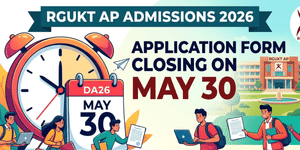
RGUKT AP Application Form 2026 Closing on May 30: Date extension unlikely; Apply now
RGUKT AP Application Form 2026: Rajiv Gandhi University of Knowledge Technologies Andhra Pradesh (RGUKT AP) has reconfirmed that the online application process for the UG admissions of 2026 will have to be submitted by May 30, 2026, by 5 PM. Students who wish to apply for the six-year B.Tech program should get their applications ready at the earliest, as chances of a deadline extension appear highly unlikely.

Calicut University PGCAP Registration 2026 to Close on May 29: Final chance to apply for PG admission
CU PGCAP Registration 2026: University of Calicut will end the registration process for PGCAP 2026 admissions on, May 29, 2026. PGCAP stands for Post Graduate Centralised Admission Process 2026, and is being conducted for admissions to different PG courses offered by Arts and Science colleges under the umbrella of the university. The process of admitting students to these colleges will take place via the Centralised Admission Process (CAP).

AP EAMCET Results 2026 Postponed: Check Revised Date & Important Details
AP EAMCET Results 2026: APSCHE (Andhra Pradesh State Council of Higher Education) has officially decided to delay the declaration of results of AP EAMCET/ AP EAPCET 2026. While the results were expected to come out by June 1, the decision has been made that the results shall be declared after June 18, 2026, upon completion of the Intermediate Supplementary & Improvement examinations evaluation.
Top Courses at GD Goenka University
Related Questions
Dear Sorab Kumar,
Check the admission criteria and requirements of the specific institution or program you are interested in to see if you are eligible for a diploma in clinical pathology.
Individuals with a Bachelor's degree in Medical Laboratory Technology (MLT) or a comparable subject are typically eligible for clinical pathology diploma programs. You may meet the educational criteria for various clinical pathology diploma programs if you hold a B.Sc. MLT from GD Goenka University. It is, however, critical to confirm this with the specific institution or college that offers the diploma program.
To acquire accurate and up-to-date information on eligibility requirements and application procedures, contact the admissions office or visit the official website of the institution providing the diploma in clinical pathology.
I hope this was helpful!
If you have any further queries or questions, please contact us.
Dear Sorab Kumar,
To determine your eligibility for a diploma in clinical pathology, you should check the admission criteria and requirements of the specific institution or program you are interested in. Typically, diploma programs in clinical pathology are designed for individuals who have completed a Bachelor's degree in Medical Laboratory Technology (MLT) or a related field. Since you have completed a B.Sc. MLT from GD Goenka University, you may meet the educational requirements for some diploma programs in clinical pathology. However, it is crucial to verify this with the specific institution or college offering the diploma program. Contact the admissions office or visit the official website of the institution offering the diploma in clinical pathology to get accurate and up-to-date information on eligibility requirements, and application procedures.
I hope this helps!
If you have more queries or questions, we would be happy to help.
Dear Khushi Gupta,
GD Goenka University BBA in Marketing fee structure is Rs 2,60,000 and the faculties are quite good. For other questions, we will reach you soon.
I hope this was helpful!
If you have any further queries or questions, please contact us.

Similar Colleges


Explore More Engineering Colleges in Haryana
- By State
- By City
By Degree
By Specialization
By Degree
By Specialization

