


The central caste list 2025 is broadly classified into Scheduled Castes (SC), Scheduled Tribes (ST), Other Backward Classes (OBC), Economically Weaker Sections (EWS) and the General / Forward category. You can have detailed information about the category list state wise.
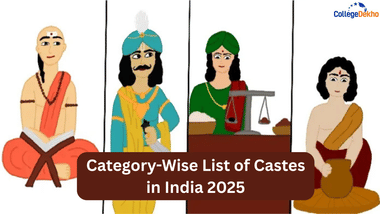
The social dynamics of categorisation in view of public policy and decision making has been constantly evolving. Though being a complex affair, the Ministry of Social Justice & Empowerment and Ministry of Tribal Affairs publish the Category Wise Central List 2025 for SC and ST. For the OBC category the National Commission for Backward Classes maintains the list. You can check this article for detailed information about the state wise caste list 2025.
Also Read: OBC Caste List in UP
Central Caste List 2025
You can check the list for SC, ST and OBC categories divided state wise from the below table.
Category | Central List Category Wise |
|---|---|
SC | |
ST | |
OBC |
Summary of SC, ST and OBC
Lets check who comes under SC, ST and OBC list.
- Scheduled Castes - The SC list is published by the Ministry of Social Justice & Empowerment. This list consists of communities identified by the Constitution of India as historically subjected to untouchability and social exclusion.
- Scheduled Tribes - This community is identified indigenous groups or the tribal groups. The central list for the STs is prepared by the Ministry of Tribal Affairs.
- Other Backward Classes - This community as identified by the Constitution of India are mainly the socially backward groups and the educationally backward groups. The central OBC list is prepared by the National Commission for Backward Classes.
You can check the below table for detailed information and the comparison among the various categories as mentioned in the Central List.
Category | Purpose | Examples |
|---|---|---|
Scheduled Castes | Castes recognized in the Constitution (via Presidential Orders) as historically disadvantaged, eligible for reservations in jobs, education, etc. | The Constitution (Scheduled Castes) Order, 1950 (as amended) lists over 1,109 castes across the states. Examples include Adi Andhra, Adi Dravida, Chamar, Mahar, Holeya, Dom, etc |
Scheduled Tribes | Indigenous / tribal communities recognized as disadvantaged and eligible for affirmative action. | The ST lists are maintained state-wise and include many indigenous groups (e.g. Gonds, Bhils, Santhals, etc.) |
Other Backward Classes | Castes / communities considered socially and educationally backward (but not SC/ST), eligible for a portion of reservations | Each State (and the central government) maintains a list of OBCs. E.g., in Bihar, Yadav, Kurmi, Koeri, etc. are common OBCs. |
Legal Framework for Caste Categorisation
You must check the legal framework behind the categorisation.
Caste | Details |
|---|---|
Scheduled Castes and Scheduled Tribes | Defined by Articles 341 and 342 of the Constitution. The Union government maintains central lists of SCs and STs (and states may have separate lists for state-level benefits). The Ministry of Social Justice & Empowerment (for SCs) and the Ministry of Tribal Affairs (for STs) publish the central lists and notifications. |
Other Backward Classes | The National Commission for Backward Classes (NCBC) maintains the central list of OBCs (which is what applies for central government jobs and centrally-funded institutions). States maintain their own OBC lists for state jobs/colleges; a community may be on a state OBC list but not on the central OBC list (this difference matters for central recruitment/admissions). |
Economically Weaker Sections | Created by the 103rd Constitutional Amendment (2019) and implemented by government orders, EWS provides up to 10% reservation to persons who are not SC/ST/OBC and meet specified economic/asset criteria. Central rules and DoPT/Ministry of Social Justice OM/circulars set the operational details for central services. |
How Castes in India are included in the Central List
The inclusion of caste is a diversified process. You must know the legal process behind this inclusion.
Particulars | Details |
|---|---|
Constitutional Basis |
|
Role of State Governments |
|
Legislative Action |
|
Separate Lists for States and Centre | A caste may be recognized as OBC or SC/ST in a particular state but not necessarily in the Central List. This means that a community might receive benefits under State Government schemes, but not under Central Government programs, unless it appears in the Central List. |
The Category Wise Central List is an ongoing commitment of the government to promote social equality, social justice and inclusiveness. Through this representation these communities are able to get fair access to educational institutes, employment opportunities and governance.















Similar Articles
Indian Navy Posts for Class 10 and Class 12 Students: Eligibility Criteria, Application Process and Selection Process
CBSE Class 12 Re-Evaluation 2026 (Application Opens May 19): Fees Slashed, OSM Backlash & Refund Policy
AP Inter Supplementary Exams 2026: Dates (Out), Application Fee, Hall Ticket, Results
Can I do B.Arch after 12th Arts/Commerce?
Stream-Wise Expected CUET UG 2026 Cutoffs for Top DU Colleges
Top Central Universities with Low CUET Cutoffs for 2026 Admissions