



Both CTET and Super TET (commonly referred to as UPTET) share a common purpose: evaluating whether candidates are qualified and suitable for government teaching positions. However, the main difference between Super TET and CTET lies in their scope - CTET is conducted to recruit teachers for central government schools at elementary and middle school levels, whereas Super TET is specifically designed for hiring teachers in Uttar Pradesh state government schools.
The
CTET certificate
as well as the Super TET certificate stays valid for lifetime, from when it's issued, giving candidates enough time to build their teaching careers within these periods. This article will examine the major differences between CTET and Super TET to help you decide which examination best matches your professional goals.
Also Read:
Comparison Between Super TET and CTET: Key Points
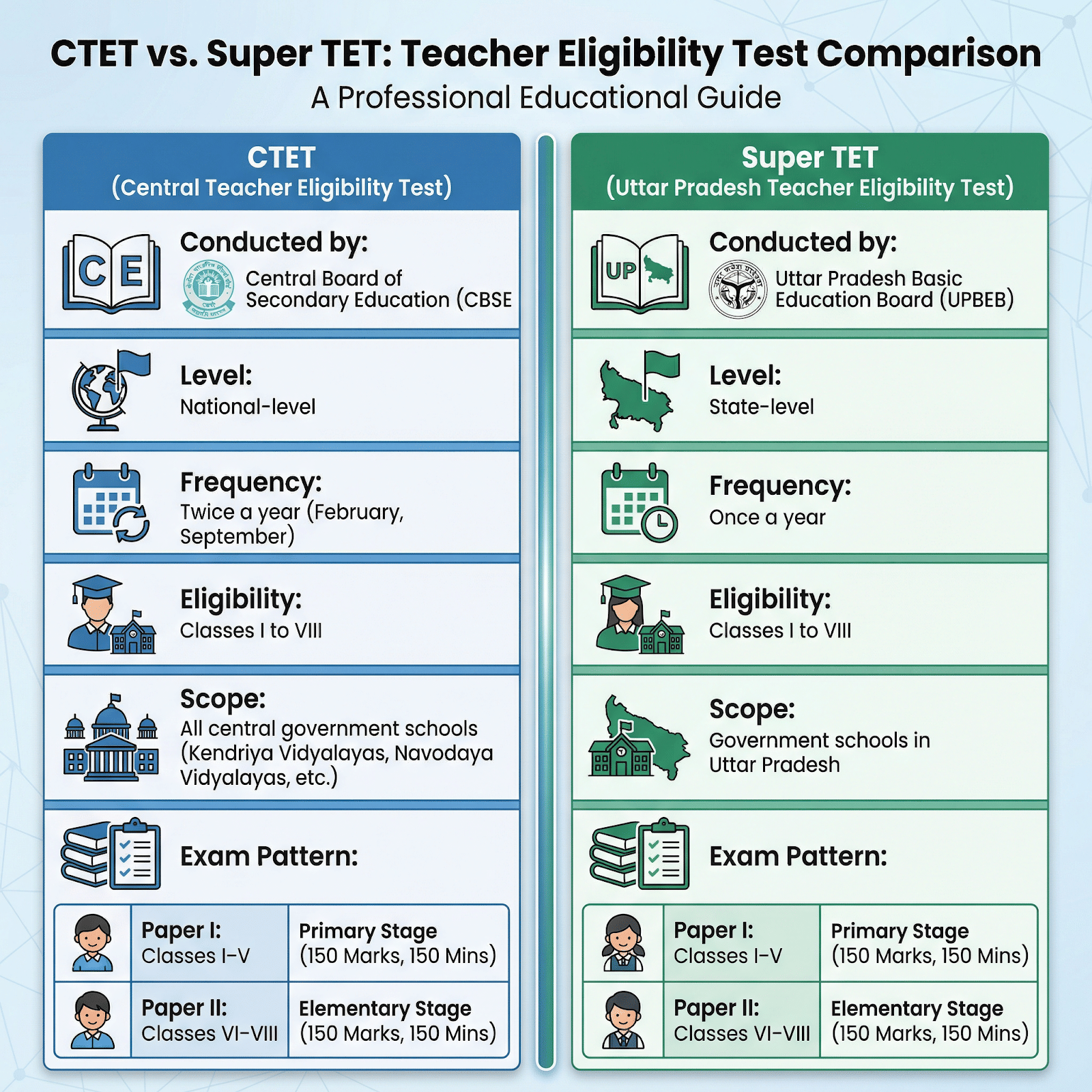
The broader difference between Super TET and CTET is highlighted below:
Eligibility Criteria & Age Limit for Super TET and CTET:
The most significant difference between the prerequisites for Super TET and CTET eligibility is the type of educational background required.
CTET Eligibility Criteria
- Candidates aiming to appear for the CTET exam conducted for the Primary stage (Class I to V) must have passed Senior Secondary (10+2) examination with a minimum of 50% marks. Additionally, they must have obtained a Diploma in Elementary Education over a duration of 2 years.
- Candidates aiming to appear for the CTET exam conducted for the Elementary Stage (Class VI to VIII) must have a Graduation degree. In addition to this, they must have obtained a Bachelor’s of Education (B.Ed.) degree or must be in the first year of their B.Ed course.
- It must also be noted that there is no age limit to appear for the CTET examination.
CTET Age Limit: No age limit has been prescribed to appear for the CTET exam. However, candidates must be at least 18 years of age to become eligible to fill out the application form.
Super TET Eligibility Criteria
The type of educational qualification required for Super TET has been observed to differ from that of CTET. Additional requirements such as age limits, language proficiency, and domicile requirements specific to the state of Uttar Pradesh have also been observed.Candidates must have passed Class 12th with at least 50% marks (45% for reserved categories) and must possess any one of the following:
- A 2-year Diploma in Elementary Education (D.El.Ed/BTC)
- A 4-year Bachelor's Degree in Elementary Education (B.El.Ed)
- A 2-year Diploma in Education (Special Education)
- Bachelor's degree with at least 50% marks and B.Ed qualification
Super TET Age Limit: The minimum age limit is 21 years and the maximum age limit is 40 years to apply for the Super TET exam. Hence, a candidate can appear for the UPTET exam any number of times till he/she reaches the age of 40.
Also Read:
CTET Passing Marks 2024
Difference Between for Super TET and CTET
In order to apply for both Super TET and CTET through online mode, candidates need to visit the official website of UPTET and CTET, respectively. The application process for both Super TET and CTET involves filling out the online application form, uploading scanned images of the candidates’ photograph and signature, and payment of the application fee through online payment methods such as credit/debit cards, net banking, and UPI. Candidates who will successfully register for both exams will be able to download the admit cards a few weeks before the date of the examination.
However, the only difference lies in the fact that the exam fee for the CTET exam is typically higher than the fee for the Super TET exam. The exam fees for CTET are: for theGeneral/OBC candidates, Rs. 1000 for Paper I or Paper II (one paper) and Rs. 1200 for Both Papers (Paper I + Paper II). On the other hand, the exam fees for UPTET are INR 600 for General/OBC candidates and INR 400 for SC/ST/Differently Abled candidates.
Difference Between Super TET and CTET Syllabus and Exam Pattern
The syllabus for CTET and Super TET have been observed to be identical in terms of covering topics related to Child Development & Pedagogy, Teaching Methodology, Mathematics, Language I and II, Environmental Studies, and Social Studies/Science. Both The Super TET and CTET exams comprise two papers i.e. Paper I dealing with General Knowledge (common to all the subjects) and Paper II dealing with the concerned subject. Paper I is conducted for candidates aiming for the Primary stage (Class I to V) and Paper II is administered for recruitment of teachers in the Elementary Stage (Class VI to VIII). A total of 150 Multiple Choice Questions (MCQs) will be asked in both CTET and Super TET exams and the total duration of both exams is 2 hours and 30 minutes each. Each question carries one mark and there is no negative marking for incorrect answers.
However, it must be noted that CTET offers question papers in English, Hindi, and other regional languages according to the choice of the candidate. On the other hand, Super TET is administered only in the Hindi and English language. But it must be noted that proficiency in Hindi language is a mandate for candidates aspiring to become government teachers in Uttar Pradesh since teaching will be conducted in Hindi medium schools.
Also Read:
CTET Syllabus 2024
Super TET and CTETCertificate Validity
There is a major difference in the validity periods of the Super TET and CTET certificates. The CTET certificate is valid for lifetime from the date when it is issued and the results for all categories are announced. Thus, candidates who pass the CTET exam are eligible to apply for teaching positions in any state in India. To add to this, there is no restriction on the number of times a candidate can take the CTET exam.
On the other hand, the Super TET certificate is valid for lifetime from the date of issuance of the certificate. Additionally, the validity of the Super TET certificate is confined to the state of Uttar Pradesh. This implies that candidates who pass the Super TET exam become eligible to apply for teaching positions only within the state of Uttar Pradesh only.
Super TET vs CTET Career Opportunities
The geographical scope of opportunities serves as the main point of difference between CTET and Super TET. After qualifying the CTET exam, candidates receive a national-level eligibility certificate and become eligible to apply for teaching positions in central government schools in any state in India. A CTET qualification is also preferred by some state governments and private schools all across India during the recruitment of teachers, although it is not mandatory for them.
On the other hand, a state-level eligibility certificate that is only valid within the state of Uttar Pradesh is awarded to candidates who pass the Super TET exam. This implies that candidates who qualify the Super TET exam can apply for teaching positions only within the state of Uttar Pradesh. Nevertheless, Uttar Pradesh is one of the largest states in India and has an enormous number of private and government-run schools that provide Super TET certificate holders with a wide range of employment options.
Related Links:
CTET and Super TET are essential certification exams for aspiring government teachers. Although both exams share similarities in their eligibility criteria, course content, and registration procedures, there are notable differences between CTET and Super TET that applicants must understand before choosing which test to appear for.
According to my suggestion, candidates should carefully evaluate these distinctions based on their geographic preferences and career objectives. "Understanding the key differences helps aspirants make an informed choice that aligns with their long-term teaching goals," suggest career counselors in the education sector.
If you have any questions regarding the difference between Super TET and CTET, drop your queries in the CollegeDekho QnA section . Stay tuned to our page for more updates on CTET and Super TET!
FAQs
No maximum attempts are there in the CTET and Super TET exams. Candidates just need to be at least 18 years of age to become eligible to fill out the CTET application form, while candidates must be in the age group of 21 to 40 years to apply for the Super TET exam.
CTET and Super TET are conducted in a variety of languages. CTET is conducted in English, Hindi, and other regional languages according to the preference of the candidate. Contrastingly, Super TET is conducted only in the Hindi language, and candidates must be proficient in Hindi language to become government teachers in the state of Uttar Pradesh. Different administering authorities, regional focus, and target teaching levels are responsible for the differing languages in which CTET and TET are conducted.
The validity of the CTET and Super TET certificates are 7 years and 5 years, respectively. The CTET certificate is valid for a period of 7 years from the date when it is issued, which implies, candidates who pass the CTET exam are eligible to apply for teaching positions in any state in India for a period of 7 years. On the other hand, the Super TET certificate is valid for a period of 5 years from the date of issuance of the certificate only within the state of Uttar Pradesh.
The factors that determine CTET and Super TET cutoffs are the number of candidates who registered for the CTET and Super TET exam, number of candidates who appeared in the CTET and Super TET exam, the minimum qualifying marks for the CTET and Super TET exam, and the difficulty level of the papers.
CTET and Super TET marks are calculated taking into consideration the marks of the written exam and the scores of Class 10th/12th/Graduation. To prepare the CTET and Super TET merit lists, 60% weightage is given to the written exam marks and 10% weightage is given to scores obtained in Class 10th, 12th, graduation, or teacher training.
No, there is no negative marking in CTET and Super TET for incorrect answers. There are 150 multiple-choice questions (MCQs) in both Paper I & II each and each question carries one mark.
The salaries of CTET teachers and Super TET teachers range from INR 35,000-37,000 and INR 9300-34,800, respectively. A CTET-qualified teacher gets an in-hand salary of INR 43,000-46,000 at the upper-primary level, and INR 48,000-50,000 at the PGT level.
The difference between the eligibility of CTET and Super TET lies in the fact that the candidates must have obtained a Bachelor’s of Education (B.Ed.) degree to become eligible for the CTET exam, while they must have completed a Diploma in Elementary Education over a duration of 2 years or a Bachelor's Degree in Elementary Education (B.EI.Ed) over a duration of 4 years to become eligible for Super TET. It must also be noted that there is no age limit to appear for the CTET examination but it is mandatory that candidates must be between the ages of 21 and 40 years to be qualified for Super TET.
The primary difference between TET and CTET is that CTET is a more widely recognized exam than the Super TET exam. The CTET exam is conducted on a national-level to recruit teachers in the primary and upper primary levels in central government schools in any state in India. On the other hand, Super TET makes the candidates eligible for teaching positions only within the state of Uttar Pradesh.
In order to determine which is better, CTET or Super TET, candidates must understand which exam most closely aligns with their career aspirations. Qualifying the CTET opens up opportunities all across India in central government schools such as Kendriya Vidyalayas, Navodaya Vidyalayas, etc., while qualifying the Super TET exam will make you eligible for teaching positions only within the state of Uttar Pradesh.















Similar Articles
Jharkhand B.Ed Entrance Exam 2026: Admit Card, Exam Date, Answer Key, Result
Top Private Colleges to Target for 85-90 Percentile in MAH B.Ed CET 2026
90-92 Percentile in MAH B.Ed CET 2026: Top Colleges for General Category Students
Which B.Ed colleges accept 95+ percentile for general category in Maharashtra?
Top Colleges Accepting 95+ Percentile in MAH B.Ed CET 2026
Mumbai University MAH B.Ed CET 2026 Cutoff