


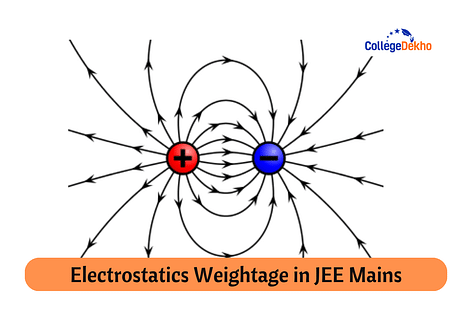
Electrostatics Weightage in JEE Main 2026: Aspirants who are preparing for the JEE Main 2026 to pursue an engineering degree must go through the weightage of electrostatics in the JEE Main exam, as it is one of the most important chapters from the JEE Main 2026 syllabus. The expected Electrostatics Weightage in JEE Main 2026 is 6.6% . Candidates can expect 3 to 5 questions to be directly asked from Electrostatics in the JEE Main 2026 . Aspirants can check the Electrostatics weightage in the JEE Main 2026 exam along with the important subtopics, questions asked in the previous session, and more in the article.
Electrostatics Weightage in JEE Main 2026
Aspirants preparing for the JEE Main 2026 exam can check the Electrostatics weightage in the JEE Main question papers along with the different topics in the table below:
Topics | Expected Weightage | Expected Number of Questions |
|---|---|---|
Electrostatics | 6.66% | 3 to 5 |
Thermodynamics | 15% | 4 to 5 |
Waves and sounds | 9% | 2 to 3 |
Laws of Motion | 9% | 3 to 4 |
Modern Physics | 9% | 2 to 3 |
EMI and AC | 15% | 4 to 5 |
Units and Dimensions and Errors and Measurements | 6% | 1 to 2 |
Current Electricity | 12% | 3 to 4 |
Kinematics | 3% | 0 to 1 |
Fluid Mechanics | 6% | 1 to 2 |
Optics | 12% | 3 to 4 |
COM and Rotational Mechanics | 18% | 5 to 6 |
MEC and Magnetism | 3% | 0 to 1 |
Waves and Sounds | 9% | 3 to 4 |
Also Read: JEE Main Application Form 2026
Electrostatics Weightage in Previous Year JEE Main Exam
The electrostatics chapter is one of the most important chapters in the JEE Main Physics Syllabus 2026, and it can be seen through the number of questions asked in the JEE Main exam. Check the number of questions asked from the electrostatics chapter in the JEE Main exam in the table below:
| Year |
Number of Questions
|
|---|---|
2024 | 3 |
2023 | 3 |
2022 | 3 |
2021 | 3 |
2020 | 4 |
2019 | 1 |
Topics with Maximum Weightage in Electrostatics for JEE Main 2026
Aspirants can check important subtopics for the Electrostatics chapter from the JEE Main 2026 exam below. It will benefit the candidates to prepare for the exam well and secure maximum marks in the JEE Mains 2026:
- Coulomb’s Law.
- Electric field and electric lines of force.
- Electric field due to continuous charge distribution.
- Electric dipole and dipole moment.
- Gauss Law.
- Electric potential and Equipotential surface.
- Electric potential due to the various charge distributions.
- The capacitance of a capacitor
Also Read: JEE Main 2026 Eligibility Criteria
Electrostatics Key Points for JEE Main 2026
It is very important to go through the key points for the electrostatics chapter for the JEE Main 2026. Checking the key points will help the aspirants understand the concepts that are important for the electrostatics chapter. The key points for electrostatics comprise topics like Coulomb’s law, Electric Charge, Electric Field, and more. Check the Key points for electrostatics below:
Coulomb’s Law
The force of attraction or repulsion between two charged bodies is directly proportional to the product of their charges and inversely proportional to the square of the distance between them. It acts along the line joining the two charges considered to be point charges.
- Coulomb’s First Law: Coulomb’s first law states that two charged particles of the same charge (positive or negative) will repel each other and two charged particles of opposite charges (one positive and one negative) will attract each other
- Coulomb’s Second Law: Coulomb’s second law states that the force of attraction or repulsion between two electrically charged particles is directly proportional to the product of magnitudes of two charges and inversely proportional to the square of the distance between two charges.
The Coulomb's law can be mathematically stated as

Where,
F = Force of attraction or repulsion between the charges
Q1, Q2= = magnitude of charge 1 and charge 2
d = Distance between two charges.
k = Constant whose value depends on the medium in which charges are placed.

Electric Charge: Conservation of Charge
Electric charge (symbol q, sometimes Q) is the physical property of matter that causes it to experience a force when placed in an electromagnetic field. Electric charge can be positive or negative. Like charges repel each other, and unlike charges attract each other. An object with no net charge is referred to as electrically neutral. Early knowledge of how charged substances interact is now called classical electrodynamics and is still accurate for problems that do not require consideration of quantum effects.
- S.I unit of charge is Coulomb (q)
- Positive Charge and Negative Charge
Also Read: JEE Main Exam Pattern 2026
Electric Field Due to Continuous Charge Distribution
When the charge is distributed uniformly over a conductor, it is known as a continuous charge distribution. In a continuous charge distribution, an infinite number of charges are closely packed together so that there is no space left between them. As a result, the load distribution is uninterrupted and flows continuously throughout the charging system, unlike the discrete charging system.
Three types of continuous charge distribution systems occur:
- Linear charge distribution
- Surface charge distribution
- Volume charge distribution
Also Read: JEE Main Admit Card 2026
Gauss Law
The flux of the electric field out of an arbitrary closed surface is proportional to the electric charge enclosed by the surface, irrespective of how that charge is distributed. Even though the law alone is insufficient to determine the electric field across a surface enclosing any charge distribution, this may be possible in cases where symmetry mandates uniformity of the field. Where no such symmetry exists, Gauss's law can be used in its differential form, which states that the divergence of the electric field is proportional to the local density of charge.
Best Books for Electrostatics JEE Mains 2025
Aspirants preparing for the exam can check the best books for JEE Main 2026 for the Electrostatics chapter below:
- Concepts of Physics (Vol. 1 & 2) by H.C. Verma
- Fundamentals of Physics By Halliday, Resnick & Walker
- Problems in General Physics by I.E Irodov
- Understanding physics by Freedman and Young
- Problems in physics by SS Krotov
- Problems and Solution of Physics by Shashi Bhushan Tiwari
Electrostatics Preparation Tips for JEE Main 2026
Aspirants preparing for the JEE main exam and covering the Electrostatics chapters must check the important JEE Main 2026 preparation tips so that they can secure maximum marks from the chapter:
- Go through the JEE main previous year question paper and check for repeated concepts in Electrostatics
- Solve as many numerical problems from the Electrostatics
- Memorise the laws stated in the Electrostatics with its SI unit and symbols
- Solve the chapter-wise mock test and manage the timings to solve the problems
Related Reads
We have provided the complete details for the Electrostatics Weightage in JEE Main 2026. We hope that the article is helpful to you in preparing for the JEE Main 2026. Stay tuned with CollegeDekho for the latest updates regarding the JEE Main 2026 exam. All the best for your exam!
















Similar Articles
Important Topics in GATE 2026 Electrical Engineering
Preparation Tips for GATE 2026 Verbal Ability and English Section
Can I get direct B.Tech admission in Amrita University?
JEE Mains 2026 Marks Calculator: What Your Score Could Mean
GATE 2026 IN Expected Marks vs Rank Analysis: Check Raw Score and Scaled Score Analysis
List of PSU Recruitment through GATE 2026