To crack UCEED in first attempt you need to first build a strong conceptual foundation, improve drawing practice on a daily basis, practice Part A smartly, analyse mock tests and finally develop a study plan.
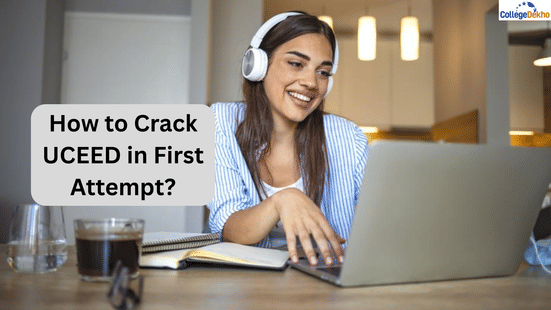
The UCEED exam conducted by IIT Bombay is not merely a test of your academic knowledge but also your creative ability, visualisation skills, logical reasoning and problem solving ability. The basic necessity required to clear the UCEED exam is to balance your artistic expression with analytical thinking. With the correct strategy it is quite possible to clear the UCEED 2026 exam. You must take note that the exam focuses more on spatial ability, design thinking, observation skills and lastly creativity level. Experts recommend that on a daily basis you must inculcate sketching, analyse day to day objects and practice reasoning questions. Moreover, originality matters in this exam and at the same time you need to perfectly blend it with a clear thought process and communicate your ideas visually and logically. You can check this article to know how to clear UCEED in first attempt.
Strategy to Crack UCEED in First Attempt
Check the tips below.
Tips
|
Details
|
|---|
Build Strong Conceptual Foundations
|
Focus Areas:
-
Spatial reasoning: Mirror images, rotations, paper folding
-
Logical reasoning: Patterns, sequences, cause-effect
-
Design sensitivity: Identifying good vs bad design
-
Observation skills: Spotting minute differences
-
Language & creativity: Unusual usage, word associations
|
Master Visualization and Drawing Skills for Part B
|
Even students with average drawing skills can score well if they focus on clarity of ideas.
What Examiners Look For:
-
Proportion & perspective
-
Neatness and line quality
-
Clear communication of ideas
-
Creativity with practicality
How to Improve:
-
Practice speed sketching (5–10 min per sketch)
-
Draw daily objects (chairs, bottles, streets, people)
-
Learn basic perspective rules
-
Practice storytelling through sketches
|
Solve Previous Year Question Papers
|
Strategy:
-
Solve at least last 10 years’ papers
-
Analyze:
-
Why your answer is wrong
-
What concept was tested
-
Redo incorrect questions after 7–10 days
|
Develop Speed, Accuracy, and Smart Guessing
|
Time pressure is a real challenge in UCEED.
Techniques:
-
Attempt NAT questions first (no negative marking)
-
Then move to MSQs
-
Attempt MCQs last (negative marking involved)
|
Strengthen Observation & Design Sensitivity
|
This section separates average students from top rankers.
Improve By:
-
Studying good and bad design examples
-
Understanding:
-
Ergonomics
-
User experience
-
Sustainability
-
Observing:
-
Road signs
-
Furniture
-
Mobile apps
-
Packaging designs
|
Improve Environmental & General Awareness
|
Focus on:
-
Everyday objects and their usage
-
Social problems & design solutions
-
Cultural symbols
-
Public spaces & systems
|
Also Read:
Is UCEED for Fashion Designing?
High Weightage Part A Topics
Check the important topics below.
General Topics
|
High Weightage Areas
|
|---|
Visualization & Spatial Ability
| -
3D rotation, mirror images
-
Paper folding & cutting
-
Perspective-based questions
|
Logical Reasoning
| -
Odd one out
-
Visual analogies
-
Situation-based logic
|
Pattern Recognition
| -
Shape progression
-
Color & symmetry patterns
-
Missing figure questions
|
Design Thinking
| -
User problems & solutions
-
Ergonomics & usability
-
Sustainable design ideas
|
Basic Mathematics
| -
Ratio, percentages
-
Time & work
-
Simple geometry
|
Observation & General Awareness
| -
Daily-life objects
-
Signages, tools, materials
-
Design in nature & surroundings
|
UCEED Part-B Sketching Practice List
Check the practice list here.
Practice List
|
Practice Topics
|
Key Note
|
|---|
One-Point Perspective
| -
Classroom with benches and a blackboard
-
Bedroom with bed, table, window, cupboard
-
Kitchen interior with shelves, utensils, stove
-
Corridor with doors and windows
-
Study room with chair, desk, bookshelf
| -
Correct vanishing point
-
Parallel lines converging properly
-
Size reduction with distance
-
Clean overlaps (near objects darker)
|
Two-Point Perspective
| -
Street corner with shops
-
House/building at an angle
-
Table, cupboard, refrigerator in perspective
-
Bus stop, tea stall, ATM kiosk
| -
Vertical lines remain vertical
-
Equal spacing logic
-
No distortion or bending
|
Human Figures
| -
Standing person (front, side, ¾ view)
-
Sitting on chair/bench
-
Walking / running
-
Bending, lifting, reaching
-
Group of 3–4 people interacting
| -
Adult: ~7.5 heads tall
-
Shoulder width ≈ 2 heads
-
Elbow at waist level
-
Knee halfway between hip and foot
|
Daily Indian Life Scenes
| -
Tea stall with customers
-
Railway platform
-
Bus interior
-
Street vendor selling vegetables
-
School classroom
-
Doctor’s clinic
-
Small grocery shop
| -
Activity clarity
-
Natural posture
-
Environment interaction
|
Product Sketching
| -
Chair (plastic, wooden, office)
-
Table / stool
-
Bottle (water, shampoo, thermos)
-
Bag (school, laptop, travel)
-
Shoes / sandals
-
Helmet
-
Mobile phone with earphones
| -
Use light construction lines
-
Show thickness (not flat outlines)
-
Ellipses must be symmetrical
|
Hands, Feet & Faces
| -
Hand holding cup, phone, pen
-
Pointing hand
-
Open palm
-
Feet in standing posture
-
Simple face expressions (happy, shocked, confused
| |
Story-Based Sketching
| -
A sudden rain changes the scene
-
An unexpected guest arrives
-
A problem and its solution
-
Before and after scenario
-
A day without electricity
| -
Clear focal point
-
Emotion / action
-
Logical situation
-
Supporting background
|
Object Transformation & Innovation
| -
Modify a chair for elderly
-
Design a bag for cyclists
-
Redesign a water bottle for kids
-
Convert an everyday object for emergency use
| |
Also Read:
UCEED Design Aptitude Question
Best Books for UCEED Preparation
You can follow the book list below.
Books
|
Authors
|
|---|
Quantitative Aptitude
|
R.S. Aggarwal
|
Verbal and Non‑Verbal Reasoning
|
R.S. Aggarwal
|
Analytical Reasoning, Mental & Verbal Aptitude
|
Institute Of Creative Sciences
|
UCEED Design Environment & Social Awareness + Mental & Verbal Aptitude
|
Srijan Shilpa
|
Cracking CEED & UCEED
|
Ashok Goel & Arjun Kamal
|
UCEED (B.Des) Entrance Books and Test Series
|
AFA India
|
Design of Everyday Things
|
Don Norman
|
Design Drawing
|
Francis D.K. Ching
|
Perspective Drawing Handbook
|
Joseph D’Amelio
|
















Similar Articles
NIFT Bhopal Cutoff Ranks 2026: Expected Cutoff with Previous Years' Trends
NIFT Bhubaneswar Cutoff Ranks 2026: Expected Cutoff with Previous Years' Trends
NIFT Chennai Cutoff Ranks 2026: Expected Cutoff with Previous Years' Trends
NIFT Delhi Cutoff Ranks 2026: Expected Cutoff with Previous Years' Trends
NIFT Gandhinagar Cutoff Ranks 2026: Expected Cutoff with Previous Years' Trends
NIFT Jodhpur Cutoff Ranks 2026: Expected Cutoff with Previous Years' Trends