



NIFT Exam 2026 Practice Sets for Permutations and Combinations: If you’re preparing for NIFT 2026 , then mastering permutation and combination questions for NIFT, understanding permutation and combination formulas for the NIFT exam, and solving NIFT quantitative ability practice problems are very crucial to boost your score in the GAT paper. These questions are asked to test how well you can think logically, count systematically, and arrange or select items efficiently under time pressure.
In this guide, you’ll explore every important detail about NIFT counting questions with solutions and learn how to solve permutation combinations for NIFT GAT with clarity. You’ll also find key formulas, examples, and mini practice sets that mirror the actual NIFT 2026 exam difficulty level, designed especially for design aspirants from non-mathematical backgrounds.
Why Permutations & Combinations Matter in NIFT Quant
In the NIFT GAT Quantitative Ability section, around 2–3 questions on permutations and combinations appear every year. These questions not only test mathematical reasoning but also evaluate your ability to analyse situations creatively, an essential skill for a designer.
Understanding how to arrange, select, or count possibilities helps you answer logical reasoning and probability-based arithmetic questions quickly. Since the NIFT GAT Quant syllabus focuses on reasoning over rote calculation, mastering permutation combination weightage directly improves your logical accuracy and time management during the test.
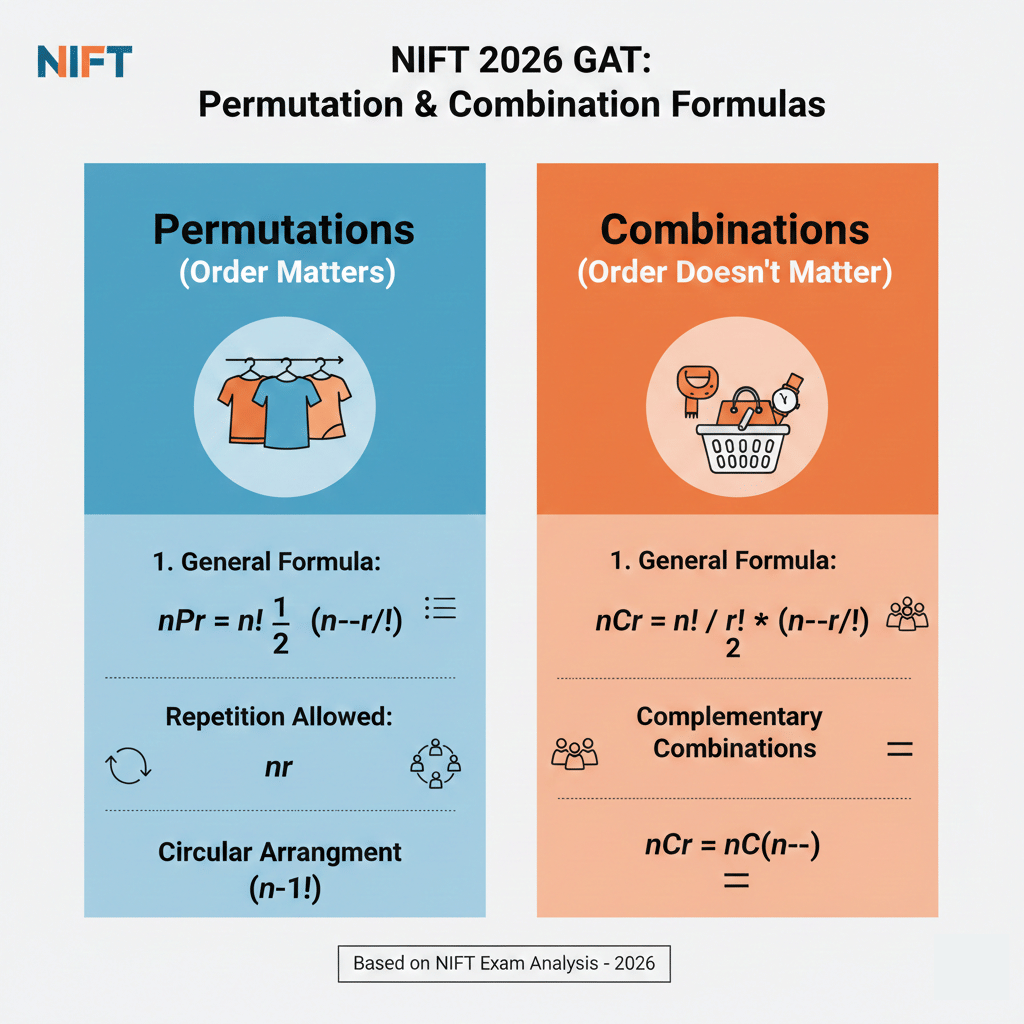
Basic Concepts & Formulas
Before diving into practice, build a strong conceptual foundation using the key permutation and combination formulas for the NIFT exam.
Concept | Definition | Formula |
|---|---|---|
Permutation (nPr) | Arrangement of ‘r’ objects from ‘n’ in a specific order | nPr = n! / (n - r)! |
Combination (nCr) | Selection of ‘r’ objects from ‘n’ without considering order | nCr = n! / [r! × (n - r)!] |
Relationship | The connection between the two | nCr = nC(n - r) |
Circular Arrangement | When an order repeats in a circle | nCr = nC(n - r) |
Example:
How many ways can 3 letters be arranged from the word DESIGN?
→ 6P3=6×5×4=1206P3 = 6 × 5 × 4 = 1206P3=6×5×4=120
Pro Tip: Always check if the problem involves arranging (Permutation) or selecting (Combination) before applying formulas.
These NIFT quantitative ability practice problems usually require identifying the correct formula within seconds, which you can master through timed drills.
Common Types of Permutation & Combination Questions
You’ll encounter multiple variations of permutation and combination questions for NIFT 2026 in mock tests and previous-year papers. Here are the most common ones:
Type | Description | Example |
|---|---|---|
Letter/Digit Arrangements | Arranging alphabet or digits in a word/number | Arrange “FASHION” → 7! = 5040 |
Team Selection | Choosing people from a group | Choose 3 from 8 students → 8C3 = 56 |
Repetition/Restriction | Some elements can’t repeat or have fixed positions | 3-digit numbers using 1–5 without repetition |
Circular Arrangements | When positions form a circle | 6 people around a table → (6 – 1)! = 120 |
Word Formation & Probability | Forming words or counting event outcomes | Arranging letters of “STYLE” starting with S |
These types often appear as NIFT counting questions with solutions in study materials, helping you recognize question patterns faster.
Step-by-Step Solving Strategy
Knowing the right approach can save you precious time in the exam. Follow these five steps to solve any permutation and combination problems for NIFT 2026:
1. Identify whether order matters.If yes, use permutation; if no, use combination.
2. Note down the given values of ‘n’ (total items) and ‘r’ (chosen items).
3. Write factorials neatly to prevent calculation mistakes.
4. Simplify numerator and denominator cancel common terms.
5. Cross-check logic: Does your answer make sense contextually?
Example:
In how many ways can a team of 3 be chosen from 8 students?
Solution:
8C3 = (8 × 7 × 6) ÷ (3 × 2 × 1)
= 336 ÷ 6
= 56
Mastering these strategies helps you handle how to solve permutation combinations for NIFT GAT questions efficiently during the timed test.
Common Mistakes to Avoid
Many aspirants lose marks in NIFT quantitative ability practice problems due to small errors. Avoid these common pitfalls:
Mistake | What Happens | Correction |
|---|---|---|
Confusing permutations with combinations | Wrong approach | Check if order matters |
Forgetting factorial (!) | Incomplete calculation | Always use factorials |
Ignoring restrictions | Invalid answer | Read the question carefully |
Overlooking identical elements | Wrong count | Divide by repeated items’ factorial |
Not simplifying | Wastes time | Cancel common terms quickly |
Avoid This: Don’t apply the permutation formula when the order doesn’t matter — that’s a combination question!
Practice Questions for NIFT Quant 2026
Below are sample NIFT counting questions with solutions designed to match the exam’s difficulty level:
No | Question | Solution | Answer |
|---|---|---|---|
1 | How many ways can the letters of “NIFT” be arranged? | 4! = 4 × 3 × 2 × 1 = 24 | 24 |
2 | In how many ways can a committee of 4 be selected from 10 members? | 10C4 = (10 × 9 × 8 × 7) ÷ (4 × 3 × 2 × 1) = 210 | 210 |
3 | How many 3-digit numbers can be formed using digits 1–5 without repetition? | 5P3 = 5 × 4 × 3 = 60 | 60 |
4 | In how many ways can 6 students sit around a round table? | (6 – 1)! = 5! = 5 × 4 × 3 × 2 × 1 = 120 | 120 |
5 | How many ways can you choose 2 accessories out of 5 designs? | 5C2 = (5 × 4) ÷ (2 × 1) = 10 | 10 |
Try solving these within 2 minutes each to simulate real exam timing. If you want to perform well in the NIFT 2026 GAT exam, you need to be consistent with the practice of permutation and combination questions for NIFT 2026. Also, understanding permutation and combination formulas for the NIFT exam and revising them, as well as solving quantitative ability practice problems every week, will improve both accuracy and speed. You must make sure that you identify whether a question asks for an arrangement or a selection before applying formulas. Be regular with the practice of NIFT counting questions with solutions and analyse your errors to strengthen weak areas.
By following the strategies mentioned above, you will confidently solve any permutation and combination problems for NIFT GAT, securing a higher percentile in the Quant section of the exam.
FAQs
The most repeated formulas include nPr = n! / (n – r)!, nCr = n! / [r! × (n – r)!], and (n – 1)! for circular arrangements. These appear often in counting and arrangement-based problems.
Not really. With a few basic formulas and some practice, even non-maths students can solve these questions easily. Start with small examples, understand the logic behind selection versus arrangement, and build confidence gradually.
Cancel out common terms between numerator and denominator instead of expanding entire factorials. This saves time and reduces calculation errors. For example, in 10C4, cancel out 6! from both sides before multiplying.
Yes, circular arrangement questions are part of NIFT Quant topics. They test your ability to arrange items around a circle, where rotations are considered identical. The standard formula used is (n – 1)!
If the order or sequence of items matters, use nPr (Permutation). If order doesn’t matter and you’re only selecting items, use nCr (Combination). Always check whether arrangement or selection is asked.
You can expect around 2 to 3 questions from Permutation and Combination in the NIFT GAT 2026 Quantitative Ability section. These usually test your understanding of counting, arrangement, and logical reasoning concepts.

















Similar Articles
UCEED Round 1 Cutoff Marks 2026 (Out)
Important Instructions to be Followed after UCEED Round 1 Seat Allotment 2026
NIFT Kannur Cutoff Ranks 2026: Expected Cutoff with Previous Years' Trends
NIFT Patna Cutoff Ranks 2026: Expected Cutoff with Previous Years' Trends
NIFT Hyderabad Cutoff Ranks 2026: Expected Cutoff with Previous Years' Trends
NIFT Kangra Cutoff Ranks 2026: Expected cutoff with Previous Years' Trends