



The aspirants who are appearing for GUJCET 2026 are seen to be bothered by one question which is - Whether Mathematics will be as moderately difficult as it has been in the previous years or will it be comparatively tougher this year. GUJCET is entirely based on the GSEB Class 11 and 12 Maths syllabus. As observed in the previous paper patterns, Mathematics has tested both the student’s conceptual clarity as well as their problem-solving skills. While GUJCET Maths’ level of difficulty has changed from one year to another, there is a certain pattern that you can see: the exam usually stays moderate, offering some variations towards the difficult side in terms of the framing of questions and the complexity of numbers. The 2025 paper saw a shift in application-based, conceptual questions rather than direct formulas. Calculus (10-12 questions) and 3D Geometry (6-8 questions) were among the high-weightage chapters.
It is important to understand these trends in order to plan your preparation wisely - striking a balance between speed and accuracy and anticipating the kind of questions you are most likely to be asked in the 2026 exam.
Also Check - How Does GSEB Textbooks and Weightage Impact GUJCET 2026 Chemistry Prep?
Historical Trends in GUJCET Maths Difficulty Level
Here is an analysis of the past few years that will offer you an idea of how the pattern of GUJCET Mathematics has evolved with time, in relation to difficulty levels.
After undergoing significant changes in syllabus and curriculum in the year 2024, the 2024/2025 cycle was seen as moderate to difficult, which led a lot of students to feel that Maths was tricky and lengthy. Therefore, it felt tougher in comparison to previous years.
In the years 2020 and 2023, there occurred a slight inclination towards moderate-level questions. This implies that the questions were conceptually-firm that could be answered with ease through consistent practice of textbooks and previous year questions.
As per the lens and analyses of students from the year of 2019 to 2021, the paper was quite a tough one, mainly because of more emphasis on long numerical questions and application-based questions.
In 2017 and 2018, the Maths section was observed to be moderately challenging in a way which had major questions based on common syllabus topics.
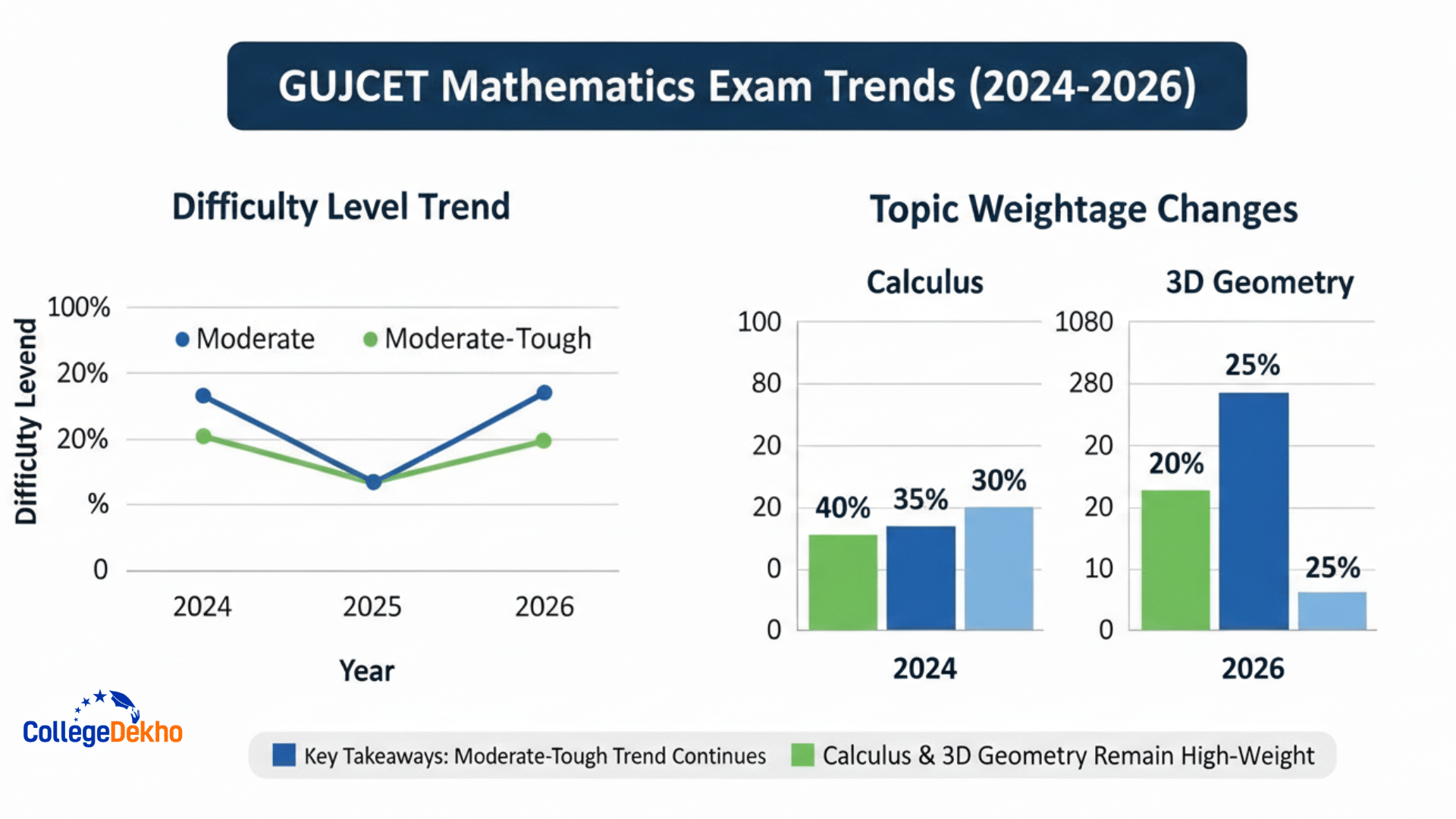
These trends indicate that the nature of GUJCET Maths is not extremely volatile. Not much of a hike in the difficulty level can be found from one year to another. Instead, it is observed as staying in a moderate area, with the spikes in difficulty occurring mainly due to the framing of the questions and complexity of numbers, not through the introduction of new concepts.
Expected Difficulty for GUJCET 2026 Maths
With reliance on the trends from previous years and the due nature of the syllabus, it would be appropriate to assume that the difficulty level of GUJCET Mathematics 2026 is likely to stay in the range of moderate to difficult.
The syllabus is still influenced by the GSEB Class 11 and 12 Maths. Moreover, the majority of the questions asked in the exam are closely-related to what is already given in the school textbooks.
The analysis of the papers published in the recent years reveals the fact that fundamental topics like Calculus (Differentiation, Integration), Algebra (Matrices, Functions), and Geometry contribute as a major part of the paper.
GUJCET generally does not tend to ask very difficult or multiple concept-based questions like those appearing in JEE and mostly, it is based on the application of conventional methods.
At the same, certain concepts like Calculus and 3D Geometry, which are known to be time-consuming, push the perceived difficulty a little higher. In the 2025 analysis, students were reported claiming that Maths was comparatively tougher than Physics and Chemistry because of the length of calculations and clever twists in questions.
On the whole, the 2026 paper pattern is likely to carry on the trend of moderate difficulty. But, to remain on the safe side, make sure that you prepare for both straight as well as application-based questions.
Also Check - GUJCET 2026 Paper Forecast: What 2025 Trends Predict for PCM Subjects
What to Focus On: Preparation Strategies Based on Recurring Weightage
To deal with the expected difficulty level of the paper with efficiency, you must ensure that your preparation matches with the recurring topic patterns that appeared in the past GUJCET papers:
Calculus (Differentiation and Integration): This topic has had high coverage in GUJCET previous year question papers and comprises of both conceptual understanding and mindful computation.
Algebra (Matrices, Functions, Relations): Matrix operations, determinant problems, and function questions appear regularly and usually seem easy with consistent practice.
Geometry (Vectors and 3D Geometry): Questions related to vectors and 3D geometry are meant to test your understanding of clarity of reasoning and are asked in the exam every year.
Calculus Numericals + Trigonometry: You can expect the paper to offer a combination of Calculus, Algebra, and Geometry-related questions.
Paying close attention to these areas will lead you to scoring better than you anticipate.
Predicted Weightage for GUJCET Maths 2026
| Chapters/ Units | 2024 | 2025 | 2026 (Expected No. of Questions) |
| Integrals (Definite & Indefinite) | 7 | 7–8 | 7 |
| Differentiation & Continuity | 4 | 4 | 4 |
| Application of Derivatives (AOD) | 3 | 3 | 3 |
| Differential Equations | 2 | 1–2 | 2 |
| Vectors & Vector Algebra | 4 | 3–4 | 4 |
| 3D Geometry | 3 | 3 | 4 |
| Matrices & Determinants | 5 | 5 | 5 |
| Relations & Functions + Inverse Trigonometric Functions | 4 | 4 | 4 |
| Probability | 3 | 2–3 | 3 |
| Permutation & Combination | 3 | 2 | 2 |
| Sets & Linear Programming | 2 | 2 | 2 |
| Total Questions | 40 | 40 | 40 |
Also Check - GUJCET 2026 Smart Question Selection & Answering Strategy
Previous Year Toppers' Insights and Advice for GUJCET 2026 Mathematics
Insights from the past years' GUJCET toppers can come handy in calibrating your preparation:
"Practice extreme accuracy. In Maths, it is always better to solve 35 questions correctly than attempt 40 questions and get 10 out of them wrong resulting in negative marking." - Aradhnaba Rathod, 117.5 marks (2025)
"Focus on NCERT textbook as your primary sourece before shifting to other reference materials. The majority of the questions are framed from these books. Also, follow a disciplined routine." - Shubh Rathod, 99.93 percentile rank (2025)
"I strongly recommend solving MCQs chapter-wise immediately after finishing a topic. This helps retain the formulas while they are fresh in your mind." - Bhavin Gohel, 110 marks (2025)
"Include Calculus in your daily study routine. This chapter alone can boost your score in Maths. Solve at least 5–10 problems from Integration every single day to maintain good speed." - Yash Lalwani, 107.5 marks (2025)
What Our Experts Suggest
Practice GUJCET sample papers in a time-bound environment. This approach serves two purposes - building your speed and familiarising you with common question patterns.
Many times, students complain that time management is a much bigger challenge than difficulty in Mathematics, and the reasons behind it are time-taking derivations and calculations involving multiple steps.
Practice of GSEB Class 11 and 12 texts to strengthen the very basics, instead of solely relying on advanced sets of problems for preparation.
Avoid just mugging up formulas. Make an effort towards understanding when and how to apply concepts under exam conditions. Time-bound practice will bridge this gap.
Also Check - How Diagrams and Graphs Boost GUJCET 2026 Scores
Final Prep Roadmap for Maths Success
Here's a road map for you to follow, keeping in mind that the paper continues to follow its moderate trend:
1. Revision Cycle
Make sure to revise important topics like Calculus, Algebra, and Geometry on a daily-basis is essential. Use short notes dedicated to formulas and concept reminders.
2. Mock Tests
Try and appear for at least one full Mathematics mock test every week. To create an exam-like environment, set a timer of 60 minutes and track your speed.
3. Previous Years Papers
Solve a minimum of the last 6–8 years of GUJCET Maths papers. This will provide you exposure to recurring patterns and topic distribution. However, skip the chapters that have been removed in 2024.
4. Balanced Practice
Do not neglect topics of weaker weightage like Probability or Differential Equations. Even if they carry slightly lower weight, they can easily contribute to your overall score.
5. Time Strategy
Allocate time to the questions as per their type. Aim at solving direct formula questions first, then moving forward with tackling long application problems.
By combining these suggested steps, you not only increase your confidence but also your potential to score.
Quick Links:
| GUJCET 2026 Preparation Tips | Best Books for GUJCET 2026 |
|---|
While there is always a possibility of surprises in exams, all the available trends suggest that GUJCET 2026 Mathematics shall be in the moderate level of difficulty like it has in the previous few years. A well-focused preparation that aligns with the weightage of topics and is aided by regular, timed- practice as well as clever revision will enable you to answer both easy and complicated questions with accuracy. Instead of fearing the exam, use the past trends to your advantage and develop a strategy that helps maximise your accuracy and speed on the day of the exam.
Related Articles
For any query, head to our QnA Zone or fill out our Common Application Form . Stay tuned to CollegeDekho for more such updates!
FAQs
Yes, time management often plays a bigger role than difficulty. Many students know the concepts but lose marks due to slow calculations. Practicing Maths in a timed environment helps you balance accuracy and speed effectively.
You should focus on high-weightage topics, practice previous year papers under time limits, revise formulas regularly, and improve calculation speed. Consistent mock testing is key to handling moderate-difficulty questions confidently.
Yes, GUJCET Maths is generally easier than JEE Main Maths. GUJCET focuses more on direct application of formulas and textbook-based questions, while JEE Main includes multi-concept and higher-difficulty problems.
Topics like Calculus (Differentiation and Integration), 3D Geometry, and Vectors often feel challenging because they are time-consuming. Even though the concepts are familiar, lengthy calculations can increase pressure during the exam.
GUJCET 2026 Maths is expected to stay moderately difficult, similar to recent years. The exam usually focuses on standard GSEB syllabus topics with application-based questions rather than very advanced problems. Difficulty often depends more on calculation length and time pressure than on unfamiliar concepts.
 Quick Facts


















Similar Articles
Why 200 Marks in JEE Advanced 2026 is a "Power Score" for the SC Category?
Is 200 a Safe Score in JEE Advanced 2026? Rank and Percentile Standing Explained
Minimum Marks in JEE Advanced to Get IIT for SC/ ST: Alternative College Options
Will 241 Marks Secure a Seat in the Top 5 IITs?
What Rank to Expect with 131 Marks in JEE Advanced 2026?
JEE Advanced Marks vs Rank Analysis 2026