


- Important Topics to Score 160+ in NEET Chemistry 2026
- Physical Chemistry: The Art of Numerical Precision
- Inorganic Chemistry: Beyond Rote Memorisation
- Organic Chemistry: The Mechanism & Reagent Map
- Why Refer to NCERT Books to Score 160+ in Chemistry …
- The 160+ Master Strategy: Error Reduction & Practice Sheet
- Faqs

To score 160+ in the NEET 2026 chemistry section, you must master GOC, Hydrocarbons, Aldehydes & Ketones in Organic Chemistry. In the case of Inorganic Chemistry, you must prioritise Chemical Bonding, p-Block, and Coordination Compounds. Then, studying Equilibrium, Thermodynamics, Solutions, and Electrochemistry in Physical Chemistry can boost your scoring chances. As the competition intensifies in the NEET 2026 exam chemistry section, scoring 160+ in Chemistry is no longer an advantage, but rather a necessity to get into top government medical colleges. With 50 questions including 5 options, Chemistry serves as the vital scoring bridge between high-yield Biology and challenging Physics.
The National Testing Agency (NTA) has recently streamlined the syllabus, removing several descriptive chapters and shifting the focus toward deep conceptual application and experimental chemistry. Previously, students spent weeks memorising the biological importance of Magnesium and Sodium or the industrial uses of Plaster of Paris in the s-Block chapter. The NTA has now shifted that weightage toward Principles Related to Practical Chemistry. So explore section-specific strategies, the psychology of error reduction, and high-yield topics to stand out from your peers.
Important Topics to Score 160+ in NEET Chemistry 2026
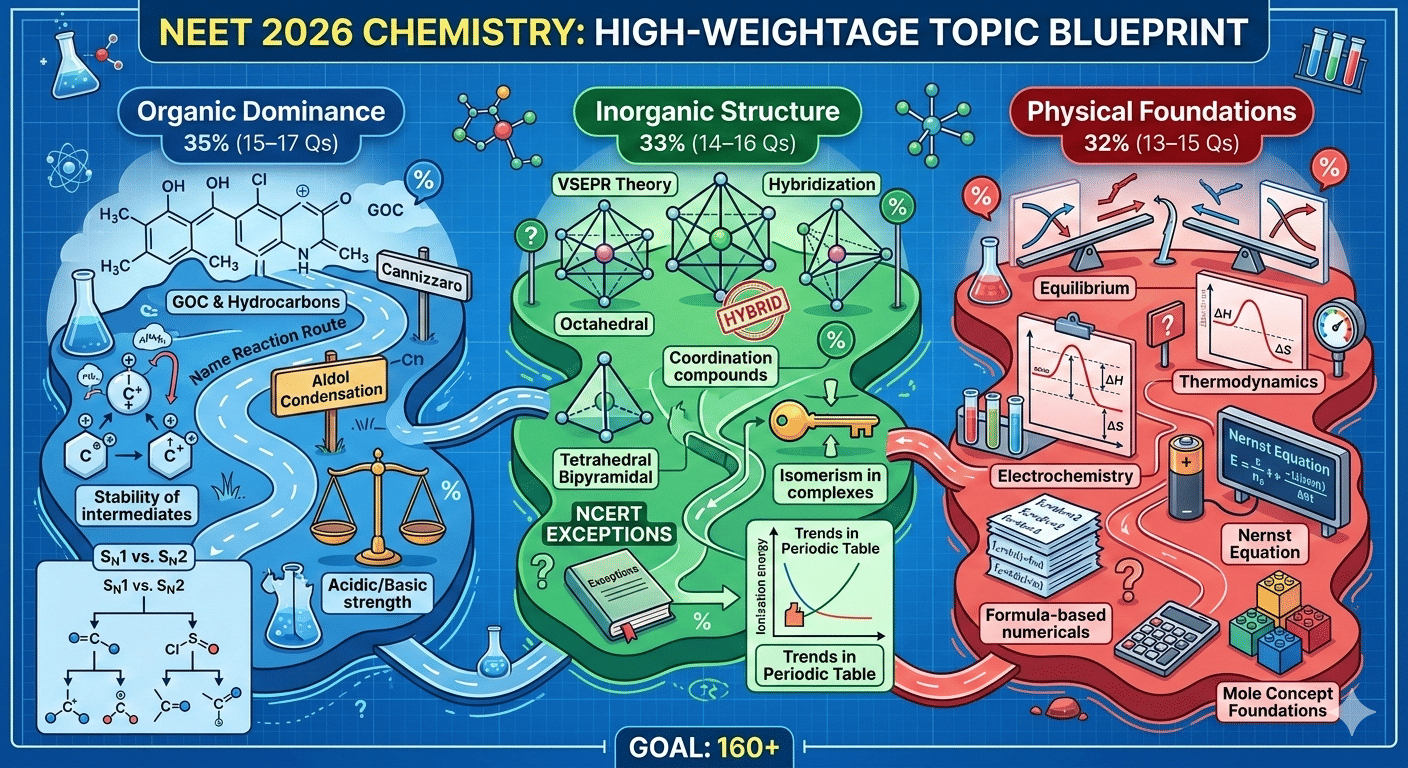
Since the NTA has shifted towards more conceptual and statement-based questions, simply memorising formulas is no longer enough. The table below breaks down the syllabus by weightage, focus areas, and the nature of questions expected for the 2026 exam.
High-Weightage Topics | Weightage (%) | Expected Questions | Important Sections |
|---|---|---|---|
GOC, Hydrocarbons, Aldehydes & Ketones | 35% | 15–17 | Name Reactions, Stability of intermediates, Acidic/Basic strength, Mechanisms (SN1, SN2). |
Chemical Bonding, p-Block, Coordination Compounds | 33% | 14–16 | VSEPR Theory, Hybridisation, Isomerism in complexes, NCERT exceptions, Trends in the Periodic Table. |
Equilibrium, Thermodynamics, Electrochemistry | 32% | 13–15 | Nernst Equation, Le Chatelier’s Principle, Formula-based numericals, Mole Concept foundations. |
Physical Chemistry: The Art of Numerical Precision
Physical Chemistry is no longer rote memorization rather p.hysics of chemical reaction. To score near to 100% in this section, you must master the transition from formula to final answer without calculation errors.
The Formula-Unit Bridge
Most students lose marks not because they don't know the formula, but because they mess up the units. For example, using $R = 0.0821$ instead of $8.314$.
- Expert Tip: Create a "Unit Conversion Sheet." Memorise the conversion between Joules and Litre-atmospheres, and Angstroms to Picometers.
- Calculation Hacks: In the exam, you must beat time. Practice "Approximation Logic." For example, use $g = 10$ instead of $9.8$ unless the options are very close. Use $1/12$ for $0.0821$ in gas equations to speed up division.
High-Yield Focus: Equilibrium & Thermodynamics
These two chapters alone often account for 4-5 questions. Focus heavily on Le Chatelier’s Principle and the relationship between $\Delta G$, $\Delta H$, and $\Delta S$. For the Chemistry 2026 section, pay special attention to Ionic Equilibrium, specifically Buffer Solutions and Solubility Products.
Inorganic Chemistry: Beyond Rote Memorisation
You must not misunderstand Inorganic Chemistry as a "cramming" subject. To score 160+, you must know the logic behind the exceptions. You can go through the hacks stated below to prepare this section more effectively.
The "Exception Log" Strategy
In the exam, the paper rarely asks for trends; rather, they ask for anomalies. For example,
- The Trend: Atomic radius increases down the group.
- The Exception: Why is the atomic radius of Gallium smaller than that of aluminium?
- What must you do to prepare better? Maintain a separate notebook for "Anomalous Behaviours." Focus on the 13-18 groups (p-block) and the d-block contractions to prepare better.
Chemical Bonding: The Backbone
You cannot score 160+ without mastering Hybridisation, VSEPR Theory, and Molecular Orbital Theory (MOT). At least 3 questions are derived from this single chapter. So, make sure you can draw the structures of Xenon fluorides and Oxoacids of Phosphorus in under 10 seconds.
Organic Chemistry: The Mechanism & Reagent Map
In the Organic Chemistry section, you must understand the flow of electrons to score from the related questions in the paper. You can go through the hacks to excel in the Organic Chemistry chapters given below.
The GOC Foundation
General Organic Chemistry and Isomerism are the roots of this unit. If you understand Inductive, Resonance, and Hyperconjugation effects, you don't need to memorise reactions in Hydrocarbons or Amines. This is so because with your understanding, you will be able to predict them.
The Reagent-Centric Approach
We recommend you not study by chapter, but rather by Reagent. For example,
- In questions like What does $LiAlH_4$ do to an Acid? An Amide? A Ketone?
- You must create a "Reagent Map" where the central node is a functional group, and the branches show various reagents and their specific outcomes.
Named Reactions & NCERT Word-to-Word
The Named Reactions are very likely to appear in the exam paper, like the Reimer-Tiemann, Aldol, and Cannizzaro. You must master the intermediate steps, not just the final product. Often, in the exam papers their may be a question that asks for the "Intermediate species" or "Rate-determining step." So, you must know them so that you can score marks in these questions.
Why Refer to NCERT Books to Score 160+ in Chemistry 2026?
While preparing for the Chemistry section, juggling between the Chemistry books is a tug of war. So, we suggest that you refer NCERT Books as the NTA has previously stated that the syllabus is defined by the boundary of the NCERT text. Below are the reasons why NCERT books can not only excel your exam preparation but also help you with the most common question types in the real-time exam paper.
- Official Syllabus Alignment: NTA strictly follows NCERT to set the difficulty level and curriculum, ensuring no "out-of-syllabus" surprises.
- Direct Question Source: Historically, 90-95% of Chemistry questions, especially in Inorganic and Organic Chemistry, are found in the NCERT books.
- The Final Reference: In case of any technical ambiguity or disputed answers, NCERT’s data is the only evidence accepted for marks.
- Conceptual Precision: It avoids "over-learning" complex JEE-level theories. Thus, keep your focus on the specific mechanisms and trends required to hit 160+ in NEET 2026.
- Integrated Practical Knowledge: The updated 2026 pattern emphasises the NCERT lab manual concepts. Thus, making the textbook indispensable for experimental chemistry questions.
The 160+ Master Strategy: Error Reduction & Practice Sheet
To score 160+ in the NEET 2026, you must prepare as a student who masters the sections rather than someone who knows the chapters. The NEET 2026 requires a tactical approach towards practising mock tests & daily discipline. You must divide your Chemistry revision into three rounds, where you do the following:
- Round 1: For 15 minutes, you must focus on Inorganic Chemistry and Theoretical Organic questions that you can answer instantly. This builds immediate momentum and saves time for tougher problems.
- Round 2: For 20 minutes, tackle Physical Chemistry numericals and Mechanism-based Organic problems. Since your "Sight" questions are done, you can now focus entirely on calculations without rushing.
- Round 3: For 10 minutes, you must revisit marked questions. If you are stuck between two options, you must identify the options that are chemically impossible to find the correct answer by default.
Therefore, scoring 160+ marks in the NEET 2026 exam requires not just hard work but precision. You must practice every mock test as if it were your real-time paper. Track your performance in every paper and maintain a practice sheet where you record your performance. Stay consistent, master the exceptions, and the 160+ mark will be easier to score with time. So, in case you are still confused regarding how to score 160+ in NEET Chemistry 2026, then drop us your query on the CollegeDekho Q&A Zone or contact us on our toll-free helpline number 18005729877.
FAQs
Attending coaching classes is not necessary to score 160+ in NEET 2026 Chemistry section. However, if you are facing difficulty in understanding the concepts or need extra guidance, then coaching classes can be helpful. You can also take help from online resources and study materials for NEET Chemistry preparation.
Time management is essential during the NEET Chemistry exam to score 160+. You can manage time by practicing previous year's question papers and mock tests. You should also focus on solving easy questions first and then move on to difficult questions.
For NEET 2026 Chemistry preparation, you can refer to NCERT textbooks, previous year's question papers, and practice books. You can also refer to online resources such as Khan Academy, Chemguide, and YouTube videos for better understanding.
You can improve your understanding of Chemistry concepts by consistently studying the topics and practicing problem-solving. You can also take help from online resources such as video lectures, books, and practice tests to improve your understanding of the topics.










Similar Articles
Best Private Medical Colleges in India with Low Fees
NEET Deleted Syllabus 2026: Official Chapter-wise List & New Topics Added
Toughest NEET Papers (2013-2025): Analysis & Strategy for NEET 2026
Gujarat NEET Cutoff 2026: College-wise Closing Ranks, Seat Matrix & State Counselling Guide
NEET 2026 Telangana Cutoff: Category-wise MBBS Marks, Ranks & Seat Matrix
Madras Medical College Chennai NEET Cutoff 2026: Category-wise Expected Ranks & Admission Guide