


Claude Live Session by Experts
Practical · No theory · See it work live
Saturday, 6 June
11 AM – 1 PM
2 HOURS
Counting on your college degree for a high-paying job four years down the line? Then you are about to make a grave mistake. The tech industry is evolving continuously. A basic B.Tech degree today is simply not enough to impress recruiters. Companies are constantly looking for individuals who know how to leverage the right tools and get the work done efficiently, rather than understand the theory. So, if you are relying solely on your course curriculum and syllabus, you are probably preparing for a job that won’t even exist by the time you graduate.
With thousands of B.Tech graduates learning the same standard coursework, scoring similar grades, and crafting generic resumes, what truly will make you stand out is not theoretical knowledge — but the way you use AI. That’s why learning these 5 AI skills early on, right from the first year of your engineering academic journey, is essential.
Also Check - Claude AI and Coding: How an AI Assistant is Changing the Way we Program
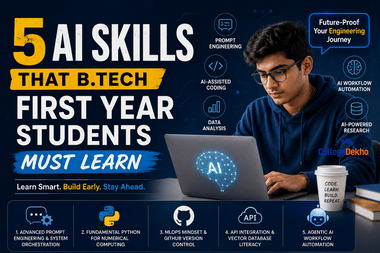
Top 5 AI Skills for Every B.Tech 1st Year Student
Listed below are 5 essential AI skills for B.Tech 1st year students India:
#1 Advanced Prompt Engineering and System Orchestration
If you are using ChatGPT to only summarize your coursework or rewrite assignments, you are falling behind. As a 1st year student, you should know how to frame structured, multi-turn prompts using the ROCC (Role-Objective-Context-Constraints) framework. You should learn how to feed the correct information and instructions to AI models, prevent them from making things up, and link prompts together to automate repetitive work.
By knowing how to guide an LLM to write, debug, and optimize code, you can multiply your daily output by five times. That is exactly how you can build an impressive portfolio right from the start.
Here are the best-fitted job roles for this specific skill set:
Prompt Engineer / AI Interaction Designer
AI Product Engineer / Full-Stack AI Developer
Workflow Automation Specialist
AI Solutions Architect
#2 Fundamental Python for Numerical Computing
Forget HTML and basic C. Python is the most important language of modern AI engineering. Instead of waiting for your college to introduce Python in the 2nd year, start mastering the core libraries in the data stack, such as NumPy, Pandas, Matplotlib/Seaborn. Understanding the fundamentals of Python can help you figure out how data moves before you start with machine learning algorithms.
Job roles that are best fitted for the Python Data Stack skill include:
Junior Data Scientist / Applied AI Associate
Data Engineer
Quantitative Analyst
Data Analyst / Business Intelligence Developer
Also Check - NITs offering B.Tech in Artificial Intelligence through JoSAA 2026: Total Seats Available, Cutoff Details
#3 MLOps Mindset and GitHub Version Control
As the tech industry is rapidly shifting towards Machine Learning Operations (MLOps) from pure Data Science, knowing only how to write a Python script is practically useless unless you can actually run it in a real corporate setting. As a B.Tech 1st year student, learn Git and GitHub. Make sure every single script, project, and prompt template you create is stored in a repository. By mastering these skills, you can learn how the branches work, how to commit clean code, and how to utilize basic cloud sandboxes, such as Hugging Face Spaces and Google Colab.
During B.Tech placements in the fourth year, having a GitHub skillset matters much more than a 9.5 CGPA scorecard.
Here are the best-suited career paths for this skill set:
Associate MLOps Engineer
DevOps Engineer
Open-Source AI Contributor / Developer Advocate
Release Engineer / Automation Engineer
#4 API Integration and Vector Database Literacy
Want to build a functional AI program? There’s no need to build neural networks from scratch. In the modern world, software largely depends on pre-built API Integrations. All you need is to learn how to connect applications to external models through OpenAI, Anthropic, or open-source Hugging Face APIs.
You should also master the basics of Vector Databases, such as ChromaDB or Pinecone. It is important to understand how data is integrated and retrieved if you want to build Retrieval-Augmented Generation (RAG) systems, as it is the core technology used to power modern AI search engines and corporate chatbots.
The best job roles for this specific skill include:
AI Product Engineer / Full-Stack AI Developer
RAG Engineer / Information Retrieval Specialist
Solutions Architect
Search and Recommendation Systems Engineer
#5 Agentic AI Workflow Automation
The industry is shifting towards Agentic AI — where AI agents can think, plan, use software tools, and perform multi-step workflows independently, without human intervention. It would be a great accomplishment if you learn how to design these multi-agent systems in your B.Tech 1st year. You can move past the standard inputs to build loops, where multiple AI agents can individually generate code, test for errors, and deploy. Simply put, by mastering these skills, you can become an AI Architect from a mere AI user.
Job roles best suited for this skill are:
Autonomous Systems Engineer / AI Agent Developer
Intelligent Automation Architect
AI Research and Development Intern
Also Check -
5 Reasons to Pursue B.Tech AI in NIT Surathkal
Don’t just wait for a degree at the end of your 4-year engineering course; make the most of your first year in college. Instead of relying on traditional syllabus and curriculum, or waiting for your professors to teach you what the market demands, take control — learn these new AI skills, build new exciting projects, and stay ahead of your peers!
FAQs
Vector Databases like ChromaDB or Pinecone are crucial for understanding data integration and retrieval. They are the core technology used to power modern AI search engines and corporate chatbots through RAG systems.
MLOps focuses on running Python scripts effectively in corporate settings. GitHub is vital for version control, storing projects, committing clean code, and utilizing cloud sandboxes like Hugging Face Spaces.
Python is the most important language for modern AI engineering. Students should master core data stack libraries like NumPy, Pandas, and Matplotlib/Seaborn early on.
It's about framing structured, multi-turn prompts using frameworks like ROCC. Learning it helps guide LLMs to write, debug, and optimize code, potentially multiplying your daily output by five times.
A basic B.Tech degree alone is insufficient to impress recruiters. Learning AI skills early helps students stand out, leverage tools efficiently, and prepare for future job roles that align with industry demands.
 Quick Facts













Similar Articles
5 Reasons to Pursue B.Tech AI in NIT Surathkal
Top Karnataka B.Tech Colleges Offering Robotics Course through KCET Counselling 2026
Top Bangalore Colleges offering B.Tech AI ML and Data Science: Fees & Admission Details; Placement Trends
Top Pune Colleges offering B.Tech in AI: Fees, Admission & Placement Details
IIT Lower Branch vs NIT CSE vs BITS Pilani: What Should You Choose in 2026?
Claude AI and Coding: How an AI Assistant is Changing the Way we Program