



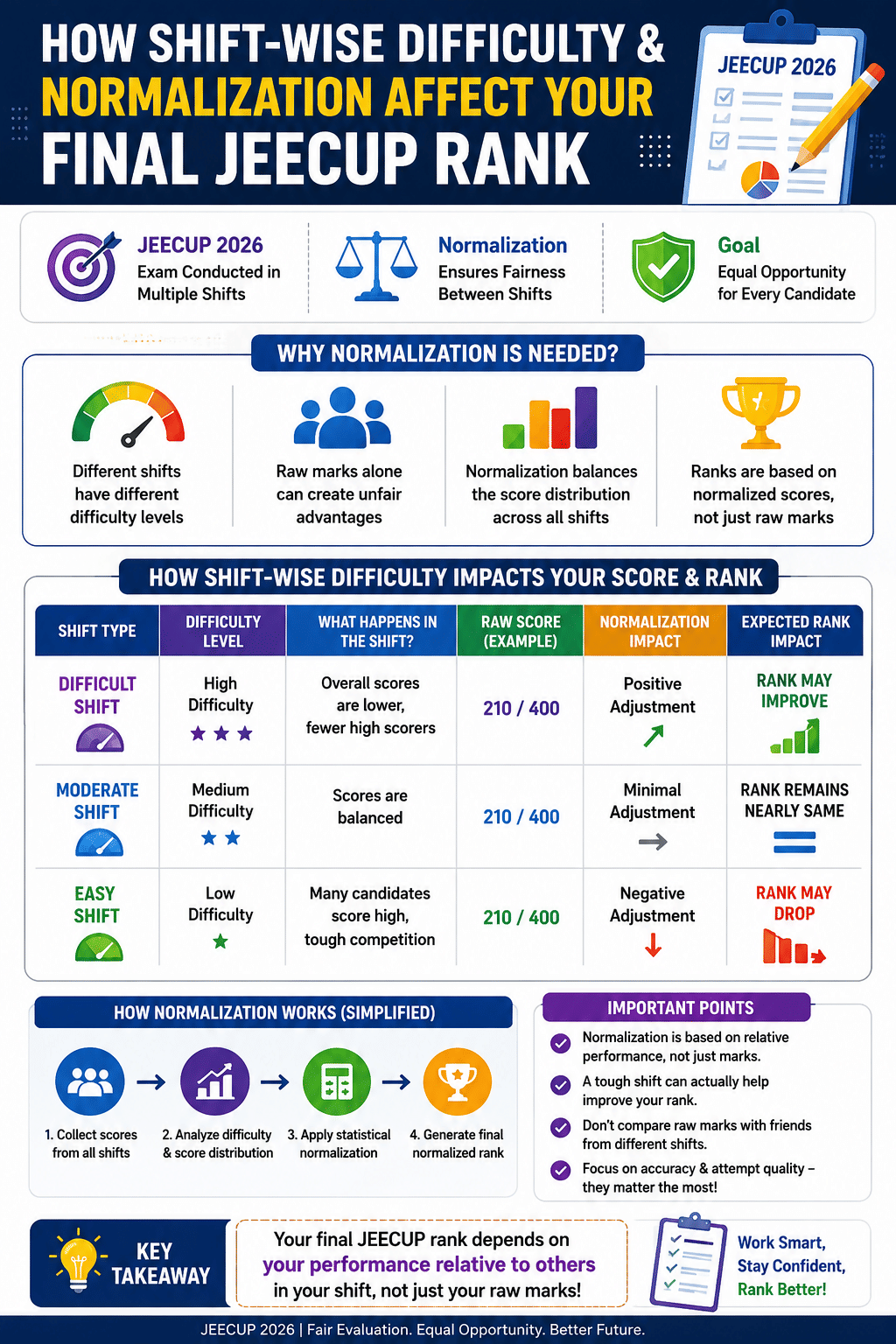
With the JEECUP 2026 exam being held across multiple days and shifts, the normalization method will play a major role in deciding your final score and rank. JEECUP 2026 normalization process ensures fair conversion of raw scores into standard metrics keeping in mind the varying question paper difficulty levels. This places all students on the same level, making sure harder shifts do not pose a disadvantage to them.
Let's say, on the exam day, Shift 1 was tougher than Shift 2. So, a student scoring 210 marks in the Shift 1 paper will see their raw score normalized to a much higher score or percentile compared to another student who might have scored the same marks in an easier Shift 2 paper.
Also Check - Expected rank for 200 marks in UP Polytechnic
How does the shift-wise difficulty adjustment affect my raw marks?
For all exams that are carried out in shifts over multiple days, each shift may differ slightly from the other. One shift may see a tough and complex Mathematics section while the other may witness a much easier direct formula-based questions. If final ranks were determined based on just raw marks, it would be unfair to students stuck in harder shifts. To avoid that, the Council uses the normalization method to adjust scores.
Here’s how it works:
Shift Difficulty | Score Adjustment Framework |
|---|---|
For a hard shift |
|
For a moderate shift |
|
For an easy shift |
|
Also Check - JEECUP Branch vs Rank vs College Analysis 2026
What is a good normalized score to target top government polytechnics?
Once your raw scores are normalized, your JEECUP State Merit Rank will be determined, based on which final admission into colleges will be done. To help you assess your scope, here we have compiled various normalized score ranges mapped with merit rank and target colleges.
Normalized Score Range (Out of 400) | Expected State Merit Rank Range | Admission Outlook | Realistic Government & Aided Colleges (Open Category) |
|---|---|---|---|
300+ | 1 – 200 | Guaranteed entry into flagship premier lines across top-tier urban branches. |
|
250 – 299 | 200 – 500 | Confident placement in premier urban branches and high-demand tech streams. |
|
190 – 249 | 500 – 5,000 | Safe target window for mid-tier competitive government polytechnic programs. |
|
130 – 189 | 5,000 – 25,000 | Accessible entry for semi-urban government programs and core branches. |
|
70 – 129 | 25,000 – 80,000 | Focus moves toward specialized branches or regional spot rounds. |
|
To make the most of the JEECUP normalization process, focus on maximizing accuracy instead of attempts. Remember, shift-wise difficulty will influence your scores, so stop comparing your performance with peers as that will only create more panic. Review shift-wise question paper analysis by subject matter experts for self-evaluation instead. At the end, accuracy, relative performance, and percentile standing matter far more than just raw marks during JEECUP counselling and admissions.
Related Articles
| List of Colleges for 75,000 to 1,00,000 Rank in JEECUP 2026 | JEECUP Round 1 Cutoff 2026: Check Opening & Closing Ranks |
|---|
If you have further queries regarding admission to top private engineering colleges in India , you can write to hello@collegedekho.com or call our toll free number 18005729877, or simply fill out our Common Application Form on the website.
FAQs
For a moderate shift, your score won't experience major changes as its difficulty matches the overall exam average. Your final normalized score will look almost identical to your actual raw marks, changing by only about +2 to -2 marks.
A normalized score of 300+ out of 400 is considered excellent, aiming for an Expected State Merit Rank range of 1-200, which guarantees entry into flagship premier lines at top-tier urban branches.
In an easy shift, the average score of the session automatically goes up. To maintain parity, your normalized marks can stabilize or slightly decrease relative to your raw score, compared to peers who faced harder questions.
For a tough shift, the average score of the session naturally drops. The normalization formula recognizes this, and your final normalized score can increase significantly above your initial raw calculation to level the playing field.
It's a method to ensure fair comparison of scores when the exam is held in multiple shifts with varying difficulty. Raw scores are adjusted based on the perceived difficulty level of each shift.
 Quick Facts













Similar Articles
DTE MP Polytechnic Merit List 2026 (Today): Release Time, Seat Allotment Process, College-wise Cutoffs
JoSAA Choice Filling 2026 - Dates, Process, Freeze, Float, Slide, Withdraw
JoSAA Counselling 2026 - Seat Allotment, Important Dates, Documents Required, Cutoff, Counselling Process
Claude AI and Coding: How an AI Assistant is Changing the Way we Program
JEECUP Branch vs Rank vs College Analysis 2026
List of Colleges for JoSAA 5000 to 10,000 Rank in JEE Advanced 2026