


As you prepare for the Gujarat Common Entrance Test (GUJCET) 2026, because of the volume of the syllabus, it is easy to feel overwhelmed. Chemistry, often perceived as a balancing act between numerical precision and rote memorisation, frequently determines the difference between a good rank and a top rank. The section demands conceptual application, but also tests your speed, accuracy, and command over Chemistry formulas and reactions. This guide will break down the vast curriculum into high-yield concepts that have consistently appeared in past years, offering a strategic roadmap for your preparation.
Also Check - 60-Min Time Management Hacks to Ace GUJCET 2026 Physics & Chemistry
Chemistry Chapter-Wise High Weightage Topics for GUJCET 2026
Here’s a brief of important topics asked in previous years of GUJCET’s chemistry section.
Section | Approx. Weightage | High-Weightage Chapters & Topics | Details |
|---|---|---|---|
Physical Chemistry | 35% |
| Focus on numerical-based questions and how to apply the formula in the questions. |
Organic Chemistry | 30% |
| Go through all the reactions and their mechanisms thoroughly. Focus on named reactions (e.g., Cannizzaro reaction) and how their conversion pathways work. |
Inorganic Chemistry | 25% - 30% |
| Questions are factual. Go through the NCERT trends. |
GUJCET tests students through basic theoretical multiple-choice questions that use particular formulas. The questions will match the essential learning objectives of Physics, Chemistry, Mathematics, and Biology from their NCERT textbooks. It still serves as the main study material for both subjects.
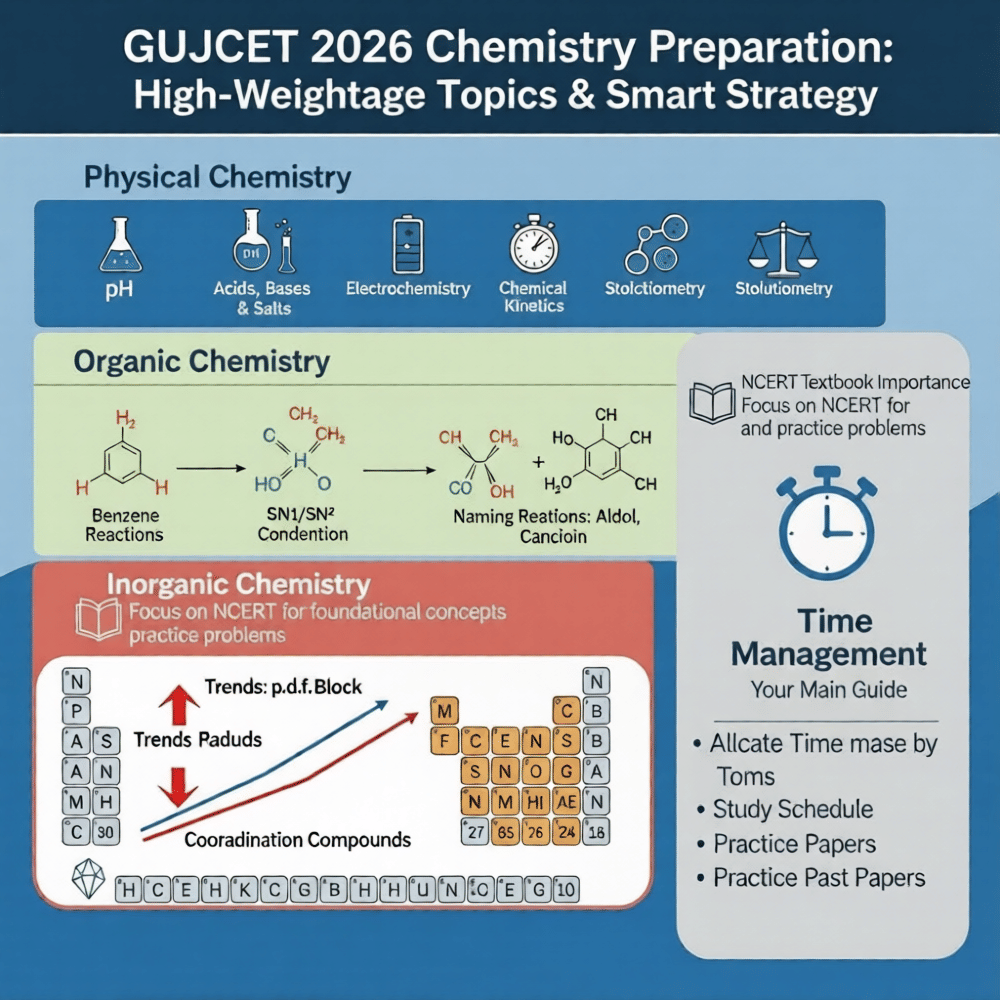
Physical Chemistry: Numericals and Concepts
Physical Chemistry in GUJCET is generally formula-centric. The questions are not complex. Memorising formulas correctly and understanding the units will help you score well. Practicing numericals as well as understanding the theoretical concepts are the key factors.
Solutions
The Solutions chapter requires strong reasoning, particularly for unit cell dimensions and packing efficiency. The chapter on solutions is a primary source for numerical questions.
Quick Tip: Around 4-5 questions in Physical hemistry are asked every year from Solutions, particularly, Solubility of Gases (Henry's Law), Raoult's Law, Colligative Properties etc. If you want to be among the top ranks, then don’t skip this topic.
Electrochemistry and Chemical Kinetics
For GUJCET, the Nernst equation is very important. You must be comfortable calculating the EMF of a cell under non-standard conditions. Similarly, in chemical kinetics, the focus is on the order of reactions and the Arrhenius equation. Here is the following table for different concepts and their application tips in electrochemistry and chemical kinetics.
Concept | Application Tip |
|---|---|
Nernst Equation | Ensure n (moles of electrons) is balanced correctly. |
First-Order Kinetics | The unit of k determines the order (s-1 for 1st order). |
Arrhenius Equation | Watch out for units of R (use 8.314 J/K·mol). |
Faraday’s Law | Convert time into seconds before calculation. |
Also Check - How Does GSEB Textbooks and Weightage Impact GUJCET 2026 Chemistry Prep?
Inorganic Chemistry: Trends, Exceptions and Structures
Inorganic Chemistry is often termed the "scoring subject" because it requires minimal calculation time. However, it requires high accuracy in memory. The d-block, and f-block elements, along with coordination compounds, are highly important in inorganic chemistry.
The Periodic Trends
For d-block elements, focus on the variation in oxidation states and the formation of coloured ions. The magnetic properties (paramagnetic vs. diamagnetic) based on unpaired electrons is a standard question format.
Coordination Compounds
This is perhaps the most conceptual chapter in Inorganic Chemistry. Nomenclature is basic, but the real test lies in Valence Bond Theory (VBT) and Crystal Field Theory (CFT). You should be able to predict the hybridisation and geometry of a complex ion instantly upon seeing the ligand strength.
Here is the table for hybridisation and geometry in coordination complexes. The following table shows the hybridisation and the respective geometry with their coordination number.
Coordination Number | Hybridisation | Geometry |
|---|---|---|
4 | sp3 | Tetrahedral |
4 | dsp2 | Square Planar |
6 | sp3d2 | Outer Orbital Octahedral |
6 | d2sp3 | Inner Orbital Octahedral |
Organic Chemistry: Reactions, Reagents and Mechanisms
Organic Chemistry can be said to be the backbone of the GUJCET paper. The questions here are a mix of direct naming reactions, conversions, and acidity/basicity orders. Understanding the "why" behind a reaction mechanism is helpful, but for GUJCET, remembering the "what" (reactant to product) is imperative.
Haloalkanes, Haloarenes, and Alcohols
Substitution reactions and emphasis must be on electronic effects in organic reactions. We would suggest you refer to the old question papers to get a better idea of the type of questions related to Haloalkanes and Alcohols topics.
Carboxylic Acids, Ketones, and Aldehydes
This section contains the highest density of named reactions. From the past papers, you will find questions like identifying the missing reagent or the major product in a sequence.
| For quick revision, you can get this Downloadable PDF of Top 20 Naming Reactions for GUJCET ! |
|---|
Tips to Score Well in GUJCET 2026 Chemistry Section
Success in competitive exams like GUJCET or KMAT isn't just about memorising the periodic table. You must learn the tactics to apply the formulas. Here are some of the tips that are sure to help you score well in GUJCET.
Common Pitfalls to Avoid
You should avoid these common traps:
Physical Chemistry “Unit” Mistake: Many students lose marks due to this trap. They often calculate the correct value but forget to convert units (e.g., centimeter cube to meter cube or Celsius to Kelvin). In Thermodynamics and Electrochemistry, always double-check your constants (R, F) against the units required by the final answer.
Alpha-Hydrogen Confusion: In naming reactions, you must identify the alpha-hydrogen. A common mistake is misidentifying the alpha-carbon in branched aldehydes. This often leads to a mix-up between Aldol Condensation and Cannizzaro pathways.
Reagent Specificity: Do not treat all reducing agents as equal. Using LiAlH_4 where NaBH_4 is required (or vice versa) can lead to unintended functional group reductions. Many students getting confused with the Rosenmund Reduction catalyst (Pd/BaSO_4). It is a very specific "poison" that makes the reaction specific to aldehydes.
Quick Links:
| GUJCET 2026 Preparation Tips | GUJCET Sample Papers | Best Books for GUJCET 2026 |
|---|
High-Yield Tactical Advice
After discussing with GUJCET, we have curated a list of some essential tips from them.
The 30-Second Rule for Inorganic: Inorganic Chemistry is mostly memory-based, so you either know the answer or you don’t. So, don’t spend more than 30 seconds on these. Save the time for complex stoichiometry or logical reasoning sets.
Focus on "The Pivot": The period between exam sessions requires a change in your mental approach. The second session prefers students who can perform mental arithmetic while recalling formulas instantly to those who need time for complex calculations.
Visualisation: The study of Organic Chemistry requires students to understand more than name recognition. Students must develop the ability to see Reaction Intermediate through their study. The product prediction process depends on your ability to identify the reaction path through either Carbocation or Nitrene. This allows you to test your knowledge about the particular "Naming Reaction" during the exam.
Want to check your preparation for GUJCET 2026? Go through these GUJCET previous year questions with solutions .
Success in GUJCET 2026 requires studying beyond passive reading of textbooks. Excellence can be achieved with the help of CollegeDekho mentors who will help master the numerical problems for physical chemistry, memorise the periodic trends of inorganic chemistry and understand the reagents that drive organic reactions.This guide is available to all students without any cost. However, GUJCET aspirants can also access CollegeDekho mentors who provide advanced personalised coaching. You will also receive doubt-clearing sessions as a premium resource.
Related Articles
| Most Important Chapters for GUJCET 2026 Mathematics Revision |
|---|
| High Weightage Chemistry Chapters for GUJCET 2026 Preparation |
| Master GUJCET 2026 Physics: High Weightage Chapters & Strategy |
For any query, head to our QnA Zone or fill out our Common Application Form . Stay tuned for more such updates!
FAQs
Focus on memorising named reactions, reagents, and final products. Writing reaction charts and practising conversion-based questions helps improve speed and accuracy in the exam.
Coordination compounds, p-block trends, d-block oxidation states, and magnetic properties are must-study topics, as they frequently appear in GUJCET papers.
Physical Chemistry numericals are very important and generally formula-based. Practising standard problems from topics like electrochemistry, solutions, and chemical kinetics can fetch easy marks.
Yes, NCERT is more than sufficient for GUJCET Chemistry. Most questions are directly or indirectly framed from NCERT concepts, tables, reactions, and examples.
Organic Chemistry usually carries the highest weightage due to direct reaction-based and conversion questions, followed closely by Physical Chemistry numericals and scoring Inorganic Chemistry topics.
 Quick Facts












Similar Articles
List of Colleges for Low Rank in TS POLYCET 2026
TS POLYCET 2026 Slot Booking for Certificate Verification - Dates, Time, Process
List of Documents Required for TS POLYCET Counselling 2026
MHT CET Percentile vs College 2026
WBJEE Rank Above 50,000? Explore Private Colleges & Spot Round Admissions
List of BTech Colleges for 50,000 to 75,000 Rank in MHT CET 2026