



Biopharmaceutics is one of the high-scoring sections in GPAT exam but students often get intimidated by the numerical problems that are asked from here. Ever since NBEMS took over as the conducting body in 2024, the paper pattern has significantly inclined towards numerical problems, especially from chapters, such as Introduction to Pharmacokinetics, Compartment Modeling etc. However, with conceptual understanding and consistent practice, you can quickly solve these numerical questions and boost your score in the GPAT 2026 exam. This article features key numerical topics along with formulas, and some effective tips to walk you through solved PYQs.
Also Check - Ace GPAT 2026 Pharmaceutics: Sectional Weightage & Smart Prep Tips
Why Practice Biopharmaceutics Numericals for GPAT 2026?
Solving numerical problems from Biopharmaceutics is very important if you really want to push your score in the Graduate Pharmacy Aptitude Test. Going by the past trends, we predict there would be around 6-8 questions from this section. With each correct answer carrying +4 marks, you have the potential to score 24-32 marks here. Besides, here's why you cannot and should not miss out on this section:
Significantly High Weightage: Biopharmaceutics and Pharmacokinetics are two such chapters that account for 50-70% of the GPAT 2026 syllabus. In 2025, around 5-6 numericals were asked from V d calculations, Bioavailability (F), AUC (Trapezoidal), and half-life (t 1/2 ) . The year before, in 2024, the GPAT paper saw 4-5 numerical questions from Michaelis-Menten kinetics, Clearance (Cl), and Loading Dose etc .
Direct & Straightforward: Contrary to theoretical questions that demand logical thinking, concept application, and often feature confusing options, numerical problems are direct and straightforward. All you have to do is solve it with accuracy, and you’ll have the correct answer.
Time Saver: Unlike theoretical questions that often take time to solve due to its complex nature, numerical questions are easier and faster to solve, so you can save valuable time while writing the exam. However, for that to happen, you need to have a solid command over the numerics, and practice lots of previous year question papers to master speed and accuracy.
Also Check - GPAT 2026 Pharmacology Section-Wise Weightage and Mastery Tips
Must-Know Biopharmaceutics Numerics Formulas for GPAT 2026
You should practice writing formulas on a daily basis during revision so that you can remember them and not show confusion during an exam. The basic formulas that every GPAT 2026 applicant should know by heart:
| Section | Topic | Key Numerical Formulas |
|---|---|---|
| Bioavailability & Bioequivalence | Absolute Bioavailability (F) | F = \frac{\text{(AUC)_{oral} \times Dose_{IV}}}{\text{(AUC)_{IV} \times Dose_{oral}}} (Where AUC = Area Under the Curve) |
| Relative Bioavailability | F_{rel} = \frac{\text{(AUC)_{test} \times Dose_{std}}}{\text{(AUC)_{std} \times Dose_{test}}} | |
| Key Parameters for Bioequivalence |
| |
|
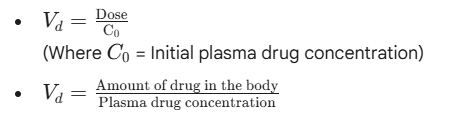
Volume of Distribution (V
d
)
| - |  |
| Clearance (Cl) | - | 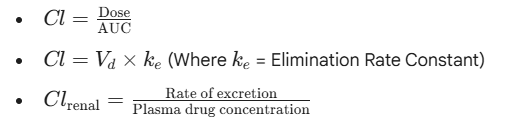 |
| Elimination Rate Constant (k e ) & Half-life (t 1/2 ) | - | 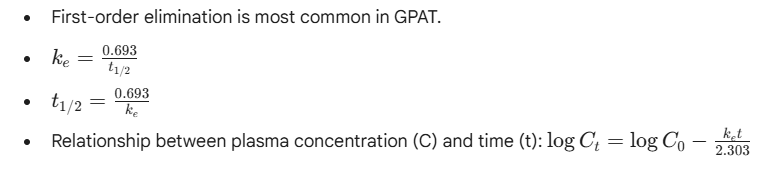 |
| Loading Dose (D L ) & Maintenance Dose (D M ) | - | 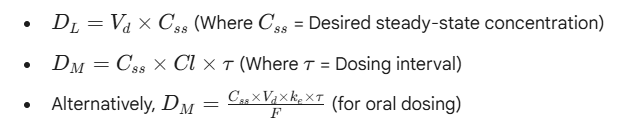 |
| Extraction Ratio (ER) | - |  |
GPAT 2026 Biopharmaceutics & Pharmacokinetics Practice Questions with Solutions
Now that you have all the important formulas in place, memorize, revise, and apply them to solve practice questions. We have curated a list of questions from GPAT sample papers that will likely feature in the upcoming exam. Although the exact question may not be repeated, you can expect similar problems with changed values to appear in the paper. Download Biopharmaceutics & Pharmacokinetics practice questions with solutions PDF from the PDF below.
| GPAT 2026 Biopharmaceutics & Pharmacokinetics Practice Questions with Solutions PDF |
|---|
Quick Tips to Score High in GPAT 2026 Biopharmaceutics Numericals
The secret to scoring the maximum marks in Biopharmaceutics is not just studying the syllabus and attempting GPAT 2026 mock test . You need to have a unique study approach that is tailor-made for the numerical section. Read on below!
Instead of mugging up formulas blindly, try to understand what each of these parameters represents – V d , Cl, K e etc.
Create a formula sheet to jot down all the essential formulas and revise them daily. This will help you recall them quickly as you begin solving the questions.
Pay attention to units of conversion (mg, L, hr, min). In the majority of the cases, students end up making mistakes here even though the numerical value may be correct.
Practice mental calculations using shortcut methods, elimination methods etc. because physical calculator are strictly prohibited inside the exam hall.
Read the question thoroughly, carefully write down the values given in the problem and understand what needs to be found before you attempt to solve the question.
Solve as many GPAT previous year question papers as possible, especially from 2024 onwards, to understand the recent NBEMS style paper pattern and difficulty level of this section.
As per the past few years’ paper analysis, we have found that the majority of the questions are focused around First-Order Kinetics, so we suggest you assume first-order elimination while solving similar questions.
By specifically targeting high-yield numericals, remaining disciplined in your unit conversions, and utilizing the best books for GPAT 2026 , such as Shargel and K.D. Tripathi, not only are you preparing to pass the exam, but are also preparing to dominate the field of pharmacy. Good luck!
For any query, head to our QnA Zone or fill out our Common Application Form . Stay tuned to CollegeDekho for more such updates.
 Quick Facts













Similar Articles
KCET Biology Answer Key 2026 (Available): Check Your Answers, Estimate Your Score
Top 10 Pharmacy Colleges Accepting AP EAMCET 2026 - Eligibility, Fees, NIRF Ranking
TS EAMCET B.Pharm Syllabus 2026
TS EAMCET B.Pharm Exam Pattern 2026
WBJEE B.Pharm Cutoff 2026: College-wise Opening & Closing Ranks
Smart PYQ Solving Strategy for GPAT 2026 Success