


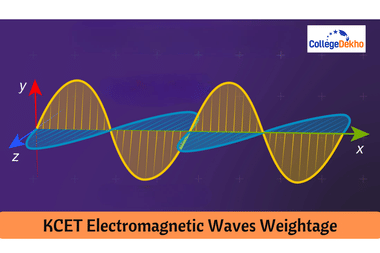
Electromagnetic Waves is one of the important chapters for the Physics section in the KCET 2026 exam. KCET Electromagnetic Waves Weightage 2026 is expected to be 2% of the total Physics Section. Students planning to appear for the KCET exam can expect 2 to 3 questions from Displacement Current, Inconsistency of Ampere’s Circuital Law, Ampere-Maxwell Law, Electromagnetic Waves, Electromagnetic Spectrum and Electromagnetic Characteristics. To score in the KCET 2026 exam , it is beneficial to be aware of the KCET 2026 syllabus, and their weightage so that they can plan their study schedule effectively. For KCET 2026 preparation strategy, understanding the relative weightage of Electromagnetic Waves helps aspirants allocate their study time more effectively. Since it carries fewer questions, many students choose to secure a solid conceptual foundation in this topic after finishing higher-weightage sections, ensuring they can confidently answer direct and formula-based questions.
Expected KCET Electromagnetic Waves Weightage 2026
The expected weightage of KCET 2026 Electromagnetic Waves is 2% of the total Physics Section. Aspirants of KCET 2026 can check the number of questions asked from this topic in the following table.
Chapter | Expected Weightage | Expected Marks |
|---|---|---|
Electromagnetic Waves | 2% | 2 to 3 marks |
Also Check - KCET Subject Wise Syllabus
KCET Electromagnetic Waves Weightage of Last 5 Years
Knowing the weight of each head is key to doing well on any test. KCET Electromagnetic Waves Weightage of the last 5 years has been provided in the following table.
Year | Weightage of Electromagnetic Waves Chapter (%) | Total Marks (Out of 60) |
|---|---|---|
2024 | 2% | 2 Marks |
2023 | 2% | 2 Marks |
2022 | 2% | 2 Marks |
2021 | 2% | 2 Marks |
2020 | 2% | 2 Marks |
2019 | 2% | 2 Marks |
With this kind of weightage, it is clear that this topic is important, and understanding its basic and advanced concepts will greatly aid in scoring well on the exam.
Important Topics of Electromagnetic Waves for KCET 2026
Electromagnetic waves are among the concepts students should be familiar with. Below are the key topics to focus on to score perfect marks in questions on electromagnetic waves:
Concept | Description | Formula/Key Points | Expected Questions in KCET 2026 |
|---|---|---|---|
Maxwell’s Equations | Describes the relationship between electric and magnetic fields, forming the basis for wave propagation. | Involves Gauss’s Law, Faraday’s Law, Ampère’s Law | Conceptual and mathematical problems related to field interactions |
Electromagnetic Spectrum | Classification of electromagnetic waves based on frequency and wavelength. | Refer to the frequency-wavelength classification table | Categorizing waves, solving wavelength/frequency-related problems |
Speed of Electromagnetic Waves | Speed is 3×10^8 m/s in a vacuum, independent of temperature. | c=f×λ | Calculating speed, frequency, and wavelength in different media |
Polarisation | The direction in which the electric field oscillates in an electromagnetic wave. | Related to Brewster’s angle, Snell’s law for refraction | Polarisation, reflection, and refraction problems |
Note: This table will help you know the weightage of each topic’s information and weightage in the Electromagnetic waves chapter.
Q uick Links:
| How to Score 50 Marks in KCET Chemistry | How to Score 50 Marks in KCET Maths |
|---|---|
| How to Score 50 Marks in KCET Biology |
Sample Questions on Electromagnetic Waves for KCET 2026
Here are some sample questions that will appear in the KCET 2026 exam. Addressing these will help you get an idea of the types of questions you may encounter:
1. What is the wavelength of an electromagnetic wave with a frequency of 5×10¹⁴ Hz5 \times 10^{14} \, \text{Hz}5×10¹⁴Hz in a vacuum?
Solution:
The wavelength λ\lambdaλ is given by the formula:
λ=cf\lambda = \frac{c}{f}λ=fc
where c=3×10⁸ m/sc = 3 \times 10^8 \, \text{m/s}c=3×108m/s and f=5×10¹⁴ Hzf = 5 \times 10^{14} \, \text{Hz}f=5×10¹⁴Hz.
λ=3×1085×1014=6×10⁻⁷ m=600 nm\lambda = \frac{3 \times 10^8}{5 \times 10^{14}} = 6 \times 10^{-7} \, \text{m} = 600 \, \text{nm}λ=5×10143×108=6×10⁻⁷m=600nm
So, the wavelength is 600 nm.
2. Calculate the speed of electromagnetic waves in a material with an index of refraction n=2n = 2n=2.
Solution:
The speed vvv in a material is calculated as:
v=cnv = \frac{c}{n}v=nc
where c=3×10⁸ m/sc = 3 \times 10^8 \, \text{m/s}c=3×108m/s and n=2n = 2n=2.
v=3×1082=1.5×10⁸ m/sv = \frac{3 \times 10^8}{2} = 1.5 \times 10^8 \, \text{m/s}v=23×108=1.5×108m/s
The speed of the wave in this material is 1.5×10⁸ m/s1.5 \times 10^8 \, \text{m/s}1.5×108m/s.
3. What is the frequency of an electromagnetic wave with a wavelength of 400 nm400 \, \text{nm}400nm in a vacuum?
Solution:
The frequency fff can be found using:
f=cλf = \frac{c}{\lambda}f=λc
where c=3×10⁸ m/sc = 3 \times 10^8 \, \text{m/s}c=3×108m/s and λ=400 nm=400×10−9 m\lambda = 400 \, \text{nm} = 400 \times 10^{-9} \, \text{m}λ=400nm=400×10−9m.
f=3×108400×10−9=7.5×10¹⁴ Hzf = \frac{3 \times 10^8}{400 \times 10^{-9}} = 7.5 \times 10^{14} \, \text{Hz}f=400×10−93×108=7.5×10¹⁴Hz
So, the frequency is 7.5×10¹⁴ Hz7.5 \times 10^{14} \, \text{Hz}7.5×10¹⁴Hz.
4. Explain the concept of polarization in electromagnetic waves.
Solution:
Polarization refers to the orientation of the electric field vector in an electromagnetic wave. In unpolarized light, the electric field oscillates in multiple directions perpendicular to the direction of wave propagation. In polarized light, the electric field oscillates in a single direction. Polarization is commonly used in sunglasses and camera lenses to reduce glare by filtering certain orientations of light waves.
5. A light wave travels from air (n = 1) into water (n = 1.33). Calculate its speed in water.
Solution:
The speed vvv of light in water is:
v=cnv = \frac{c}{n}v=nc
where c=3×10⁸ m/sc = 3 \times 10^8 \, \text{m/s}c=3×108m/s and n=1.33n = 1.33n=1.33.
v=3×1081.33≈2.26×10⁸ m/sv = \frac{3 \times 10^8}{1.33} \approx 2.26 \times 10^8 \, \text{m/s}v=1.333×108≈2.26×108m/s
The speed of light in water is approximately 2.26×10⁸ m/s2.26 \times 10^8 \, \text{m/s}2.26×108m/s.
6. If the wavelength of a wave doubles, what happens to the frequency if the speed remains constant?
Solution:
Using the relation c=fλc = f \lambdac=fλ, if the wavelength λ\lambdaλ doubles and ccc remains constant, the frequency fff must halve.
So, if the wavelength doubles, the frequency will halve.
7. A ray of light with a wavelength of 500 nm500 \, \text{nm}500nm in air enters a glass medium with an index of refraction n=1.5n = 1.5n=1.5. What is the wavelength of the light inside the glass?
Solution:
The wavelength in the glass λglass\lambda_{\text{glass}}λglass is calculated using:
λglass=λairn\lambda_{\text{glass}} = \frac{\lambda_{\text{air}}}{n}λglass=nλair
where λair=500 nm\lambda_{\text{air}} = 500 \, \text{nm}λair=500nm and n=1.5n = 1.5n=1.5.
λglass=5001.5≈333 nm\lambda_{\text{glass}} = \frac{500}{1.5} \approx 333 \, \text{nm}λglass=1.5500≈333nm
The wavelength of the light inside the glass is approximately 333 nm.
Practice Questions for KCET 2026:
Question | Concept Tested |
|---|---|
Calculate the wavelength of an EM wave with a frequency of 3 x 10^14 Hz. | Speed, frequency, and wavelength |
What are the different regions of the electromagnetic spectrum? | Electromagnetic spectrum |
Explain the working principle of X-rays and their application in medical imaging. | Applications of electromagnetic waves |
The topic of Electromagnetic Waves is an important part of the KCET Physics syllabus , carrying a weightage of 2%. By understanding the basic principles, applying mathematical problems, and reviewing key concepts regularly, you will be able to master this and improve your overall performance in the KCET 2026 exam.
Related Article: KCET Magnetism and Matter Topics
FAQs
The cutoff of KCET refers to the minimum marks required by candidates to qualify for the KCET exam. KEA KCET cutoff is released separately for the general merit and Hyderabad Karnataka region. The exam authority releases the KCET cutoff after each counselling round.
It is not mandatory to attempt the Biology paper in the KCET exam if you want to opt for Engineering. Biology marks are only considered for the Medical, Dental and Paramedical fields. However, if you want to pursue Biotechnology in Engineering, attempting Biology in the KCET exam is compulsory.
50% mark is the passing percentage for the general category candidates and 40% for the SC/ST/OBC category for the KCET exam.
Candidates cannot skip Mathematics in the KCET exam. Mathematics is a mandatory subject in the KCET exam, and skipping it would disqualify candidates from the KCET examination.
Candidates looking to score good marks in the Karnataka CET exam are advised to solve the KCET previous year question papers and mock tests. Solving PYQs of KCET will enable candidates to get an idea about the KCET question paper pattern and the marking scheme.
The identical chapters and subjects from Classes 11 and 12 are covered by the questions in both KCET and JEE Main exams. However, in comparison to KCET, the questions in the JEE Main exam are more difficult.
Chapters with maximum weightage in KCET Physics are Gravitation, Motion in a Straight Line, Oscillations and Thermodynamics since they carry 7% to 8% weightage. Important chapters for KCET Maths comprise Integration, Vectors, Permutation and Combination, and 3-D Geometry which weigh around 6% to 7% in the KCET exam.












Similar Articles
WBJEE Marks vs Rank Analysis 2026: How to Calculate & Process
List of Colleges under 5000 Rank in WBJEE 2026
WBJEE B.Tech CSE Cutoff 2026: Check Closing Ranks Here
WBJEE Rank Wise Colleges List 2026
List of Colleges for 50,000 to 75,000 Rank in WBJEE 2026
Predicted SC Rank for 170 Marks in JEE Advanced 2026: IITs You Can Target