



Symbiosis Law Admission Test (SLAT) is among the well-known law entrance exams in India, and the test is characterised by evaluating the aptitude of a candidate in different critical skills. With SLAT 2026 Test 1 and Test 2 scheduled on December 20 & 28, 2025, respectively, you should know the trends of the increasing and decreasing difficulty so as to plan your last-minute revision. According to the reports of the past few years, SLAT has been moderate in level of difficulty, with some variations in different sections providing valuable information to the aspirants.
Also Check -
Important topics for SLAT Analytical Reasoning 2026
SLAT Difficulty Level: Past Year Trends
Over the years, SLAT has mostly offered a medium level of difficulty in that it neither challenges the exam takers with the complexity of either the reasoning or the legal knowledge required, nor sets it at a level that is not too difficult.
As an example, SLAT 2022 was termed as moderate with some parts, such as Analytical and General Knowledge, having complex and long questions, but yet can be handled with practice.
The SLAT 2023 exam, in its turn, received both positive and negative feedback, but was generally considered to be of an easy to moderate difficulty, with the Logical Reasoning part being the easiest and General Knowledge and Analytical Reasoning being moderately harder.
The SLAT 2025 exam continued this trend, marked by a moderate overall difficulty that favoured those with well-rounded preparation.
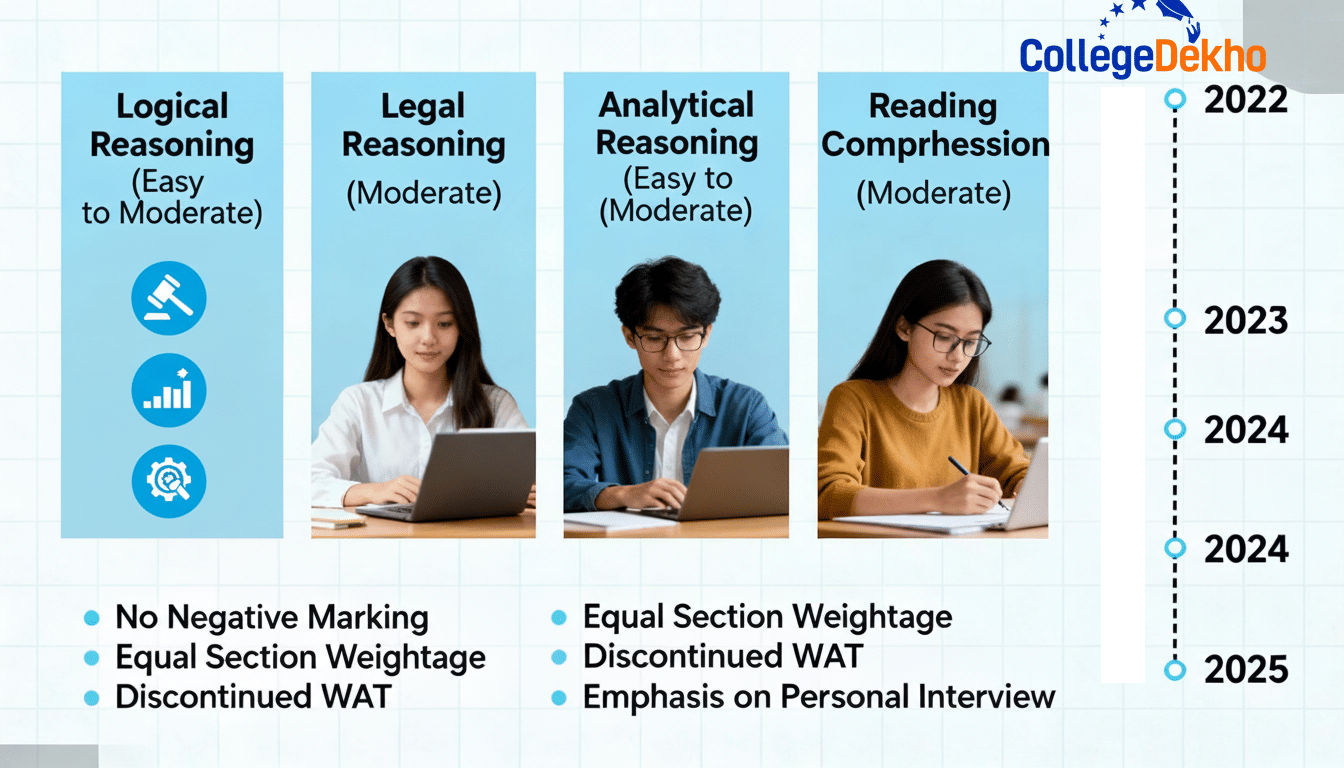
SLAT 2026 Section-wise Difficulty Trends
SLAT 2026 exam pattern consists of five equally scored parts, namely, Logical Reasoning, Legal Reasoning, Analytical Reasoning, Reading Comprehension, and General Knowledge. Every section will consist of 12 questions, where there will not be negative marking, and time will be 60 minutes; time management will be vital. Check the SLAT section-wise difficulty level below:
Logical Reasoning: Logical Reasoning questions were traditionally one of the more accessible parts and have been both easy and moderate, comprising puzzles, sequences and critical thinking questions that do not necessarily take up a lot of time.
Legal Reasoning: As the most important part, Legal Reasoning is of moderate difficulty, where the questions are based on law and its judgment and logical interpretation of the law. This section scoring is easy for candidates who have an excellent understanding of legal concepts and difficult when it comes to the rest.
Analytical Reasoning: It is an area that frequently poses the decisive level - the difficulty level here varies between easy to moderate, with puzzles, coding-decoding and interpretation of data. This section is very time-consuming, but grading when one is good at it.
Reading Comprehension: Short and medium-length passages that involve comprehension of tone, inference and vocabulary are tested, which is mostly of moderate difficulty. To achieve the maximum score in this case, efficient reading and comprehension skills are necessary.
General Knowledge: It contains current affairs of the last 8 to 10 months, as well as static GK, including polity and history. Challenge depends on the level of awareness among a candidate, though it appears to be moderate, particularly when the level of preparation is done in good time and in a holistic manner.
Also Check - Important Topics for SLAT Legal Reasoning 2026
What to Expect in SLAT 2026?
According to the historical analysis of SLAT and the latest changes in exam patterns, the general difficulty of SLAT is expected to remain the same moderate one in 2026. The exam structure is also a computerised test with 60 multiple-choice questions that should be answered in 60 minutes, and the questions are evenly spread across the 5 sections. It is also important to note that the Writing Ability Test (WAT) was also phased out, and the Personal Interview (PI) part of the final selection has become more critical, and the PI performance has been weighted with 30%. Check some additional points to keep in mind for SLAT 2026:
There is no negative marking that motivates one to take up everything.
Equal weightage implies that it is important to prepare it equally.
Management of time will also be one of the strategies because time is very restricted.
The General Knowledge section requires one to keep abreast with current affairs.
Logical and Analytical Reasoning sections are not that challenging, but they have to be practiced regularly so as to avoid traps of time.
Quick Links:
| Best Books for SLAT 2026 | SLAT 2026 Preparation Tips | SLAT 2026 Syllabus |
|---|
The moderate difficulty level of SLAT that has remained steady in the past years renders it easy but challenging for law aspirants who plan to take the examination. Having an opportunity to focus on the enhancement of the main abilities and being aware of the newest events, it is possible to go through the SLAT 2026 test easily and increase the possibilities of being chosen in the Symbiosis law schools.
Learning such trends of difficulties and preparing accordingly will assist aspirants to get the most out of scoring in SLAT 2026, and the road to success in one of the renowned law entrance exams in India remains open.
Related Articles
| What are the most scoring topics in SLAT? | Most Repeated SLAT Exam Question Types |
|---|
In case you have any other queries, write to us in the QnA zone . For any admission-related assistance, either dial the student helpline number 1800-572-9877 (toll-free) or fill out the Common Application Form. Stay tuned to CollegeDekho for more articles!
FAQs
Candidates should focus on balanced preparation across all sections, practicing mock tests to enhance their speed and accuracy. Staying updated with current affairs is essential for General Knowledge. Strengthening legal concepts, sharpening reasoning skills, and reading comprehension practice will boost performance. Preparing for the Personal Interview is also vital due to its weightage in the final selection.
The Writing Ability Test (WAT) has recently been discontinued, placing more importance on the Personal Interview (PI), which contributes significantly (30%) to the admission decision, alongside the SLAT score.
SLAT consists of 60 questions across five sections, with 12 questions each. The total time is 60 minutes, so time management is crucial. There is no negative marking, encouraging candidates to attempt all questions.
Logical Reasoning is generally considered the easiest or most approachable section. Legal Reasoning, being core to law studies, is moderately difficult and requires conceptual clarity. Analytical Reasoning and General Knowledge can pose moderate challenges depending on preparation, while Reading Comprehension requires good speed and comprehension skills.
The SLAT exam has consistently been of moderate difficulty over recent years, balancing questions across Logical Reasoning, Legal Reasoning, Analytical Reasoning, Reading Comprehension, and General Knowledge. This level tests both aptitude and legal knowledge effectively without extreme difficulty spikes.
 Quick Facts
















Similar Articles
RMLAU LLB Admit Card 2026 (OUT): Download Link, Dates & Important Instructions
Marks Distribution for MH CET 2026 Law Legal Aptitude Section
NLU Merit List 2026: Check NLU-Wise CLAT Merit List for All Rounds
CLAT 2026 Cutoff for NLU Jodhpur
CLAT Round 2 Cutoff 2026, 2025, 2024, 2023, 2022, 2021, 2020, 2019 - Check Opening and Closing Ranks for General, OBC, SC, ST
CLAT 2026 Cutoff for NLU Hyderabad