


Candidates preparing for the upcoming JEE Advanced 2026 session can go through this article to know about the major preparation tips and tricks to qualify JEE Advanced 2026 exam with good scores.

Every year, lakhs of students enrol for the JEE Advanced exam, as it is the gateway to IITs' undergraduate engineering and architectural programs. Only students who pass JEE Main 2026 and make it to the top 2,50,000 will qualify for JEE Advanced 2026 . With the exam date approaching on May 17, many students get confused and miss out on the most crucial step i.e. making a preparation strategy and systematic approach, which has time and again proven to be beneficial for all the top-scoring students in various entrance exams that are conducted across the country.
Also Check - Most Repeated Questions for JEE Advanced 2026
JEE Advanced 2026: Top 5 Preparation Tips and Tricks
Based on interviews with JEE Advanced 2025 top rankers, including AIR 1 Ved Lahoti, the final preparation days are not about studying more but about studying differently. Here are top 5 preparation tips related to the best books for JEE Advanced 2026 , important chapters and weightage, study materials and techniques to master before the exam.
1. Practice "2-Paper" Simulation
Toppers don't just solve questions, they simulate the exact 9:00 AM–12:00 PM and 2:30 PM–5:30 PM exam cycle. Your brain must be at peak cognitive performance during these specific windows. Every 3 days, take a full-length JEE Advanced 2026 mock test (Paper 1 & 2) with only a 2.5-hour break in between to build the mental stamina required for the actual day.2. Learn to Shift from Quantity to Multiple-Solution Thinking
While JEE Main is about solving 30 questions quickly, Ved Lahoti (AIR 1, 2024/25) emphasized smart work over unnecessary workload. Instead of solving 100 new problems, take 5 complex problems and try to solve each using three different methods (e.g., solving a Mechanics problem using Kinematics, then Work-Energy, then Impulse). This builds the "conceptual flexibility" needed when IIT Roorkee throws a never-before-seen question format.3. Don’t Just Revise, Analyze
Instead of re-reading NCERT concepts for the ‘n’th, take some time out to analyze your strengths and weaknesses.
You must categorise every mistake you make.
Are your concepts not strong enough?
Are you making mistakes in the calculation?
Did you interpret the question incorrectly?
In the last revision week, make sure to go through those specific concepts. This will help you in making the same error twice.
4. Prioritise Sleep & Logic over Rote Learning
A common myth is that toppers sleep only 4 hours. In reality, AIR 1 Ved Lahoti never compromised on 8 hours of sleep. Why? JEE Advanced is an analytical exam. A fatigued brain cannot "connect the dots" between a Physics concept and a Calculus application. Don't try to start a new topic in the last 30 days. It creates panic. If you want to be in the top 1% candidates, then polish your strong concepts.5. Focus on High-Weightage Chapters
JEE Advanced Papers 1 and 2 both have three sections: Sections 1, 2, and 3 for each of the following: Section I for Physics, Section II for Chemistry, and Section III for Mathematics. Students should be aware that the total marks and number of questions may vary from year to year.
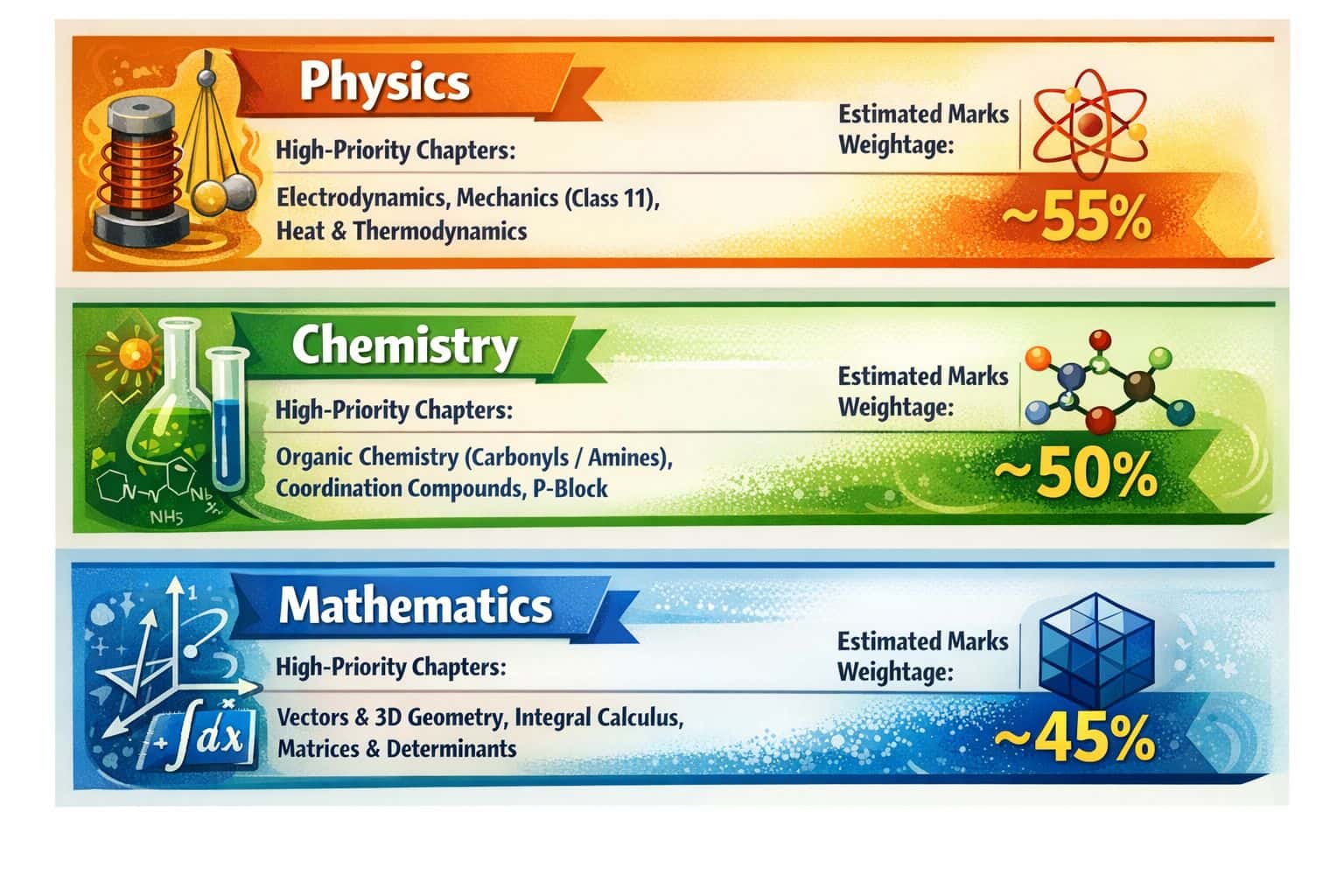
| Subject (Must-Do) | Crucial Subject-Wise Chapters | Approximate Marks Weightage | Mastery Tips |
|---|---|---|---|
| Physics |
Electrodynamics
Heat Mechanics Thermodynamics | 55% |
|
| Chemistry |
Organic Chemistry
Coordination Compounds P-Block | 50% |
|
| Mathematics |
Vectors and 3D Geometry
Integral Calculus Matrices and Determinants | 45% |
|
Also Check - How to Score 200+ Marks in JEE Advanced 2026?
General Tips for JEE Advanced Preparation 2026
The JEE Advanced 2026 exam will likely have difficult questions. Candidates should therefore be careful about the time dedicated to each subject and the number of concepts they have learned or studied each day. Here are a few general tips and tricks for preparing for the JEE Advanced exam.For JEE Advanced, focus on the quality time spent on exam preparation, which is more important than quantity. Prepare a list of learned or revised chapters for the day.
Focusing on the Class XI Mathematics, Physics, and Chemistry chapters is important because 40 to 45 per cent of JEE Advanced questions will be based on the Class XI syllabus.
The majority of JEE Advanced questions are conceptually based, remain mindful when answering them. To achieve 99 percent accuracy or perfection, revise the concepts and shortcuts.
Concentrate on improving your analytical and reasoning skills to do well in the JEE Advanced.
Time management is very important for solving the given questions in a specific time duration. Create a suitable schedule for self-study of all relevant subjects. Give yourself sufficient time to study and revise the subjects. Be practical and keep your goals in mind when you plan your schedule. Organise your time in such a way that you can give each topic and subject equal time and attention.
What Can You Expect from IIT Roorkee in 2026?
The organising committee (IIT Roorkee) always tries to establish its own testing methods, which determine the difficulty level of its examinations and create unique question types.Analysis of the 2019 Paper (Last conducted by IIT Roorkee)
Here is an analysis of the last paper by IIT Roorkee.Overall Difficulty: As per the 2019 paper, the sections were considered as moderate to difficult. On the other hand, Chemistry was easy compared to other sections. Mathematics and Physics were a bit lengthy.
Physics Signature: According to the 2019 papers what is expected is that there will be heavy focus on Electrodynamics and Thermodynamics. These both nearly constituted approx 40% of the total marks in Physics.
The 'No Paragraph' Surprise: In 2019 there was a shift in the regular trends of the paper which was done by removing paragraph-style questions entirely from Paper 1. Rather, more Multiple Correct and Numerical Value types questions were added.
Strategic Takeaway: As per the past trends it has been come to a notice that IIT Roorkee focuses more on multi-concept integration, as IIT Roorkee tends to favor problems that bridge two different chapters (e.g., Fluid Mechanics + Surface Tension).
Many candidates want to crack the exams, but only those who follow these preparation tips succeed. IIT Roorkee will be setting the paper for the JEE Advanced 2026. Historically, IIT Roorkee papers (like 2019) were not just calculation-heavy, but also conceptually based. CollegeDekho experts will guide you in reaching your full potential. From past year papers, it is clear that IIT Roorkee sets papers in a way that you can use your brains to the full potential. When solving JEE Advanced previous year question papers , pay extra attention to the last 5-6 years’ paper. Expect a higher weightage in Mechanics and Modern Physics. In JEE Advance the questions are multiple choice based and hence, requires 100% conceptual clarity to avoid negative marking. For proper planning you have to know all about the blueprint of the examination.
For any query, head to our QnA Zone or fill out our Common Application Form . Stay tuned for more such updates.
FAQs
Candidates should refer to such books which cover the topics prescribed under the syllabus of JEE Advanced in detail for the JEE Advanced 2026 preparations. They should ensure that they study from the latest editions of the books and also involve sample question papers.
Yes. The mock tests of JEE Advanced are of prime significance during the preparation stage of the JEE Advanced entrance exam. JEE Advanced mock tests enable candidates to assess their level of preparation in the real-time setup of the exam. Candidates can identify their areas of strength and weaknesses and assess their speed and time-management skills by attempting the JEE Advanced mock tests.
The JEE Advanced examination takes place in online mode. The JEE Advanced exam pattern usually consists of two compulsory papers (Paper 1 and Paper 2) of 3 hours duration each. The JEE Advanced paper involves multiple-choice questions (MCQs) along with numerical value, integer type and list match questions. The papers include questions from the subjects of Physics, Chemistry, and Mathematics. Questions are asked in the languages of English and Hindi.
Candidates preparing for the JEE Advanced entrance exam should practice consistently with a wide variety of questions from varying levels of difficulty. They should lay emphasis upon understanding the key concepts behind every problem and apply different problem-solving approaches.
Candidates appearing for the JEE Advanced 2025 entrance exam should lay down specific, achievable goals and reward themselves for achieving specific milestones. They should also surround themselves with good company and seek support from friends, family, well-wishers or mentors.
It is suggested for the candidates to start preparing for the JEE Advanced exam as early as possible, ideally 6-7 months before the commencement of the JEE Advanced entrance exam. Early preparation yields in-depth understanding of the topics and provides necessary time for revision.
Candidates should devise a daily study schedule which allots time for every subject and topic. They should also set specific goals for daily or weekly study sessions and evaluate their progress regularly.
Candidates should begin preparing for the JEE Advanced entrance exam by referring to the previous year question papers of JEE Advanced without the help of any coaching centre. Many leading publications also issue previous year questions, from which candidates can keep practicing.
All the subjects of Physics, Chemistry and Mathematics are equally important for the JEE Advanced exam. All are scoring subjects and it is suggested for the candidates to give equal prominence to all the subjects. However, candidates should allocate proper time for each subject based upon one’s evaluation of their strengths and weaknesses.
To achieve a good score in the JEE Advanced entrance exam, it is important for the candidates to adopt a strategic approach. Candidates should understand the exam pattern and syllabus in detail and set up a study plan focusing on conceptual understanding, engaging in solving mock tests and previous year question papers, and seeking valuable advice from experienced mentors.
The time needed for the candidates to prepare for the JEE Advanced entrance exam varies as per each candidate. In general, it takes around 9 to 12 months for the candidates to cover the entire syllabus of the JEE Advanced entrance exam.
Candidates can prepare for the JEE Advanced exam by themselves via referring to NCERT books and the previous year's question papers of JEE Advanced. Candidates can also undertake mock tests to evaluate their level of preparation and examine their time-management skills.
JEE Advanced is a highly competitive and difficult to crack entrance examination which needs candidates to have a clear understanding of the different topics in the subjects of Physics, Chemistry, and Mathematics.
It is advisable for the candidates to go through the previous year question papers of the JEE Advanced exam to be prepared well in advance for the JEE Advanced entrance exam. The previous year question papers of the JEE Advanced exam provide a clear understanding about the type of questions likely to be asked in the JEE Advanced entrance exam.















Similar Articles
Does a 250 Score Guarantee a Top 10 Rank in JEE Advanced?
List of Colleges for 25,000 to 50,000 Rank in TS EAMCET 2026
List of Colleges for 50,000 to 75,000 Rank in TS EAMCET 2026
List of Colleges for 75,000 to 1,00,000 Rank in TS EAMCET 2026
JEE Advanced Expected Opening & Closing Ranks for Top IIT B.Tech Branches in 2026
JEE Advanced Expected Marks vs Rank in CRL 2026