
- We’re on your favourite socials!


 Mumbai (Maharashtra)
 Gallery

IIT Bombay Secures Rs 700 Crore for R&D in 2026
IIT Bombay has achieved its largest-ever annual research and development (R&D) funding, securing Rs 700 crore in 2024. This is a significant increase from Rs 576 crore in 2023 and Rs 502 crore in 2022. The funding comes from both government agencies and private industries, with around 35% of the funds contributed by private sources.
IIT Bombay is focusing on projects that support India's goal of becoming more self-reliant in technology. One of the key projects is the Maharashtra Drone Mission, with Rs 151.8 crore funding from the state’s technical education department. IIT Bombay's R&D efforts are also growing due to increased industry outreach and participation in government research missions. This funding makes R&D the institute's second-largest source of income after government support.
IIT Bombay News

Top 10 Physics Chapters to Master for 100+ Marks in JEE Advanced 2026
To score 100+ marks in JEE Advanced Physics requires a proper strategy. It is achievable by concentrating on the important chapters from the syllabus. The Physics section is difficult in the JEE Advanced exam, and it is one of the most important and toughest subjects, with a mix of some Numerical Type and other Conceptual questions being asked in the exam. High weightage topics are Rotational Mechanics, Electrostatics, Thermodynamics, Modern Physics, Geometrical Optics, etc. These are the most important chapters to study as they are concept-based and are repeatedly asked in the exam. Mechanics itself constitutes nearly 25-30% of the Physics section.

List of IIT Colleges in India: Rankings, Courses Offered, Fees & Seats
The Indian Institutes of Technology, popularly known as IITs, are the country's most prestigious and top engineering institutes. They are autonomous institutes of higher education in the technical field and are widely known for their BTech courses. There are 23 IIT colleges in India governed by the Institute of Technology Act, 1961 - a common IT council. Candidates often wonder about which IIT is best in India. IIT Bombay, IIT Kharagpur, IIT Madras, and IIT Kanpur are some of the best IIT colleges in India. Candidates can check the list of top IIT colleges in India as per the NIRF 2025 Rankings. Before moving forward with top IITs in India, do you know What is the Full Form of JEE?

JoSAA Counselling 2026 - Seat Allotment, Important Dates, Documents Required, Cutoff, Counselling Process
The JoSAA Seat Allotment Round 1 for 2026 is expected to be conducted in mid-June 2026, with students required to complete online reporting, document upload, and fee payment within the given deadline, likely extending over 4–5 days after allotment. The second round of seat allotment is expected to begin in the third week of June 2026, followed by subsequent rounds at regular intervals. Students will be required to complete fee payment and respond to any queries within the specified timelines for each round.

IIT Placements 2025-26: Highest Package Offered, Top Recruiters
IIT Placements 2025-26: IIT Placements for the year 2025-26 will be conducted in two phases for all IITs, with the first phase typically beginning in December and the second phase running from February to May. As per the official placement reports published by the respective IIT Training & Placement Cells, IIT Bombay recorded an average package of approximately INR 23.50 LPA, with sectors like technology, finance, and consulting dominating recruitment. IIT Indore recorded an average salary of around INR 23.50 LPA, with top-performing BTech branches like Computer Science Engineering and Electrical Engineering having the highest averages. According to IIT Kharagpur's official Training & Placement Cell data, the institute recorded a domestic highest package of INR 2.68 CPA (Crore Per Annum), with top recruiters including Apple, Texas Instruments, Goldman Sachs, Uber, and SLB (formerly Schlumberger). IIT Delhi recorded a domestic highest package of INR 1 Crore Per Annum, with more than 50 offers exceeding INR 1 Crore during Phase 1. Some of the most prominent recruiters across the top IITs in India include Microsoft, Google, Apple, Qualcomm, Amazon, Flipkart, ISRO, American Express, Boston Consulting Group, and Intel.

UCEED 2026 Result to be released on March 6 at uceed.iitb.ac.in
UCEED 2026 result will be released on March 6, 2026, on uceed.iitb.ac.in. You will be able to download your result by logging in with your login and password. The result will reflect your qualifying status. The scorecard will display Part-A marks, while if you get shortlistedl then you will see Part-B marks, total score, and All India Rank, which determines eligibility for IIT seat allotment. You will be able to download your scorecard from March 10 to July 31, 2026.
IIT JAM 2026 Cutoff for IIT Bombay: Check Opening and Closing Ranks for IIT Bombay MSc Admission
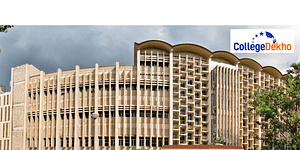
IIT JAM 2026 cutoff for IIT Bombay will be released by IIT Bombay on March 27, 2026 in the form of opening and closing ranks. IIT JAM admission list will be released based on students' choices and merit on the JOAPS portal. Students clearing JAM qualifying cutoff can only participate in the JAM 2026 counselling and secure seat based on cutoffs. IIT JAM 2026 exam was conducted on February 15, 2026. Students who will be shortlisted and would like to take admission must pay the seat booking fee. The seat booking fee differs from category to category. It is Rs 15,000/- for the General/OBC-NCL/EWS category and Rs. 7,500/- for the SC/ST/PwD category. The payment must be done online.
Latest: The IIT JAM 2025 exam result will be released on March 20, 2026 by IIT Bombay. The IIT JAM 2026 Result can be downloaded by logging in with your registered account on the JOAPs portal. JAM 2026 Scorecard will be available from March 27, 2025. Post-Result, the IIT JAM Counselling Process will begin in early April 2026, with the release of the admission form on the JOAPS portal. The direct link to check IIT JAM 2025 results will be provided here.
Direct Link: IIT JAM 2026 Result (To be Activated)
Students will be accepted to institutes based on the IIT JAM 2026 results and the options they selected in the admission form. Furthermore, there are separate IIT JAM 2026 cutoff marks for General, OBC, and SC/ST applicants.
Based on the qualifying marks obtained in various subjects, students will be able to get admission to IITs through IIT JAM Counseling 2026. Below, we have provided the detailed structure and break up of IIT Bombay MSc Cut-Off for previous years (2025, 2024, 2023, 2022, 2021 and 2020) respectively for the basic understanding of the cut-off system. Check the opening and closing marks of different subjects based on the different categories. Along with this, an expected IIT JAM cut-off list for 2026 for different subjects are also mentioned.
Top IIT Colleges in India 2026: Ranking, Placements & Cutoff Trends
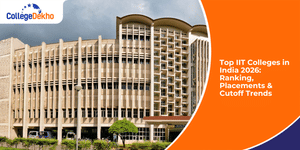
The top IIT Colleges in India 2026 include IIT Madras, IIT Delhi, IIT Bombay, IIT Kanpur, IIT Kharagpur, IIT Roorkee, IIT Hyderabad, etc., among others, according the NIRF rankings for the year 2025. At INR 2.5 crore (international) and INR 1.48 crore (domestic) respectively, IIT Hyderabad and IIT Bombay can be expected to offer the highest salary packages. Da Vinci, Jane Street, and NK Securities may make it to the list of organizations with the highest compensation.

CEED Passing Marks 2026: Category-wise Cutoff
The expected CEED passing marks 2026 for different categories are predicted to be roughly 25 for OPEN category applicants, 23 for the OBC/ EWS category, and 13 for the ST/ SC/ PWD category, based on the cutoff trends from the previous year. IIT Bombay will publish the CEED 2026 results on March 4, 2026 and the CEED cutoffs 2026 for Part A have been released on February 5, 2026, on its official site, ceed.iitb.ac.in. They have been released in the form of means and standard deviations. The mean and standard deviation for CEED 2026 Part A are 39.35 and 16.89, respectively. The CEED 2026 exam was conducted on January 18, 2026.

UCEED Passing Marks 2026: Category Wise Cutoff
UCEED Passing Marks 2026: The UCEED passing marks 2026 or the UCEED 2026 cutoffs for Part A has been declared on February 5, 2026. IIT Bombay have also declared the official mean and standard deviation for Part A. The mean and standard deviation for Part A (UCEED 2026) are 70.86 and 25.77, respectively. A good score for UCEED 2026 exam is generally considered to be 200+ out of 300. If you belong to the general category, you must aim to score above 200+ to secure a spot among the top 100 candidates. There is no minimum passing or qualifying score in UCEED 2026. The exam aims to get a high rank that would help in getting admission to a B.Des program in one of the UCEED participating colleges in 2026. Read below to learn about the expected UCEED passing marks 2026 to know your chance to study at top design colleges in India.

Why IIT Bombay Summer Internship 2026 Is a Big Opportunity for Students
When you are drawing your summer 2026 map, the IIT Bombay Summer Internship should be on your list, but not because of the obvious reasons. While any internship opportunity at the prestigious IIT Bombay is a big deal, the 6-8 week long Summer Internship is a class apart. There will be no lectures or shadowing professors. Rather, you will be solving real problems with PhD scholars in the laboratories on the bleeding-edge projects.
Related News
KCET Physics All Formulas PDF
KCET Physics All Formulas PDF -Are you preparing for KCET 2026? Mastering the Physics section can significantly boost your overall score. Based on a thorough analysis of previous years' KCET question papers, the Physics section is heavily formula-driven, making it essential for candidates to revise key formulas regularly. The KCET Physics syllabus, as prescribed by the Department of Pre-University Education (PUE), Karnataka, covers both First and Second PUC topics. With consistent practice and the right formula sheet, scoring 160+ in KCET becomes an achievable target for you. This article provides a comprehensive guide to KCET Physics All Formulas PDF 2026, along with syllabus details, topic-wise weightage, and previous year questions to strengthen your exam preparation.
Also read | KCET Answer Key 2026 Live Updates (Unofficial Keys)

KCET Physics Answer Key 2026
After appearing for the KCET examination comes the part that actually matters, that is figuring out how your performance was. For all of you who are taking the test this year, KCET Physics answer key 2026 solutions with memory-based questions will be made available here. Using these, you can check if you have attempted all the 60 questions or left a few. By checking your answers against the KCET 2026 unofficial answer key you will get a clear idea and a number-based picture of where you stand before the official results are out.

List of Colleges Accepting KCET 50,000 to 1,00,000 Rank for B.Tech Admission 2026
The list of colleges accepting KCET 50,000 to 1,00,000 rank for B.Tech admission 2026 include MSRIT, BMSCE, DSCE, etc. After the KCET exam is over and you are expecting a rank between 50,000 - 1,00,000, then you can refer to this article to shortlist a tentative list before the result is out. While it is difficult to get a CSE specialisation with this rank range, some of the specialisations that are possible with a 50,000 to 1,00,000 rank in KCET include Civil Engineering, Automobile, Aerospace Engineering, etc. Read on to know more details about the KCET 50000 rank colleges 2026 along with the one lakh range.

KCET Mathematics Answer Key 2026: Download Solutions & Check Your Score
Following the KCET 2026 exam on April 23, you will surely want to check your answers as soon as you walk out of that exam hall. To make it easier for you, KCET Mathematics answer key 2026 along with memory-based questions will be updated here shortly. KCET 2026 is your ticket to the best engineering and science colleges in Karnataka and each mark in the Mathematics section does count.The KCET paper consists of 60 questions with 1 mark each and which has to be attempted within 80 minutes. We will immediately provide you with the best and the most accurate answer key and will do it as soon as the exam gets over. The links to the questions of KCET Mathematics that you will be able to download will be provided in the article below.

SRMJEEE 2026 Question Paper Analysis; Day-wise Difficulty Level, Topics Asked, Cutoffs
Will you be sitting for the SRMJEEE 2026 exam? If yes then the question paper analysis will help you immensely in understanding details about the exam, its difficulty level, paper structure, etc. The SRMJEEE 2026 question paper analysis on this page will be prepared based on the initial reviews provided by the exam takers. Along with this, we will also be including details about the high weightage topics, questions from which have a high probability of appearing in the exam. Electrostatistics, Nuclear Physics, Optics, Probability, Vector Algebra, and Number Systems count as some of the SRMJEEE high weightage topics. Read on to know more about the SRMJEEE 2026 day wise difficulty level, topics asked, cutoffs etc. here!
Top Courses at IIT Bombay
Related Questions
Admission Updates for 2026
Sanjay Ghodawat University
Kolhapur (Maharashtra)
Jawaharlal Darda Institute of Engineering and Technology
Yavatmal (Maharashtra)
Alard University
Pune (Maharashtra)
MIT ADT University
Pune (Maharashtra)
NIT's Late Annasaheb Patil Polytechnic College
Nashik (Maharashtra)
Related News






Similar Colleges


Explore More Engineering Colleges in Maharashtra
By Degree
By Specialization
By Degree
By Specialization

