




The NTA Score in JEE Main Results, which is based on the relative performance of all candidates who took the exam in a single session, are normalised score across multi-session papers. For every
JEE Main 2026
exam session, the marks obtained are converted into a scale from 100 to 0. The NTA score in the JEE main result shows a percentage of candidates who, in that session, received raw scores that were equal to or below that specific candidate. The JEE Main Session 1 Result was released on February 16, 2026, on the official website at jeemain.nta.nic.in. Candidates can access their scorecard/results by logging into their registered accounts using their application number and password. The National Testing Agency releases the JEE Main 2026 result separately for Session 1 and Session 2.
Check Also:
| NITs for 99 Percentile in JEE Main 2026 | Is 95 Percentile Good in JEE Mains 2026? | NIT CSE Expected JEE Main Cutoff Mark and Rank 2026 |
|---|
What is an NTA Score?
The NTA score is a normalised score that reflects a candidate's relative performance in JEE Main compared to other test-takers in the same session. Unlike traditional marking schemes that simply award marks based on the number of correct answers, the NTA score takes into account the difficulty level of the exam, the number of test-takers, and the overall distribution of marks. NTA score in JEE Main Results is the primary criterion for shortlisting candidates for the next stage of the JEE selection process, which is the JEE Advanced exam. They are also considered during admissions to various engineering colleges across India that accept JEE Main scores for their programs.
How to Calculate NTA Score in JEE Main Results?
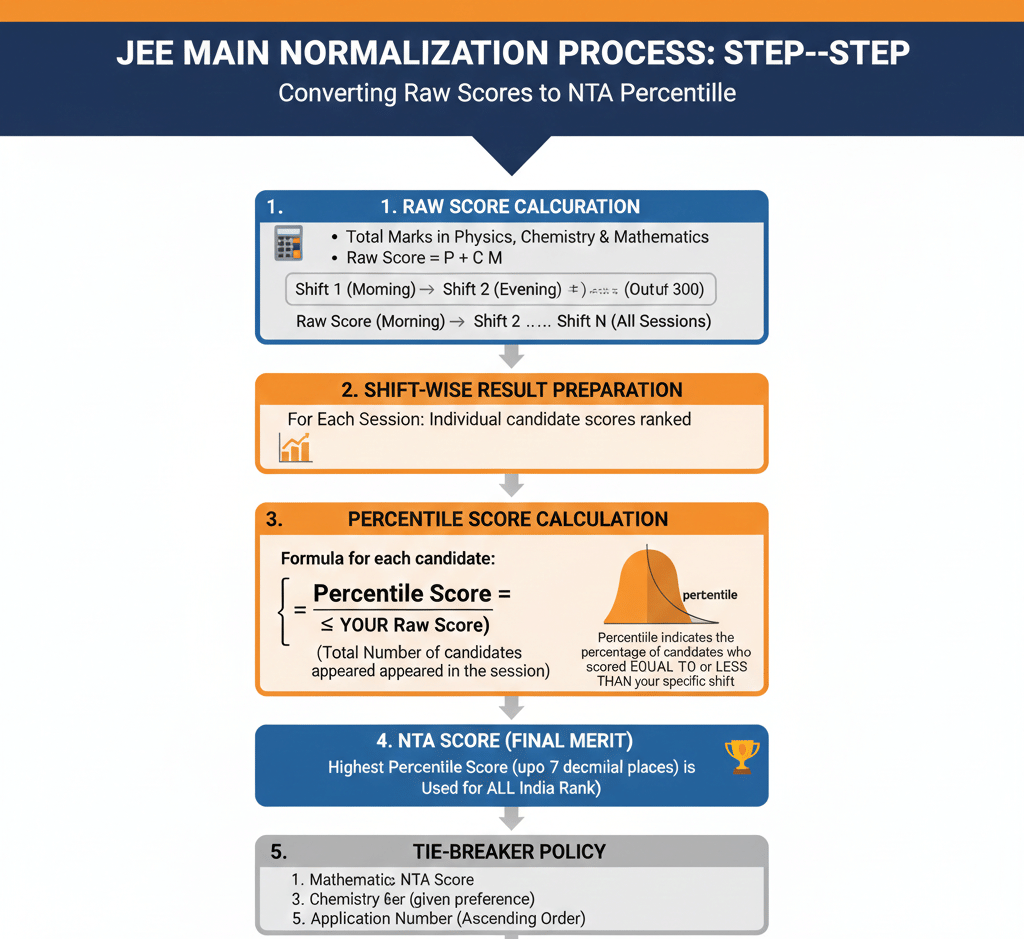
To get the NTA normalised scores, the candidate's percentile score must be determined. To prevent bunching and lessen the possibility of ties in rankings and scores, the National Testing Agency typically computes percentile scores to seven decimal places. The formula to calculate percentile score is -

Steps to Calculate NTA Score in JEE Main Results
To calculate the NTA score in JEE Main Results a series of steps are followed which is mentioned below -
Raw Scores: Each question in JEE Main is assigned a specific number of marks. A candidate's raw score is determined by adding up the marks for all the correct answers they provide. Negative marking is also applied for incorrect answers.
Normalisation Process: JEE Main is conducted across multiple sessions throughout the year. The difficulty level of the question paper might vary slightly between sessions. To ensure fairness and equal opportunity for all candidates, the NTA employs a normalisation process to account for these variations. This process transforms the raw scores obtained by candidates in each session into a scale ranging typically from 100 to 0.
Percentile Calculation: Once the normalised scores are obtained, the NTA calculates the percentile score for each candidate. The percentile score indicates the percentage of candidates who scored equal to or lower than a particular candidate in that session. For instance, an NTA score percentile of 90 implies that the candidate has outperformed 90% of the test-takers in their session.
How JEE Main Percentage is Calculated?
The percentile for each candidate in the session will be calculated as follows:
Let’s consider TP1 as the percentile score of the total raw score of a candidate in the JEE Main.

What is the Normalisation Procedure?
Exam results normalisation is the process of modifying scores to reflect differences in test difficulty among various exam papers or test sets. This is done to guarantee consistency and fairness in the ranking or grading process. In order to normalise scores and guarantee that the final grades fairly represent the students' performance in relation to the exam's difficulty, statistical techniques may be used. Thus, the goal of the normalisation process is to resolve any disparities in test sets or exam papers' varying degrees of difficulty. It is predicated on the idea that different tests and test sets present different levels of difficulty, and that it would be unfair to compare raw scores without accounting for these variations.
Also Read: JEE Main 2026 Normalisation
Key Points to Remember About NTA Scores
Check out some of the important points related to the NTA scores:Not the Same as Percentage: The NTA score is not the same as the percentage of marks obtained in the exam. It is a relative score based on the performance of other candidates in the same session.
Separate Scores for Each Subject and Total: The NTA score is calculated for each subject (Physics, Chemistry, and Mathematics) in JEE Main, as well as for the total score.
Not an Aggregate: The NTA score for the total is not simply an average of the individual subject scores. A specific formula is used to calculate the total NTA score.
Benefits of Using NTA Scores
You can understand the benefits of using NTA scores here:
Ensures Fairness: The NTA score system helps to ensure fairness across multiple exam sessions by accounting for variations in difficulty level.
Compares Performance: Percentile scores based on NTA scores allow candidates to effectively compare their performance with others who took the exam in the same session.
How to Calculate NTA Rank from NTA Score?
It would make sense for a candidate to compare themselves to the top scorers by examining their percentile scores. Similarly, they believe that knowing their percentile could help them comprehend their relative standing. The JEE percentile calculator is provided below. It is also applicable as a percentile predictor for JEE Mains. To determine your JEE Main 2026 rank based on your percentile score, we can apply the formula below.
([100 - P] / 100) * N + 1
Where,
N is the total number of students who have appeared for the exam
P is the percentage of students below or equal to your marks
(100 - P) is the percentage of students above your marks
([100 - P]/100) * N+1 is the number of students above your marks
Quick Links:
- List of Colleges for 50-60 Percentile in JEE Main 2026
- List of Colleges for 60-70 Percentile in JEE Main 2026
- List of Colleges for 70-80 Percentile in JEE Main 2026
- List of Colleges for 80-90 Percentile in JEE Main 2026
JEE Main 2026 Tie-Breaking Policy
The JEE Main 2026 tie-breaking policy is used by NTA to decide ranks when two or more candidates score the same NTA percentile or total marks. Since lakhs of students appear for the exam every year, ties are very common, especially at higher percentiles. To ensure fairness in the final merit list, NTA applies a subject-wise comparison system.
According to the tie-breaking criteria, candidates are ranked higher based on their performance in specific subjects. First, the student with a higher score in Mathematics is given preference. If the tie continues, the Physics score is considered next, followed by the Chemistry score. If candidates remain tied even after subject comparisons, NTA may use additional parameters such as the candidate’s age, giving preference to the older candidate.
JEE Main Marks vs Percentile vs Rank 2026
Candidates should be familiar with JEE Mains 2026 rank vs. percentile analysis in addition to JEE Mains marks vs. percentile. Candidates can determine what rank will fall at a given percentile by using the JEE Main Marks vs Percentile vs Rank 2026 analysis. The percentile vs rank is determined by several factors, including the exam's difficulty level, the number of students taking it, the percentile vs. rank from the prior year etc.
Also Read: JEE Main Marks vs Percentile vs Rank 2026
Related Articles
By understanding the concept of JEE Main result 2026 NTA score and following these tips, JEE Main aspirants can approach the exam with greater clarity and confidence, putting them on the path to securing their dream engineering seat.















Similar Articles
AP EAMCET 2026 May 15 Question Papers with Answer Key Solutions (Out)
Can I get CSE with 40,000 Rank in AP EAMCET 2026?
What is the rank for 75 marks in AP EAMCET 2026?
ECE vs CSE vs AI/ML: Which Branch Should You Choose Based on Your AP EAMCET Rank?
13,759 M.Tech Seats Available through GATE CCMT Counselling 2026: Check category-wise seats details
List of Colleges for 10,000 to 25,000 Rank in AP EAPCET (EAMCET) 2026