



Your hands are trembling while comparing your answers with those of a friend after the exam. That question in the chemistry section- was it option B or C? The following few weeks after the JEE Mains 2026 seem to be interminable because you will be preoccupied with thoughts of every mark, every possible mistake that could have been avoided, waiting to know what your score holds.
After your exam, you can't sleep. Your mind keeps revolving around that physics question from section B. You already are on the third college predictor JEE Mains, comparing keys to answers, and your calculator application is more active than your social media. This is the JEE aftermath, and uneasy worry mingles with hopeless interest.
But there is something no one can tell you in this state of nervous waiting: the number you are obsessing over now is not the number you should actually worry about. Your raw score is only the tip of a bigger iceberg.
Related Links:
What Students Misunderstand About JEE Mains Marks
The biggest misconceptions that you need to clarify to control your post-exam panic right now are:
The Percentile Funk: It is common knowledge among most students that once you score 120 marks, it is the same thing no matter when you took the JEE Mains 2026. It doesn't. Your friend with the 125 in the day 1 exam is likely to get a lower percentile than your 115 on day 2 when the session you took was more difficult. This is called normalization and this is where confusion is the greatest.
The Comparison Trap: You sit there, and you are thinking, Rohan got 135, and I got 118, I am doomed. Wrong. You cannot have that comparison with Rohan unless he took the same shift that you took. Different shifts vary in terms of level of difficulty, various distributions of questions and varying pools of competition.
The Magic Number Myth: I need to have 95 percentile to get into NIT is a statement you have most likely heard or said. The reality? Cutoffs change every year. A 92 percentile with a home state quota may get you into a higher branch than a 97 percentile. The choice of your category, state and branch is as important as your percentile.
The Single Attempt Mindset: A lot of students consider the first attempt scores to be final. But it's not. JEE Mains occurs twice- typically in January and April in the same year. Also, remember, you can attempt JEE Mains up to six times across three consecutive years after passing Class 12th, with two sessions available each year.
What Does JEE Mains Marks Actually Reveal?
Your score isn't just a number; it's a gateway to specific college tiers. This breakdown shows exactly what doors open at each level, so you can stop comparing yourself to others and start planning your actual options.
Score Range | Likely Percentile | What This Opens For You | Admission Prospects & Strategy |
|---|---|---|---|
180-250 | 98-99+ | Top NITs, IITs (via Advanced) | You're in elite territory, but branch matters |
140-180 | 95-98 | Good NITs, top IIITs | Strong chances for engineering branches |
100-140 | 85-95 | Mid-tier NITs, IIITs, GFTIs | Home state quota becomes crucial |
60-100 | 70-85 | State colleges, private institutes | Focus on colleges with good placements |
Understanding Your JEE Mains 2026 Marks
What is the meaning of getting a score of 115 marks? First of all, this is your raw score, i.e. your score in that particular session without any corrections. The next stage is normalization in which NTA corrects scores in various shifts so that they are comparable. Your normalised score would be higher than your raw score if your shift was more difficult. The simplified formula for calculating your percentile is:
Percentile = (Number of candidates with a raw score equal to or less than yours/ Total number of candidates in the session) × 100
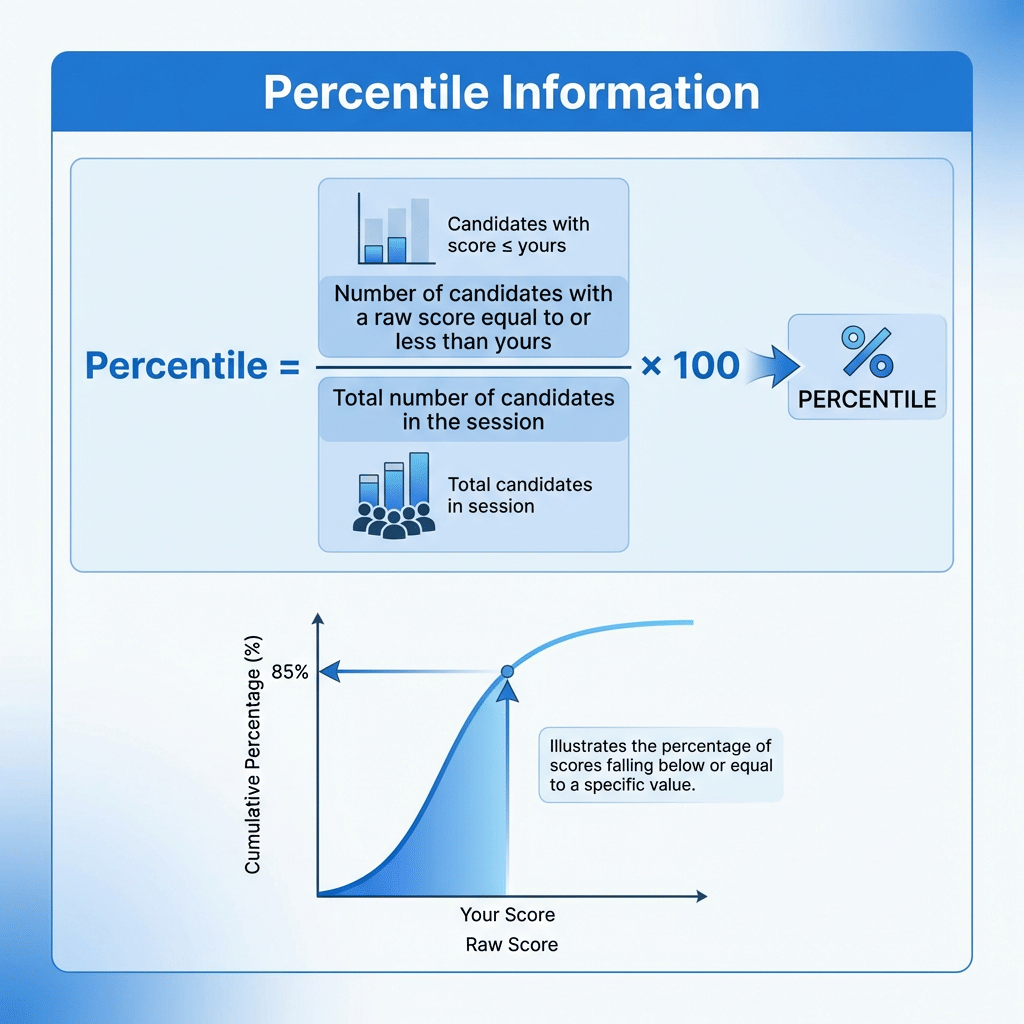
This calculation ensures that your final result reflects your performance in relation to your specific peer group, thus changing your mere raw scores into a standard NTA score.
The real picture is in the percentile. The point of the 90th percentile does not imply that you got 90 per cent marks, it implies that you did better than 90% of the appearing candidates.
Enter your marks in the College Predictor JEE Mains: Applications such as the JEE Mains 2026 College Predictor are used to predict where you stand based on your projected marks. These predictors rely on past-year data and tendencies of normalisation to provide a likely percentile and rank range. However, they might not be completely accurate as the final results depend on a lot of factors.
Predictors turn your anxiety into actionable data, allow you to explore various score scenarios, allow you to shortlist colleges before official results, and display category-wise predictions to candidates who are reserved.
But one must understand that they operate using previous data, and there may be a variation in the level of difficulty this year, which will affect your rank. The final percentile may be within a range of 1-3 points as compared to the predicted percentile, thus creating a difference of thousands of ranks.
Also Read: Steps to Challenge JEE Main 2026 Answer Key
Using JEE Mains College Predictor Without Overtrusting Them
Approach the predictor smartly - College Dekho JEE Mains rank predictor can serve as a roadmap that is to be followed, not as a conclusive judgment. Check your most realistic expected score and then add a buffer of 5000 ranks to be on the safe side.
- Follow a three-tier list approach: Create a list of colleges in your range of predicted rank, though also take into consideration the 10,000 ranks above and below. Prepare an ambitious list (in case of prediction), a realistic list (in case of rank 5000 lower), and a safe list (in case of rank 10,000 lower).
- Don't be overconfident with your answers: Do not say (because of a College Predictor JEE Mains) I am getting a 95th percentile. Be true with your inputs- in case you are not sure about some 10 questions, then do consider it while calculating your marks.
- Do not depend on only one college predictor for JEE mains: Check 2-3 various predictors. Assuming that one predictor reports a 92-94 percentile and another reports 90-93, your realistic range is likely to be 90-94.
- The actual time when you should use the College Predictor JEE Mains: They should not be used until the official JEE Mains 2026 Answer keys to the answers are issued, and you have once more checked your answers with care.
- Some predictors can bring your anxiety levels down to a manageable level by providing you with a point of reference in your college research, not to take the place of official results. The most effective tip is to create a savvy college choice list prior to the counseling becoming open, but in this way, you will be prepared once real outcomes come in.
Also Read: JEE Main 2026 Predicted Safe Rank for NIT Admission
It is okay to be anxious just before the JEE Mains 2026 Results, but don’t let that overwhelm you. The scores depend on a lot of reasons, such as the normalisation, percentiles, category ranks and not just your raw scores. Let me assure you that this stress is temporary, and understanding how the scores truly work will calm you and will help you make a conscious decision. All the Best!
In case of any queries related to JEE Mains 2026, reach out to us on the CollegeDekho QnA zone . Also, please stay tuned to keep yourself updated on all major Engineering exams.
FAQs
Yes, especially through the home state quota and for certain branches. Check previous year cutoffs for your specific state and category.
Your raw marks stay the same, but your normalised score may differ slightly based on your shift's difficulty level compared to others.
Above 90 percentile is considered good for NITs. However, the 75-85 percentile also opens quality options in IIITs, GFTIs, and state colleges.
Wait for official results, percentile is calculated after normalisation across all shifts. Your raw marks won't directly convert to a percentile through simple formulas.















Similar Articles
GATE 2026 IN Expected Marks vs Rank Analysis: Check Raw Score and Scaled Score Analysis
List of PSU Recruitment through GATE 2026
Didn’t Get an IIT? Why an NIT Can Still Be a Smart Choice
List of PSUs for Civil Engineering through GATE 2026 - Eligibility, Application Form, Selection Process, Average Salary
How to Get Admission in MTech Courses at IITs, NITs Without GATE Score?
Why a College Predictor Can Reduce Stress After JEE Mains