


Claude Live Session by Experts
Practical · No theory · See it work live
Saturday, 6 June
11 AM – 1 PM
2 HOURS
You know well that SRMJEEE Chemistry has 35 questions, and they each carry 1 mark. There is no negative marking and this implies that each question that you are trying is an opportunity to get, not to lose. It is all about having the right chapters that you can concentrate on. The official SRMJEEE 2026 Chemistry syllabus contains 12 units (all of Class 12 NCERT). By attacking the most scoring ones wisely, 25+ is indeed possible.
(Source: 2026 SRMIST Admission Brochure Syllabus)
Also Read: Top 10 Most Repeated Topics to Study for SRMJEEE 2026
The 7 NCERT Chapters You Must Focus On For SRMJEE Chemistry
According to the official SRMJEEE 2026 syllabus and the analysis of past year papers, the following chapters are always with the highest weight:
1. Electrochemistry (Unit 2): Learn the Nernst equation, standard electrode potentials, molar conductivity, and laws of Faraday. Maintain a formula sheet on one-page and update it after every 3 days, as this chapter is all about how clear you are with the formulas.
2. Coordination Compounds (Unit 7): Learn about IUPAC nomenclature, isomerism, Werner theory, VBT and CFT fundamentals. Name at least 10 different compounds: this will be easy when you understand the pattern.
Pro-tip: SRMJEEE has always tested IUPAC in bridging ligands, practice five such examples as they are high-probability 1-mark questions.
3. Aldehydes, Ketones and Carboxylic Acids (Unit 10): Learn about nucleophilic addition reactions, aldol condensation, Cannizzaro reaction, and acidic nature of carboxylic acids. Write a list of all named reactions having one-line summaries to quickly revise.
4. Chemical Kinetics (Unit 3): Rate laws in the form of cover rate, order of reaction, zero and first order rate equations that are integrated, and the Arrhenius equation. Numbers of this chapter are very simple, regular practice of 2-3 problems per day is sufficient.
5. Solutions (Unit 1): The emphasis on colligative properties - Raoult law, lifting of boiling point, lowering of freezing point, and osmotic pressure. Categorical questions of this chapter are quite straightforward and direct, and if your formulas are clear, you can score well here.
6. p-Block Elements (Unit 5): The official SRMJEEE syllabus only includes Groups 16, 17 and 18. Learn their oxides, hydrides, significant compounds (such as SO 2, H 2 S O 4, HCl) and tendencies of their properties. Divide into groups and analyse a group at a time.
7. Haloalkanes and Haloarenes (Unit 8): Learn about the mechanisms of substitution reactions, the nature of C X bond, and optical rotation. This chapter is not bad and easy to score when you know the logic of the reaction and not memorising.
*Note: A most frequent mistake that the students make in electrochemistry is that they forget to convert cm square to m square or vice-versa in Conductivity problems. Always check your SI units!
(Source: SRMJEEE previous year question papers analysis)
SRMJEE Chemistry Chapter-Wise Weightage at a Glance
You can refer to the below table to understand the chapter wise weightage. Since the test requires solving questions in under 60 seconds, these chapters are prioritized for their formula-driven numericals and direct factual recall, allowing you to maximize your score within the tight time limit.
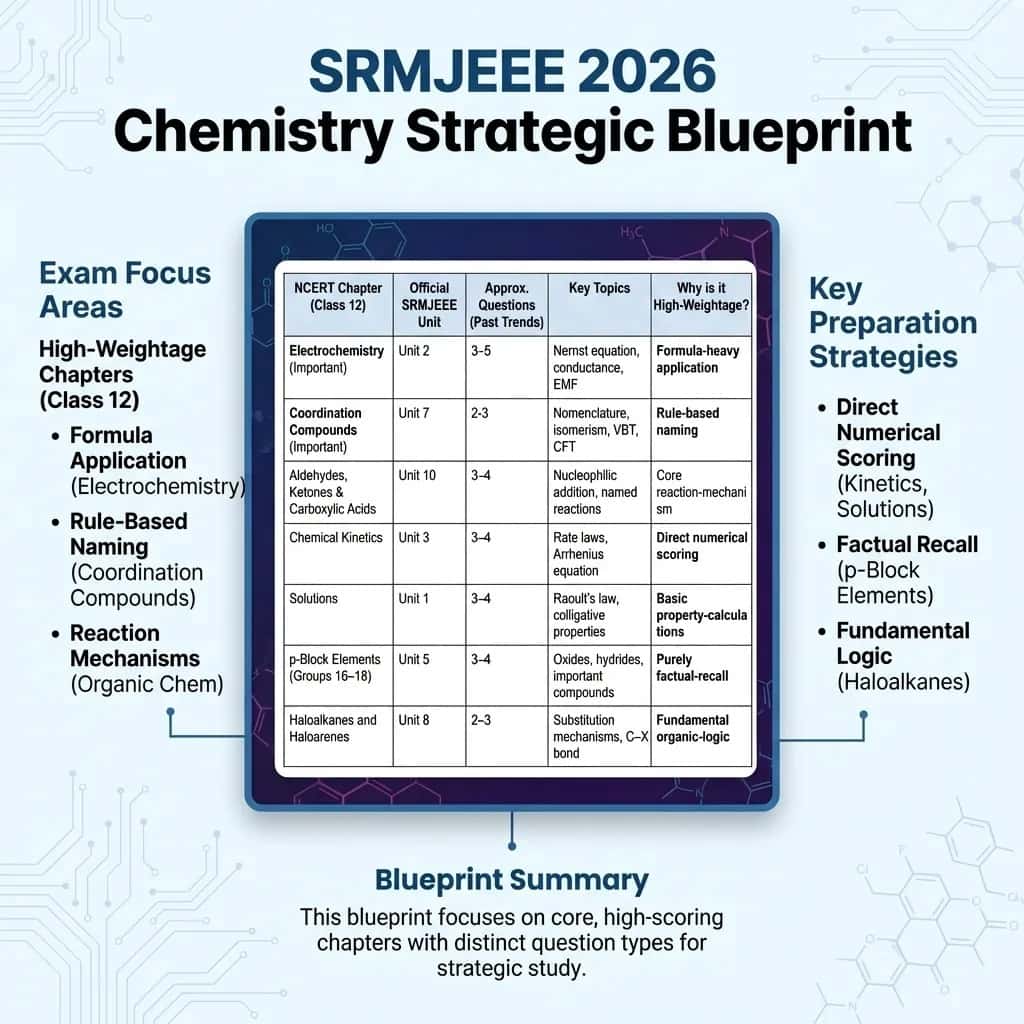
*Note: Question numbers are approximate estimates based on past paper trends. SRMIST does not officially release chapter-wise question distribution.
How to Actually Study These Chapters and Score 25+
It is always recommended to start with the Electrochemistry and Solutions chapter first as they both are heavily numerical and require consistent formula practice. Before immediately jumping on solving the previous year SRMJEE style questions from the chapters, read the NCERT once and understand the concept thoroughly.
When it comes to Organic chapters like the Aldehydes, Ketones and Haloalkanes, just do not blindly memorise the reactions but instead try to understand why a reaction is taking place. If you know the mechanism then you will be able to tackle even those questions that you have never seen before.
For p-Block Elements, stick strictly to Groups 16, 17, and 18 as per the official syllabus. Do not waste time on Group 15, it is simply not part of the SRMJEEE 2026 Chemistry syllabus .
Spend the last 10 days doing chapter-wise SRMJEEE 2026 mock test . Do not start full-length mocks too early, it is simply wasting time if your chapter concepts are not solid yet.
Also Read: Does Appearing in SRMJEEE Phase 1 Give You an Edge with Early Ranks & Scholarships?
If you will go through the SRMJEEE Chemistry syllabus, you will understand that the topics are entirely taken from the class 12 NCERT and has 12 units in total. If you develop a strong understanding of the above mentioned 7 high-weightage units duly verified from the official syllabus and real exam analysis, you can surely outperform those who do not have a set direction to move forward in. It is always suggested to stick to the syllabus, revise purposefully and then you will see that scoring 25+ is not that a big deal!
In case of any queries on the topic, SRMJEEE 2026 Exam, reach out to us on the CollegeDekho QnA zone . Also, please stay tuned to keep yourself updated on Engineering exams.
If you have further queries regarding admission to top private engineering colleges in India , you can write to hello@collegedekho.com or call our toll free number 18005729877, or simply fill out our Common Application Form on the website.
 Quick Facts














Similar Articles
Top Karnataka B.Tech Colleges Offering Robotics Course through KCET Counselling 2026
Top Bangalore Colleges offering B.Tech AI ML and Data Science: Fees & Admission Details; Placement Trends
Top Pune Colleges offering B.Tech in AI: Fees, Admission & Placement Details
IIT Lower Branch vs NIT CSE vs BITS Pilani: What Should You Choose in 2026?
Claude AI and Coding: How an AI Assistant is Changing the Way we Program
NITs offering B.Tech in Artificial Intelligence through JoSAA 2026: Total Seats Available, Cutoff Details