



The GUJCET exam is a test of speed, efficiency, and accuracy within the limit of 180 minutes. To cover all the 120 questions, you need to give 1.5 minutes for each question. To secure top performance, proper strategy needs to be implemented. The only way to achieve this is to ensure zero wasted time and proper optimisation. This requires training in the form of practice. In this guide, we are going to break down exactly how to train your brain for speed without sacrificing accuracy.
Also Check - GUJCET 2026 Chemistry Essential Concepts & Reactions You Can't Miss
Strategic Shortcuts to Answer Fast in GUJCET 2026
"The secret isn't studying 15 hours one day and nothing the next. GUJCET success requires you to study every day without breaks. You should spend your 30-minute study session, which you have during busy days, to practice solving multiple-choice questions from GUJCET previous year question papers . Your brain needs daily practice to sustain reflexes during a speed-based examination." — Aman Pathak (GUJCET & JEE Ranker)
In GUJCET , you don't get extra points for solving a problem. The OMR sheet doesn't care if you derived the formula or just knew the shortcut; it only cares that the bubble is filled correctly. For example, in Physics, check the units/dimensions in the options. If the question asks for force, and two options have units of energy, you can instantly eliminate 50% of the choices.
Mastering the Art of Elimination
To boost speed and accuracy, the elimination technique helps with objective exams. This is especially powerful in Chemistry and Biology.
Feature | Traditional Solving | Smart Elimination |
|---|---|---|
Approach | Calculate from Step 1 to the final answer. | Look at the options first, then the question. |
Time Taken | 2-3 Minutes | 30-45 Seconds |
Risk | High calculation error risk. | Lower risk (logic-based). |
Best For | Direct formula questions. | Theoretical & dimensional analysis questions. |
Formula Finger-Tips and High-Yield Topics
You cannot afford to derive formulas during the exam. For GUJCET 2026, your formula sheets should be memorised to the point of muscle memory. Certain topics are notorious for having direct, formula-based questions that can be solved in under 30 seconds if you are prepared.
Subject | Speed-Friendly Topics (Quick Solve) | Time Trap Topics |
|---|---|---|
Physics | Electrostatics, Modern Physics, Wave Optics | Rotational Motion, Ray Optics |
Chemistry | d & f - Block Elements, Coordination Compounds | Electrochemistry, Equilibrium |
Maths | Vectors, 3D Geometry, Matrices | Integration |
Biology | Biotechnology and Genetics | Physiology of Plants |
Also Check - Your Daily Time Management Plan for GUJCET 2026 Syllabus Success
Subject-Wise Strategic Shortcuts to Answer Faster in GUJCET 2026
Have a look at some shortcut strategies by GUJCET toppers and subject experts.
Physics
The questions from Modern Physics or Wave Optics are usually direct substitutions. The questions from these topics are binary. A direct formula will give you the answer in 30 seconds.
Example: If the question asks for Pressure. In one option, you have [M L^{-1} T^{-2}] while the other is [M L^{2} T^{-3}]; you don't even need to solve the physics. Just go through the equations and check which one matches the units of Pressure.
Chemistry
Inorganic chemistry, like d and f-blocks, is memory-based. You don’t have to calculate the numericals like the Physical Chemistry questions.
Example: In Oxidation State Filter type questions, suppose you have to predict products in Redox or d-Block reactions. You don’t have to balance the whole equation. You can calculate the oxidation state of the central atom. Based on that, keep eliminating the options where the product doesn't show a logical change in oxidation state.
Maths
Trigonometry or Vectors are some of the topics that follow a fixed pattern of questions. There are standard templates to solve angles between two planes or the shortest distance between two objects without deep derivation."
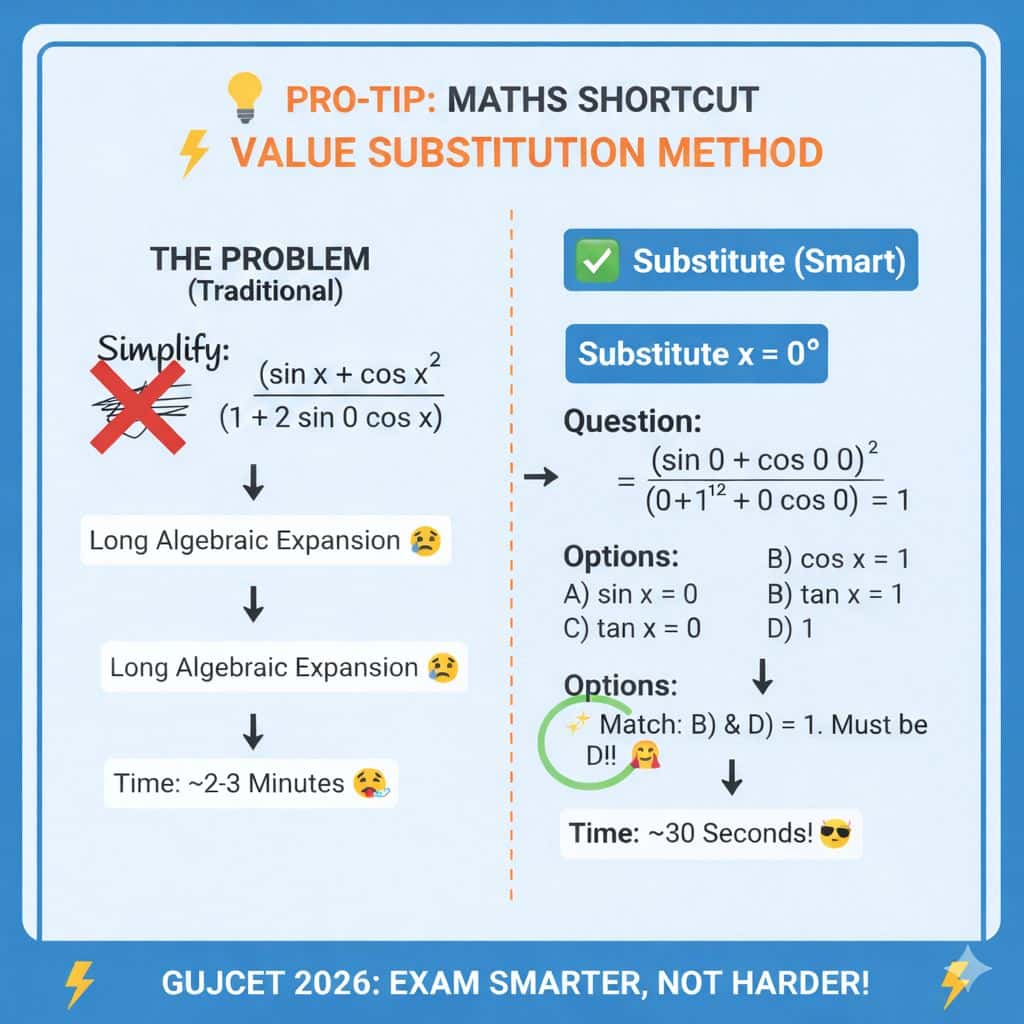
Example: If the question is about trigonometric identities, then instead of solving the whole expression, you can just schedule the standard angle. Like, theta = 45^\circ or 0^\circ. You can now use this in both the question and the options.
Also Check - GUJCET 2026 Expected Difficulty: Will Maths Stay Moderately Difficult Like Recent Years?
The 60-Minute Drill: Simulating Exam Pressure
Practicing without a timer is just reading; it’s not training. You need to simulate the pressure of the exam room in your daily study routine. The best way to do this is by adopting a "rounds strategy".
The 3-Round Strategy
Never attempt the paper linearly from Question 1 to 40. That is a trap. Instead, move through the paper in three distinct waves. This ensures you bag all the easy marks first and leaves the heavy lifting for later.
Round | Objective | Type of Questions | Time Allocation (approx.) |
|---|---|---|---|
Round One | The Sweeper | purely theoretical, memory-based, direct formula. | 15 to 20 Minutes |
Round Two | The Solver | Requires 2 to 3 steps of calculation or logic. | 25 to 30 Minutes |
Round Three | The Grinder | Lengthy, tricky, or complex questions. | Remaining Time |
Analysing Your Speed Breakers
After every mock test, do not just check your score. Check where you lost time. You need to identify your personal "speed breakers", which are the habits that are slowing you down without you realising it.
Speed Breaker | Description | The Fix |
|---|---|---|
Silly Math Errors | Getting the logic right but messing up +/-. | Write steps clearly; don't scribble in corners. |
Bubble Panic | Filling OMR sheets at the very last minute. | Fill OMR bubbles after completing each page or section. |
Over-checking | Recalculating an answer 3 times to be "sure". | Trust your first calculation unless the option isn't there. |
Please note that these recommended strategies will clearly be based on your level of preparation and practice.
Quick Links:
| GUJCET 2026 Preparation Tips | GUJCET Sample Papers | Best Books for GUJCET 2026 |
|---|
Expert Opinion: Master Strategy to Crack GUJCET 2026
To excel in GUJCET 2026, you need to leave rote learning and focus on strategic execution. We advise you to align your preparation with the latest exam patterns. Your quick decision-making can give you a competitive advantage.
Prioritise Important Content: When you start your preparation, keep a list of the topics that yield the highest points. Then, check the latest GSEB and NCERT syllabus. The syllabus keeps updating, so you need to focus only on the current relevant topics.
Learn When To Skip: You will learn speed, but is it enough to get you in the top rank range? You must not forget about the 0.25 negative marking penalty. Hence, perform calculative skipping during the exam. We suggest you to narrow down an answer to two options within 40 seconds. And, if you still can’t get it, move on.
Build Psychological Resilience: Often, students who did well in mocks are unable to perform on the main day because of exam anxiety. A steady mind will prevent the "panic-blur" that leads to errors. I will suggest you take a few deep breaths and drink water whenever you feel anxious.
Toppers Insight: GUJCET topper, Jaydeep Hadiya, who scored 117.5/120, suggests that filling the OMR bubbles after every 10 questions gave him better clarity and saved time.
Developing speed for GUJCET 2026 is about structured efficiency. The skill will help transition smoothly through the paper. You will eventually know when to skip a complex question and when to answer the straightforward questions. The top performers simply train their speed into reflex. Start your targeted practice today with the help of CollegeDekho mentors. You will struggle initially, but your performance will sharpen, and your cognitive speed will rapidly improve.
Related Articles
QnA Zone or fill out our Common Application Form . Stay tuned for more such updates!FAQs
GUJCET has 120 questions to be solved in 180 minutes, giving only 1.5 minutes per question. Speed is crucial to attempt maximum questions accurately without panic or time loss.
Use elimination techniques, memorise formulas, focus on high-yield topics, and follow a round-based strategy to improve speed while maintaining accuracy.
The 3-round strategy involves first attempting easy and direct questions, then solving moderate ones, and finally tackling lengthy or complex questions with the remaining time.
If you hit a "wall" early, skip immediately. GUJCET is often front-loaded with difficult questions to trigger panic. Use the "60-second rule": if no solution path appears, move to your strongest subject. Securing easy marks elsewhere builds the confidence needed to return and tackle those initial "grinder" questions later.
Timed mock tests help simulate exam pressure, identify personal speed breakers, improve time management, and train your brain to answer fast under real exam conditions.
 Quick Facts

















Similar Articles
MHT CET Passing Marks 2026
List of Colleges Accepting 25,000 to 50,000 Rank in JEE Main 2026
NIT Warangal BTech CSE Cutoff 2026 - General, SC, ST, EWS
COMEDK UGET 2026 Coordinate Geometry Practice Questions with Solutions
NITs for 99 Percentile in JEE Main 2026
IIITs for 96 Percentile in JEE Main 2026