


- Why 120–150 Marks Are Not Enough in KMAT Kerala?
- How Percentiles Behave for OBC & SC Candidates in This …
- Why Category Makes a Bigger Difference Than Marks Here
- Admission Reality Check: What This Score Actually Means in KMAT …
- Strategic Advice for OBC/SC Candidates With 120-150 Score in KMAT …
- Mistakes That Cost OBC & SC Candidates Seats
- Faqs

Scoring 120-150 out of 720 on the KMAT Kerala isn’t a victory. It is a wake-up call. The official qualifying bars for OBC and SC candidates are set comparatively low, so that they permit you to achieve "passing" status, yet a 120-150 score places you between the 40th and 50th percentiles. In the competitive landscape of Kerala’s management exams, this score will place you in a below-average position.
You may have achieved success in your technical requirements, yet failed to pass through the admission process for the state’s top universities. At this score, you might be exploring Tier-3 colleges and local universities. Basic eligibility requirements can be met with a "safe" score, yet this score presents severe hazards for achieving success in high-growth job paths.
Also Check - Expected Rank for 150 Marks in KMAT Kerala 2026: General vs SEBC Cutoffs Explained
Why 120–150 Marks Are Not Enough in KMAT Kerala?
Well, 120-150 marks in the KMAT exam will fall somewhere in the low performance range. As thousands of applications are filed every year, the competition gets quite intense. But what makes this score range the “Grey Zone”?
A small difference in the score of this range can create a huge difference in the overall KMAT rank.
KMAT Kerala 2026 counselling will give high importance to category-wise cut-offs.
While 120-150 is low for General seats, for SC/ST candidates, is 2.5x the qualifying mark. However, this score is not particularly good enough for student of any category to sget into top B-school. Qualifying cut-off marks released by CEE Kerala:
General/SEBC: 10% (72/720 marks)
SC/ST/PwD: 7.5% (54/720 marks)
*Note: Weightage may slightly vary by institution. This is only qualifying marks which will help you apply for the counselling process. It will not be enough to get you in the top government institutes.
How Percentiles Behave for OBC & SC Candidates in This Range
You must be aware that since KMAT declares a percentile-based result, the exact cut-off is not fixed. A total of 180 questions are asked in KMAT Kerala 2026. Each correct answer will give you +4, and an incorrect answer will deduct -1. So, scoring 120-150 out of 720 is pretty low. However, based on the past counselling data, you will get a realistic picture of what to expect.
Score Range (Out of 720) | Estimated Rank/Percentile | Admission Prospects |
|---|---|---|
450+ | 95+ Percentile | Top-tier (CUSAT, Rajagiri, IMK) |
300–440 | 80–90 Percentile | Reputed Private B-Schools (XIME, Saintgits) |
120–150 | 40–60 Percentile | Tier-3 / Regional Private Colleges |
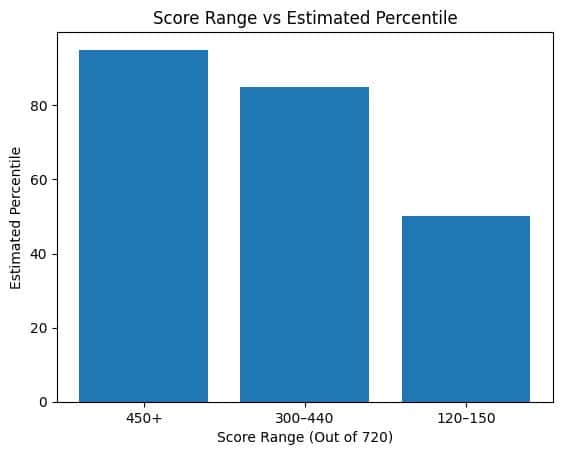
*Note: Percentiles are not officially provided by CEE Kerala. They are raw-score-based rankings.
The SC candidates perform better than the OBC candidates because they achieve higher percentiles at identical marks according to these ranges. OBC candidates need to follow specific guidance to maintain their competitiveness according to the results from these ranges.
Also Check -
What Percentile is 150-175 Marks in KMAT Kerala 2026?
Why Category Makes a Bigger Difference Than Marks Here
If you score in the higher range, like 450+, then the category reservation rules will hardly bother you. But when your score is in the lower bracket, like 120-150, then reservation rules might benefit you.
Key reasons:
The direct competition will be less, as someone from a reserved category, your major competitors will be applicants from the same category.
The cut-off for reserved candidates in KMAT is comparatively low, especially for SC candidates.
In the later rounds of KMAT counselling, OBC and SC candidates will get a great advantage.
This is why many OBC and SC candidates convert admissions at scores where general candidates struggle.
Admission Reality Check: What This Score Actually Means in KMAT Kerala 2026
A score of 120–150 in KMAT Kerala 2026 places you comfortably above the minimum qualification line, but it’s a "danger zone" for top-tier aspirational candidates. Here is the unfiltered reality of where you stand with a 120-150 score range in KMAT.
For OBC (SEBC) Candidates
This score is a safe pass, but not a strong play. You have cleared the 10% (72 marks) qualifying hurdle, but you are competing in a crowded middle-ground.
Admission Reality: You will likely be excluded from the first-list call for premier institutions like CUSAT School of Management Studies or Rajagiri Centre for Business Studies , where cutoffs typically hover above 300-400 marks.
Target Colleges: You have a chance at private and autonomous colleges such as DC School of Management (DCSMAT), Albertian Institute of Management , and various self-financing centres under Calicut and MG Universities.
The GD/PI Factor: Since the entrance score carries 80% weightage, a score of 120-130 puts a massive burden on your Group Discussion and Interview. You must score in the top 5% of your GD group to displace candidates with 200+ marks.
Tip: If you haven't locked in a seat, aim for Session 2. Moving from 130 to 380+ will change your prospects from "any private college" to "top-tier private B-schools."
For SC Candidates
In this category, a 120–150 score is still not good enough. The good thing is you are nearly triple the 7.5% (54 marks) qualifying requirement. However, no point in keeping your hopes high if you want top government institute.
Admission Reality: This score might give you a chance in the reserved seats in University departments like Institute of Management, Kerala (University of Kerala) or the School of Management Studies (Kannur University).
Regional Dominance: You have fair access to almost any regional college in Kerala. Many SC candidates with this range secure seats in the second or third allotment rounds.
Fate in Counselling: In later rounds, when general seats remain vacant and are converted or when reserved quotas aren't filled by higher scorers, your 130-150 range might give you a seat.
Tip: Focus on your Statement of Purpose (SOP). Top colleges often look for leadership potential in reserved category candidates who have cleared the academic threshold.
Also Check - KMAT Kerala 2026: What 175-200 Marks Mean for Your Percentile?
Strategic Advice for OBC/SC Candidates With 120-150 Score in KMAT Kerala 2026
If you have scored between 120 and 150 marks in KMAT Kerala 2026, then the best advice would be to reappear in the next session. A top B-school is not possible with this score range. However, if you are aiming for admission in the same year then you need to use this score for strategic purposes. The range above the qualifying cutoff marks, but it does not provide automatic access to elite government MBA programs. Your final outcome will depend on how well you use your category benefits, documentation accuracy, college selection strategy, and GD/PI performance.
Strategic Pillar | OBC (Non-Creamy Layer) Strategy | SC/ST Category Strategy |
|---|---|---|
Admission Realism | You are qualified but not “safe” for the most elite government seats. You may try for Tier 3 autonomous and private colleges. | Your 120+ score is nearly triple the qualifying mark (54). You have a chance of getting into private colleges. |
Documentation Priority | Without a valid Non-Creamy Layer (NCL) certificate, you are in the General category. In that case, 120 marks is a “failure” for top colleges. | Ensure your Caste Certificate is issued specifically for educational purposes in Kerala to claim the lower fee structures. |
Target Institution | DCSMAT, Albertian Institute, or Naipunnya. These look for consistency over raw high scores. | IMK (Kariyavattom) or MG University departments. Your score makes you a priority here. |
The “80:10:10” Play | You must use the 10% GD weightage to prove communication skills that compensate for a 150-range entrance score. | Use the 10% Interview weightage to highlight leadership and resilience. Admissions officers look for high potential in this category. |
Financial Strategy | Check for SEBC-specific fee waivers. Many private colleges offer small “merit-cum-means” scholarships for OBC. | Focus on Govt/Aided colleges where your tuition fees could be effectively zero via E-Grantz and other schemes. |
Expert Opinion: Realistic ROI Check (2026 Trends)
At this score level, if you are looking for admission, then you should evaluate colleges based on their Placement-to-Fee ratio.
For example, if a college costs INR 4 Lakhs for two years and offers an average placement of INR 5 Lakhs, your ROI is positive. If the fee is INR 8 Lakhs for the same placement, you should look elsewhere.
Mistakes That Cost OBC & SC Candidates Seats
You must be aware of the government reservation policies and how the cutoffs of almost all the national/state levels differ for different categories. But even after this, OBC and SC students lose their chance of getting any admission because:
They don’t give attention to the GDPI rounds, which are the main game-changer with such average performance.
Panicking while filling the college preference list and filling too few colleges.
Abandoning the KMAT counselling process and giving up during the first session only.
Since your score is in the middle, you must be patient. Therefore, set reasonable expectations.
Quick Links:
| KMAT Kerala 2026 Result | KMAT Kerala 2026 Cutoff |
|---|
A score of 120–150 in KMAT Kerala 2026 is a "safe pass" but a "weak rank." For OBC candidates, you’ve cleared the qualifying hurdle, but without a Non-Creamy Layer (NCL) certificate, you will be the same as General category scorers. You can aim for tier-3 autonomous colleges where your reservation actually carries weight. For SC candidates also, this score is still below average performance. You are nearly triple the 54-mark cutoff. But to be a top contender for high-ROI University Departments, you need a 350+ score in KMAT. You shouldn’t settle for this score.
But if you are still confused about how to guess your KMAT percentile and which colleges to prioritise while shortlisting, then get in touch with the CollegeDekho mentors. Along with deciding your counselling strategies, they will also guide you in preparing for the GDPI round. You will get complete help in converting your KMAT score into the best possible admission outcome.
If you have further queries regarding admission to top private management colleges in India , you can write to hello@collegedekho.com or call our toll free number 18005729877, or simply fill out our Common Application Form on the website.
FAQs
It is very unlikely to be possible, but you may hope in the later counselling rounds. Top-tier seats are often filled by those scoring 300+, but as students move to national-level exams like CAT or CMAT, vacancies open up. Persistence through the second and third rounds of allotment of Tier-3 colleges is key for SC candidates in this range.
While your rank is derived from your raw score, most colleges look at your final composite score. Your raw marks (120–150) are the primary data point used to invite you for the GD and PI rounds, which together carry 20% weightage.
You can still apply for the exam, but for admission reservation, you will be treated as a General Category candidate. This means you will not benefit from the lower qualifying marks or reserved seat quotas. Ensure your NCL certificate is updated for the 2026-27 financial year.
Admissions are based on a composite merit list. If you have 150 marks but perform poorly in the GD/PI, your total score may drop below the final cut-off for top colleges. Conversely, an excellent interview can pull up a 120-mark score, helping you beat candidates who scored higher on the written test but lacked communication skills.
Yes. For OBC (SEBC) candidates, the qualifying mark is 72 out of 720 (10%). For SC/ST candidates, the requirement is 54 out of 720 (7.5%). With a score of 120–150, you are comfortably above the minimum eligibility threshold and can apply to any participating B-school in Kerala. However, top-tier universities and government colleges will not be possible with this score.
 Quick Facts

















Similar Articles
MAH MBA CET Cutoff 2026 for XIMR Mumbai: Check Expected MMS Cutoff Percentile
Rajagiri MBA Placements: Why Your KMAT 2026 Score is the Key to High ROI
MBA Admissions in Telangana 2026: Dates, Selection Process, Eligibility, Top Colleges
TS ICET 2026 Date, Time & Arrangement Weightage & Sample Questions
IIM CAP 2026: Result, PI/WAT, Cutoffs, Colleges
Rajagiri Kochi MBA Fees 2026 & KMAT Topper Scholarships Explained