- We’re on your favourite socials!


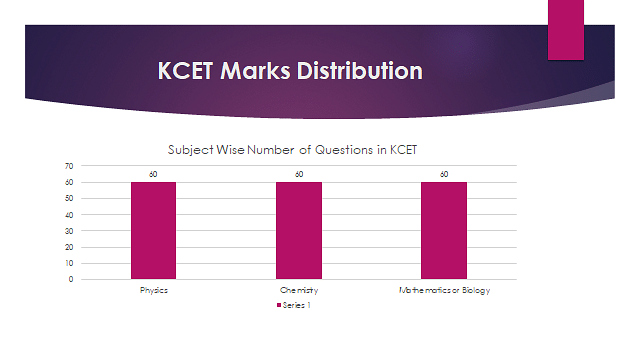
As per the KCET 2026 Exam Pattern, the exam will consist of 180 questions, with 60 questions each from Physics, Chemistry, and Mathematics. If you are planning to take the exam, then it is strongly advised that you thoroughly review the KCET exam pattern 2026 to ensure effective preparation.
Get KCET Sample Papers For Free
As per the KCET exam pattern 2026, you will be awarded one mark for every correct answer, and no marks will be deducted for incorrect responses. The KCET 2026 question paper comprises a total of 180 questions, with 60 questions each from Physics, Chemistry, and Mathematics.
The KCET 2026 exam pattern explains all important aspects of the examination, including the mode of exam, type of questions, exam duration, marking scheme, medium of instruction, total number of questions, and more. Before you begin your KCET 2026 preparation, it is essential that you thoroughly understand the exam pattern. You can go through this page to get complete details about the KCET exam pattern 2026.
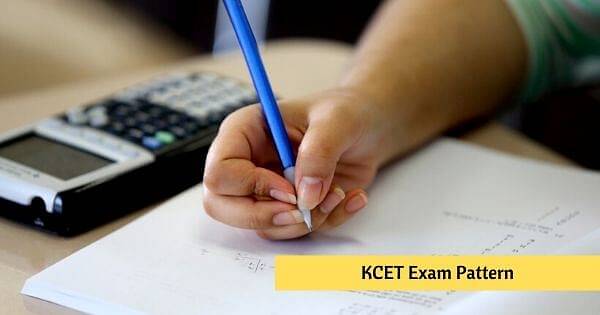
Some of the major highlights of the KCET 2026 exam pattern are as follows -
The entrance test will be conducted in offline mode, which means it will be a pen-and-paper-based exam
The paper will consist of multiple types of questions. Each question will consist of four options, out of which candidates will have to choose one correct response
KCET 2026 will cover units from subjects including Physics, Chemistry, and Mathematics, or Biology and Kannada (If applicable)
The maximum marks for each paper will be 60
Each question will carry 1 mark
There will be no negative marking for incorrect answers
The medium of the language will be either English or Kannada in the exam
Each paper will be of 1 Hour and 20 Minutes
| Particulars | Details |
|---|---|
Number of Papers | 3 Papers (Physics, Chemistry, and Mathematics/Biology) |
Exam Mode | Pen and Paper-based Test |
Total number of questions | 180 MCQs |
Marks for each question | 1 Mark for Every Correct Response |
Negative Marking | Not Applicable |
The KCET 2026 examination will be split into four sessions. Hence, each session will carry 60 questions for 60 marks. Overall, you have to answer 180 questions, excluding the Kannada paper, to crack KCET. The total number of questions in the KCET 2026 exam is as follows -
Subject | Number of questions | Duration | Marks |
|---|---|---|---|
Physics | 60 | 80 minutes | 60 |
Chemistry | 60 | 80 minutes | 60 |
Mathematics or Biology | 60 | 80 minutes | 60 |
Total | 180 | 3 hours | 180 |
KEA will publish the Optical Mark Reader (OMR) on its official website. The OMR sheet is divided into the top and bottom portions; the top portion contains the candidate's details such as Name, Application Number, Serial number of booklet, etc. You need to take utmost care while filling out the OMR sheet. The bottom half of the OMR sheet will be used for answering the questions. The instructions will be written on the OMR sheet, and you should go through them before proceeding to fill the form. In the top section, you will need to provide important details like their name, CET number, version code of the question booklet, and the serial number of the booklet. In the bottom section, you will mark their answers and include their signature, as well as the signature of the invigilator (the person supervising the exam) and their left-hand thumb impression.
Here are some tips for using the KCET OMR Sheet 2026 -
1. Download the OMR sheet from the website and practice filling it out using a blue or black ink pen. This will help you get better at accurately writing your details, like your name and KCET 2026 application number.
2. The KCET 2026 OMR sheet is made up of two layers. The top layer is for marking your answers and will be scanned for grading. The bottom layer has a special coating that works like carbon paper and will be returned to you after each part of the KCET 2026 is over.
By following these guidelines, you can ensure that they fill out the KCET 2026 sheet correctly and avoid any issues during the exam.
Also check: KCET Previous Year Question Papers
The exam will be conducted in four sessions according to the subjects. The marking scheme remains the same for all four subjects. The marking scheme of KCET 2026 exam is as follows -
Sections | Marks | Negative Marking |
|---|---|---|
Chemistry | 60 marks | No negative marking |
Physics | 60 marks | |
Mathematics/Biology | 60 marks | |
Kannada (in case) | 50 marks |
If your mother tongue is Kannada, Tulu, or Kodava, and you are claiming eligibility for government seats under the Horanadu & Gadinadu Kannadiga clauses. You need to demonstrate your proficiency in speaking, reading, and writing Kannada through a Kannada language test. The Kannada Language Examination will take place at the following centres in Bengaluru, Belagavi, Ballary, Bijapura, Mangalore, and Bidar.
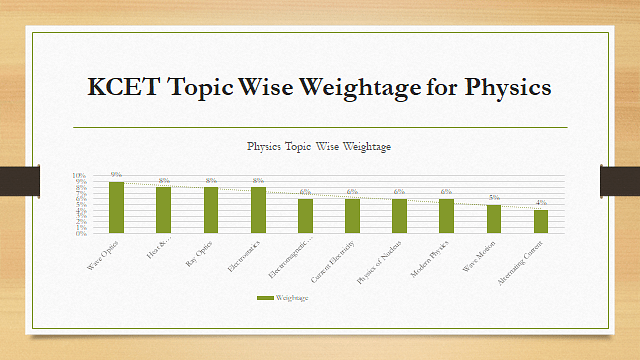
Physics is one of the compulsory subjects in KCET 2026. The paper contains 60 questions that will cover 10+2 Physics syllabus. The topic-wise weightage for KCET 2026 is as follows -
Topic Name | Weightage (in %age) |
|---|---|
Wave Optics | 9% |
Heat & Thermodynamics | 8% |
Ray Optics | 8% |
Electrostatics | 8% |
Electromagnetic Induction | 6% |
Current Electricity | 6% |
Physics of Nucleus | 6% |
Modern Physics | 6% |
Wave Motion | 5% |
Alternating Current | 4% |
Also Read: KCET 2026 Physics Topic Wise Weightage
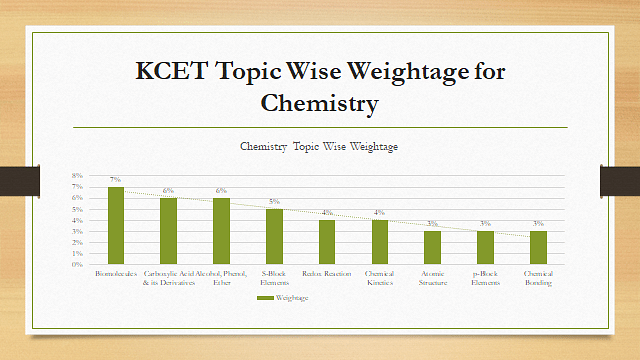
The chemistry session of the exam will contain 60 questions in MCQ format covering the entire syllabus. You have 1 hour and 20 minutes to attempt all the questions. The topic-wise weightage for KCET 2026 Chemistry can be checked below -
Topic Name | Weightage (in %age) |
|---|---|
Biomolecules | 7% |
Carboxylic Acid & its Derivatives | 6% |
Alcohol, Phenol, Ether | 6% |
S-Block Elements | 5% |
Redox Reaction | 4% |
Chemical Kinetics | 4% |
Atomic Structure | 3% |
p-Block Elements | 3% |
Chemical Bonding | 3% |
Also Read: KCET 2026 Chemistry Topic Wise Weightage
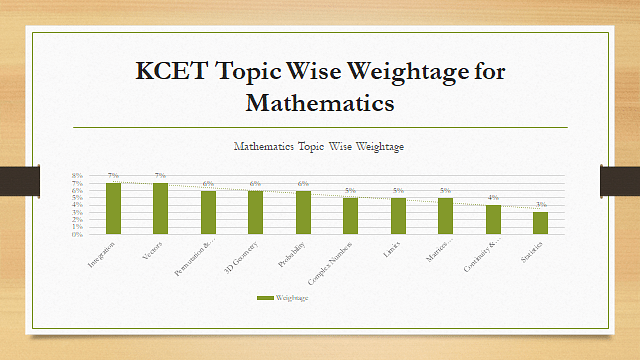
You can opt to choose either Mathematics or Biology, depending on the course you wish to pursue. The syllabus is that of the 10+2 mathematics syllabus. The topic-wise weightage for KCET 2026 Mathematics can be checked below -
Topic Name | Weightage (in %age) |
|---|---|
Integration | 7% |
Vectors | 7% |
Permutation & Combination | 6% |
3D Geometry | 6% |
Probability | 6% |
Complex Numbers | 5% |
Limits | 5% |
Matrices Determinants | 5% |
Continuity & Differentiability | 4% |
Statistics | 3% |
Also Read: KCET 2026 Mathematics Topic Wise Syllabus
You must also be aware of all the important KCET 2026 exam day instructions as per the official brochure listed below.
Want to know more about KCET
One examination from Biology/Mathematics will be mandatory for candidates, while Physics and Chemistry questions will be compulsory for all students.
Candidates are awarded 1 mark for every correct answer provided in the KCET examination.
The KCET exam takes place in English and Kannada language.
Candidates are asked multiple-choice questions in the KCET exam.
The KCET exam is conducted for a duration of 1 hour and 20 minutes.
No, there is no negative marking in KCET exam.
KCET exam is conducted for a maximum marks of 180 - 60 each from Physics, Mathematics and Chemistry/Computer/Electronics/Biology/Biotechnology.
KCET paper contains a total of 180 questions - 60 each from Physics, Mathematics and Chemistry/Computer/Electronics/Biology/Biotechnology.
KCET exam consists of three subjects such as Physics, Chemistry and Mathematics or Biology. Form each subject, the candidates will have to answer 60 questions, and the total number of questions are 180.
The exam is conducted in a pen-paper based format.
The examination is conducted once a year.
Typical response between 24-48 hours
Get personalized response
Free of Cost
Access to community