- We’re on your favourite socials!

Updated By Dipanjana Sengupta on 14 Apr, 2025 13:52

Get KCET Sample Papers For Free
KCET 2023 Question Paper has been released by KEA. Candidates aspiring to appear for KCET 2025 can download the KCET question paper PDFs 2023 from here as we have provided subject-wise question papers. By solving the previous year's question papers of KCET, candidates can understand the question paper pattern, type of questions asked, and marking scheme and improve their time management skills. Aspirants can become aware of the weightage of various topics and chapters by practising the KCET 2023 Question Papers.
Check Also: KCET Syllabus 2025
According to the KCET Question paper analysis 2023, candidates found the paper to be moderate but time-consuming. Many questions were repeated over the last three years. CollegeDekho recommends every aspirant to practice the KCET 2023 Question paper to become familiar with the question paper.
Candidates can download Subject-Wise KCET 2023 Question Paper PDFs from here.
The Mathematics question paper of KCET 2023 has been provided below.
Download KCET 2023 Physics question papers from here.
The Chemistry question paper of KCET 2023 has been provided below.
You can download the various sets of KCET 2022 Question Paper PDFs from the table below.
Candidates can download the KCET 2021 Question Paper PDF from the table below. The KCET 2021 Question Paper is available to download in various sets.
Candidates can check the KCET 2023 Physics questions along with the answers here.
1. In a permanent magnet at room temperature
Answer: A
Due to thermal agitation, with an increase in temperature randomness of the molecules increases and magnetic field moments get partially aligned. Hence the domains are partially aligned.
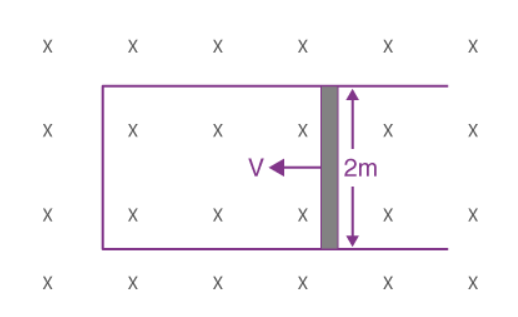
2. A rod of length 2 m slides with a speed of 5 ms-1 on a rectangular conducting frame as shown in the figure. There exists a uniform magnetic field of 0.04 T perpendicular to the plane of the figure. If the resistance of the rod is 3Ω then the current through the rod is
Answer: C
We know that the current, i = Blv/R= (0.04×2×5)/3 = 133 mA
3. The ratio of the magnetic field at the center of a current-carrying circular coil to its magnetic moment is ‘x’. If the current and the radius both are doubled then the new ratio will become
Answer: A
The magnetic field at the center of the current carrying loop is given by B=(μ0/4π)×(2πi/a)=(μ0 i)/2a.
The magnetic moment at the center of the current carrying loop is given by M=iπa2
thus B/M=μ0/(2πa3 )=x (given) when both current and radius are doubled ratio becomes x/8 times.
4. The current in a coil of inductance 0.2 H changes from 5 A to 2 A in 0.5 sec. The magnitude of the average induced emf in the coil is
Answer: c
Average induced emf, ϵ=L dI/dt
=0.2 ((5-2)/0.5)=(2/5) × 3=1.2 V
5. Three polaroid sheets P1, P2, and P3 are kept parallel to each other such that the angle between the pass axes of P1 and P2 is 450 and that between P2 and P3 is 450. If an unpolarised beam of light of intensity 128 Wm-2 is incident on P1. What is the intensity of light coming out of P3?
Answer: D
We have unpolarised beam’s intensity I0=128w/m2
Using Malu’s law we have I=I0 cos2 θ
When the beam passed from the first polaroid, I=I0/2
Again, as the angle between p1 and p2 is 450, beam intensity when it will pass p2 would be I1=I0/2 cos2450=I0/4
And, also the angle between p2 and p3 is 450, and beam intensity when it comes out of p3 will be I2=I0/4 cos2 450=I0/8=128/8=16w/m2
6. Two poles are by a distance of 3.14 m. The resolving power of the human eye is the minute of an arc. The maximum distance from which he can identify the two poles distinctly is
Answer: B
Given the lateral separation of the poles d=3.14 m
The resolving power of the eye is θ=1min=π/(60×180) rad
The maximum distance from which poles are distinctly visible is D=d/θ
⇒D=(3.14×60×180)/π=10800m=10.8 km
7. The following figure shows a beam of light converging at point P. When a concave lens of focal length 16 cm is introduced in the path of the beam at a place shown by a dotted line such that OP becomes the axis of the lens, the beam converges at a distance x from the lens. The value of x will be equal to
Answer: a
So, here when we put the concave lens, let the beam converge at a distance of x=v
Using lens formulae, we have, 1/f=1/v-1/u
Where u=12 cm and f=-16 cm is given
∴1/v=(1/f)+(1/u)=(-1/16)+(1/12)=1/48 cm⇒ v=48 cm
Hence, x=48 cm
8. The de-Broglie wavelength associated with the electron of a hydrogen atom in this ground state is
Answer. C
De-Broglie wavelength is given by λ=12.27/√E0, where E0 is the ground state energy of the hydrogen atom whose value is 13.6 V
∴λ=12.27/(√1 3.6)=3.33 Ǻ
9. The de-Broglie wavelength associated with the electron of a hydrogen atom in this ground state is
Answer. C
De-Broglie wavelength is given by λ=12.27/√E0, where E0 is the ground state energy of the hydrogen atom whose value is 13.6 V
∴λ=12.27/(√1 3.6)=3.33 Ǻ
10. In Young’s Double Slit Experiment, the distance between the slits and the screen is 1.2 m and the distance between the two slits is 2.4 mm. If a thin transparent mica sheet of thickness 1μm and R.I of 1.5 is introduced between one of the interfering beams, the shift in the position of the central bright fringe is
Answer: A
Path difference due to insertion of mica sheet Δx=(μ-1)t
Let the shift in the fringe pattern be 'y'
Also, path difference Δx=y×d/D, so comparing both (μ-1)t=y×(d/D)
y=(μ-1)t×(D/d) , where μ=1.5,D=2.4 and d=1.2 putting the values, we get
y= 0.25 mm.
Students can review the chemistry questions of KCET 2023 along with the answers here.
1. Aqueous solution of a salt (A) forms a dense white precipitate with BaCl2 solution. The precipitate dissolves in dilute HCl to produce a gas (B) which decolorizes the acidified KMnO4 solution. A and B respectively are:
Solution: Answer: (C)
The corresponding reactions are -
BaCl2 + Na2 SO3 → BaSO3 + 2NaCl
BaSO3 + 2HCl → BaCl2 + SO2 + H2 O
Salt A is Na2SO3 and the dense white precipitate is BaSO3 (Barium sulfite).
Gas B is SO2. It decolorises acidified KMnO4 solution because of its reducing nature.
The corresponding reaction is:
2KMnO4 + 5SO2 + 2H2 O → K2 SO4 + 2MnSO4 + 2H2 SO4
2. The bond angle in PH4+ is more than that of PH3. This is because:
Solution Answer: (C)
The hydrides of groups 15, and 16 below the 3rd period, follow Drago’s rule. The rule states that due to a large energy difference between the atomic orbitals, these compounds do not exhibit hybridization. Thus, PH3 will not exhibit hybridization and here the bond formation takes place due to the overlap of pure p-orbitals and s-orbitals. PH3 has a lone pair on the central P atom, which is absent in PH4+. Thus in PH3, there will be bond pair – lone pair repulsion and this is the reason why the bond angle in PH3 is less than that of PH4+.
3. Incorrectly matched pair is:
Solution- Solution (D)
In XeF6 there are 6 bond pairs and one lone pair. Thus the shape of XeF6 is distorted octahedral.
In XeOF4, Xe is sp3d hybridized and the shape is square pyramidal.
In XeO3, Xe is sp3 hybridized and the shape is trigonal pyramidal.
In XeF4, Xe is sp3 d2 hybridized. It has 4 bond pairs and two lone pairs. Thus, the shape is square planar.
4. Phosphorous pentachloride
Answer: (C)
(a) Phosphorous pentachloride (PCl5) has a trigonal bipyramidal structure. Here, the five bonds are not of equal lengths as the axial bonds are slightly longer than the equatorial bonds.
(b) PCl5 solid exists as [PCl4]+ and [PCl6]- and they have tetrahedral and octahedral structures respectively.
(c) On hydrolysis, PCl5 gives H3 PO4which is tribasic.
PCl5 + 4H2 O →H3 PO4 + 5HCl
In H3PO4, P is in its +5 oxidation state. So it is in its highest oxidation state and hence is not a good reducing agent.
5. The co-ordination number of Fe and Co in the complex ions [Fe(C2O4 )3]3- and [Co(SCN)4]2- are respectively:
Answer: (b)
C2 O42- is the oxalate ligand. It binds through two oxygen atoms and thus, is a bidentate ligand.
Hence the co-ordination number of Fe in [Fe(C2 O4 )3]3- is 6.
SCN- is the thiocyanate ligand. It is a monodentate ligand. Hence the co-ordination number of
Co in the complex ion [Co(SCN)4]2- is 4.
Check the KCET 2023 Mathematics Questions along with solutions here.
1. If the curves are 2x = y2 and 2xy = K intersect perpendicularly, then the value of K2 is
Answer: (a)
2x = y2 . . . (1)
2xy = K . . . (2)
Solving (1) and (2), we get
(x,y) = (K(2/3)/2, K(1/3))
Differentiating (1) and (2) w.r.t. x
m1 = dy/dx = 1/y ...(3)
m2 = dy/dx = -y/x ...(4)
∵ Both curves intersect each other perpendicularly
∴m1 m2 = -1
⇒ -1/x = -1
⇒ x = 1
⇒ K(2/3) = 2
⇒ K2 = 8
2. If the side of a cube is increased by 5%, then the surface area of a cube is increased by
Answer: (B)
Let one side of the cube be x and the surface area by A
So, dx = 5% = 5x/100
Then, A = (6x)2
⇒dA/dx = 12x
⇒dA = (12x)dx
⇒dA = (12x) (5x/100)
⇒dA = 10A/100
⇒dA = 10%
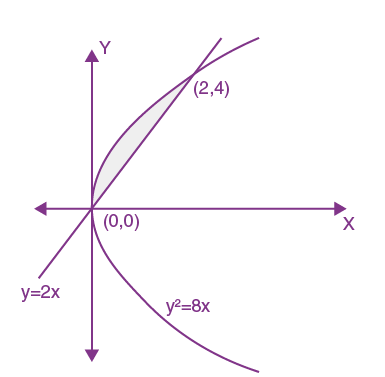
3. The area of the region bounded by the curve y2 = 8x and the line y = 2x is
Answer: (C)
Solving y2 = 8x and y = 2x, we get (x,y) = (0,0), (2,4)
So, the area bounded by the curve is
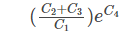
4. The order of the differential equation obtained by eliminating arbitrary constants in the family of curves c1y = (c2+c3)e x+c4 is
Answer: (b)

where A =
Order = Number of independent arbitrary constants = 1
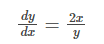
5. The curve passing through the point (1, 2) given that the slope of the tangent at any point (x,y) is 2x/y represents
Answer: (a)
Given,
⇒ ydy = 2xdx
⇒ ∫ydy = ∫2x dx
⇒ y2/2 = x2+A, where A is a constant.
The above equation represents a hyperbola.
6. The sine of the angle between the straight line (x-2)/3 = (3-y)/(-4) = (z-4)/5 and the plane
Answer: (A)
Given the line is

and the plane is 2x-2y+z = 5
7. A die is thrown 10 times, the probability that an odd number will come up at least one time is
a. 1013/1024
b. 1/1024
c. 1023/1024
d. 11/1024
Answer: (C)
Given n = 10
Probability of odd number, p = ½
∴q=1/2
Required probability = P(X≥1)
=1-P(X=0)
= 1 – 1/210
= 1 - 1/1024
= 1023/1024
8. The probability of solving a problem by three persons A, B, and C independently is 1/2,1/4, and 1/3 respectively. Then the probability that the problem is solved by any two of them is
a. 1/8
b. 1/12
c. 1/4
d. 1/24
Answer: (c)
Required probability = P(A'BC) + P(AB'C) + P(ABC')
= 1/2 × 1/4 × 1/3 + 1/2 × 3/4 × 1/3 + 1/2 × 1/4 × 2/3
= 1/24 + 1/8 + 1/12
=(1+3+2)/24
= 1/4
9. If tan A+cot A=2, then the value of tan4 A+cot4 A=
Answer: (b)
tan A + cot A = 2
⇒ (tan A + cotA )2 = 4
⇒tan2 A + cot2 A + 2tan A cotA = 4
⇒tan2 A+cot2 A=2
⇒(tan2 A+cot2 A) 2=4
⇒tan4 A+cot4 A+2 tan2 A cot2 A=4
⇒tan4 A+cot4 A=2
10. If the parabola x2 = 4ay passes through the point (2, 1), then the length of the latus rectum is
a. 8
b. 1
c. 4
d. 2
Answer: (c)
x2=4ay
Given parabola passes through (2,1).
⇒ 22= 4a
⇒ a = 1
Length of latus rectum= 4a = 4.
Also Check,
Want to know more about KCET
Typical response between 24-48 hours
Get personalized response
Free of Cost
Access to community