- We’re on your favourite socials!



Search for best colleges, Courses, Exams and Education updates
Updated By Ankita Jha on 29 Jan, 2026 17:14
AFCAT 1 Exam Pattern covers GA, English, Math, and Reasoning with 300 marks. Check full details below.
Get AFCAT Sample Papers For Free
AFCAT 2026 Exam pattern must be checked before the exam. AFCAT 1 2026 will be conducted on January 31, 2026. You need to go over AFCAT Exam Pattern 2026, which has been released by the Indian Air Force along with the notification. You must familiarise with AFCAT Exam Pattern to understand the exam's main sections, such as subject-specific sections and the AFCAT 2026 marking scheme. Additionally, AFCAT exam pattern outlines the total marks allotted, the section-wise marks distribution, and details about negative markings.
It is advisable for you to thoroughly review these specifics before commencing their exam preparation. So, to know the paper pattern, you must go through AFCAT exam pattern 2026. As per AFCAT exam pattern 2026, the exam comprises a written test, supplemented by an Engineering Knowledge Test (EKT) that technical position applicants must also undertake. Successful students proceed to the subsequent stages involving the ASFB interview and medical examination. Students eager to know more about AFCAT 2026 exam pattern can go through the detailed pattern, dress code guidelines, etc.
Also Read:
Both the EKT and AFCAT tests are administered online in English only. The only applicants who select the Ground Duty (Technical) branch are eligible for the EKT. This test lasts 45 minutes and comprises 50 questions, whereas the AFCAT exam has 100 questions and lasts two hours.
AFCAT 2026 syllabus is produced at the graduate level. General Awareness, Verbal Ability, Numerical Ability, Military Reasoning, and Aptitude are some of the sections included in the AFCAT exam. Electrical and electronics, computer science, and mechanical are among the topics included in the EKT exam.
The EKT exam is assessed out of 150 marks, and the AFCAT exam is evaluated out of 300 marks. To help applicants prepare, the exam pattern for AFCAT comprises specifics about different sections, topic weighting, exam duration, total marks, marking procedure, etc. The salient features of the AFCAT exam pattern 2026 are listed as follows:
Exam | AFCAT 2026 Exam Pattern | EKT (only for technical) |
|---|---|---|
Mode of Exam | Online | Online |
No. of Questions | 100 | 50 |
Maximum Marks | 300 | 150 |
Duration of Exam | 2 hours (120 minutes) | 45 minutes |
Sections in Paper | General Awareness, Verbal Ability in English, Numerical Ability and Reasoning and Military Aptitude Test | Mechanical, Computer Science and Electrical & Electronics |
Negative Marking | 1 mark | 1 mark |
Here is the simplified AFCAT 2026 exam pattern for the online test:
The detailed structure of the AFCAT exam pattern is outlined below:
Subject | Exam Duration | No of Questions | Maximum Marks |
|---|---|---|---|
General Awareness | 2 Hours | 100 | 300 |
Verbal Ability in English | |||
Numerical Ability | |||
Reasoning and Military Aptitude Test |
The EKT exam lasts for 45 minutes and covers subjects like Mechanical Engineering, Computer Science Engineering, and Electrical & Electronics Engineering. The test paper comprises 50 questions, with a maximum of 150 marks allotted for the EKT exam. The EKT exam pattern structure is outlined below:
Subject | Time | No. of Questions | Maximum Marks |
|---|---|---|---|
Mechanical | 45 minutes | 50 | 150 |
Computer Science | |||
Electrical & Electronics |
Below is a breakdown of the AFCAT 2026 exam pattern for the Technical Branch:
Section | Questions | Marks | Time |
|---|---|---|---|
Reasoning and Military Aptitude Test | 35 | 105 | 2 Hours |
Verbal Ability in English | 30 | 90 | |
Numerical Ability | 15 | 45 | |
General Awareness | 20 | 60 | |
Mechanics/ Computer Science/ Electrical and Electronics | 50 | 150 | 45 Minutes |
Candidates applying for Non-Technical ground duty positions should be familiar with the AFCAT exam format. The AFCAT 2026 exam pattern for Non-Technical Branch is provided below.
Section | Questions | Marks | Time |
|---|---|---|---|
Reasoning and Military Aptitude Test | 35 | 105 | 2 Hours |
Verbal Ability in English | 30 | 90 | |
Numerical Ability | 15 | 45 | |
General Awareness | 20 | 60 |
Those who pass the online AFCAT examination are invited to interview with the Air Force Selection Board or AFSB. Applicants must go to the websites afcat.cdac.in or careerindianairforce.cdac.in to participate in the AFSB interview. Using this portal, they can be updated with the AFCAT AFSB interview process timeline 2026 and also choose a time and location for the interview as per their preference. There are three phases to the AFSB interview in the AFCAT exam 2026 as listed below.
Stage 1: This phase comprises the Discussion Test (DT), Picture Perception (PP), and Officer Intelligence Rating (OIR) tests. Following Stage 1, applicants are subjected to eligibility tests for the applied branches and document verification. Participants will not advance to the next round of the screening process if they are unable to pass Stage 1.
Stage 2: Applicants are qualified for Stage 2, which takes three to four days, after finishing the first stage. A psychological test, a group test, and an interview make up Stage 2. It evaluates individuals for the designated roles based on their mental agility, physical fitness, and personality. This phase also includes group assignments that combine both indoor and outdoor activities.
Stage 3: The Computerised Pilot Selection System (CPSS) is the third phase of the AFSB test, which hopefuls take for the Flying Branch. To be eligible for Flying Training, one must qualify in the CPSS. Those who fail at this phase are not eligible to continue in the Flying Branch.
Also Read:
The importance of applicants being knowledgeable about the AFCAT 2026 exam pattern/ format will be discussed in the subsequent section.
Students should familiarise themselves with the AFCAT 2026 exam format since it offers a glimpse at the final question paper.
With this knowledge, candidates can focus on subjects that are more important in exams.
Due to its national-level format and coverage of multiple disciplines, including technical and flying ground branches, the AFCAT exam 2026 is very competitive. Students who are familiar with the format of the exam have a higher probability of succeeding.
Those who are familiar with the AFCAT exam pattern 2026 do better on the final exam.
Those who are aware of the AFCAT 2026 exam format can more efficiently plan their preparation and devote more time to key subjects.
Students can make efficient use of their time by concentrating on answering the prior year's question papers and practice exams methodically.
The AFCAT online test lasts for two hours. The EKT lasts 45 minutes. Below are the times for the AFCAT exam:
Activity | Shift 1 | Shift 2 |
|---|---|---|
Reporting time | 7.30 am | 12.30 pm |
Verification of the admit card and ID Proof, Biometrics, Photo/ Thumb Impression/ Sign on the Attendance Sheet and candidate seating in the exam hall | 7.30 am to 9.30 am | 12.30 am to 2 pm |
Reading of instructions by candidates | 9.30 am to 9.45 am | 2 pm to 2.15 pm |
AFCAT exam | 9.45 am to 11.45 am | 2.15 pm to 4.15 pm |
Knowing about the AFCAT 2026 exam pattern as well as the marking scheme will help the candidates avoid negative marking in the final exam. Details regarding the AFCAT marking scheme are mentioned below:
For every correct question answered, the candidates would be given three marks each.
For all the questions in the exam that are left unattempted by the candidate, no marks will be provided.
For every incorrect answer, one mark will be deducted.
Exam | Total No. of Questions | Marks for Each Correct Answer | Marks Deducted for Each Wrong Answer | Max Marks |
|---|---|---|---|---|
AFCAT | 100 | 3 | 1 | 300 |
EKT (only for technical) | 50 | 3 | 1 | 150 |
Note: Candidates are advised to leave the question unattempted if they are not confident while answering it.
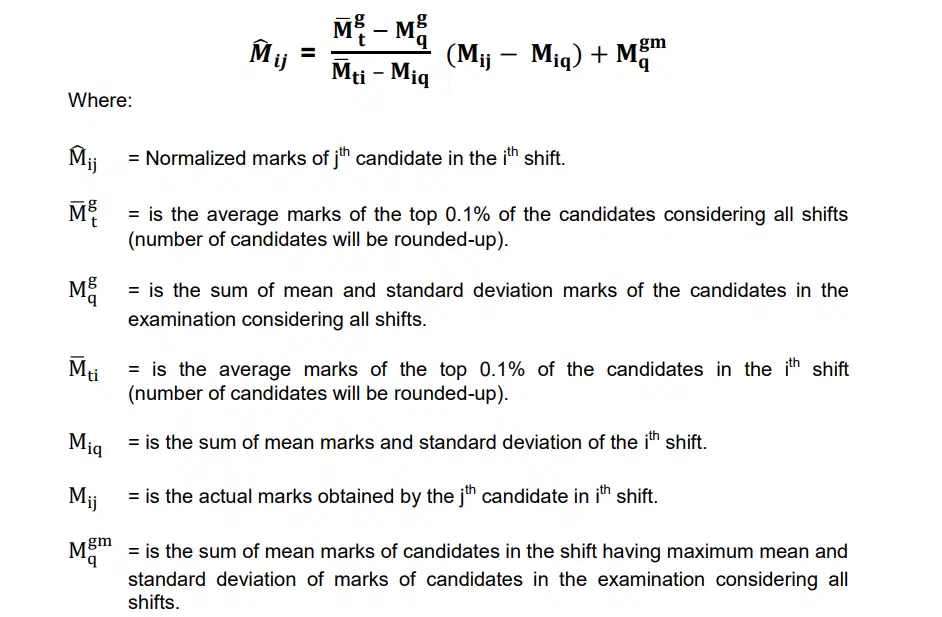
The process of normalisation is applied to applicants who took the examination in different shifts to equitably modify or balance their marks. It guarantees that a common scale is used to analyse the AFCAT result 2026. To put it plainly, normalisation is the process of dividing the average result equally across all test takers. The Standard Deviation notion is the backbone of this approach, and even applicants with rudimentary statistical understanding can easily understand it. The following is the IAF's formula for the AFCAT normalisation scheme:
Take this example into consideration to demonstrate the AFCAT normalisation procedure: The normalised score is calculated as follows: if a student has a raw score of 70, the top 0.1% of applicants in all shifts have an average score of 80, and the sum of the mean and standard deviation of every applicant in all shifts is 60. Additionally, the average marks of the top 0.1% of applicants in a given shift are 70, and the sum of the mean marks and standard deviation of that shift is 60.
[(80-60) / (70-60)] X (70-60) + 60 = (20/10) X 10 + 60 = 80
As a result, the raw score will be 70 whereas the normalised score will be 80. It is crucial to remember that this example is merely meant to serve as clarification. Aspirants can rest easy knowing that the IAF will systematically determine their marks.
Candidates who clear the AFCAT online test proceed to the AFSB interview, held in three stages at various centres including Dehradun, Varanasi, Gandhinagar, and Mysuru. During the AFSB interview, candidates undergo several tests to evaluate their suitability and potential as officers in the Indian Air Force.
On the first day, candidates go through the Officer Intelligence Rating Test along with the Picture Perception and Discussion test. Stage I is a screening process, and only those who qualify move on to subsequent testing. Eligibility for the applied branches is checked through a document verification process. Candidates not meeting the criteria are sent back on the first day.
Candidates who pass Stage I undergo testing over four to five days in Stage II. The fifth day includes CPSS testing for the Flying branch. Stage II comprises of:
Candidates recommended by the Selection Board undergo a medical examination at either the Air Force Central Medical Establishment (AFCME), New Delhi, or the Institute of Aviation Medicine, Bengaluru.
Applicants who are aiming to apply for the ground duty (technical) branch will have to appear for an additional online test - Engineering Knowledge Test (EKT). In AFCAT exam pattern 2026, aspirants will be asked challenging core syllabus questions to determine candidates’ skillset and understanding of the overall syllabus: Here is the AFCAT EKT syllabus for reference:
Syllabus | Topics |
|---|---|
Fundamental Engineering Syllabus | Engineering Physics, Engineering Drawing, and Engineering Mathematics |
Electrical & Electronics Engineering Syllabus | Microwave Engineering, Electronic Devices, Analog, and Digital Electronics, Telecommunication Systems, Electrical Engineering, Microwave Engineering, and Control Engineering, |
Mechanical Engineering Syllabus | Thermodynamics, Engineering Mechanics, Fluid Mechanics/Hydraulic Machines, Materials Science, Manufacturing Science, Thermodynamics, and Machine Drawing |
Allied Engineering Topics Syllabus | Control Engineering, Electrical Engineering, Telecommunication Systems, Radar Theory, Instrumentation, Microwave Engineering, Antenna, and Wave Propagation, |
Computer Science Engineering Syllabus | Network Theory Design, Information Technology, Analog, and Digital Electronics, Switching Theory, Computer Networks, and Electronic Devices |
Want to know more about AFCAT
As mentioned, the online test of AFCAT 2026 is conducted for two hours. EKT is held for 45 minutes. The exam timings for AFCAT 2026 is mentioned as per the table given below:
Activity | Shift 1 | Shift 2 |
Reporting time of the Candidate | 7.30 am | 12.30 pm |
Verification of admit card & ID Proof, Biometrics, Photo/ Thumb Impression/ Sign on Attendance Sheet & candidate seating in exam hall | 7.30 am to 9.30 am | 12.30 am to 2 pm |
Reading of instructions by candidates | 9.30 am to 9.45 am | 2 pm to 2.15 pm |
AFCAT exam | 9.45 am to 11.45 am | 2.15 pm to 4.15 pm |
The AFCAT 2026 exam will consist of four papers as per the AFCAT Exam Pattern. These papers cover General Awareness, Verbal Ability in English, Numerical Ability, and Reasoning, along with the Military Aptitude Test. The duration of the AFCAT paper is 150 minutes, equivalent to two hours. To qualify in the AFCAT exam, candidates should aim to score between 140 to 190 marks out of the total 300 marks.
The Engineering Knowledge Test (EKT) is an essential component of the AFCAT exam for those aiming to join the technical branches of the Indian Air Force. This test employs a negative marking system. Specifically, you receive 3 marks for each correct response, but you lose 1 mark for every incorrect answer. If you choose not to answer a question, no marks are awarded or deducted. Therefore, it's often more advantageous to attempt a question, even if you are unsure, rather than skipping it entirely.
The AFCAT exam covers a wide range of topics, including:
- English: Grammar, vocabulary, comprehension, and writing skills
- General Awareness: Current affairs, history, geography, science, and technology
- Numerical Ability: Basic math operations, arithmetic, and algebra
- Reasoning and Military Aptitude Test: Verbal and non-verbal reasoning, problem-solving, and logical thinking
The AFCAT exam lasts for two hours, which is 120 minutes. During this time, students be assessed on several subjects such as General Awareness, English, Numerical Ability, Reasoning and Military Aptitude.
The AFCAT 1 (Air Force Common Admission Test) for 2026 will be held exclusively in English. This information is confirmed by the official syllabus and notifications issued for the exam.
No, there is no penalty for leaving questions unanswered in AFCAT 2026. Students lose one mark for every wrong answer, but you gain three marks for each correct one. Therefore, concentrate on answering only when you are confident and skip the questions you are unsure about to avoid negative marking.
Yes, marking scheme of both EKT and AFCAT is same. 3 mark will be granted for each correct answer while one mark will be deducted for each incorrect answer.
The AFCAT 2025 exam is scored out of 300 marks. It includes 100 questions, covering topics such as General Awareness, Verbal Ability, Reasoning, and Military Aptitude.
The AFCAT 2025 exam will be administered exclusively online. Candidates will complete the computer-based test at specified exam centres.
The AFCAT exam for 2025 does not have official sections but assesses candidates in five key areas: English, General Awareness, Numerical Ability, Reasoning, and Military Aptitude. While the exam is not formally segmented, these subjects are typically studied in clusters to prepare effectively.
A total of 100 questions will be asked in the AFCAT exam.
Typical response between 24-48 hours
Get personalized response
Free of Cost
Access to community