- We’re on your favourite socials!

Updated By Puja Dey on 27 Jul, 2025 04:31
Registration Starts On February 04, 2026

Tell us your NEET score & access the list of colleges you may qualify for!
Predict My CollegeNEET Biology Syllabus 2026 PDF is announced by the National Medical Commission (NMC) in the official exam brochure. Some of the important chapters included in the syllabus of NEET 2026 are Diversity of Living Organisms Change, Structural Organization in Plants & Animals Change, Genetics & Evolution, Human Physiology, Plant Physiology, Cell Structure and Function, among others. Each part of the NEET Biology Syllabus 2026 is curated based on the topics from the NCERT Syllabus of classes 11th and 12th. The NEET UG 2026 Biology syllabus is divided into 2 sections - Botany and Zoology.
In the year 2024, there have been significant changes in the NEET UG 2026 Biology Syllabus. The NMC has reduced the content from the biology syllabus of NEET 2025. However, some topics have been added to the syllabus. The NEET Biology Syllabus 2026 is the most scoring section of the NEET UG 2026 Question Paper. Thus, students who successfully and sincerely complete the NEET Biology Syllabus 2026 before the time are likely to score better marks than the rest. To know more about the topic-wise details of NEET Biology Syllabus 2026, including the weightage, chapter-wise division, list of important topics, etc., refer to the following detailed information mentioned on this page below.
Useful Links:
Get real time exam experience with full length mock test and get detailed analysis.
Attempt nowThe NMC is yet to declare the NEET Biology Syllabus 2026 PDF. Meanwhile, applicants can refer to the table below to get an idea about the NEET 2025 Biology syllabus to generate an idea.
NEET Biology Syllabus 2025 PDF | Download Here |
|---|
To download the NEET syllabus for Physics and Chemistry, check out the links given below.
NEET Biology Syllabus 2026 consists of the update topics from NCERT Syllabus of Classes 11th and 12th. A total of 90 questions are asked from this section in the entrance exam. A detailed overview of the NEET Biology Syllabus 2026 has been provided below for all interested students to refer to:
Particulars | Details |
|---|---|
Name of exam | NEET UG 2026-27 |
Exam conducting body | National Testing Agency (NTA) |
Duration of exam | 200 minutes |
Syllabus available | Online (PDF format) |
NMC NEET 2026 Syllabus - Official Website | neet.nta.nic.in |
Subjects included in NEET UG Biology Syllabus | Botany and Zoology |
Total questions from the NEET Syllabus for Biology 2026 | 90 Questions |
Maximum marks in NEET UG 2026 Exam | 720 Marks |
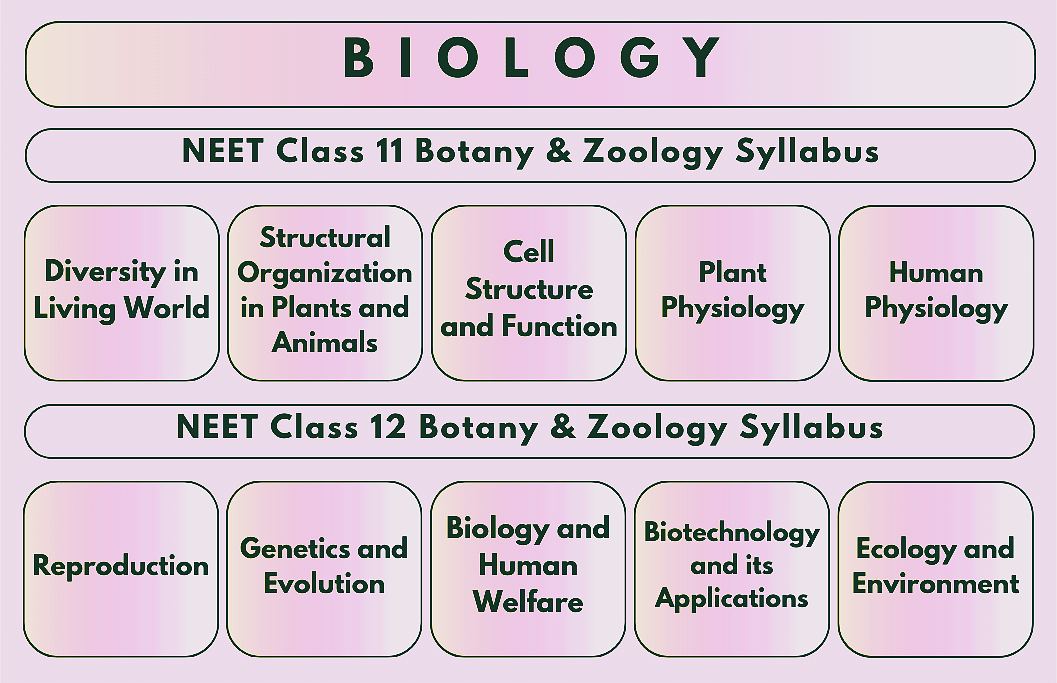
Every subject from NEET syllabus carries 180 marks, it is important to score above 120 in all subjects to be able to enrol in top colleges. Here's How to Score 120+ in NEET 2026 Biology. Enlisted below are the names of chapters/units included in NEET Biology Syllabus 2026 -
Diversity in Living World
Ecology and environment
Human physiology
Biotechnology and Its Applications
Structural Organisation in Animals & Plants
Biology and Human Welfare
Cell Structure and Function
Reproduction
Plant Physiology
Genetics and Evolution
NEET biology syllabus is vast, hence it is required for candidates to focus more on the important topics. A few questions are always asked from the NEET Biology Syllabus Important Topics are mentioned below. Referring to Best Books for NEET 2026 Recommended by Toppers will help candidates cover all the key topics better.
Important Topics from NEET 2026 Syllabus for Biology | |
|---|---|
Botany | Zoology |
|
|
The class 11 Biology syllabus for NEET 2026 consists of five units. Mentioned below are the topics included in each unit (from 1 to 5) of the NEET biology syllabus. Creating a proper NEET 2026 Biology Study Plan will help you cover all the topics completely.
Unit | Unit Name | Topics |
|---|---|---|
1 | Diversity in Living World |
|
| ||
| ||
up to class level | ||
2 | Human physiology |
|
artery disease, Angina pectoris, and Heart failure. | ||
Natriuretic Factor' ADH and Diabetes insipidus.
| ||
| ||
| ||
| ||
3 | Structural Organisation in Animals & Plants |
Note: Frog is not an insect. It is anticipated that NMC NEET syllabus 2026 was released with some errors that will be rectified in the near future. |
| ||
4 | Cell Structure and Function |
|
| ||
| ||
5 | Plant Physiology |
|
| ||
|
The total number of units included in the syllabus of Class 12th is five. Candidates can refer to the table below for elaboration of all the six units.
Unit | Unit Name | Topics |
|---|---|---|
1 | Reproduction |
|
| ||
Medical Termination of Pregnancy (MTP)
| ||
2 | Genetics and Evolution |
|
| ||
| ||
3 | Biotechnology and its Applications |
|
| ||
4 | Biology and Human Welfare |
|
| ||
5 | Ecology and Environment |
|
| ||
|
NEET Biology syllabus 2026 is a mix of topics from NCERT class 11 and 12 zoology and botany syllabus. The NCERT NEET botany and zoology chapters are combined in the NEET NCERT biology syllabus 2026. There are high and low weightage chapters in the NEET biology syllabus 2026. Students can find the classwise NEET biology syllabus 2026 given below.
A thorough understanding of NEET Biology Chapter Wise Weightage and Mark Distribution helps in saving time during NEET 2026 preparations. Students can find the subset-specific chapter-wise weightage and marks distribution given below.
The table below consists of detailed NEET Biology Chapter Wise Weightage and Mark Distribution for the session 2026-26.
Botany Chapters | Number of Questions (Expected) | Weightage (%) |
|---|---|---|
Ecology-Biodiversity and Conservation – Introduction, Level of biodiversity, Pattern of biodiversity, Loss of biodiversity | 2 | 4 |
Genetics II – Nucleic Acids (The Genetic Material, DNA, RNA) | 4 | 8 |
Ecology-Environmental Issues – Types of pollutants, Types of pollution-Air pollution, Noise pollution, Acid rain, Ozone depletion, Water pollution | 1 | 2 |
Application Biology (Biotechnology) – Principles of Biotechnology | 4 | 8 |
Ecology-Organisms and Population – Introduction, Abiotic factors, Responses to abiotic factors | 2 | 4 |
Plant Physiology-I-Mineral Nutrition – Methods to study mineral requirements of plants, Essential mineral elements, Role of macro and micronutrients, deficiency symptoms of essential elements, Toxicity of micronutrients | 2 | 4 |
Cell Biology – Introduction, Prokaryotic Cell | 5 | 10 |
Sexual Reproduction in Flowering Plants – Sexual Reproduction Introduction | 4 | 8 |
Biomolecule – I – Carbohydrates | 1 | 2 |
Plant Kingdom-Algae | 2 | 4 |
Biomolecule-II – Nucleic Acids | 1 | 2 |
Plant Physiology-II-Plant growth and Growth Hormones – Growth and Development | 4 | 8 |
Total | 50 | 100 |
Zoology is interesting yet one of the most challenging subjects of the NEET 2026 exam. Here’s a table that demonstrates the chapter-wise weightage and marks distribution for the NEET Zoology section.
Zoology Chapters | Number of Questions (Expected) | Weightage (%) |
|---|---|---|
Chemical Coordination and Integration -Endocrine Gland | 3 | 6 |
Cell Biology – Introduction, Prokaryotic Cell | 4 | 8 |
Genetics I – Introduction, Mendelism, Monohybrid Cross, Dihybrid Cross, Back Cross, Test Cross, Incomplete Dominance, Codominance, Multiple Alleflism, Pleiotropy | 2 | 4 |
Human Reproduction and Reproductive Health – Male Reproductive System | 6 | 12 |
Ecology-Environmental Issues – Types of pollutants, Types of pollution-Air pollution, Noise pollution, Acid rain, Ozone depletion, Water pollution | 1 | 2 |
Biomolecule-II – Nucleic Acids | 1 | 2 |
Excretory Products and Their Elimination – Homeostasis and Osmoregulation | 1 | 2 |
Biology In Human Welfare – Microbes in Human Welfare | 1 | 2 |
Locomotion and Movement – Muscles | 2 | 4 |
Origin and Evolution – Origin of Life | 2 | 4 |
Application Biology – Principles of Biotechnology | 2 | 4 |
Genetic II – Nucleic Acids (The Generic Material, DNA, RNA) | 3 | 6 |
Ecology-Organisms and Population – Introduction, Abiotic factors, Responses to abiotic factors | 1 | 2 |
Digestion and Absorption – Nutrition | 2 | 4 |
Structural Organisation in Animal – Epithelial tissue | 1 | 2 |
Breathing and Exchange of Gases – Respiratory Organ | 1 | 2 |
Neural Control and Coordination – Nervous Tissue | 2 | 4 |
Animal Kingdom-2 – Chordata | 2 | 4 |
Biology In Human Welfare-Strategies for Enhancement of Food Production in Animal | 1 | 2 |
Animal Kingdom-1 – Porifera | 4 | 8 |
Biology In Human Welfare-Human Health and Disease – Diseases caused by a virus | 3 | 6 |
Structural organization in animals – Connective tissue | 1 | 2 |
Total | 50 | 100 |
Solving NEET previous year question papers is crucial for grasping the exam pattern. It acquaints candidates with the format, question distribution, and time constraints, enhancing familiarity with the actual test. To check their understanding of the NEET Biology Syllabus 2025, and become familiar with the exam pattern, candidates should solve the NEET Previous Year Question Paper. Understanding the pattern allows for efficient time allocation, strategic planning, and improved confidence during the exam. Additionally, analyzing past papers helps in identifying recurring question types, variations in difficulty levels, and trends over the years. This comprehensive insight aids in formulating an effective study strategy, making candidates better prepared to navigate the NEET exam with precision and confidence.
To effectively cover the NEET Biology Syllabus for 2026, here's what you can do:
KnowYourSyllabus: Understand the updated NEET Biology Syllabus for 2026. Understand which topics are more important so you can focus on them.
BreakItDown: Divide the syllabus into smaller sections based on sub-topics. This will help you plan your study sessions more efficiently.
UseGoodBooks: Use recommended textbooks like "Biology" by NCERT, "Trueman’s Elementary Biology," "Objective Biology" by Dinesh Publications, and "Biology" by Pradeep Publications.
ExploreOnlineResources: Check out platforms like Khan Academy, NEETPrep, and BYJU for video lectures, courses, and study materials.
TakeNotes: Summarize important points, formulas, and diagrams as you study. These notes will come in handy during revision.
Practice, Practice, Practice: Solve lots of MCQs from past NEET papers and take mock tests to get used to the exam pattern and improve your problem-solving skills.
ReviewRegularly: Set aside time for regular revision. Go over your notes frequently and revisit any tough topics for better understanding.
AskforHelpWhenNeeded: If you're stuck on something, don't be afraid to ask your teachers, mentors, or online forums for help.
StayUpdated: Keep yourself informed about the latest developments in Biology through scientific journals and online resources to deepen your understanding.
KeepMotivated: It is important to stay motivated while preparing for the NEET Biology Syllabus to keep eliminate distractions of all kinds.
While preparing for the NEET exam biology section it is important to know the NEET biology section exam pattern to create a well-strategised study plan. Students can find the NEET 2025 biology section exam pattern given below.
Particulars | Biology Section Exam Pattern |
|---|---|
NEET 2025 Total Marks | 720 |
Total Time Duration | 3 Hour 20 minutes |
NEET Biology Section Breakdown | Zoology (Sections A and B) Botany (Sections A and B) |
Zoology Total Marks | 180 |
Botany Total Marks | 180 |
Total Marks for NEET Biology Section | 360 |
Biology Section Weightage | 50% |
Want to know more about NEET
Typical response between 24-48 hours
Get personalized response
Free of Cost
Access to community