- We’re on your favourite socials!



Search for best colleges, Courses, Exams and Education updates
Updated By Aindrila on 10 Mar, 2026 12:54

GUJCET 2026 exam will have a total of 120 questions of 1 mark each, 40 each from Physics, Chemistry, and Mathematics. The total duration of the GUJCET 2026 is 3 hours. There will be a negative marking of 0.25 in case of an incorrect answer.
Get GUJCET Sample Papers For Free
The GUJCET 2026 exam pattern is announced by GSEB at gujcet.gseb.org. The GUJCET exam will be conducted in offline mode (pen and paper) for 3 hours, with Physics and Chemistry combined taking 120 minutes, while Mathematics or Biology will take 60 minutes. Candidates can choose to take the exam in English, Hindi, or Gujarati. According to the GUJCET 2026 exam pattern, GUJCET 2026 consists of 120 multiple-choice questions (MCQs) divided into three sections: Mathematics or Biology featuring 40 questions each for Physics and Chemistry. For each correct answer, 1 mark is awarded, and 0.25 marks are deducted for incorrect answers.
GUJCET exam pattern 2026 throws light on the type and number of questions asked, the total duration of the GUJCET exam, the marking scheme, the sections included and related details. As per the paper pattern, GUJCET 2026 will be administered in offline mode as a pen and paper-based exam. Having a deeper understanding of the exam pattern along with the GUJCET syllabus 2026 will assist candidates in developing a methodical and successful preparation strategy. Practising with mock tests, sample papers and previous year's question papers will help in understanding the GUJCET paper pattern more effectively.
Quick Links:
| List of most important topics for GUJCET | How to score 80 plus in GUJCET? |
|---|
There are two components of the Gujarat CET exam: PCM (Physics, Chemistry & Mathematics) and PCB (Physics, Chemistry & Biology). The GUJCET question paper will have a total of 120 questions, which are to be solved within a duration of three hours. Since the mode of the examination is offline, candidates will be provided with an OMR sheet to mark their responses.
The highlights of the GUJCET exam pattern 2026 can be checked from the table below:
Particulars | Details |
|---|---|
Mode of GUJCET 2026 | Offline Mode (Pen and Paper) |
Duration of Exam | 3 hours
|
Language Medium | English/Hindi/Gujarati |
Section-wise Questions |
|
Type of Questions | Multiple-Choice Questions (MCQ) |
Total Number of Questions | 120 questions |
Marking Scheme |
|
Negative Marking | Yes |
Candidates must obtain the qualifying marks as specified below in PCM of Class 12 to be eligible for inclusion in the GUJCET 2026 merit list:
| Name of the Board | Category | Qualifying Marks Required in Theory | Qualifying Marks Required in Theory + Practical |
|---|---|---|---|
| GSEB | Open | 130/300 | 180/400 |
| GSEB | EWS/ SC/ ST/ SEBC | 120/300 | 160/400 |
| CBSE/ ICSE/ NIOS & Others | Open | 108/240 | 135/300 |
| CBSE/ ICSE/ NIOS & Others | EWS/ SC/ ST/ SEBC | 96/240 | 120/300 |
The details of the GUJCET 2026 Exam Pattern have been provided below for candidates. Based on the paper pattern, candidates can know which sections to focus on for better coverage of marks.
The question paper will be set in three languages, of which candidates may opt for one - English/Hindi/Gujarati
The total time allotted for the exam is 3 hours
There will be 120 questions in total, 40 from each of the three sections - Physics, Chemistry and Mathematics/Biology
All the questions asked will be of an objective type, MCQ-based questions
The applicants will be given four options, of which they must select one
Candidates must only darken the correct option on the OMR sheet with a black pencil
The full marks allotted to the paper are 120
For each correct answer, candidates will be rewarded 1 mark
A negative marking of 0.25 marks will be applicable for each incorrect answer
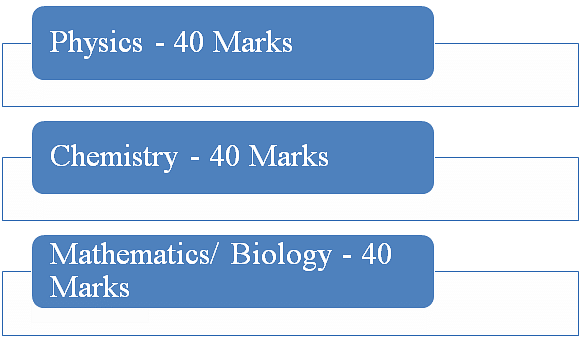
Subjects | No. of Questions | Marks |
|---|---|---|
Physics | 40 | 40 |
Chemistry | 40 | 40 |
Mathematics/ Biology | 40 | 40 |
Total | 120 | 120 |
Candidates can check the syllabus of the GUJCET 2026 exam from the official portal. The GUJCET 2026 syllabus comprises the topics which are asked in the GUJCET exam. In the GUJCET 2026 exam, questions will be asked from classes 11 and 12 topics from the subjects of Physics, Chemistry, and Mathematics. Candidates should prepare for the GUJCET exam using the prescribed syllabus, as questions in the exam will be prepared based on the syllabus.
GUJCET best books 2026 which are available in the market comprise subject-wise detailed topics, previous year’s question papers, model questions papers and important highlights for the GUJCET 2026 examination. Candidates can check out some of the GUJCET best books 2026 listed below for their GUJCET 2026 preparations.
Subject | Name of the GUJCET best book | Name of the Author |
|---|---|---|
Physics | Fundamentals of Physics | Halliday / Resnick / Walker |
Physics/Chemistry/Biology | GUJ-CET 15 Practice Sets | Dr.Chandresh Agrawal |
Physics/Chemistry/Mathematics | TEST SERIES GUJCET (PCM) in English | Devesh Bhardwaj |
Chemistry | Concepts of Organic Chemistry | OP Tandon |
Organic Chemistry | Morrison Boyd | |
Mathematics | Handbook of Mathematics | Amit Rastogi |
Want to know more about GUJCET
Yes, there is a negative marking in the GUJCET 2026 exam. For each wrong attempt, 0.25 marks will be deducted but unanswered questions will not attract any negative marking.
GUJCET 2026 is conducted for a maximum marks of 120 - 40 each from Physics, Chemistry and Mathematics/Biology.
There will be a total of 120 questions in GUJCET 2026 exam.
GUJCET Exam Pattern 2026 is conducted in Pen-Paper Mode. The paper can be taken in English, Hindi or Gujarati languages. MCQs with four options are asked in the paper. Subjects covered in the exam are Chemistry, Physics, and Mathematics/Biology.
GUJCET score will have 40% weightage in the merit list.
Marks scored in both Theory and Practical Exams of Class 12th are considered in GUJCET. There is 60% weightage for these two.
ACPC gives 60% weightage to the marks scored by candidates in Class 12th PCM subjects.
Typical response between 24-48 hours
Get personalized response
Free of Cost
Access to community