- We’re on your favourite socials!



Search for best colleges, Courses, Exams and Education updates
Updated By Prateek Lakhera on 03 Oct, 2025 14:06

The conducting authority of the WBJEE exam 2026 will release the WBJEE Chemistry syllabus 2026 PDF at wbjeeb.nic.in tentatively in December. The WBJEE 2026 Chemistry syllabus will be based on the Class 11 and 12 Chemistry course curriculum. The WBJEE 2026 Chemistry important topics list includes chapters, like Coordination Compound, Nuclear Chemistry, Radioactivity, etc. The WBJEE 2026 Chemistry paper, carrying 50 marks, will be conducted for 2 hours. Since students often fall short of time while preparing for the WBJEE 2026 exam alongside their Class 12th Board exams, you are advised to start your preparation for the WBJEE 2026 syllabus Chemistry as early as possible. Knowing about the WBJEE 2026 Chemistry syllabus weightage and key topics will help them identify the chapters that are most likely to be covered in the upcoming examination. Going through the chapter-wise WBJEE 2026 Chemistry syllabus weightage will also help the students be aware of the exam pattern and recurring important topics. When preparing for the WBJEE 2026 exam, you need to focus on key topics of the WBJEE 2026 syllabus in Chemistry that can significantly impact your performance.
Quick Links:
If you are looking for the detailed WBJEE Chemistry syllabus 2026 PDF, you can download the same from this page once released by the conducting body. Click on the link provided below to download the WBJEE 2025 Chemistry syllabus PDF:
Subject | PDF Download Link |
|---|---|
WBJEE 2026 Chemistry Syllabus PDF | To be released |
| WBJEE 2025 Chemistry Syllabus PDF | WBJEE 2026 Chemistry Download PDF |
The WBJEE Chemistry syllabus 2026 covers a range of topics that are important for the exam. It's essential to understand these topics well to perform well in the chemistry section of the test. Here in the table below, we have outlined the main topics and some important sub-topics from the general WBJEE 2026 Chemistry syllabus.
Chapters | Sub-topics |
|---|---|
Atoms, Molecules, and Chemical Arithmetic | Dalton’s atomic theory, Avogadro’s Hypothesis, Mole concept, Balanced chemical equations, Concentration units (molarity, molality, normality) |
Atomic Structure | Rutherford’s model, Bohr’s model, Quantum numbers, Electron configurations, Dual nature of matter |
Radioactivity and Nuclear Chemistry | Radioactive decay, Half-life, Radioisotopes, Nuclear fission and fusion |
The Periodic Table and Chemical Families | Modern periodic table, Periodic trends, Properties of elements (atomic radii, ionization energy, electronegativity) |
Chemical Bonding and Molecular Structure | Octet rule, Covalent bonds, Hybridization, Molecular shapes, Resonance, Hydrogen bonding |
Coordination Compounds | Werner's theory, Coordination number, IUPAC nomenclature |
Solid State | Types of solids, Unit cell, Packing in solids, Band theory of metals |
Liquid State | Vapour pressure, Viscosity, Surface tension |
Gaseous State | Boyle’s Law, Charles Law, Ideal gas equation, Dalton's Law, Real gases |
Chemical Energetics and Chemical Dynamics | First law of thermodynamics, Enthalpy change, Hess’s Law, Equilibrium constants, Le Chatelier's Principle, Reaction rates |
Physical Chemistry of Solutions | Colloidal solutions, Raoult’s Law, Colligative properties |
Ionic and Redox Equilibria | Ionization of weak electrolytes, pH scale, Buffer solutions, Redox reactions, Nernst equation |
Hydrogen | Preparation, properties, uses of hydrogen, Hydrides, Heavy water, Hydrogen peroxide |
Chemistry of Non-Metallic Elements and their Compounds | Allotropes of carbon, Preparation and properties of NH3, HNO3, H2SO4, Halogens |
Chemistry of Metals | Metallurgy principles, Properties and reactions of typical metals (Na, Ca, Al, Fe, Cu, Zn), Electroplating |
Chemistry in Industry | Production and uses of H2SO4, NH3, HNO3, Sodium bicarbonate, Polymers |
Surface Chemistry | Adsorption, Catalysis, Colloidal state, Emulsions |
Environmental Chemistry | Air, water, soil pollution, Ozone layer, Greenhouse effect, Global warming |
Chemistry of Carbon Compounds | Hybridization, Isomerism, IUPAC nomenclature, Stability of carbocations and carbanions, Electrophiles and nucleophiles |
Compounds | Preparation and reactions of alkanes, alkenes, alkynes, haloalkanes, alcohols, ethers, aldehydes, ketones, carboxylic acids, amines, aromatic compounds |
Application Oriented Chemistry | Ingredients and effects of antiseptics, analgesics, antacids, Vitamin-C |
Introduction to Biomolecules | Carbohydrates, Amino acids, Peptide bond, ADP and ATP, Nucleic acids |
Principles of Qualitative Analysis | Detection of acid and basic radicals, Functional groups in organic compounds |
Quick Links:
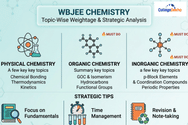
When preparing the WBJEE 2026 Chemistry syllabus, you must read the important topics that majorly cover the concepts and the formulas. You have less time on hand to prepare for the WBJEE exam 2026, so you must focus on some key topics mentioned below. These WBJEE Chemistry 2026 syllabus important topics are asked often in the WBJEE exam. However, it is recommended not to rely only on these key topics, but also to read the whole WBJEE Chemistry syllabus 2026 thoroughly, as questions can be asked from anywhere.
| Important Topics | Subtopics |
|---|---|
| Organic Chemistry | Read the basics of organic compounds, their reactions, and how to name them. Give more attention to concepts like hydrocarbons, alcohols, and carbonyl compounds. |
| Inorganic Chemistry | Study the periodic table, and read the properties and reactions of different elements. Learn about coordination compounds, transition metals, and their properties. |
| Physical Chemistry | Know the concept behind thermodynamics, chemical kinetics, and equilibrium. Know how different factors affect reaction rates and chemical balances. |
| Chemical Bonding | Must know how atoms bond together to form molecules. Study covalent, ionic, and metallic bonds. |
| Solutions and Colligative Properties | Learn about different types of solutions, their properties, and how factors like temperature and pressure affect them. Understand colligative properties like boiling point elevation and freezing point depression. |
Quick Links:
The WBJEE Chemistry syllabus 2026 has some topics that carry more weightage because they have a higher number of questions appearing in the exam. Knowing about the WBJEE 2026 Chemistry syllabus weightage can help you focus better on your studies. By paying extra attention to these chapters, students can improve their chances of scoring higher in the Chemistry section of the WBJEE exam 2026.
Chapters | Question Weightage (%) |
|---|---|
Redox Reaction | 6% |
p-Block Elements | 5% |
Chemical Equilibrium | 4% |
Chemical Thermodynamics | 4% |
Coordination Compounds | 4% |
Ionic Equilibrium | 4% |
Since the WBJEE syllabus 2026 for Chemistry consists of topics from the 11th and 12th standard Chemistry syllabus, the NCERT books will cover all of the units that need to be studied. However, you are advised to refer to and study from a few other important books that are referred to by the toppers. By referring to the best books for the WBJEE 2026 Chemistry syllabus, you will be able to understand concepts better and be well-prepared for the examination.
| Name of the Books | Author/Publication |
|---|---|
| NCERT Chemistry for class X & XII | NCERT |
| Physical Chemistry | O.P Tandon |
| Inorganic Chemistry | O.P Tandon |
| Concepts of Organic Chemistry | O.P Tandon |
| Organic Chemistry | Arihant |
| Organic Chemistry | Morrison & Boyd |
Want to know more about WBJEE
Typical response between 24-48 hours
Get personalized response
Free of Cost
Access to community