


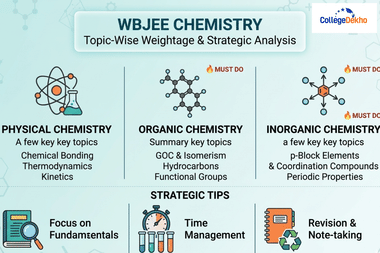
In the WBJEE Chemistry 2026 section, your speed must meet precision, allowing you to get more marks in no time. The high-yield topics you must master include Chemical Kinetics and Chemical Bonding. In Organic Chemistry, you must go through high-weightage topics like specifically Alcohols, Phenols, and Carboxylic Acids. In addition, prioritise p-Block Elements, Coordination Compounds, and Ionic Equilibrium, as these chapters frequently appear in the multi-correct Category III section, where partial marking can significantly boost your rank.
Understanding the question type in the WBJEE 2026 Exam Paper 2 is very important as it contributes to 50% marks in your total score. There are three categories with different marking in the paper, where category 1 has 30 questions, category 2 & 3 have 5 questions in the paper. In category 3, there is particle negative marking, and there are multiple-choice questions; for every correct response, there is a marking of 2 marks. In category 2, there is ½ negative marking for incorrect answers and 2 marks for correct answers in the paper. On the other hand, category 1 has 1 mark for every correct answer & ¼ negative marking for incorrect responses.
The Core Pillars of WBJEE Chemistry 2026
To master the 50-mark Chemistry section effectively, you must understand the distribution across Physical, Inorganic, and Organic sections in the syllabus. The table below synthesises the high-yield chapters, expert insights, and strategic priorities for each branch for your reference.
Chemistry Section & Weightage | Important Areas | High-Impact Topics & Must-Knows | Expert Insight & Priority |
|---|---|---|---|
Physical Chemistry (35-38%) | The Numerical Foundation: Focus on "clean" calculations and units over complex approximations. | • Chemical Kinetics: k=Ae−Ea/RT • Thermodynamics: ΔG=ΔH−TΔS • Equilibrium: Qc vs. Kc and Ksp • Electrochemistry: Nernst Equation | WBJEE favours the direct application of laws. Master the Nernst Equation and Rate Laws for quick scoring. |
Inorganic Chemistry (30-32%) | The Speed Factor: Rapid-fire marks based on trends. Reference both NCERT and WBCHSE for depth. | • p-Block (Gr. 15–18): Oxoacids and Xenon fluorides. • Chemical Bonding: VSEPR & MOT. • Coordination Compounds: IUPAC & CFT. | This is the fastest section. Focus on Category III (Multiple Correct) as these topics bridge Physics and Chemistry. |
Organic Chemistry (32-35%) | The Differentiator: Moving from rote memorisation to understanding electron flow and mechanisms. | • GOC: Stability of Carbocations & Inductive effects. • Oxygen Compounds: Alcohols, Phenols, Carbonyls. • Named Reactions: Aldol, Cannizzaro, Reimer-Tiemann. | Don't just learn products. WBJEE targets intermediates (such as dichlorocarbene) to test the true logic. |
WBJEE 2026 Chemistry Topic-Wise Weightage
In WBJEE, Chemistry consists of 40 questions totalling 50 marks. While the number of questions per chapter can shift slightly, the weightage percentage remains remarkably consistent. You can go through the WBJEE 2026 chemistry topic-wise weightage given below.
Chapter Name | Expected No. of Questions | Weightage (%) | Difficulty Level |
|---|---|---|---|
Chemical Kinetics | 3–4 | 7–8% | Moderate |
Chemical Bonding | 3 | 6–7% | Easy-Moderate |
p-Block Elements (Gr. 15–18) | 3–4 | 6–8% | Moderate |
General Organic Chemistry (GOC) | 3–4 | 6–7% | Hard |
Transition Elements (d & f block) | 2–3 | 6% | Moderate |
s-Block Elements | 2 | 5–6% | Easy |
Redox Reactions | 2 | 5% | Easy |
Alcohol, Phenol & Ethers | 2 | 4–5% | Moderate |
Coordination Compounds | 2 | 4% | Moderate-Hard |
Ionic & Chemical Equilibrium | 2–3 | 4% | Hard |
Thermodynamics & Energetics | 2 | 4% | Hard |
Carboxylic Acids & Derivatives | 1–2 | 4% | Moderate |
Atomic Structure | 1–2 | 3–4% | Easy |
Solutions & Colligative Properties | 1–2 | 3% | Moderate |
Hydrocarbons | 1–2 | 3% | Moderate |
Tips To Score 40+ marks in WBJEE Chemistry 2026
Check out the WBJEE 2026 exam preparation tips for the Chemistry section below.
- Constructing and executing a proper study plan - The most important thing that is to keep in mind is that you will have to study the subjects simultaneously, and engagement in extracurricular activities is necessary to freshen up your mind so that you do not feel tired.
- Be cordial with your syllabus - Go through the WBJEE Chemistry chapter-wise weightage and focus on the highest weightage chapters for WBJEE.
- Management of time is necessary - Time management is the most important element for any examination. Since only 2 hours are granted to you for each paper, you need to be smart to answer the questions.
- Solving the previous year's questions along with the sample papers- Attempting these papers will help you amend and highlight the incorrect answers that you have made.
- Preparation of bullet notes- Preparing and following your own written notes can be useful. In case of any doubts, write it down and revise it until you are clear with the entire idea.
- Diligently revise & rephrase- Periodic tables are to be revised every day. The formulas and tables must be there at your fingertips, and revision of the previously learned topics according to the weekly schedule will make you remember them and never forget them.
- With a healthy body comes healthy success- Stress levels should be minimized and a good 8 hours of sleep with a healthy diet should be maintained. Short breaks should be taken in between your study sessions.
So, to get good marks in WBJEE 2026, you must study smarter, not harder. You must focus on topics like Chemical Kinetics, P-Block Elements & Organic Mechanisms. With a data-driven approach and good focus on calculations, you can prepare faster and get good scores. Therefore, in case you are still confused regarding the WBJEE 2026 Chemistry, then drop us your query on the CollegeDekho Q&A Zone or contact us on our toll-free helpline number 18005729877.
FAQs
To prepare Chemistry for WBJEE 2026, you must learn all the equations, understand the concepts, and memorize the theory part well. Solving previous year question papers and mock tests will help you practice and score good marks in the WBJEE Chemistry section.
Some of the best books for WBJEE chemistry are NCERT Chemistry for Classes XI, and XII, Physical Chemistry by O.P. Tandon, Organic Chemistry by Arihant, and Inorganic Chemistry by O.P. Tandon.
Students must study the important chapters of chemistry for the WBJEE 2025 exam. The authorities can repeat the important topics / chapters from the subject but the questions are not always repeated.
When compared to questions from mathematics and physics, the chemistry questions are fairly easy in WBJEE exam.
Students are required to attempt 40 questions in the chemistry section of the WBJEE exam.

















Similar Articles
Why 200 Marks in JEE Advanced 2026 is a "Power Score" for the SC Category?
Is 200 a Safe Score in JEE Advanced 2026? Rank and Percentile Standing Explained
Minimum Marks in JEE Advanced to Get IIT for SC/ ST: Alternative College Options
Will 241 Marks Secure a Seat in the Top 5 IITs?
What Rank to Expect with 131 Marks in JEE Advanced 2026?
JEE Advanced Marks vs Rank Analysis 2026